
2 Days 20x, How Big Can the Legendary Golden Dog Snowball's "Auto-Compound" Snowball Grow?

 Prefer us on Google

Original Title: "2 Days 20x, Quick Look at the Automatic Market Maker of the New Gold Dog snowball"
Original Author: David, Shenzhen TechFlow
The crypto market in December is as cold as the weather.
On-chain transactions have been dormant for a long time, and a new narrative has also been difficult to produce. Just look at the arguments and gossip in the Chinese CT community in recent days, and you will know that there are hardly any people playing in this market anymore.
But the English community has been discussing something new in the past few days.
A meme coin called Snowball, launched on December 18 on pump.fun, saw its market capitalization surge to $10 million in just four days, reaching a new all-time high; yet hardly anyone in the Chinese community mentioned it.
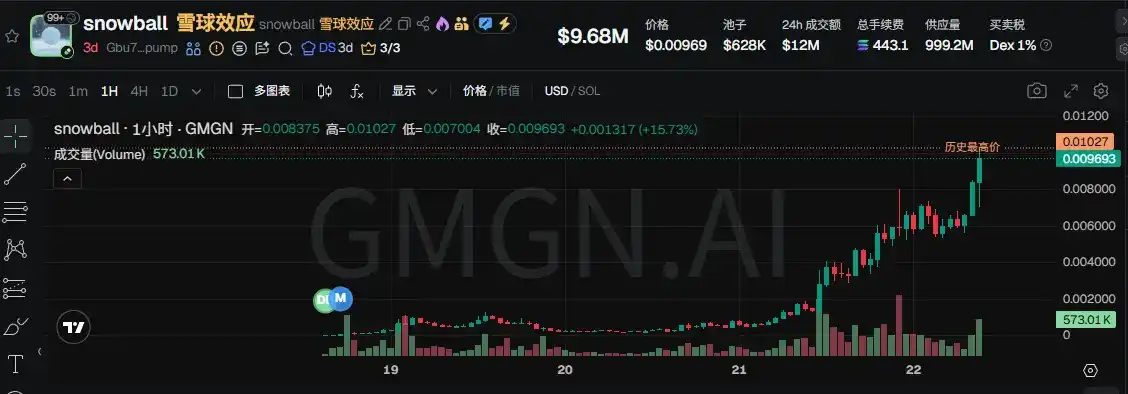
In the current environment where there are no new narratives and even meme coins are not attracting interest, this is one of the few things that have caught people's attention, displaying a kind of localized wealth effect.
And the name Snowball itself translates to the "snowball effect," which is the story it aims to tell:
A mechanism that allows the token to "grow bigger on its own as it rolls."
Turning Transaction Fees into Buybacks, Snowball Market Rolling
To understand what Snowball is doing, you first need to know how tokens on pump.fun typically make money.
On pump.fun, anyone can spend a few minutes creating a token. Token creators can set a "creator fee," which is essentially a percentage taken from each transaction and sent to their own wallet, usually between 0.5% and 1%.
This money can theoretically be used for community development and marketing, but in practice, most Devs' choice is: exit scam when they have accumulated enough.
This is also part of the typical life cycle of meme coins. Launch, pump, harvest fees, exit. Investors are not betting on the token itself but on the developer's conscience.
Snowball's approach is to not take this creator fee money.
More precisely, 100% of the creator fee does not go into anyone's wallet but is automatically transferred to an on-chain market-making bot.
This bot performs three actions at regular intervals:
First, use the accumulated funds to buy tokens on the market, creating buying pressure;
Second, add the purchased tokens and corresponding SOL to the liquidity pool to improve trading depth;
Third, burn 0.1% of the tokens on each operation to create deflation.
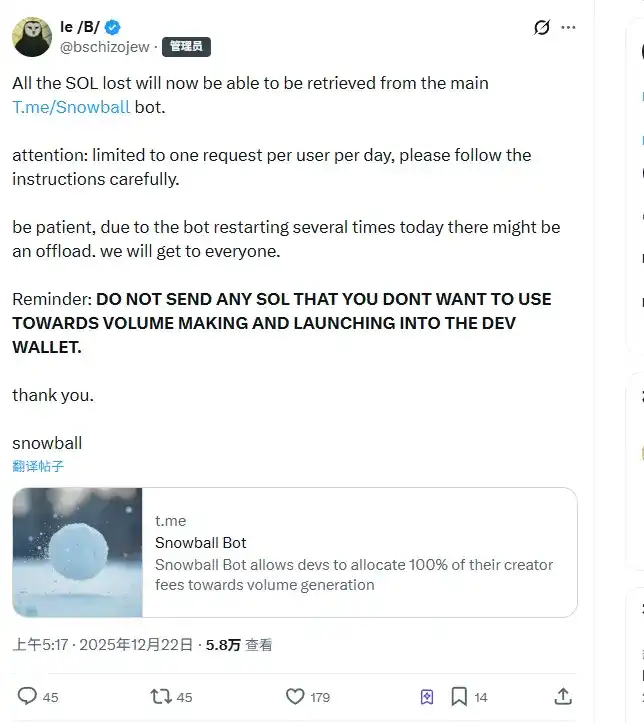
At the same time, the proportion of creator fees collected by this token is not fixed and will fluctuate between 0.05% and 0.95% based on market capitalization.
When the market capitalization is low, a higher fee is charged to rapidly accumulate ammunition for bots; when the market capitalization is high, the fee is reduced to minimize trading friction.
To summarize the logic of this mechanism in one sentence, every time you trade, some money automatically becomes buying pressure and liquidity, rather than going into the developer's pocket.
Therefore, it is easy to understand the snowball effect:
Trading generates fees → Fees become buying pressure → Buying pressure drives up the price → Price attracts more trading → More fees... theoretically, it can roll on its own.
On-Chain Data
Now that the mechanism is explained, let's look at the on-chain data.
Snowball was launched on December 18 and has been four days since then. The market cap surged from zero to $10 million, with a 24-hour trading volume exceeding $11 million.
For a meme coin on pump.fun, this performance is already considered long-standing in the current environment.
In terms of token distribution, there are currently 7270 holder addresses. The top ten holders together own about 20% of the total supply, with the largest single holder owning 4.65%.
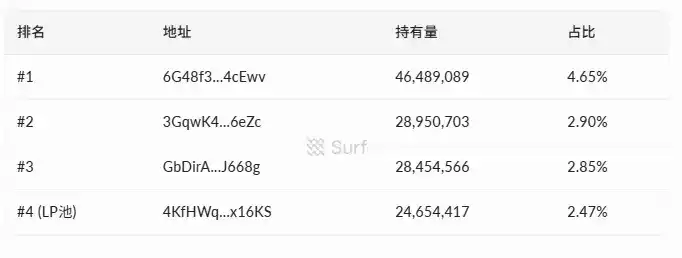
(Data Source: surf.ai)
No single address holds a significant share of two or three, indicating a relatively decentralized distribution.
Regarding transaction data, there have been over 58,000 transactions since launch, including 33,000 buys and 24,000 sells. The total buy amount is $4.4 million, sells amount to $4.3 million, with a net inflow of approximately $100,000. Buys and sells are roughly balanced, with no significant selling pressure.
There is approximately $380,000 in the liquidity pool, half in one token and half in SOL. For this market cap size, the depth is not considered deep, so large orders in and out will still experience significant slippage.
Another point worth noting is that shortly after the launch, Bybit Alpha announced the listing of the token in less than 96 hours, which to some extent also confirms its short-term popularity.
Perpetual Motion Machine Meets Bear Market
After taking a look around, it can be seen that the English community's discussion of Snowball mainly focuses on the mechanism itself. Supporters' logic is very straightforward:
This is the first meme coin that locks 100% of creator fees into the protocol, so developers cannot rug pull. At least structurally, it is more secure than other meme coins.
The Dev is also in line with this narrative. The developer wallet, liquidity pool bot wallet, and transaction logs are all public, emphasizing "on-chain verifiability."
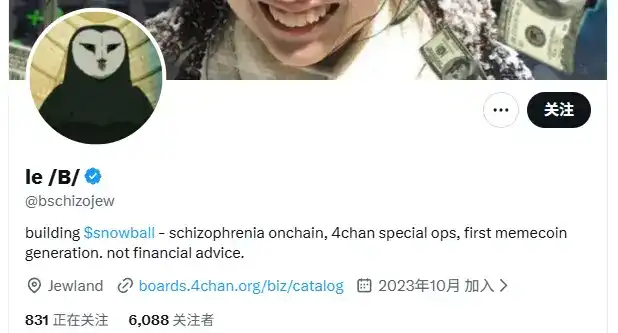
@bschizojew labels himself as "on-chain schizophrenia, 4chan special forces, first-generation meme coin veteran," exuding a self-deprecating degenerate vibe that is very much in line with the taste of the crypto-native community.
But mechanism security and profit-making are two different things.
The premise of the Snowball effect is to have enough trading volume to continuously generate fees, which are then fed to the bot to execute buybacks. The more the transactions, the stronger the bot's ammunition, the stronger the buy pressure, the higher the price, attracting more people to trade...
This is also the ideal state for any meme coin's buyback flywheel to start spinning in a bull market.
However, the flywheel needs external power to start.
What is the current state of the crypto market? On-chain activity is low, overall interest in meme coins is declining, and funds willing to ape into meme coins are already scarce. In this context, if new buy pressure cannot keep up, trading volume shrinks, the bot receives less and less in fees, the buyback strength weakens, price support diminishes, and trading interest further declines.
The flywheel can spin forward but also backward.
More realistically, the mechanism addresses only the risk of "developer rug pulls," but meme coins face risks far beyond that.
Whale dumping, insufficient liquidity, narrative fatigue — if any of these occur, the impact of 100% fee buyback is very limited.
Everyone is scared of being rugged. A prominent figure in the Chinese community summarized it well:
Play around, but don't get too involved.
More Than One Snowball Rolling
Snowball is not the only project talking about this automated market-making story.
Also in the pump.fun ecosystem, there is a token called FIREBALL doing a similar thing: automatic buyback and burn, packaging it as a protocol that other tokens can plug into. But its market cap is much smaller than Snowball's.

This indicates that the market is currently responsive to the direction of "mechanism-based meme coins."
The traditional practices of shilling, pumping, and community hype are finding it increasingly challenging to attract funds. Telling a "structural security" story through mechanism design may be one of the recent strategies of meme coins.
However, when it comes to artificially creating a mechanism, it's not a new play.
In 2021, OlympusDAO's (3,3) is the most typical case, using game theory to package a staking mechanism, telling a story of "if everyone holds, everyone gains," with the peak market cap soaring to tens of billions of dollars. The eventual outcome, as everyone knows, was a downward spiral, with a drop of over 90%.
Going back a bit further, there is Safemoon's play of "taxing each transaction and distributing it to holders," which was also a narrative of mechanism innovation, but eventually led to an SEC lawsuit, with the founder being charged with fraud.
Mechanisms can be excellent narrative hooks, able to attract funds and attention in the short term, but mechanisms themselves do not create value.
When external funds cease to flow in, even the most intricate flywheel will come to a halt.
Finally, let's clarify what this little Shiba Inu is up to:
Turning the meme coin's creator fee into an "automated market-making robot." The mechanism itself is not complex, and the problem it solves is very clear: preventing developers from directly taking the money and running.
Developers not running away doesn't mean you will make money.
If you find this mechanism intriguing after reading and want to participate, remember one thing: it is first and foremost a meme coin, and secondly an experiment with a new mechanism.
-- Price
This content is provided for general informational purposes only and doesn't constitute financial, investment, legal, or tax advice. Any events, rewards, online promotions, or related information mentioned herein should not be considered a recommendation, solicitation, or invitation to purchase, sell, trade, or otherwise deal in any crypto assets. Crypto assets are highly volatile and may result in loss. The availability of WEEX services, products, and related events may vary by region. You are responsible for ensuring that your participation is in accordance with applicable local laws and regulations.
You may also like

SynFutures to support SK Hynix stock token trading starting July 13

BFB Token on BSC Chain Attacked, Losses Approximately $220,000

Data: BY tokens on the BSC chain were attacked, resulting in a loss of approximately $88,400

The US SEC is advancing a framework for securities token trading and coordinating regulatory policies with the CFTC

The AROS token on the BSC chain was attacked, resulting in a loss of approximately $295,300

Former NBA player Thompson sues World Mobile over a token endorsement agreement worth up to $2 million

The supply of Tether's USAT increased by 540% month-on-month
Data: ONTR token contract access control vulnerability caused a loss of approximately $98,000
SUPERFORTUNE: GUA security incident or multi-signature address tampering involved
Data: pvp.trade has purchased HYPE with a commission of 8.68 million USD, currently with an unrealized profit of over 15 million USD

Orca launches a compliant trading market for tokenized physical assets

Aztec Labs acquires Obsidion, the company behind the privacy identity tool ZKPassport

DeFi has reached its most dangerous moment: the real vulnerabilities are not in the code
Babylon proposes to integrate native Bitcoin collateral on Aave V4 without the need for cross-chain bridges and custody

B.AI, in collaboration with BNB Chain, has launched an AI Token subsidy event with a joint prize pool of $8,000

ZachXBT: The same entity is associated with multiple BSC tokens manipulation, ESPORTS plummeted 93% in a single day

Data: Base ecosystem token KTA rose 22% intraday, market capitalization returned to 200 million USD
Alipay has launched AI wallet products and Token Pay, and its AI payment now supports 95% of general intelligent agent frameworks

StablR has suspended USDR and EURR operations due to excessive token issuance from an attack
ClawCivi.ai completes millions of dollars in seed round financing
The ICON Network will permanently shut down on December 31, 2026, and fully migrate to SODAX
Vitalik talks about the future of the Ethereum Foundation: a smaller, more distinctive, yet more enduring ship
Why have foreign exchange stablecoins never taken off?

The competition among Morpho vault curators intensifies, with Steakhouse Fi leading with a $1 billion advantage

BNKR’s Recent Surge Marks New Heights in Cryptocurrency Market
Key Takeaways BNKR Token Peak: BNKR reached an all-time high of $0.0011 on July 31, 2025. Significant Market…

FTX/Alameda Wallet Transfers Over $8 Million in ZRO Tokens to Wintermute
Key Takeaways An FTX/Alameda-associated wallet moved 4.126 million ZRO tokens to market maker Wintermute, with an approximate value…
Dragonfly Receives $55.8 Million Worth of LIT Tokens, Locked Until December 2026
Key Takeaways Dragonfly has acquired 55.8 million LIT tokens from Lighter, according to Arkham. The tokens are valued…

How Crypto Futures Markets Are Fueling ‘Scam Coin’ Insider Schemes
Key Takeaways: RAVE’s market cap skyrocketed to $6.7 billion before plummeting by 95% due to insider control and…
Breaking: Justin Sun Sues Trump’s World Liberty Financial Over Token Dispute
Key Takeaways: Justin Sun has filed a lawsuit against World Liberty Financial, alleging unjust freezing of his WLFI…
Anza recommends upgrading Solana mainnet validator to Agave 4, with Turbine retransmission delay reduced to about 0.8ms
SynFutures to support SK Hynix stock token trading starting July 13
BFB Token on BSC Chain Attacked, Losses Approximately $220,000
Data: BY tokens on the BSC chain were attacked, resulting in a loss of approximately $88,400
The US SEC is advancing a framework for securities token trading and coordinating regulatory policies with the CFTC
The AROS token on the BSC chain was attacked, resulting in a loss of approximately $295,300
Former NBA player Thompson sues World Mobile over a token endorsement agreement worth up to $2 million

Contents
Latest articles


Latest coin listings on WEEX


