
- Buy Crypto
- Markets
 Futures
- Spot
- Copy Trade
- Earn
- More
2024 Public Blockchain Industry Annual Report: From Infrastructure Competition to Application Breakthrough

Original Article Title: "2024 Public Blockchain Industry Annual Report: From Infrastructure Competition to Application Breakthrough"
Original Author: Stella L, Footprint Blockchain Analytics
2024 marks a significant milestone for the public blockchain industry, as the industry focus shifts from technical competition to practical application implementation. In this year, the public chain market capitalization grew by 105.3% to reach $28 trillion. The price of Bitcoin surpassed $100,000 and achieved institutional adoption through ETFs, the Ethereum Layer 2 network expanded to over 200 chains, and Bitcoin Layer 2 TVL grew by 1,277.6%. These developments all demonstrate the industry's transition from technical experimentation to real-world practical application. The public blockchain industry is currently undergoing a shift from being primarily technology-driven to being increasingly demand-driven by applications.
Note: Unless otherwise specified, all data in this report is as of December 20, 2024.
Market Dynamics: Growth and Transformation
In 2024, the public blockchain industry experienced unprecedented growth, with several key indicators showing significant expansion.
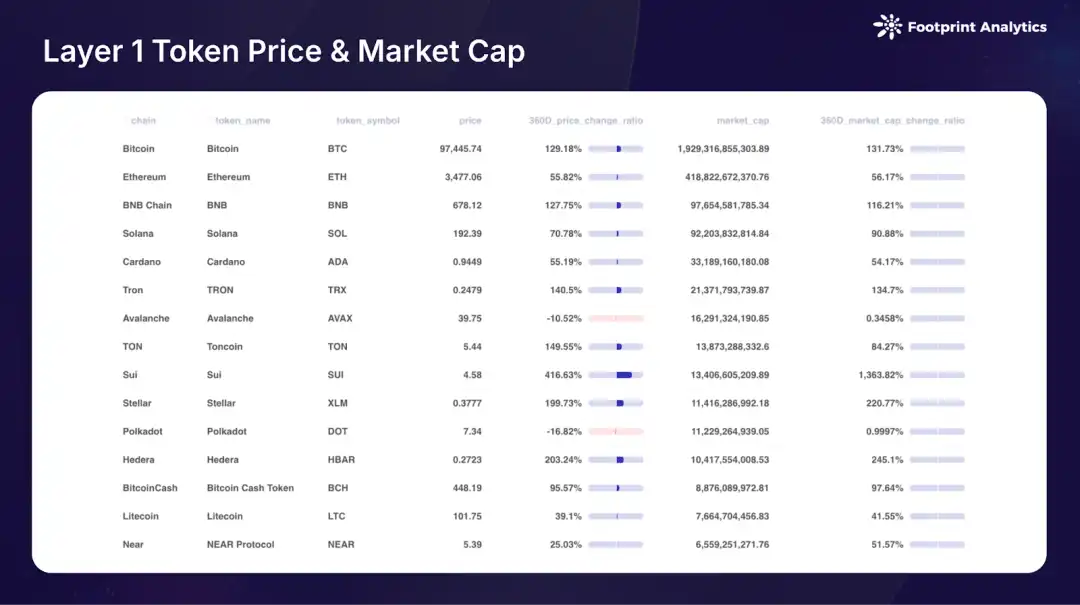
The total market capitalization of public chains grew by 105.3% to reach $28 trillion. Bitcoin's dominance rose to 69.8%, while Ethereum's share decreased from 20.4% to 15.2%. BNB Chain and Solana maintained their shares at 3.5% and 3.3%, respectively, with other platforms accounting for 8.1%.
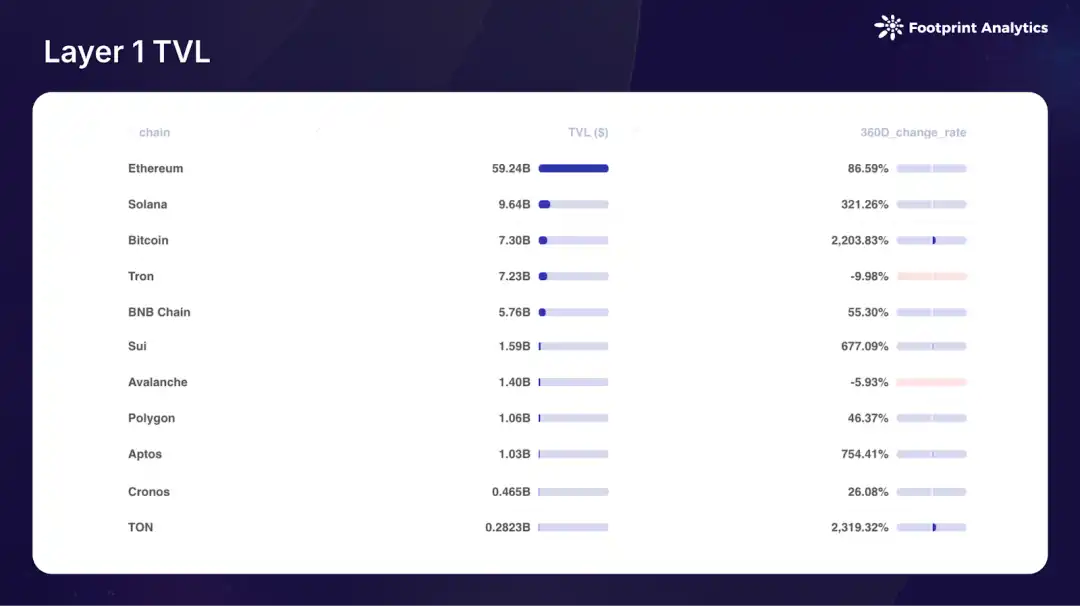
The DeFi sector also demonstrated strong growth momentum in 2024, with the total value locked (TVL) reaching $102.8 billion by the end of the year, an 88.6% year-on-year increase. Among the top 10 public chains by TVL, Bitcoin and TON showed the most significant growth, both exceeding 2,000%. Aptos, Sui, and Solana also performed well, with growth rates of 754.4%, 677.1%, and 321.3%, respectively. However, Tron and Avalanche saw decreases in their TVL.
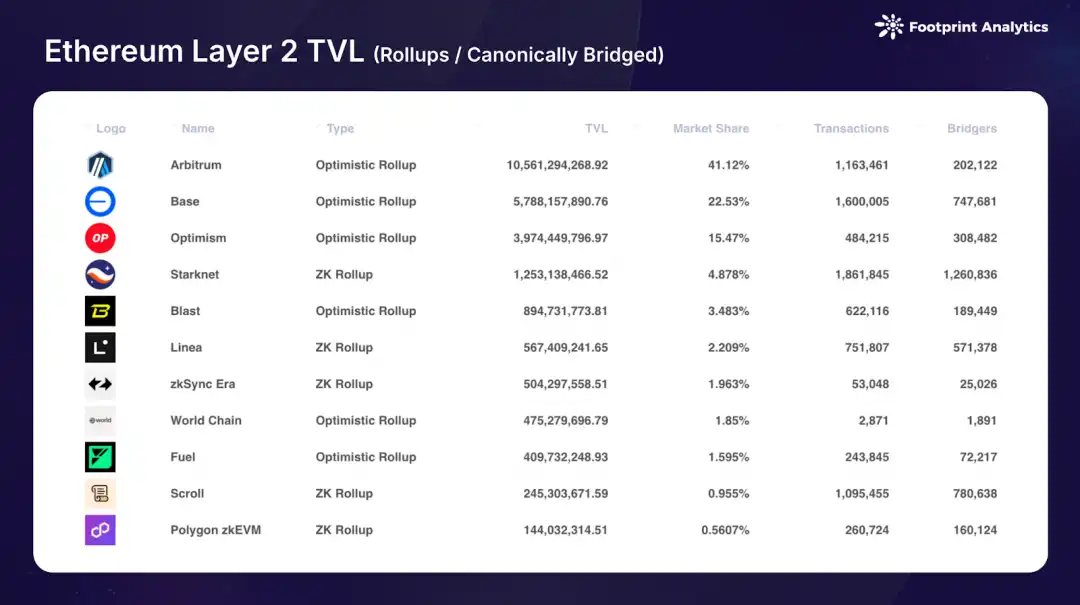
The Ethereum Layer 2 ecosystem experienced a noticeable trend of centralization in 2024. Arbitrum maintained its leading position with a TVL of $10.6 billion and a market share of 41.1%, a decrease from 50.8% in 2023. Base emerged as the dark horse of the year, ranking second with a $5.8 billion TVL (22.5% share), while Optimism ranked third with a $4 billion TVL (15.8%). These three platforms collectively held 79.1% of the Ethereum L2 DeFi TVL, with previous competitors such as Blast, zkSync, and Starknet experiencing a decline in market share.
Meanwhile, the ecosystem continues to expand, with currently 50 Rollups and 70 Validium & Optimium running on the mainnet, along with approximately 90 chains about to launch, bringing the total number of Ethereum L2 chains to over 200.
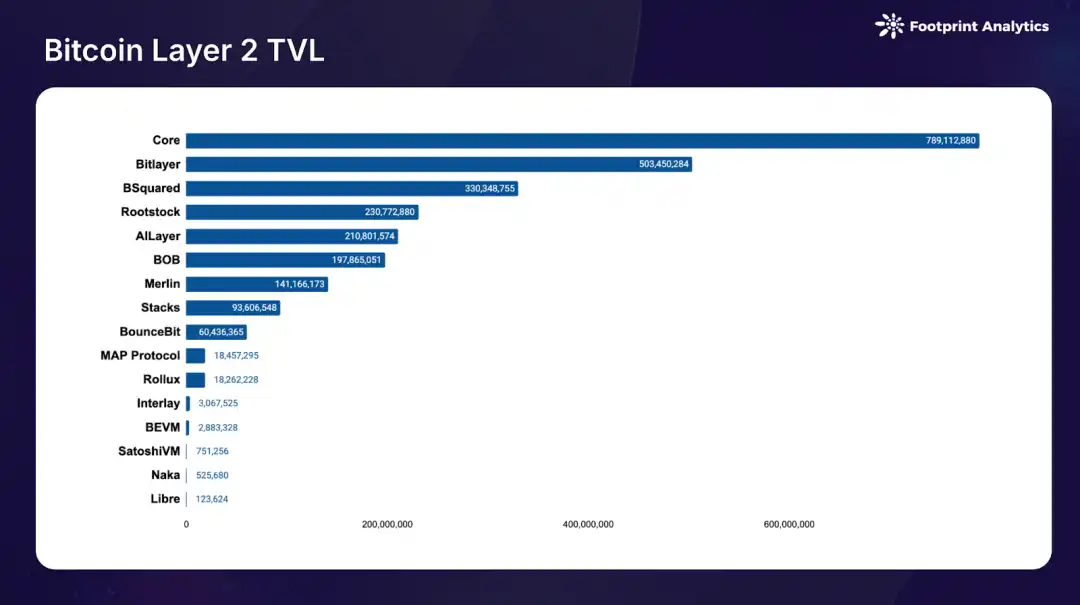
Bitcoin Layer 2 and sidechain ecosystems have experienced explosive growth, with a total locked value of $2.6 billion, representing a significant increase of 1,277.6% compared to 2023. Core leads with $0.79 billion TVL (30.3% market share), followed by Bitlayer ($0.50 billion, 19.4% share) and BSquared ($0.33 billion, 12.7% share). This growth is not only reflected in TVL but also in the number of active chains, which has more than doubled over the past year, reaching nearly 20 chains.
Competitive Landscape: Leaders and Challengers
In 2024, the competitive landscape of the public chain ecosystem underwent significant changes, characterized by Bitcoin's increased dominance, Solana's recovery, and the rise of emerging challengers.
Bitcoin: From Store of Value to Financial Infrastructure
In 2024, Bitcoin achieved remarkable growth, with a price increase of 129.2% and a market cap growth of 131.7%. This growth was primarily driven by institutional adoption of spot ETFs, the April halving event, and post-election positive sentiment in the United States. In addition to surpassing the $100,000 price milestone, the Bitcoin ecosystem saw two key developments:
Institutional Adoption Boost: The successful issuance of spot ETFs in January fundamentally changed the institutional access landscape, with BlackRock's product quickly reaching a $20 billion scale. Bitcoin surpassed silver and Saudi Aramco, becoming the seventh-largest global asset, marking a shift from a speculative asset to a recognized store of value.
BTCfi Emergence: The Bitcoin ecosystem expanded beyond price growth through innovative financial products. Babylon's Bitcoin staking project, Solv Protocol's cross-chain solution, and Core's Fusion upgrade all showcased a maturing ecosystem. Cross-chain functionality made progress through BOB Network's integration with Optimism and the BEVM's "Super Bitcoin" framework, although standardization still faces challenges.
Ethereum: Layer 2 Driving Ecosystem Evolution
2024 was a pivotal year for Ethereum's transformation into a Layer 2-centric ecosystem. Despite a 55.8% price increase to $3,744, Ethereum faced complex challenges of redefining its role and staying relevant amidst Layer 2 adoption growth. The successful launch of a spot ETF in July garnered some institutional acceptance, but Ethereum's price performance lagged significantly behind Bitcoin.
The Ethereum mainnet underwent the "Cancun Upgrade" to achieve significant changes, successfully reducing Layer 2 transaction costs and improving scalability. However, the shift in activity to Layer 2 led to a decrease in Ethereum's own transaction fee revenue, sparking discussions about Ethereum's long-term sustainability. The Ethereum Foundation responded through various measures, including implementing Proto-Danksharding (EIP-4844), developing cross-L2 communication standards, and strengthening security requirements for Layer 2 solutions.
The Layer 2 ecosystem demonstrated significant growth and integration throughout the year. Notable newcomers enriched the ecosystem, including World Chain, Uniswap's Unichain, and Sony's Soneium. This evolution highlighted Ethereum's transition from a pure execution layer to a diversified Layer 2 ecosystem of settlement and security providers. While questions around revenue models and competitive dynamics persist, Ethereum's ongoing development in developer activity and innovative scaling solutions showcased its adaptability.
Solana: The Third Giant
2024 witnessed Solana's strong comeback, with a 70.8% price increase and a 90.9% market cap growth. In November, the coin price broke $260, setting a new all-time high. This resurgence began with the January Jupiter airdrop, and Solana's ecosystem saw unprecedented activity. Solana established itself as a hub for retail trading, nurturing a vibrant meme and DeFi community. Beyond meme culture, Solana made advancements in various areas: re-staking protocols, modular Layer 2 solutions, and stablecoin innovation. The ecosystem's expansion through SVM chains like Eclipse, Soon, Atlas, and Sonic further extended its influence.
Rise of Emerging Powers: TON, Sui, and Base
TON: Social Integration-Driven Platform Growth
The Open Network (TON) showed significant growth in 2024, with the Toncoin price rising by 149.6% and market cap increasing by 84.3%. TON's success was primarily driven by its deep integration with Telegram, effectively bridging the gap between traditional social networks and blockchain technology. The platform simplified the crypto experience through Telegram wallet functionality and blockchain integration, providing easy access for millions of users to games, memes, and DeFi applications, establishing a model for mass adoption.
Sui: From Move Language Pioneer to Ecosystem Leader
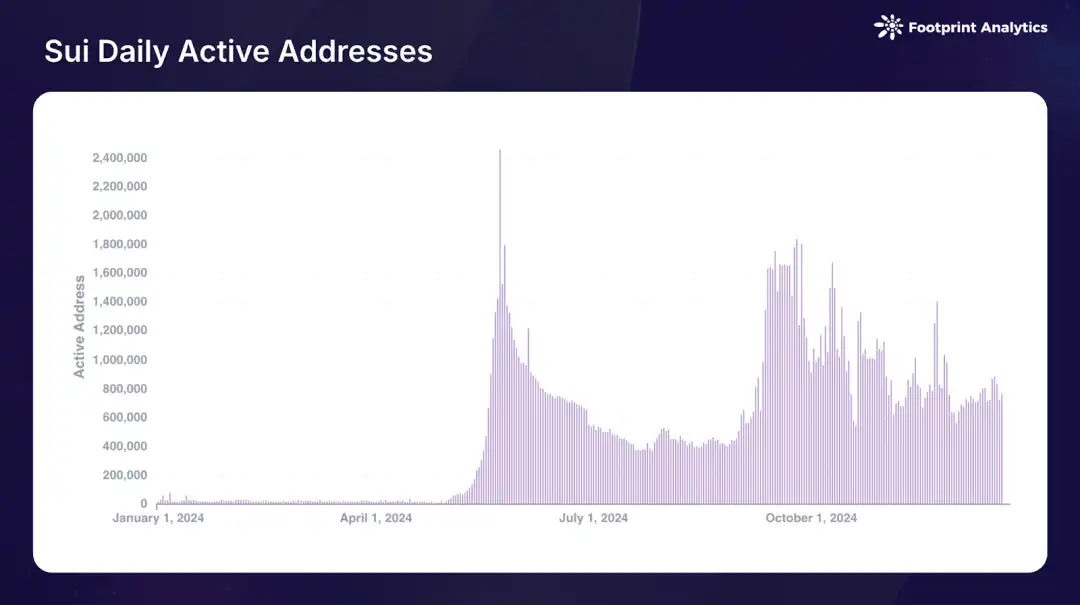
Sui demonstrated outstanding performance, with the token price skyrocketing by 461.6% and market cap increasing by 1,363.8%. This success reflects market confidence in Move language technology and ecosystem development. Sui focuses on the DeFi and gaming sectors, including Telegram game integration and innovative SuiPlay0X1 game console development, showcasing its comprehensive ecosystem growth strategy. The platform's emphasis on user experience and protocol development has created a positive network effect, attracting the participation of developers and users alike.
Base: Institutional Background Driving Rapid Growth
Base's significant growth was driven by several key factors. Coinbase notably lowered the entry barrier for mainstream users through its user-friendly smart wallet. The platform gained substantial momentum from successful social apps like friend.tech and Clanker, while the popularity of memecoins further boosted Base's on-chain activities. The implementation of the "Cancun Upgrade" significantly reduced transaction fees, enhancing Base's appeal to developers and users.
Key Trends in the 2024 Public Chain Industry
A Proliferation of New Chains
In 2024, many projects launched their own public chains. DeFi giant Uniswap announced Unichain; the gaming platform Treasure DAO developed a ZK-based Layer 2; the NFT sector saw the launch of Abstract by Pudgy Penguins; and the Web3 platform Galxe introduced Gravity. Furthermore, innovative new chains like Monad, Berachain, and HyperLiquid entering the scene reflect the public chain industry's shift towards specialized blockchain infrastructure.
Institutional Adoption: From Exploration to Strategic Integration
Institutional Engagement Transformation
2024 marks a decisive shift in institutional adoption from experimental blockchain initiatives to strategic implementation. Financial institutions are leading this transformation, with BlackRock's Bitcoin ETF quickly reaching a $20 billion scale, PayPal expanding PYUSD to Solana. Tech giants are demonstrating deeper engagement through innovative means: Sony launching the Soneum chain for entertainment applications, and Google Cloud expanding its Web3 gateway services. Infrastructure developments are particularly noteworthy, with Circle launching native USDC on Sui, and Visa integrating with Solana for settlements.
Institutional Investment Paradigm Shift
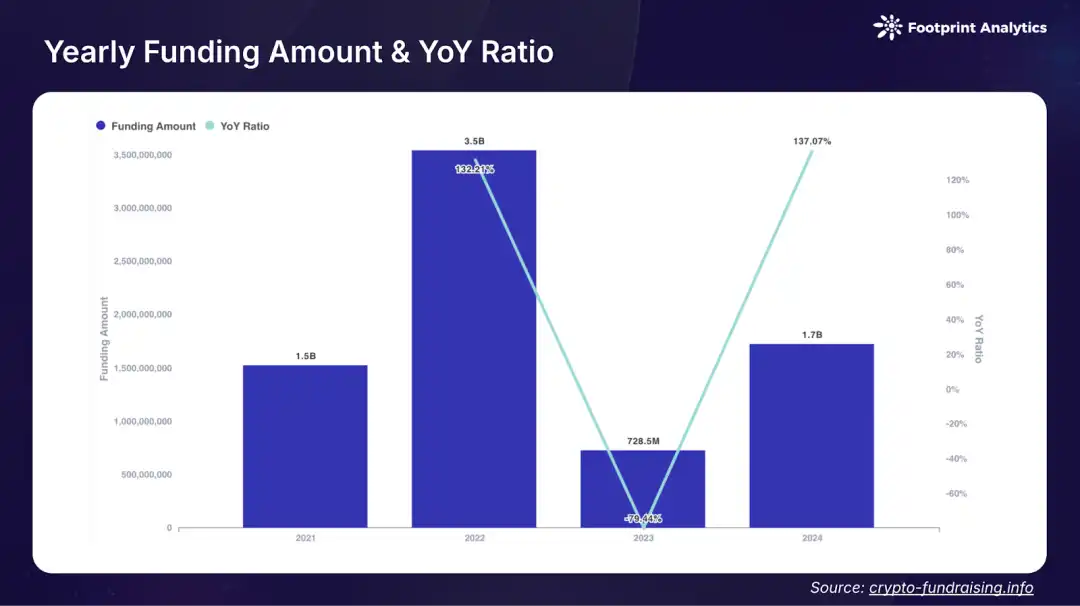
The public chain sector showed a strong recovery in 2024, with 174 funding events raising a total of $1.7 billion, a 137.1% increase from the previous year. It is worth noting that institutional investment strategies have shifted from pure infrastructure to application-driven innovation. Early-stage funding events accounted for 21.4% of total funding events, while Series A and Series B rounds accounted for 31.8%, reflecting a maturing ecosystem.
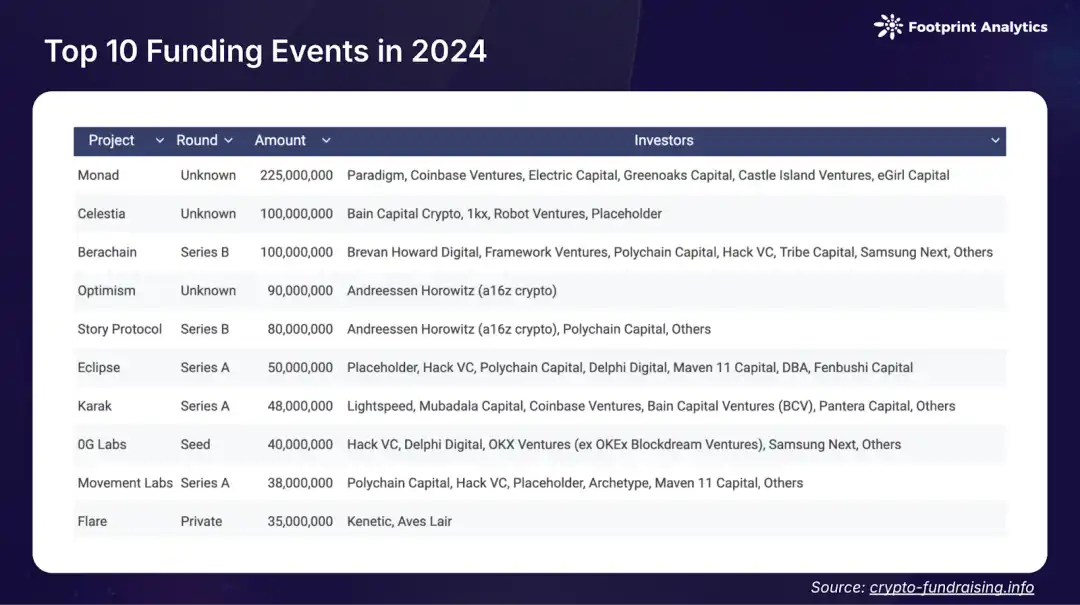
Venture capital investment philosophies have undergone a significant evolution, prioritizing user-facing applications over traditional infrastructure development. This is reflected in significant investments in consumer-facing projects: Monad raised $225 million to optimize user experience, while Celestia and Berachain each received $100 million for application-focused infrastructure.
From Technical Competition to Application Innovation
The public chain industry underwent a fundamental shift in 2024, moving from a technology-driven approach to an application-focused strategy. This transition challenged the previous industry mindset of "build it, and users will come" mentality. Despite significant advancements in technical capabilities, increased network capacity did not directly translate into corresponding user growth. For example, despite being "hardware-limited," Ethereum's base layer boasts a higher "user operations per second" (UOPS) than most Layer 2 solutions, highlighting the complex relationship between technical capabilities and actual adoption.
This reality has prompted the ecosystem to strategically pivot. Blockchain platforms are increasingly focused on identifying specific user needs and building targeted solutions rather than pursuing pure technological advancement. This "find users first, then build" approach is evident in several successful initiatives. Social finance integration has proven to be a particularly effective strategy, with TON's Telegram integration and Base's friend.tech showcasing how familiar social platforms can drive blockchain adoption. By simplifying user experience through account abstractions and familiar authentication methods, the barrier to entry for mainstream users has significantly decreased.
The evolution of meme culture in the blockchain space further exemplifies this shift towards application-oriented development. What initially started as purely speculative activity has evolved into an effective user acquisition channel, particularly on platforms like Solana and Base. These networks have successfully leveraged meme-driven initiatives to drive ecosystem growth while fostering sustainable community engagement. The success of these user-centric approaches indicates that sustainable growth in the blockchain space increasingly relies on understanding and serving user needs, rather than solely advancing technological capabilities.
Outlook for 2025
As the blockchain industry transitions from technical experimentation to practical implementation, 2025 is poised to be a pivotal year of transformation.
Regulatory Clarity
There is hope for a significant improvement in the regulatory landscape, especially in the United States. A more clear regulatory framework is expected to benefit the entire industry, particularly with advancements in stablecoin legislation. This regulatory clarity is expected to facilitate institutional blockchain adoption through the proliferation of regulated products and services, while fostering competition among jurisdictions in crypto regulation.
Public Chain Specialization
Public chain specialization has become a dominant trend, shifting from generalized Layer 1 competition to purpose-specific architectures. With the support of cross-chain infrastructure, application-specific chains and optimized execution environments will experience significant growth. The "Rollup as a Service" (RaaS) sector is poised to expand, offering enterprises and projects more convenient custom blockchain solutions.
Technological Innovation and AI Integration
In 2025, technological innovation will transition from mere breakthroughs to application-oriented infrastructure upgrades. The implementation of Proto-Danksharding will double Blob capacity, propelling Layer 2 scalability into a new phase; the development of chain abstraction technology will bring about a more intuitive user experience; standardized cross-chain communication will streamline interoperability.
At the infrastructure level, we anticipate seeing more development being driven by practical needs. A modular blockchain technology stack will mature, providing specialized solutions for data availability, settlement, and execution layers. Notably, the deep integration of AI technology with blockchain will reshape the infrastructure landscape: from enhancing user interfaces to realizing complex on-chain AI agents, from decentralized model training to supporting social finance integration, these innovations will underpin more sophisticated applications while maintaining security and decentralization, laying a solid foundation for the next wave of blockchain innovation.
Conclusion
The past year has demonstrated that sustainable growth relies not only on technological capabilities but also on meaningful user adoption and practical utility. With increasing regulatory clarity, advancements in technical infrastructure, and growing institutional involvement, the foundation for blockchain technology to achieve meaningful large-scale adoption is now in place. The focus has shifted from "what's technically possible" to "what's practically valuable," defining the next stage of industry growth in 2025.
You may also like

Exploring the ‘Super Cycle’ in Artificial Intelligence: Insights from Brad Gerstner
Key Takeaways The concept of a ‘super cycle’ in AI technology is gaining traction, spearheaded by industry experts.…

Children and Trump’s Investment Program: Billionaires’ Contributions to “Trump Accounts”
Key Takeaways: President Donald Trump has introduced the “Trump Accounts” program, massively funded by billionaires to provide financial…

Could Stablecoins Resolve U.S. Debt? Standard Chartered Predicts $1 Trillion in Treasury Demand
Key Takeaways Projected Growth: The stablecoin market could see its capitalization soar to $2 trillion by 2028, significantly…

Missouri Advances Bitcoin Reserve Bill to House Committee in Policy Push
Key Takeaways Missouri pushes HB 2080, aiming to establish a state-run Bitcoin Strategic Reserve Fund. The bill mandates…

Ethereum Faces $1,500 Downside as Vitalik Buterin Sells 9,000 ETH
Key Takeaways Vitalik Buterin’s recent sale of nearly 9,000 ETH has triggered concerns over Ethereum’s price stability, given…
Hong Kong to Connect New Digital Bond Platform With Regional Crypto Tokenization Hubs
Key Takeaways Hong Kong is pioneering the integration of its debt market with blockchain technology through a new…

Elon’s Grok AI Predicts the Price of XRP, Cardano, and Ethereum by 2026
Key Takeaways Grok AI forecasts significant price growth for XRP, Cardano, and Ethereum by 2026. XRP could see…

Anchorage Digital Confirms Its Stake in Strategy’s STRC – A Sign of Long-term Confidence
Key Takeaways Anchorage Digital has officially disclosed holding Strategy’s STRC perpetual preferred stock, reinforcing its strategic alignment within…

Bitcoin Price Prediction: Major Miner Expands in Texas: Is a Massive BTC Production Surge Anticipating?
Key Takeaways: Canaan Inc. has expanded its role from hardware selling to direct Bitcoin production by acquiring a…

Crypto Price Prediction Today 25 February: XRP, Solana, Bitcoin
Key Takeaways Bitcoin’s recent surge to $66,000 reflects a potential bullish trend bolstered by institutional interest and regulatory…

Bitcoin Climbs on Market Optimism Ahead of Trump’s State of the Union
Key Takeaways Bitcoin’s price surged over $2,000 to surpass the $66,000 mark following optimistic signals prior to Trump’s…

An AI Crypto Agent Accidentally Bestows Six Figures, Then a Twist of Fate Strikes
Key Takeaways: An AI crypto agent mistakenly sent 52.4M LOBSTAR tokens to an unintended recipient due to a…
XRP Price Prediction: Will Massive Whale Movements Lead to a Crash Below $1?
Key Takeaways Significant whale activity on Binance has seen the movement of over 31 million XRP, causing potential…
Arizona Just Named XRP in a State Crypto Reserve Bill — Is Government Adoption Beginning?
Key Takeaways Arizona’s Senate Bill 1649 proposes the inclusion of XRP and DigiByte, alongside Bitcoin, in a Digital…

Ethereum Secures FOCIL and Redirects $6.8M in ETH to Staking
Key Takeaways Ethereum’s Hegota upgrade in the second half of 2026 will integrate the FOCIL proposal, reinforcing censorship…
ZachXBT Insider Trading Report Targets Major Crypto Firm in 2 Days
Key Takeaways $6 Million in Prediction Market Activity: Trading volume related to the ZachXBT investigation has surpassed $5.6…
Bitcoin Bloodbath: $370M Liquidations as Corporates Defend $60K
Key Takeaways The crypto market faced a significant deleveraging event, with over $370 million in liquidations, particularly affecting…

Ethereum Co-Founder Vitalik Buterin Sells 10,000+ ETH Amid Price Decline
Key Takeaways Vitalik Buterin, Ethereum’s co-founder, has sold over 10,000 ETH as the cryptocurrency strives to maintain its…
Exploring the ‘Super Cycle’ in Artificial Intelligence: Insights from Brad Gerstner
Key Takeaways The concept of a ‘super cycle’ in AI technology is gaining traction, spearheaded by industry experts.…
Children and Trump’s Investment Program: Billionaires’ Contributions to “Trump Accounts”
Key Takeaways: President Donald Trump has introduced the “Trump Accounts” program, massively funded by billionaires to provide financial…
Could Stablecoins Resolve U.S. Debt? Standard Chartered Predicts $1 Trillion in Treasury Demand
Key Takeaways Projected Growth: The stablecoin market could see its capitalization soar to $2 trillion by 2028, significantly…
Missouri Advances Bitcoin Reserve Bill to House Committee in Policy Push
Key Takeaways Missouri pushes HB 2080, aiming to establish a state-run Bitcoin Strategic Reserve Fund. The bill mandates…
Ethereum Faces $1,500 Downside as Vitalik Buterin Sells 9,000 ETH
Key Takeaways Vitalik Buterin’s recent sale of nearly 9,000 ETH has triggered concerns over Ethereum’s price stability, given…
Hong Kong to Connect New Digital Bond Platform With Regional Crypto Tokenization Hubs
Key Takeaways Hong Kong is pioneering the integration of its debt market with blockchain technology through a new…


 App
App