
2025 Crypto Card Annual Report: 40,000 Monthly Active Users, Average Spending of Less Than $100

Original Title: The State of Crypto Cards and What Comes Next
Original Author: @ahboyash, Crypto Researcher
Original Translation: Deep Tide TechFlow
Introduction
2025 was a milestone year for the development of crypto cards, as they transitioned from a niche entry tool to an increasingly widely used payment instrument. Whether for deposits or spending, crypto cards demonstrated strong growth momentum in this year, driven by improved user experience, broader blockchain support, and a gradual increase in user acceptance of stablecoin-denominated spending.
This report provides an ecosystem-level overview of crypto card activity over the past two years (December 2023 to October 2025), with a focus on analyzing the observable on-chain behavior of leading crypto card providers.
Executive Summary
· From Experimentation to Real-World Application: In 2025, crypto cards transitioned from the experimentation phase to real-world application, with both deposits and spending showing sustained exponential growth trends.
· Deposit-Led Spending: Stablecoins took the lead in deposit behavior, occupying nearly all collateral asset shares, further reinforcing a low-volatility spending pattern akin to debit cards.
· Leading Usage by @Rain Card: The @Rain series of crypto cards led in usage, but most users still primarily engaged in small-value spending, indicating their main use for daily spending wallet top-ups.
· Future Growth Potential: The growth trend is expected to continue in 2026, with profitability, exchange economics, and credit-related factors set to further develop, focusing not only on the singular goal of user acquisition.
Methodology and Scope
This report analyzes crypto card activity through verifiable on-chain data, with a focus on observable economic behaviors rather than self-reported metrics.
· Card Coverage:
· Type 1 Cards: On-chain verifiable deposits and spending (e.g., Rain series cards, Gnosis Pay cards, MetaMask cards)
· Type 2 Card: Supports on-chain verifiable deposits only (e.g., WireX Card, RedotPay Card, Holyheld Card)
· Type 3 Card: Card issued by centralized exchanges (CEX) (e.g., Binance Card, Bybit Card, Nexo Card) → Not included in the analysis due to limited data availability
· Analysis Method:
· Deposit Analysis: Includes Type 1 and Type 2 Cards to capture a broader range of liquidity inflows.
· Spending Analysis: Limited to Type 1 Cards only, as their transaction behavior is directly observable on-chain.
For wallets with native cards that do not follow traditional deposit flows, their spending activity is considered as a deposit in the analysis to maintain consistency. Non-stablecoin balances are normalized using the average price from the past 12 months to represent all transaction volumes in equivalent USD.
Deposits: How Liquidity Enters the System
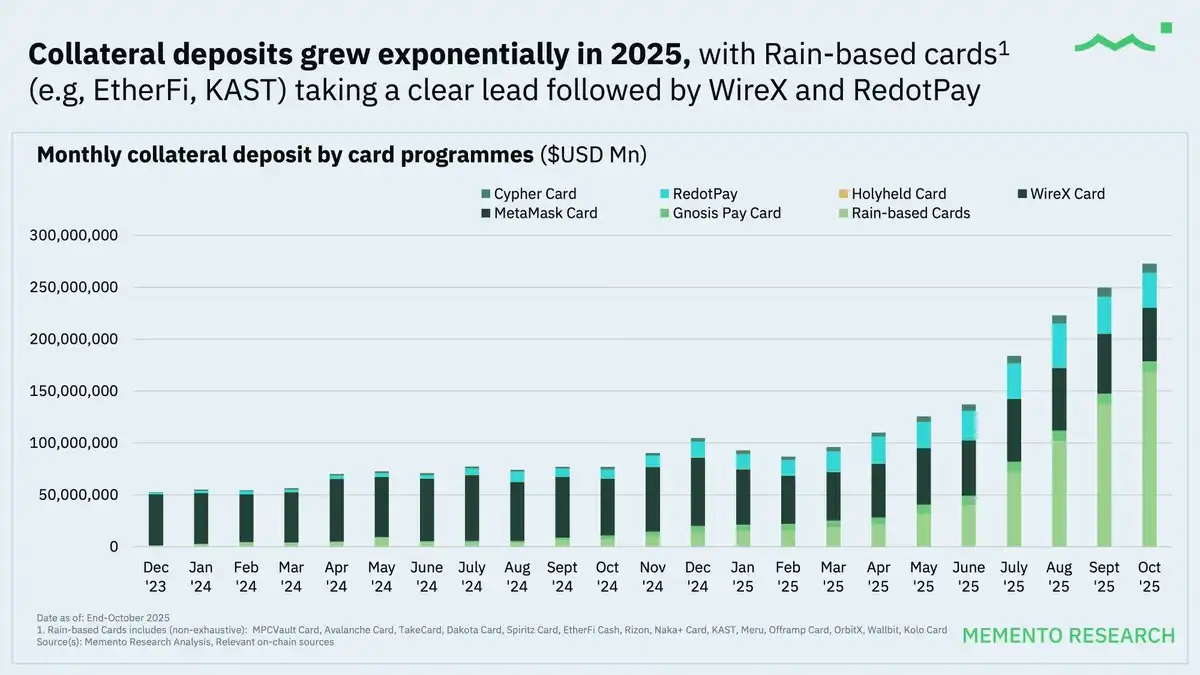
Deposits Lead Expansion with the Fastest Growth Rate
Between 2024, the monthly collateral deposit volume of crypto cards experienced exponential growth and further accelerated in 2025.
Cards projects based on the Rain series of crypto cards consistently maintained a leading position in deposit volume, as they serve as core infrastructure for various popular crypto card projects, including @ether_fi Cash, @KASTxyz, @OfframpXYZ, and Avalanche (@avax) cards.
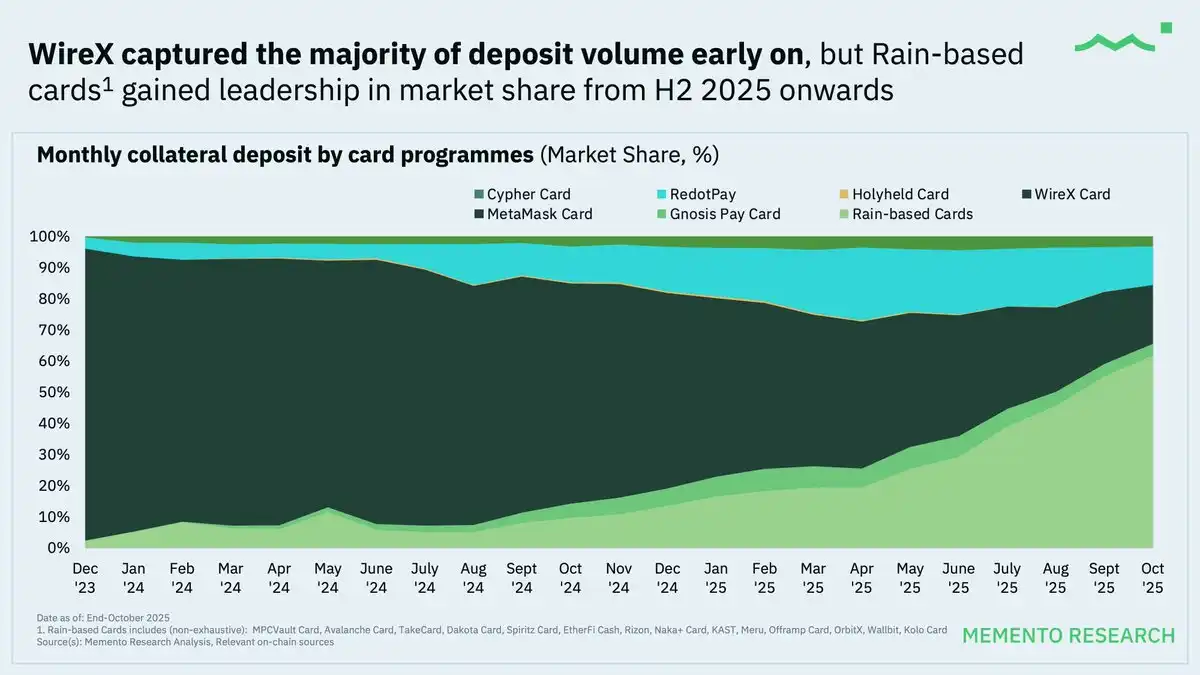
Market Share: Initially Concentrated, Then Distributed
Throughout most of 2024, @wirexapp held the major share of the deposit volume, but starting in the second half of 2025, the Rain series of crypto cards took the lead in market share.
Key Insight: Since the second half of 2025, a new wave of crypto card projects has been launched, with Rain being chosen as the core infrastructure partner. This trend has driven increased deposit inflows and accelerated the onboarding of new users.
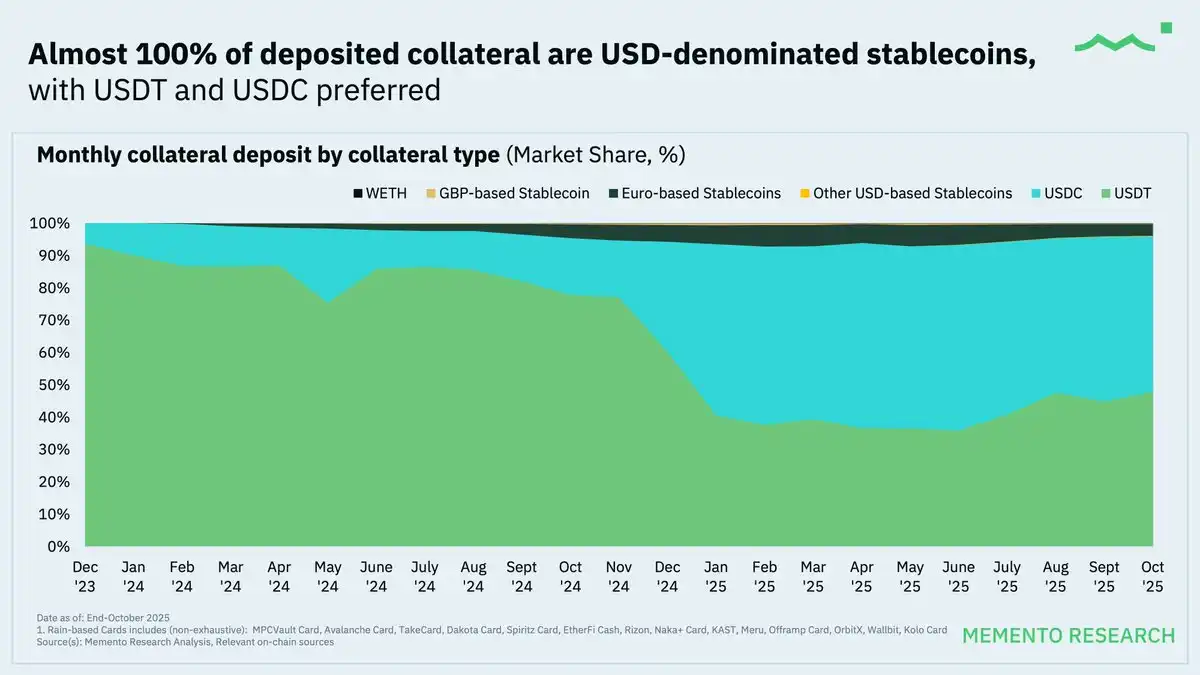
Stablecoins Almost Completely Dominate
Across the dataset, nearly 100% of deposit-backed assets are composed of USD-denominated stablecoins, with USDT and USDC as the primary leaders.
This phenomenon further demonstrates that current crypto cards are closer to international payment accounts rather than speculative spending tools, even for non-U.S. users.
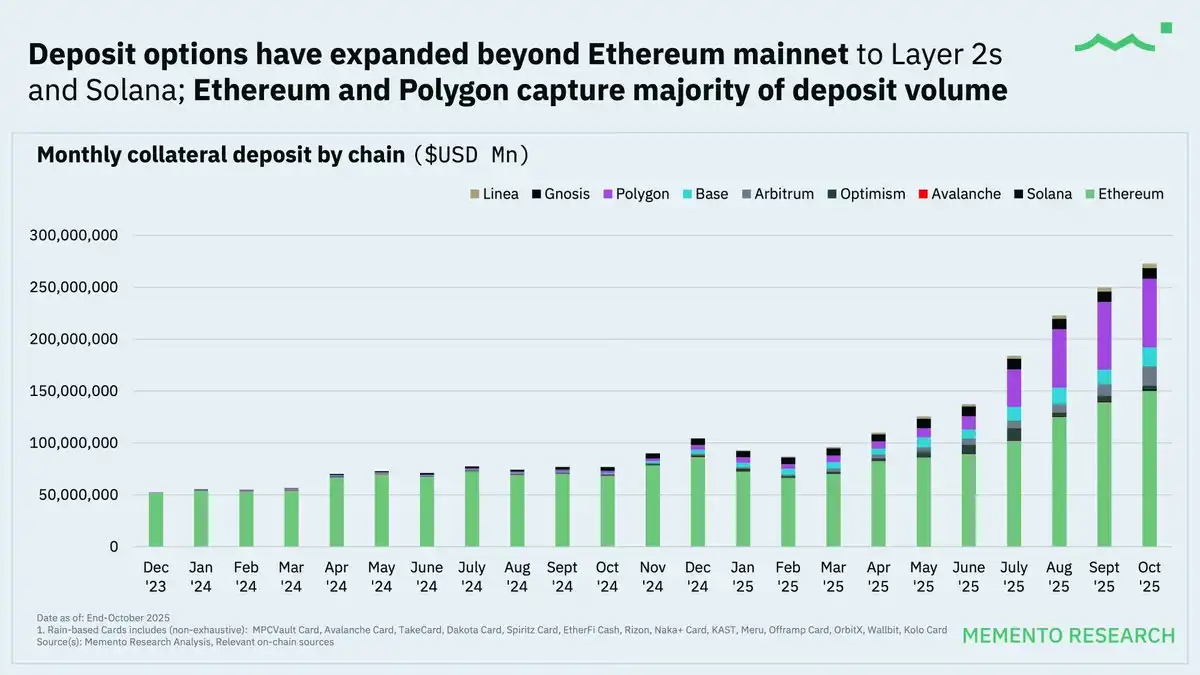
@ethereum and @0xPolygon are the dominant chains for deposits, with multi-chain usage gradually increasing.
While Ethereum (@ethereum) and Polygon (@0xPolygon) remain the primary deposit networks, other layer-one chains (such as @base, @arbitrum, @Optimism, and @solana) are also steadily gaining market share.
The rise of multi-chain trends reflects the following factors:
· Lower transaction costs: Lowering the threshold for users to recharge more frequently.
· Card service provider-optimized routing: No longer forcing users onto a single chain, multi-chain deposits have gradually become a "basic feature."
Consumer Behavior: The Actual Usage of Crypto Cards
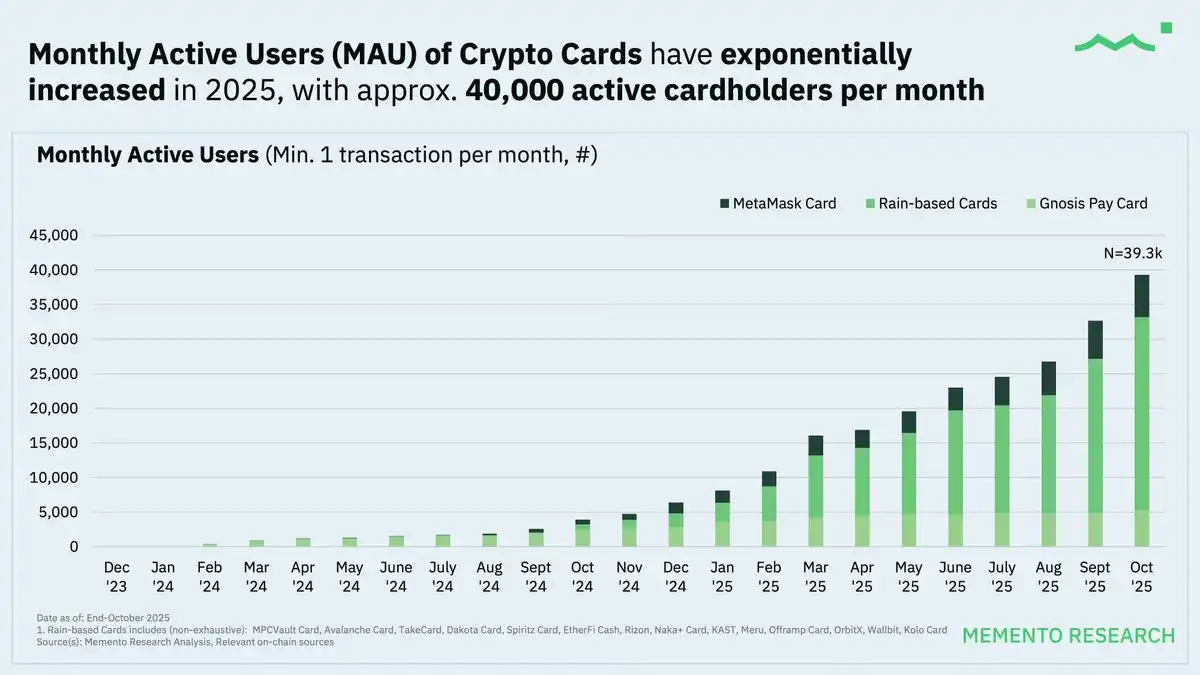
Monthly Active Users (MAU) Continues Rapid Growth in 2025
As of October 2025, monthly active card users (MAU) have reached approximately 40,000, indicating an increasing user acceptance of crypto cards as a reusable payment tool rather than just a one-time experimental tool.
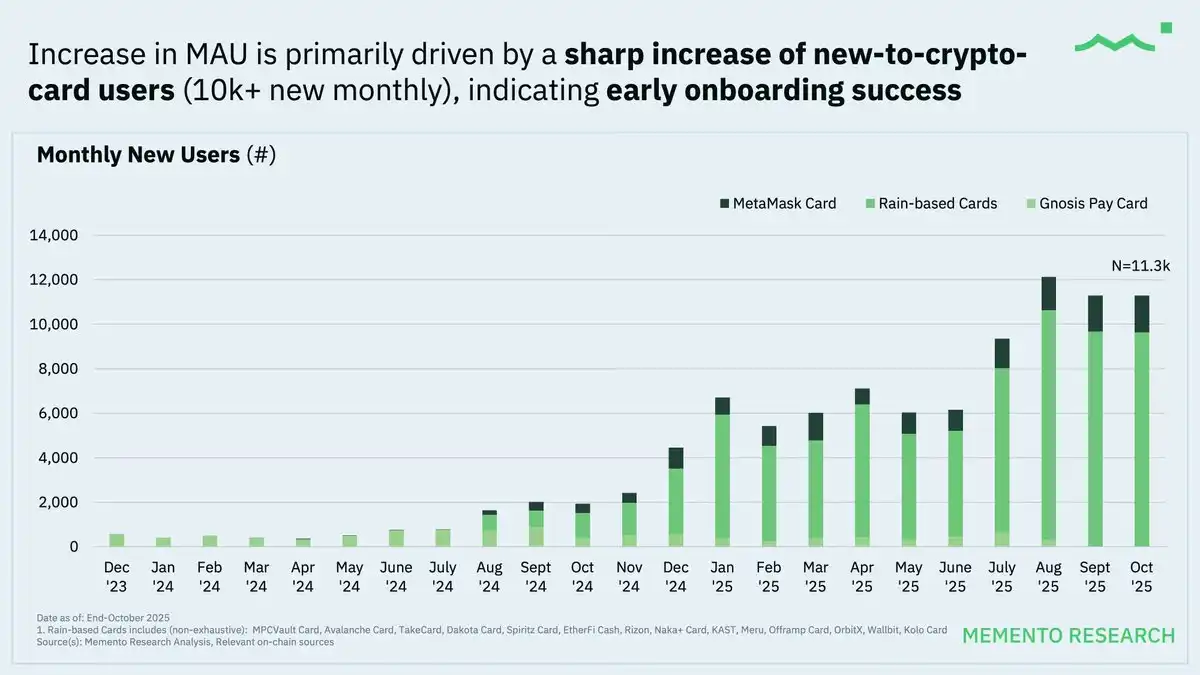
The crypto card industry is still in its early "user adoption-driven" growth stage, indicating that the industry's adoption curve is still in its infancy, with distribution and accessibility continuously expanding.
The Rain series of cards, due to their role as shared infrastructure for multiple crypto card projects (card-as-a-service), occupy the major share of transaction volume. The data of these Rain series cards is better suited for trend-level interpretation.
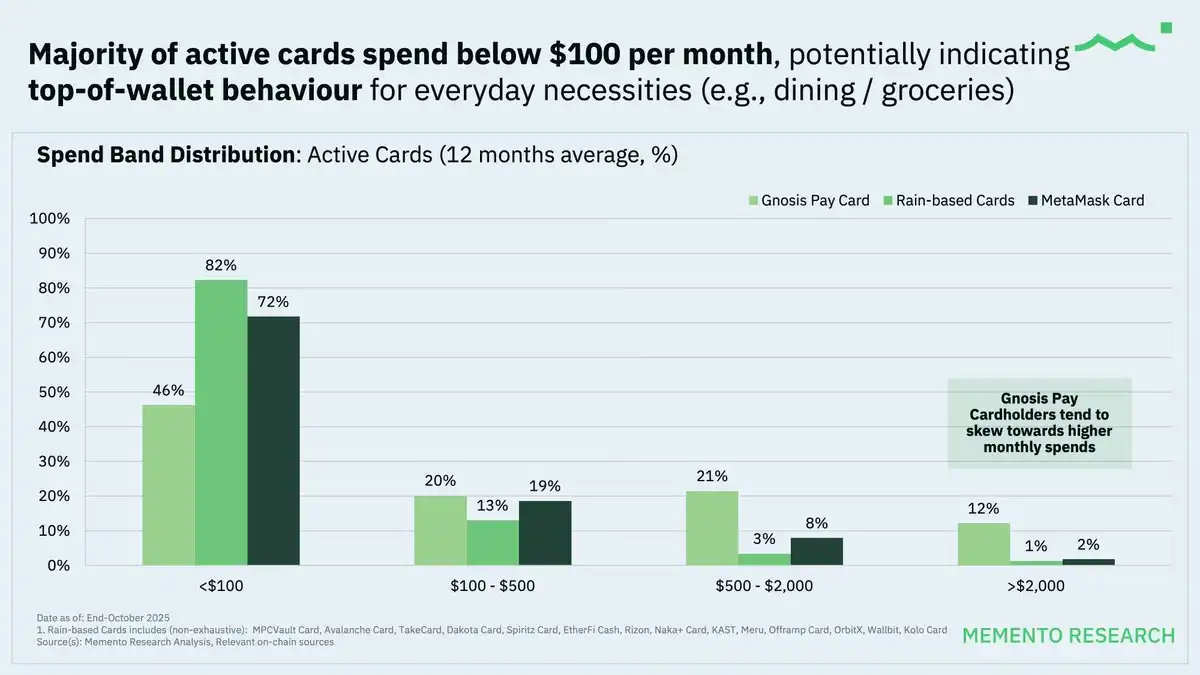
The overall spending amount remains at a relatively low level, which may indicate that crypto cards are primarily used for daily expenses.
The pattern of low-value card usage may also suggest that users treat crypto cards as a fiat withdrawal tool, thereby bypassing the manual stablecoin-to-fiat conversion step directly.
It is worth noting that @gnosispay cardholders have a higher monthly spending amount, indicating that their users are more inclined to use it as their primary payment card for more consistent usage.
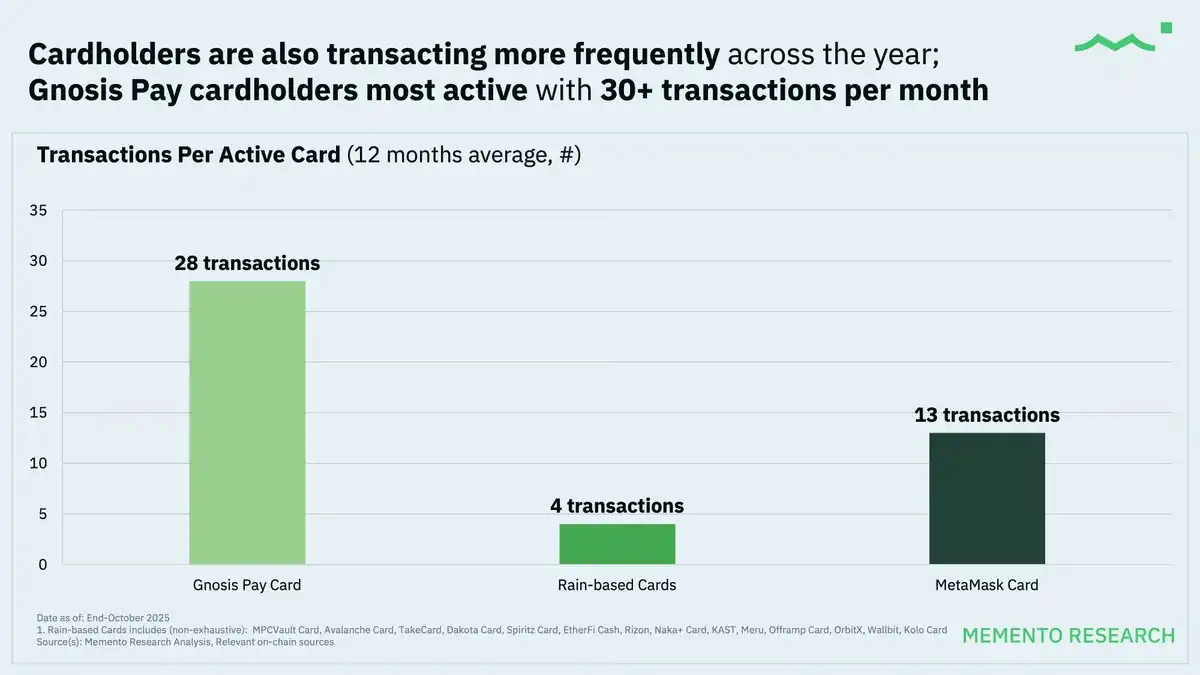
Over time, the transaction frequency of active cardholders has increased year by year; similar to spending patterns, @Gnosis Pay cardholders have the highest level of activity, with an average of over 30 transactions per month, fully reflecting the behavioral characteristics of daily payments.
Key Insights
· Increased User Activity: More and more people are truly starting to use crypto cards, not just registering, with 2025 seeing a steady rise in consumption and activity levels.
· Emphasis on Everyday Small Transactions: Users rely more on stablecoins for small, regular transactions rather than large or speculative trades.
· Core Role of Infrastructure Providers: The shared "card as a service" model has driven transaction volume concentration and determined the ecosystem's expansion path.
Outlook for 2026: From Experimentation to Sustainable Expansion
The data from 2025 indicates that crypto cards have transitioned from the experimental phase to the early application stage. While deposits, spending, and active usage have seen significant growth, user behavior remains cautious, similar to a stablecoin-centered prepaid card model rather than a complete replacement for traditional credit cards.
Currently, crypto cards mainly serve as a bridge between on-chain liquidity and real-world payments, rather than a complete replacement for traditional credit cards.
Looking ahead to 2026, growth is expected to be more driven by economic sustainability and product design, rather than solely relying on the momentum of user adoption. As the scale of usage expands, card service providers need to find a balance between expansion, cross-border and domestic flow economics, routing efficiency, and increasingly complex operational management.
Key Issues to Note:
1. Privacy Concerns Persist: Transaction records are public on-chain, and spending behavior may be exposed. Once addresses are clustered or linked to deposit addresses on centralized exchanges, ownership attribution can become easy based on on-chain behavioral traces (such as time, amount, etc.).
2. Double-Edged Sword of Public Data: While public data is easy to analyze, it can also be exploited by competitors. Competitors can monitor traffic, mimic incentive measures, and even target high-value users through predatory discount attacks.
3. Non-Vertical Integration Risk: Most cryptocurrency card projects rely on issuers, payment processors, and a few "card-as-a-service" providers. This model may lead to single points of failure or be subject to restrictions due to upstream compliance events or policy changes, triggering sudden limitations or shutdowns.
4. High-Risk Merchant Categories: High-risk merchant categories such as gaming, online casinos, adult entertainment, etc., often face higher fraud and dispute/chargeback rates, which may lead card networks and issuers to implement stricter controls. Furthermore, these categories may face more stringent anti-money laundering (AML) scrutiny in different jurisdictions.
5. Homogenization Issue: The core functionalities offered by most cryptocurrency cards in the current market are similar, with limited differentiation apart from selected cardholder rewards such as cashback or points. The continued reliance on a prepaid structure and a few card-as-a-service providers (such as Rain) may pose long-term challenges for cryptocurrency card issuers seeking to compete with global incumbent banks.
Key Future Trends to Watch:
· Transition from a prepaid model to credit card-like designs, similar to the @Coinbase One AMEX card.
· Stablecoins continuing to dominate as the primary unit of account.
· Intensified focus on profitability and unit economics as competition grows.
Cryptocurrency cards are gradually becoming a foundational tool for embedded payments within wallets and apps. Market demand has been established for 2025, with 2026 determining which models can achieve sustainable scalability.
You may also like

The large models in the United States are moving towards closure in the name of security

Morning Report | CoinEx becomes a key hub for Iran to evade sanctions, involving over $3.8 billion in funds; Kalshi seeks a new round of financing, with a valuation potentially rising to $40 billion

From the white-haired stock god to the billionaire fund mogul, the smart people shorting Nvidia are all getting rich using the same framework

Why do cryptocurrency projects always like to change their names?

Global Launch: As predictions become the most scarce asset in the AI era, Manadia is defining the next generation of the value internet

Who is footing the bill for the $64 billion accounting frenzy?
I never expected that the first application of AI x Crypto would be in security auditing

What is your view on Binance's competitive advantages?

ETH has entered a non-consensus phase, and the turning point is approaching!
The shift in the cloud of the air: from despising stablecoins a year ago to the high-profile entry of capital today
The survival dilemma of small and medium exchanges behind the withdrawal anomalies exposed by AscendEX

Why Is Bitcoin Falling Below $60K? 5 Key Market Drivers Explained
Bitcoin has dropped sharply amid ETF outflows, Strategy stock weakness, AI stock rallies, and changing Fed expectations. Explore the key forces driving BTC’s latest correction and what traders should watch next.

Bitcoin vs. Gold in 2026: Which Asset Performs Better in Different Markets?

Morning News | The draft amendment to the People's Bank of China Law aims to clarify the legal status of digital renminbi; South Korea will transfer about 40 unregistered virtual asset service providers to law enforcement agencies
The cryptocurrency industry has entered the "Show Me" era: merely relying on vision is no longer enough

Interpreting the Ethereum Foundation's new structure: Reaffirming self-sovereignty amid institutional trends
Former SpaceX engineer reconstructs the financial execution system using first principles
Standard Chartered Bank sings a 50x rhapsody again, aiming for AAVE to reach 3500 USD
The large models in the United States are moving towards closure in the name of security
Morning Report | CoinEx becomes a key hub for Iran to evade sanctions, involving over $3.8 billion in funds; Kalshi seeks a new round of financing, with a valuation potentially rising to $40 billion
From the white-haired stock god to the billionaire fund mogul, the smart people shorting Nvidia are all getting rich using the same framework
Why do cryptocurrency projects always like to change their names?
Global Launch: As predictions become the most scarce asset in the AI era, Manadia is defining the next generation of the value internet
Who is footing the bill for the $64 billion accounting frenzy?


