
- Buy Crypto
- Markets
 Futures
- Spot
- Copy Trade
- Earn
- More
Base's 2025 Report Card: Revenue Grows 30X, Solidifies L2 Leadership

Original Title: Are you Based? Base's Outlook for 2026
Original Author: AJC, Messari
Original Translator: Tim, PANews
In 2025, Base further solidified its position as the Ethereum L2 leader across various performance metrics. Among these, revenue remains the most telling indicator of its dominance in the overall L2 ecosystem.
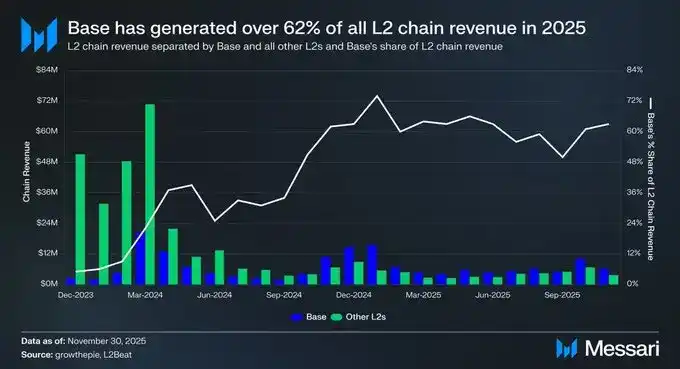
Despite a significant drop in L2's total revenue from its 2024 peak, Base continues to command a significant share of the L2 market. In December 2023, Base's on-chain revenue was $2.5 million, accounting for only 5% of L2's total revenue of $53.7 million. One year later, Base's on-chain revenue grew to $14.7 million, representing 63% of L2's total revenue of $23.5 million in December 2024. This trend persisted into 2025, with Base achieving $75.4 million in revenue year-to-date, accounting for 62% of L2's total revenue of $120.7 million.
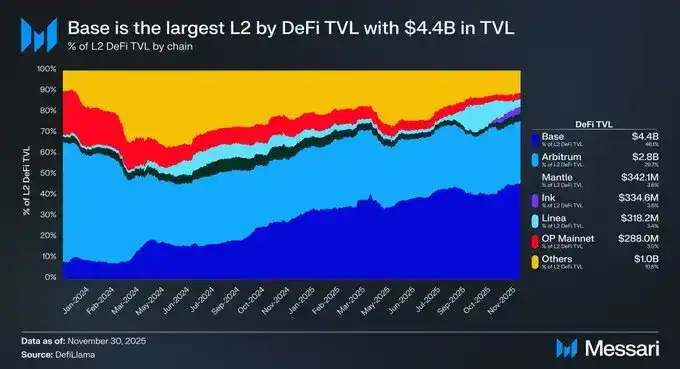
Base's leadership is not only evident at the revenue level; its DeFi TVL has also become a frontrunner in the L2 race. After surpassing Arbitrum One in January 2025, Base's current $46.3 billion DeFi TVL accounts for 46% of the entire L2 market. Of particular note, Base's DeFi TVL share has steadily increased throughout 2025, rising from 33% at the beginning of the year to the current level.
Base's most significant advantage over other L2 solutions lies in its distribution channel, a critical advantage that speaks for itself. According to Coinbase's latest 10-Q filing, with 9.3 million monthly active trading users in the third quarter, Base can directly reach a large and onboarded user base, which is challenging for other L2 networks to achieve. While most L2s must acquire users through incentives or third-party integrations, Base, thanks to its direct connection to the largest U.S. centralized exchange, enjoys a natural distribution advantage.
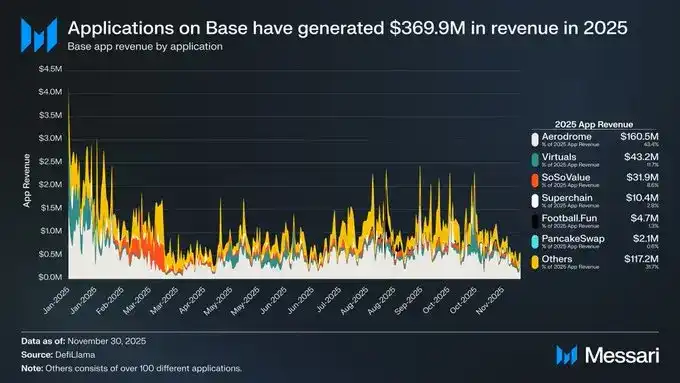
Base has also stood out for the ecosystem's application of scalable development and tangible value creation. This year, applications within the Base ecosystem have generated $369.9 million in revenue. Notably, application revenue is primarily concentrated in Aerodrome, which contributed $160.5 million, accounting for 43% of total application revenue. However, the top DEX on Base was not the only successful application in 2025.
The AI Agent Launch Platform Virtuals has achieved $43.2 million in revenue, accounting for 12% of the Base ecosystem's total revenue from applications; meanwhile, the recently launched sports prediction app Football.Fun has also generated $4.7 million in revenue. These data indicate that a diverse set of revenue-generating products has been established on Base across multiple sectors, and the ecosystem's vibrancy does not rely on a single application or use case.
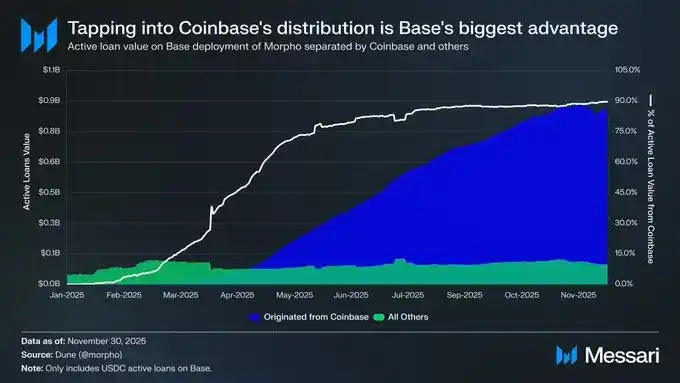
This distribution advantage was best exemplified in the Coinbase and Morpho collaboration case. This partnership allows Coinbase users to borrow USDC directly on the platform using cryptocurrency as collateral. While the user experience is embedded within the Coinbase website, collateral management and loan execution are carried out on-chain through Morpho deployed on Base. This lending product was launched less than a year ago, but its adoption rate has been quite high.
Coinbase users have borrowed $866.3 million through Morpho, currently representing 90% of active loans on Morpho on the Base network. Concurrently, Morpho's TVL on the Base chain has grown by 1906% over the year, surging from $48.2 million to $966.4 million. Base's distribution advantage means on-chain activity can serve as a byproduct for Coinbase's product usage. This user onboarding channel is not available to other L2 networks, leading them to rely mainly on incentive programs to attract liquidity and users to the DeFi ecosystem.

Although Base chain's DeFi TVL has continued to grow since 2025, and on-chain revenue remains stable, user on-chain behavior has started to shift. Based on daily filtered user statistics (referring to the number of unique addresses conducting at least two transactions in a specific contract in a day and spending more than 0.0001 gas), USDC has now become the most widely used application on the Base chain, with an average of 83,400 daily users in November, a 233% year-on-year increase from 25,100 users in the same period last year.
Meanwhile, retail and DEX interaction has significantly decreased. The daily filtered user count for Uniswap and Aerodrome has dropped by 74% and 49%, respectively. However, it is more noteworthy that DEX trading volume on the Base chain hit a record high in 2025, indicating that activity on Uniswap and Aerodrome is increasingly concentrated among traders with larger fund sizes and higher transaction volumes.
Base 2026 Key Initiative: Base App
Leveraging Coinbase's natural advantage, Base enjoys a luxury condition that other chains find hard to reach. It has established a solid moat in terms of user base, liquidity, and application ecosystem. Base leads in revenue on the L2 network, has the deepest DeFi TVL in the field, and continues to receive on-chain user traffic from Coinbase. In other words, unlike most L2 networks still struggling to establish themselves or attract users, Base has long surpassed this stage of development.
With this moat, Base's focus has shifted beyond core L2 network metrics to the creator economy sector. If this market opportunity is seized, the potential total market size is estimated to be close to $5 trillion. To seize this market direction, Base's core strategy is focused on the Base App. This "super app" aims to integrate asset custody, trading, social, and wallet core functions into one. Unlike most crypto wallets, the Base App features several innovative functions beyond basic asset management:
· Social feed based on Farcaster and Zora;
· Direct messaging and group chat functionality through XMTP (supporting interaction with other users and AI agents like Bankr);
· Built-in mini-app discovery feature, allowing users to directly access and use various mini-apps within the Base App.

The Base App launched an internal beta in July, initially only available to users invited through a whitelist. Nevertheless, the Base App has shown significant growth. A total of 148,400 users have created accounts, with accelerated registrations in November, seeing a 93% increase month-over-month. User retention is also strong, with 6,300 weekly active users (a 74% increase) and 10,500 monthly active users (a 7% increase). Although not explicitly confirmed, the Base App is likely to conclude its internal testing phase this month, paving the way for a full public launch before the new year.

The most critical goal of the on-chain economy Base is trying to build is to enable creators to directly profit from their created content. Content created in the Base App is tokenized by default (although users can opt out of this feature), turning each post into a tradable market. Creators can earn a share of the transaction fees generated by the content, specifically 1% of each transaction.
In the future, users will also be able to mint creator tokens for their accounts directly within the Base App, opening up another monetization avenue (this feature is currently in early testing). At a technical level, both creator tokens and content tokens are tokenized based on the Zora protocol. As of now, creators have cumulatively earned $6.1 million through Zora's tokenization model, with an average monthly payout of $1.1 million since July.
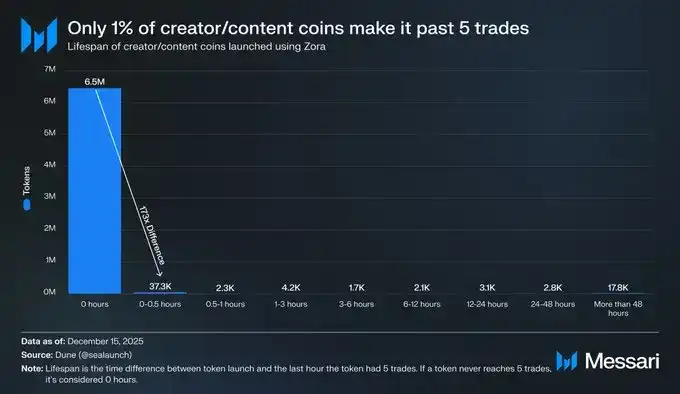
As of now, the total number of creators and content tokens tokenized through Zora has exceeded 6.52 million. Among them, 6.45 million (about 99% of the total) have failed to achieve five transactions. Only 17.8 thousand tokens (0.3% of the total) remain transactional after 48 hours of issuance.
Before interpreting this data, one must understand a fundamental fact: the vast majority of content published on the Internet is inherently worthless. From this perspective, the fact that 99% of tokens have not garnered market attention may simply reflect the natural distribution of online content, rather than a structural flaw in the Base model. What truly matters are the tokens that survive beyond 48 hours. We believe that a creator or content token being able to continue trading after 48 hours of issuance signals the genuine value of the creator or content itself.
In other words, Base has so far made little impact on the creator economy. Only 17.8 thousand creator and content tokens show ongoing activity, which is a mere drop in the ocean compared to the vast daily output of online content. Pessimists may deem this model unviable, but optimists believe that while Base has essentially achieved near-zero penetration in the creator economy, there is significant room for growth through optimizations in content distribution, content discovery, and functional tools. In any case, increasing the number of tokens that can survive beyond 48 hours should be a key focus for Base in 2026.
Lastly, Base may possess the most effective incentive mechanism in the crypto market: tokens. In September of this year, Base confirmed that it is exploring token issuance but has not yet disclosed specific details regarding allocation, utility, or potential launch dates. The most notable aspect of the Base token is not the token itself but its use cases. Unlike most L2s, Base does not rely on tokens to attract liquidity. Instead, it can use tokens to incentivize on-chain creator participation, rewarding behaviors that drive user engagement, content creation, and social activities rather than short-term trading.
In conclusion, leveraging its established L2 core ecosystem, Base is advancing through distribution channels, product coverage, and potential token incentives, exploring consumer and creator-oriented use cases. If this strategy succeeds, Base will establish a moat around the social and creator ecosystem. This moat exhibits higher user stickiness compared to DeFi TVL and stablecoin balances, areas where other L2 solutions have not yet ventured.
You may also like

March 4th Market Key Intelligence, How Much Did You Miss?

Taking Stock of Crypto's Washington Power Players: Who is Advocating for US Crypto Regulation?

DDC Enterprise Limited Announces 2025 Unaudited Preliminary Financial Performance: Record Revenue Achieved, Bitcoin Treasury Grows to 2183 Coins
On March 4, 2026, DDC Enterprise Limited (NYSE American: DDC) today announced preliminary, unaudited full-year financial performance for the year ended December 31, 2025. The company expects to achieve record revenue and record positive adjusted EBITDA, primarily driven by continued growth in its core consumer food business and overall margin improvement. The final audited financial report is expected to be released in mid-April 2026.
Revenue: Expected to be between $39 million and $41 million, reaching a new company high.
Organic Growth: Excluding the impact of the company's strategic contraction of its U.S. operations, core revenue is expected to grow 11% to 17% year over year.
Gross Profit Margin: Expected to be between 28% and 30%, reflecting continued operational efficiency improvements.
Adjusted EBITDA: The company expects to achieve a positive full-year result in 2025, a significant improvement from a $3.5 million loss in 2024, mainly due to rigorous cost controls and a higher-margin sales mix.
In 2025, DDC's core consumer food business maintained strong operational performance.
The company also disclosed Core Consumer Food Business Adjusted EBITDA, a metric that further excludes costs related to its Bitcoin reserve strategy and non-cash fair value adjustments related to its Bitcoin holdings from adjusted EBITDA to more accurately reflect the core business performance.
In 2025, Core Consumer Food Business Adjusted EBITDA is expected to be between $5.5 million and $6 million.
In the first half of 2025, DDC initiated a long-term Bitcoin accumulation strategy, holding Bitcoin as its primary reserve asset.
As of December 31, 2025: The company holds 1,183 BTC.
As of February 28, 2026: Holdings increased to 2,118 BTC
Today's additional purchase of 65 BTC brings the company's total holdings to 2,183 BTC
DDC Founder, Chairman, and CEO Norma Chu stated, "We are proud to have closed 2025 with record revenue and positive adjusted EBITDA, demonstrating the steady growth of the company's consumer food business and the ongoing improvement in profitability. We are building a disciplined, growth-oriented food platform and strategically allocating capital to Bitcoin assets with a long-term view, aligning with our core beliefs. We believe that this dual-track model of 'Steady Consumer Business + Strategic Bitcoin Reserve' will help DDC create lasting long-term value for shareholders."
For the full year 2025, the company defines "Adjusted EBITDA" (a non-GAAP financial measure) as: Net income / (loss) excluding the following items:· Interest expense· Taxes· Foreign exchange gains/losses· Long-lived asset impairment· Depreciation and amortization· Non-cash fair value changes related to financial instruments (including Bitcoin holdings)· Stock-based compensation
DDC Enterprise Limited (NYSE: DDC) is actively implementing its corporate Bitcoin Treasury strategy while continuing to strengthen its position as a leading global Asian food platform.
The company has established Bitcoin as a core reserve asset and is executing a prudent, long-oriented accumulation strategy. While expanding its portfolio of food brands, DDC is gradually becoming one of the public company pioneers in integrating Bitcoin into its corporate financial architecture.

Uncovering YZi Labs 229 Investment: Over 18% of the portfolio is already inactive, with an average project transparency score of 78

The business of crypto VC is becoming promising

China's AI Compute Power Counterstrike

Global Assets Plunge: Hormuz, Chips, and a South Korean Holiday

Bloomberg has reported twice, Hyperliquid once again in Wall Street's radar

Trump Backs Crypto Bill, SEC Halts Leveraged ETF, What Is the English-Speaking Crypto Community Talking About?

OpenClaw Floods Into Polymarket, Some Making Tens of Thousands Per Month
Understanding Trump's "Warfare Playbook": Ten Signals Investors Must Know

Iranian Missile Heading Toward UAE, Claude Also Within Range
Successive Core Team "Heroes" Depart, Has Aave's DAO Dream Crumbled?

Is This the Year of the Robot? A Deep Dive into Robotics Projects
When AI Takes Over Money: Bitcoin Becomes the "First Choice," Fiat Is Left Out

AI Trading in Live Markets: 4 Lessons From a WEEX Hackathon Top 10 Finalist
AI trading meets real markets. Explore 4 lessons from a WEEX Hackathon Top 10 finalist on surviving volatility, trusting AI models, and building smarter crypto trading systems.

MegaETH Co-founder: 48 Hours After Leaving Dubai, I Reassessed the Entire Crypto Space

Web3 Winter Mass Exodus: Resignations, Closures, Transformations, and Acquisitions
March 4th Market Key Intelligence, How Much Did You Miss?
Taking Stock of Crypto's Washington Power Players: Who is Advocating for US Crypto Regulation?
DDC Enterprise Limited Announces 2025 Unaudited Preliminary Financial Performance: Record Revenue Achieved, Bitcoin Treasury Grows to 2183 Coins
On March 4, 2026, DDC Enterprise Limited (NYSE American: DDC) today announced preliminary, unaudited full-year financial performance for the year ended December 31, 2025. The company expects to achieve record revenue and record positive adjusted EBITDA, primarily driven by continued growth in its core consumer food business and overall margin improvement. The final audited financial report is expected to be released in mid-April 2026.
Revenue: Expected to be between $39 million and $41 million, reaching a new company high.
Organic Growth: Excluding the impact of the company's strategic contraction of its U.S. operations, core revenue is expected to grow 11% to 17% year over year.
Gross Profit Margin: Expected to be between 28% and 30%, reflecting continued operational efficiency improvements.
Adjusted EBITDA: The company expects to achieve a positive full-year result in 2025, a significant improvement from a $3.5 million loss in 2024, mainly due to rigorous cost controls and a higher-margin sales mix.
In 2025, DDC's core consumer food business maintained strong operational performance.
The company also disclosed Core Consumer Food Business Adjusted EBITDA, a metric that further excludes costs related to its Bitcoin reserve strategy and non-cash fair value adjustments related to its Bitcoin holdings from adjusted EBITDA to more accurately reflect the core business performance.
In 2025, Core Consumer Food Business Adjusted EBITDA is expected to be between $5.5 million and $6 million.
In the first half of 2025, DDC initiated a long-term Bitcoin accumulation strategy, holding Bitcoin as its primary reserve asset.
As of December 31, 2025: The company holds 1,183 BTC.
As of February 28, 2026: Holdings increased to 2,118 BTC
Today's additional purchase of 65 BTC brings the company's total holdings to 2,183 BTC
DDC Founder, Chairman, and CEO Norma Chu stated, "We are proud to have closed 2025 with record revenue and positive adjusted EBITDA, demonstrating the steady growth of the company's consumer food business and the ongoing improvement in profitability. We are building a disciplined, growth-oriented food platform and strategically allocating capital to Bitcoin assets with a long-term view, aligning with our core beliefs. We believe that this dual-track model of 'Steady Consumer Business + Strategic Bitcoin Reserve' will help DDC create lasting long-term value for shareholders."
For the full year 2025, the company defines "Adjusted EBITDA" (a non-GAAP financial measure) as: Net income / (loss) excluding the following items:· Interest expense· Taxes· Foreign exchange gains/losses· Long-lived asset impairment· Depreciation and amortization· Non-cash fair value changes related to financial instruments (including Bitcoin holdings)· Stock-based compensation
DDC Enterprise Limited (NYSE: DDC) is actively implementing its corporate Bitcoin Treasury strategy while continuing to strengthen its position as a leading global Asian food platform.
The company has established Bitcoin as a core reserve asset and is executing a prudent, long-oriented accumulation strategy. While expanding its portfolio of food brands, DDC is gradually becoming one of the public company pioneers in integrating Bitcoin into its corporate financial architecture.


 App
App