

Bitcoin Network Hash Rate Hits Record High, Drops 15% - Have Miners Been Sniped by AI?

Original Article Title: "Bitcoin Network Hash Rate Drops From Peak by 15%, Have Miners Been Poached by AI?"
Original Article Author: ChandlerZ, Foresight News
The Bitcoin hash rate has grown approximately 10 times since 2020, but has seen a more pronounced decline in recent months.
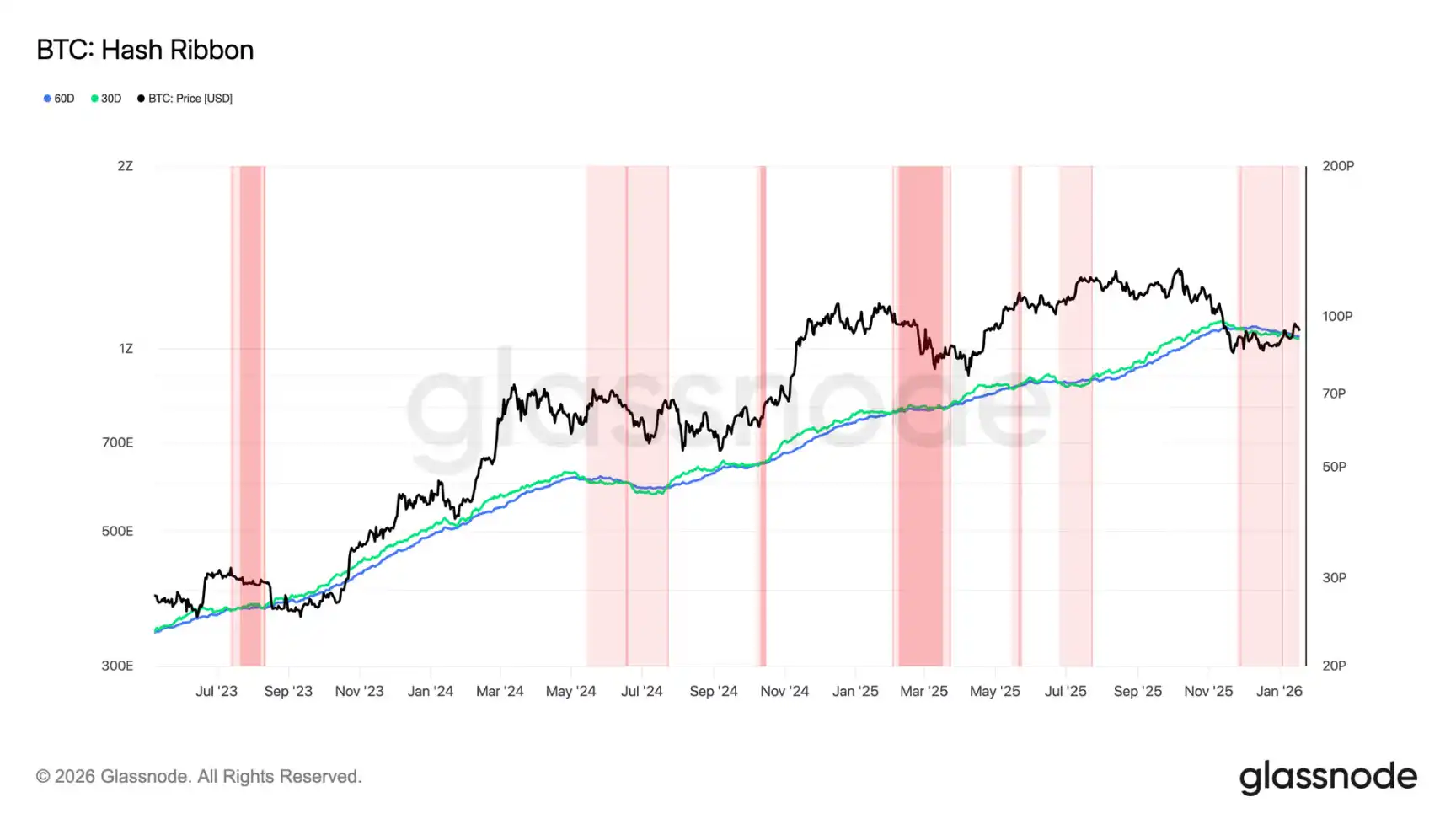
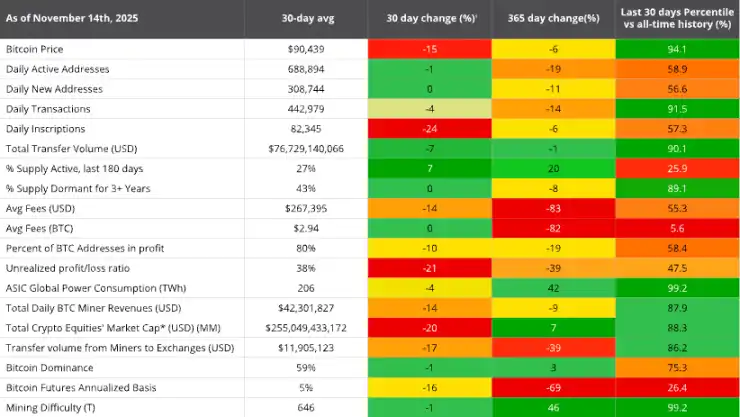
Data shows that the Bitcoin network's hash rate has dropped by around 15% from its October peak, with miners surrendering for nearly 60 days. The network's average hash rate has decreased from around 1.1 ZH/s in October to around 977 EH/s, indicating that miners are shutting down machines or surrendering as profitability declines.
Furthermore, Glassnode's Hash Ribbon indicator reversed on November 29, reflecting miners' surrender by tracking short-term and long-term hash rate trends. Currently, short-term supply pressure in the Bitcoin market may increase further, and the Bitcoin mining difficulty is expected to see its seventh downward adjustment out of the past eight on January 22, dropping to around 139 T.
Mining Profitability Sees Five-Month Continuous Decline
JPMorgan Chase stated that the Bitcoin network's hash rate decreased by about 3% month-over-month to 1045 EH/s in December 2025, easing miner competition, but mining profitability continues to decline.
However, data shows that in December 2025, miners' average daily block reward income per EH/s was $38,700, a 7% decrease from November and a 32% year-over-year decrease, hitting a historical low.
A report analysis by VanEck suggests that the Bitcoin mining industry is facing significant pressure. On one hand, the periodic halving of block rewards causes miners' income to decrease "step-wise"; on the other hand, since 2020, the network's hash rate has expanded at a compound growth rate of about 62%, forcing miners to continuously invest in CAPEX to increase hash rate to avoid obsolescence. If the coin price fails to hedge against the decline in subsidies and the unit cost increase brought by hash rate growth, miner profits will be systematically compressed.
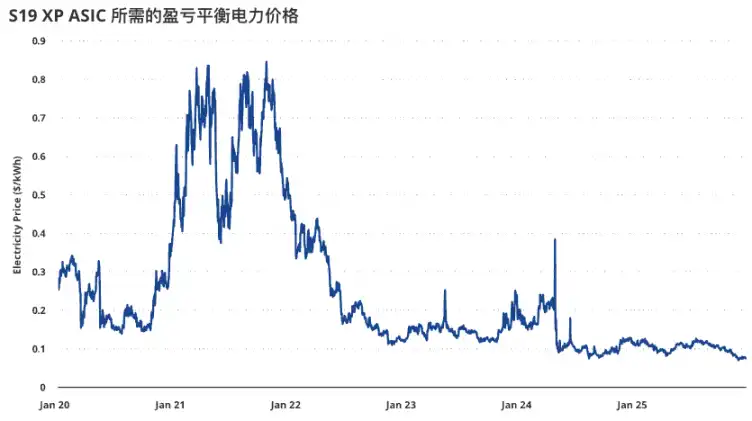
The deterioration of miner profitability can be seen intuitively from the electricity price breakeven point. Taking the 2022 generation mining machine S19 XP as an example, its tolerable breakeven electricity price has decreased from around $0.12 per kWh in December 2024 to around $0.077 per kWh in December 2025. This means that against the backdrop of a recent weakening BTC price, mining marginal economics have significantly worsened, further increasing the industry's reliance on low electricity price resources, economies of scale, and operational efficiency.
Despite the approximately 10x increase in total network hash rate since 2020, the past 30 days have seen a 4% decline in network hash rate based on a 30-day moving average, marking the largest drop since April 2024. Simultaneously, supply-side disruptions have also impacted the hash rate, such as mining facilities in the Xinjiang region shutting down approximately 1.3GW of capacity under regulatory review, with an estimated 400,000 miners turned off.
Mining Farms Actively Transitioning to AI Data Centers
A report from Guojin Securities indicates that by the third quarter of 2025, the depreciation-adjusted mining cost for publicly listed U.S. companies has risen to $112,000, exceeding the current Bitcoin price. Cryptocurrency mining companies possess powered and high-bandwidth hash rate infrastructure near major urban centers, with electricity costs generally ranging from 3 to 5 cents per kWh, making them naturally suited for AI cloud service operations. With the increasing demand for AI computing power, the transition of cryptocurrency mining farms to AI data centers is an inevitable choice.
The 14 major publicly traded mining farm companies are expected to reach a power capacity of 15.6GW by 2027, with the primary transformed business models being cloud computing leasing and IDC power leasing.
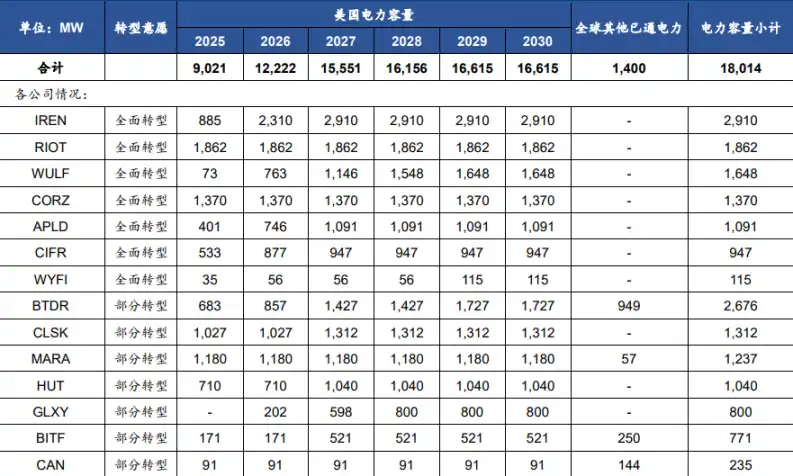
Cryptocurrency mining farms transitioning to AI data centers mainly have two business models.
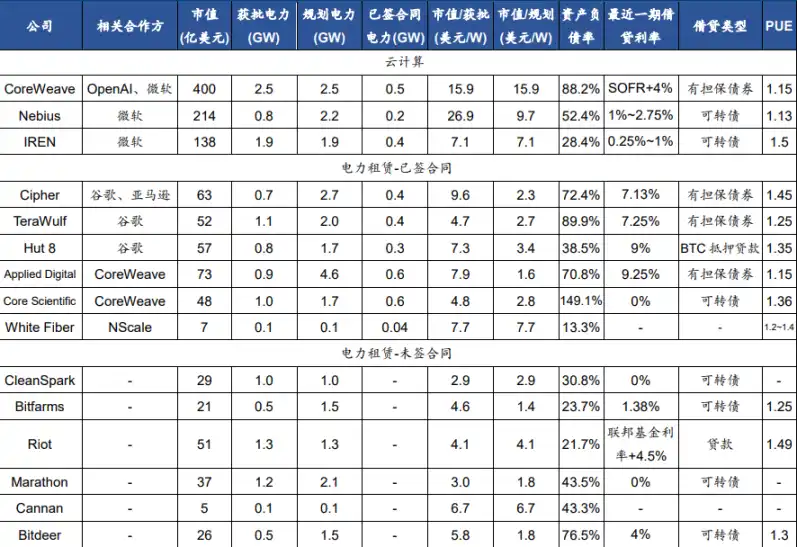
One is similar to CoreWeave and Nebius, purchasing chips for cloud computing leasing. Currently, IREN adopts this business model. IREN has an electricity gross capacity of 2.91GW, corresponding to approximately 1.9GW of core capacity, with a market value per watt lower than CoreWeave and Nebius. It has already partnered with Microsoft for a 200MW core capacity.
The second model is similar to IDC power leasing, only leasing the rights to use data center buildings and power capacity, with tenants paying for servers and electricity. Currently, most cryptocurrency mining farms use this hosting model. Some companies have signed leasing contracts with Google, Amazon, CoreWeave, and other firms, while the majority are still seeking partners due to their late transition.
VanEck: Hash Rate Decline Could Actually Be a Positive
However, the VanEck report also suggests that a hash rate decline could actually be a positive factor. By comparing the 30-day and expected 90-day returns since 2014 based on Bitcoin's hash rate changes, when the Bitcoin hash rate drops, there is a higher likelihood of positive expected returns compared to when the hash rate rises. Moreover, the average expected return over 180 days is approximately 30 basis points higher when the hash rate declines versus when it increases.
When hash rate compression persists for a long time, forward-looking profitability often occurs more frequently and to a greater extent. Since 2014, out of the 346 days with negative 90-day hash rate growth, the probability of positive 180-day Bitcoin forward returns is 77%, with an average return of +72%. In addition, the probability of positive 180-day Bitcoin forward returns is around 61%, with an average return of +48%.
Therefore, buying BTC when the 90-day hash rate growth is negative has historically increased the expected return for 180 days by 2400 basis points.
Even in an economically weaker phase, many entities choose to continue mining. Short-term profit pressures and hash rate fluctuations are more likely to lead to industry consolidation and centralization, accelerating the cleansing of the industry, which does not necessarily imply the long-term decline of the mining industry.
You may also like

Full text of the Federal Reserve's decision: Holding steady for the third consecutive time but increasing divisions

Dan Bin takes action, building a position in Circle

The Impossible Triangle of DeFi Lending

Bitcoin ETF News: Why Bitcoin Is Falling Even After $2.43B ETF Inflows in April
Bitcoin ETF news today shows $2.43B in April inflows as institutions absorbed thousands of BTC, yet the price dropped from $79K to $76K. Traders are now watching whether the $80K resistance breaks or triggers another pullback.

What Is RWA in Crypto? Real-World Assets Explained (2026 Guide)
What Is RWA in Crypto?RWA stands for Real-World Assets — traditional financial assets like bonds, real estate, gold, and private credit that have been converted into blockchain tokens.

Revisiting RWA: Nearly 50,000 people's first on-chain transaction was not Bitcoin, but stock indices and crude oil

Altcoin Price Outlook 2026: The Rotation Is Coming — Just Not the Way You Think
Bitcoin dominance at 58%, Fear & Greed at 39. If you think altcoin season is dead, you're reading the wrong signals. Here's what the data actually says about what comes next.

Oracle: The Second Battlefield Behind the Prediction Market War

a16z's key bet: Kalshi's weekly trading volume approaches $3 billion, transitioning from "prediction games" to financial infrastructure, the market begins to price "uncertainty."

Morning Report | Galaxy Digital announces Q1 2026 financial report; Liquid completes $18 million Series A financing; Polymarket plans to bring major exchanges to the U.S

From a banned economist to the new CEO of Xinhua: Fu Peng has figured out the second half of traffic

Why Private Credit Became the First True Bridge from TradFi to DeFi

Senior cryptocurrency investor: Blockchain is showing a siphoning effect on capital

When traditional crypto derivatives start to subtract: Insights from Hyper Trade's products

My view on blockchain has changed

Will AI Agents use bank cards? Why can't Agentic Payment avoid stablecoins and blockchain?

Deconstructing 80 mainstream payment institutions and wallets worldwide
The MiCA Fast Track for Cryptocurrency Licenses: Why OKX and BVNK Choose Malta
Full text of the Federal Reserve's decision: Holding steady for the third consecutive time but increasing divisions
Dan Bin takes action, building a position in Circle
The Impossible Triangle of DeFi Lending
Bitcoin ETF News: Why Bitcoin Is Falling Even After $2.43B ETF Inflows in April
Bitcoin ETF news today shows $2.43B in April inflows as institutions absorbed thousands of BTC, yet the price dropped from $79K to $76K. Traders are now watching whether the $80K resistance breaks or triggers another pullback.
What Is RWA in Crypto? Real-World Assets Explained (2026 Guide)
What Is RWA in Crypto?RWA stands for Real-World Assets — traditional financial assets like bonds, real estate, gold, and private credit that have been converted into blockchain tokens.
Revisiting RWA: Nearly 50,000 people's first on-chain transaction was not Bitcoin, but stock indices and crude oil


