
 Buy Crypto
- Markets
 Futures
- Spot
- Copy Trade
- Earn
- More
Bitcoin's "Identity Crisis": Why It's Becoming Less Like a Safe Haven Asset?

Original Article Title: The Real Connection Between BTC and Software Stocks
Original Source: Machines & Money
Original Translation: AididiaoJP, Foresight News
Everyone Has Been Asking the Wrong Question
Since hitting a historical high of $126,000 on October 6, 2025, Bitcoin has now retraced 50%.
Gold, on the other hand, hit a new all-time high of $5,595 on January 29, 2026.
Since Bitcoin's peak, gold has risen over 25%, while Bitcoin's price has been cut in half.
The cryptocurrency market's "fear and greed index" dropped to an all-time low of 5 on February 6, a number more extreme than during the COVID-19 pandemic and the collapse of the FTX trading platform, only timidly rebounding to the teens later.
Commentators in the crypto space have once again reignited the age-old debate: Is Bitcoin truly digital gold?
However, this question itself is wrong as it assumes that Bitcoin's identity as an asset is fixed. In fact, under different macroeconomic conditions, Bitcoin's behavior has significantly changed multiple times. In 2017, it followed gold, in 2021, it followed tech stocks, and from late 2024 to now, it has been closely tied to software stocks.
For institutional investors, a more meaningful question is: What factors are actually driving Bitcoin's price in this current liquidity environment?
Based on evidence up to February 2026, the answer is: Bitcoin's current performance is like that of a high-volatility software stock. Whether this is a temporary phenomenon due to their sensitivity to the same macroeconomic factors, or if Bitcoin's role in portfolios has been permanently redefined, remains to be seen, but the data is becoming increasingly hard to ignore.
How Strong Is This Correlation? How Long Has It Lasted?
The relationship between Bitcoin and the IGV (an ETF tracking software stocks) has become increasingly tight over three different timeframes:
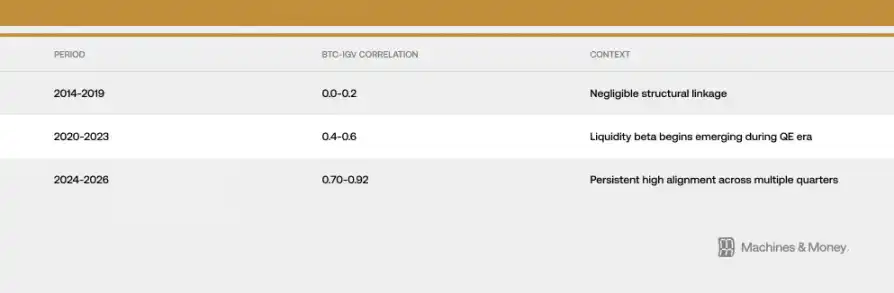
By late February 2026, their 30-day rolling correlation had reached around 0.73. More importantly, this high correlation above 0.5 has been sustained for over 18 months. This length of time, significantly longer than the typical 3-6 months of short-term style rotations, but not yet enough to prove a permanent shift across a full market cycle (4-7 years).
The recent downturn has made their relationship more pronounced. By late February 2026, IGV has already dropped by around 23% for the year, and Bitcoin has also seen a 19-20% drop. This software stock ETF, IGV, is facing its worst quarter since the 2008 financial crisis. Over the past month and three months, the movements of Bitcoin and IGV have been almost synchronous, meaning their price fluctuations have been very close. During the downturn, Bitcoin's volatility is around 1.1 to 1.3 times that of software stocks, lower than the 2 to 3 times many people thought.
One thing to note: During market turbulence, regardless of whether there is a substantive relationship between assets, short-term correlation may soar as everyone's risk appetite drops simultaneously. However, this high level of synchronization has persisted for over 18 months, indicating something more substantive behind it than random fluctuations. Nevertheless, this alone does not prove who is leading whom, nor does it prove that this relationship will continue indefinitely.
2025: A Major Test of the "Safe Haven Asset" Identity
If there is any year to test whether Bitcoin can indeed hedge against currency devaluation risk, it is 2025. That year saw accelerated fiscal expansion, a weakening dollar, escalating geopolitical risks, persistent inflation, and growing market expectations of a Fed rate cut.
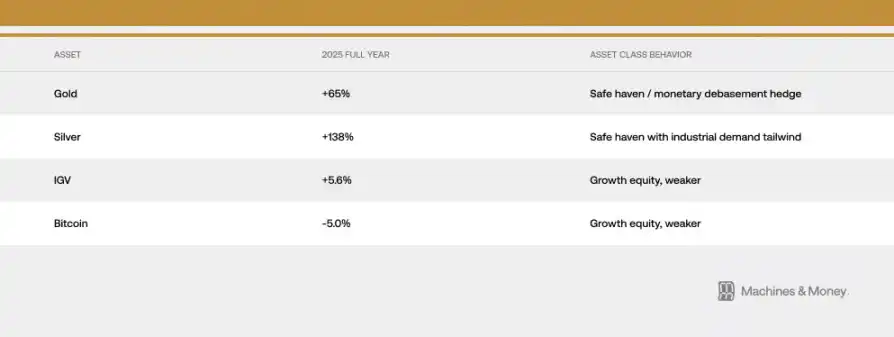
This should have been the ideal environment for Bitcoin to showcase its "digital gold" attributes. However, the events since October 2025 have provided a different answer: Gold hit a historical high of $5595 from $4400, while Bitcoin fell from over $126,000 to just over $60,000. These two things with the same "anti-inflation" function, in the most conducive environment for them to perform this function, moved in completely opposite directions. The result is what we see:
Gold hit a historical high of $5595 on January 29, 2026. Central banks globally bought 863 tons of gold in 2025, the third consecutive year of large purchases. However, not a single central bank bought Bitcoin.
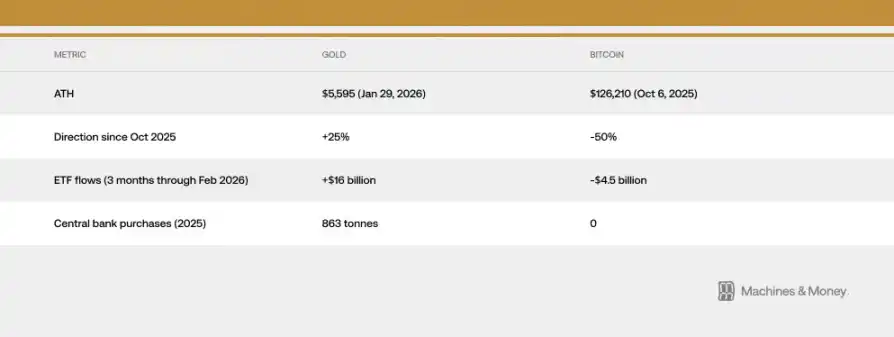
The significant difference in fund flows is the most powerful rebuttal to the "digital gold" thesis: when those large institutions and sovereign wealth funds truly need a safe haven to hedge against the kind of macro environment that Bitcoin should protect them from harm, they chose gold in a more than three-to-one ratio.
Of course, this is not to say that Bitcoin will never become a safe haven asset in the future. It's just that at the current point in time, based on the existing investor structure, market conditions, and liquidity environment, it cannot yet do so. In 2025, both Bitcoin and tech stocks delivered modest single-digit returns, while traditional hard assets performed remarkably well. In this major test, Bitcoin and tech growth stocks exhibited highly consistent behavior, providing one of the most compelling pieces of evidence for the "convergence of the two."
Why is this happening? Three structural reasons
Changes in how institutional funds operate
The emergence of Bitcoin ETFs fundamentally changed how it is traded at the institutional level.
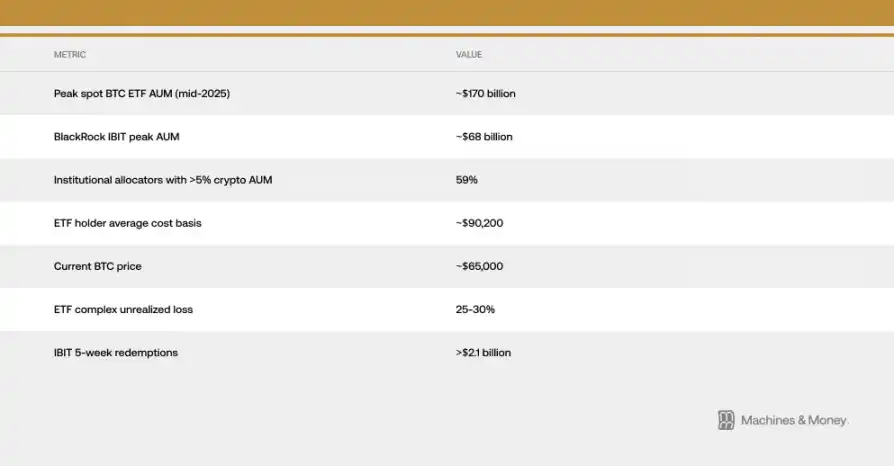
The result is that Bitcoin is now placed in the same investment decision framework as tech stocks. Risk management systems treat them equally, and when portfolio adjustments are needed, institutions buy and sell these two asset classes simultaneously, often benchmarking their performance against tech stocks. When a fund holding various assets feels that the risk of growth stocks is too high and needs to reduce its exposure, it will sell off both its software stocks and Bitcoin in the same transaction.
This sets up a self-reinforcing cycle: because institutions classify it as a tech stock, its fund flows are synchronized with those of tech stocks, which in turn reinforces the institutions' positioning of it as a tech stock. It is estimated that the average cost base for U.S. spot Bitcoin ETF holders is around $90,000, meaning that with the price now dropping to around $64,000, institutional funds in the entire ETF are facing unrealized losses of 25% to 30%. This cost gap is significant because it has transformed institutional funds that could have held for the long term into persistent selling pressure. Those who thought buying ETFs would diversify risk or hedge are now watching gold ETFs rise while their holdings are continuously losing value. Since early 2026, we have been able to see in real time the chain reaction of ETF redemptions followed by Bitcoin price drops, setting a record for the longest outflow of funds since the ETF's listing. Just one fund, BlackRock's IBIT, has seen outflows of over $2.1 billion in the past five weeks alone.
They're as Sensitive to the Macro Environment's "Pressure Points" as Ever
Bitcoin and software stocks are sensitive to the same macroeconomic information: changes in real interest rates, whether there is too much or too little money in the market (M2), whether the Fed is printing money or tapering, whether the dollar is strong or weak, and the overall market's risk appetite (which can be seen through the VIX panic index and credit spreads). They both belong to "long-duration" assets sensitive to interest rates. When real interest rates fall, they rise; when real interest rates rise, they fall. When there is a lot of money in the market, they both benefit; when money is tight, they both suffer.
A key question is: is Bitcoin closely related only to software stocks, or is it tightly linked to all growth assets sensitive to liquidity? Evidence supports the latter. The price movement of Bitcoin is not due to the profitability of software companies but rather because the same contractionary environment that devalues software stocks also siphons money out of speculative assets. This correlation reflects their common "sensitivity" to the macroeconomic environment, rather than suggesting they are fundamentally the same.
However, sometimes the transmission mechanism is directly surprising. In February 2026, two AI products completely unrelated to Bitcoin were released, yet both affected Bitcoin's price. How did they affect it? Through the "institutional channel" mentioned above. This is the manifestation of correlation in reality.
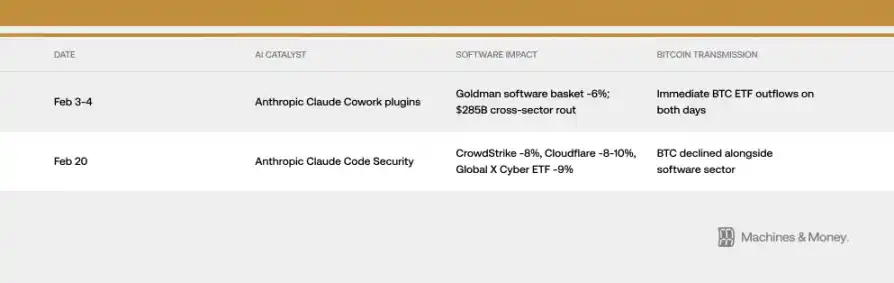
The VIX panic index can also shed light on the issue. When the VIX soars due to inflation data, both Bitcoin and software stocks fall. But when the VIX drops from a low point, neither of them benefits much. This aligns perfectly with the characteristics of high-volatility growth stocks rather than safe-haven assets.
Understanding this difference is crucial. If the correlation is only because they are sensitive to the same macro factors, then once the macro environment changes, even if Bitcoin itself is stable, it may part ways with software stocks. There have been precedents: Bitcoin was synchronized with gold in 2017 and with tech stocks in 2021, both of which ended as the macro environment changed.
MicroStrategy's "Amplifier" Effect
MicroStrategy (formerly known as Strategy) is the world's largest publicly traded company holding Bitcoin, and on the Nasdaq trading platform, it is classified as a software/technology company. This has created a direct, mechanistic link that ties the performance of the software sector to the "popularity" of Bitcoin.
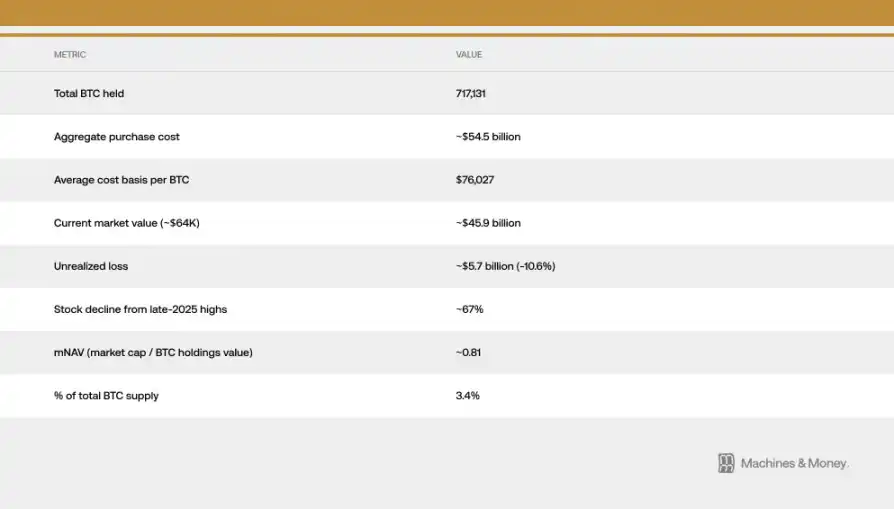
This loop is bidirectional. If Strategy's stock price falters, the software sector will suffer. As Strategy's price drops, it exacerbates bearish sentiment around Bitcoin in the market, potentially leading to actual selling pressure. During market downturns, this loop tightens the relationship between Bitcoin and the software index. Strategy's stock has plunged about 67% from its late 2025 peak, a far greater decline than software stock ETFs or Bitcoin itself. Currently, the company's market cap is even lower than the value of the Bitcoin it holds, essentially trading at a discount. This illustrates that beyond the correlation between Bitcoin and software stocks, there is an additional layer of the company's self-imposed amplification effect.
In January 2026, the MSCI Index company considered excluding companies holding more than half of their assets in digital assets from certain indices. If implemented, this could trigger significant forced selling. This event highlights how companies like Strategy, holding substantial Bitcoin, are highly susceptible to traditional financial regulations. While MSCI ultimately did not take this step, they indicated it might be revisited in the future, keeping this risk alive.
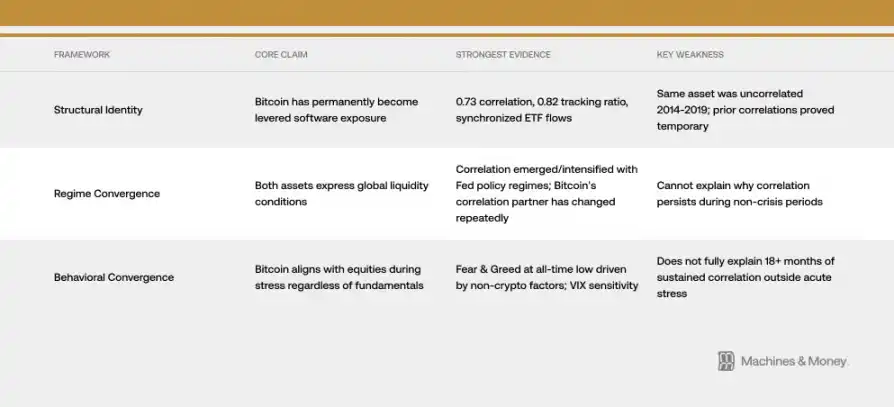
What does the future hold? Three possible frameworks
Framework One: Bitcoin has become leveraged software stock (identity has shifted)
This view suggests that Bitcoin has been permanently redefined. Evidence includes the aforementioned: a correlation as high as 0.73 with software stocks, nearly synchronous price movements, synchronized ETF flows, and shared institutional investors. In this framework, the ETF era has integrated Bitcoin into tech stock portfolios, permanently altering its risk profile. This correlation is expected to persist regardless of market cycles.
The issue with this view is that history does not support it. Bitcoin itself hasn't changed, but from 2014 to 2019, its correlation with software stocks was nearly zero. Previously, it has shown high correlations with other assets temporarily (such as alternative coins in 2017-2018, Nasdaq in 2021-2022), only to prove fleeting. To prove its permanence, it would need to withstand at least one full interest rate cycle, which has not yet occurred.
Framework Two: They are simply expressions of "market got money" (cyclical convergence)
This explanation is simpler. Bitcoin and software stocks are both "long duration" assets sensitive to liquidity, happenstance aligning them in the current "market lacks money" environment, displaying strong synchronicity. This synchrony began in 2020 during massive liquidity injections, intensified as liquidity began to tighten in 2022, and has persisted into the current state of liquidity stress.
According to this framework, once we enter the next easing cycle (Fed starts easing again), this synchronicity could be broken. Historically, when the Fed shifts its policy, Bitcoin tends to start its bull run one to two months ahead of software stocks. In addition, Bitcoin itself experiences a supply change due to its "halving" event (historical data shows a bull run usually occurs 12-18 months post-halving), which could potentially lead it to diverge from software stocks by the end of 2026.
Framework Three: When the market panics, Bitcoin correlates with stocks (behavioral convergence)
Bitcoin is fundamentally a highly volatile risky asset; during market downturns driven by fear, regardless of its inherent nature, it tends to move in tandem with stocks. At such times, the dominant sentiment is between "flight to safety" or "risk-on." When the VIX fear index spikes, both Bitcoin and stocks drop together. Sometimes, overarching narratives (like concerns about AI disruption devaluing many tech companies) also impact software valuations and overall market risk appetite, further aligning them. On February 6th this year, the cryptocurrency fear and greed index hit an all-time low, not due to any specific issue within the crypto space, but because all growth assets were being sold off, driven by macro and tech sector concerns. Bitcoin's most bearish sentiment historically has been caused by the same reasons as software stocks.
Current evidence strongly supports "Framework Two" (cyclical convergence), but the mechanisms mentioned in "Framework One" (especially how institutional funds operate) are indeed prolonging this convergence in the current environment.
What Lies Ahead? Several Possible Scenarios
Truth be told, we cannot definitively say which scenario will unfold. However, we can consider various possibilities, observe future signals, and eliminate certain options accordingly.
· Scenario One: Continued correlation (this is the baseline). If market liquidity remains tight in 2026, Bitcoin will continue to behave like a high-volatility growth stock, maintaining a high correlation of 0.5 to 0.8 with software stocks ETF. The question of what it truly is still remains unanswered. As long as there are no major changes in Fed policy, institutional positions, or Bitcoin itself, this is the most likely outcome.
· Scenario Two: Divergence. If the Fed starts easing again, coupled with the post-2024 "halving" effects and reduced concerns about AI disruption, Bitcoin might significantly outperform software stocks in the second half of 2026. Their correlation could decrease to 0.3 to 0.5. If this scenario unfolds, it would confirm that "Framework Two" (cyclical convergence) is correct, suggesting that the current synchronicity is only temporary.
· Scenario Three: Permanent Convergence. If their correlation further rises to 0.8 or above, and spans a full dovish cycle where even major index companies formally reclassify it as a tech sector, then Bitcoin's identity has indeed permanently shifted.
The key litmus test is straightforward. If the correlation breaks when the Fed starts cutting rates and easing, it's cyclical convergence. If they remain tightly intertwined post-easing, then "identity has shifted" becomes the primary explanation.
The answer to this question is truly open until the next dovish cycle in 2026-2027.
Conclusion
Bitcoin's identity has never been static. It has always been what mainstream buyers in the market perceive it to be. And now, those mainstream buyers are institutional investors treating it as a growth stock. This could change in the future, but the fundamental aspects of Bitcoin itself have not changed. The market prices the asset based on who holds it, why they hold it, not what it was originally designed for. Until the next significant shift in market conditions, this synchrony is the reality. And for anyone looking to understand what role Bitcoin can play in their portfolio at this moment in time, reality is everything.
You may also like

Michael Saylor: Winter is Over – Is He Right? 5 Key Data Points (2026)
Michael Saylor tweeted yesterday “Winter‘s Over.” It is short. It is bold. And it has the crypto world talking.
But is he right? Or is this just another CEO pumping his bags?
Let us look at the data. Let us be neutral. Let us see if the ice has really melted.

WEEX Bubbles App Now Live Visualizes the Crypto Market at a Glance
WEEX Bubbles is a standalone app designed to help users quickly understand complex crypto market movements through an intuitive bubble visualization.

Polygon co-founder Sandeep: Writing after the chain bridge chain explosion

Major Upgrade on Web: 10+ Advanced Chart Styles for Deeper Market Insights
To deliver more powerful and professional analysis tools, WEEX has rolled out a major upgrade to its web trading charts—now supporting up to 14 advanced chart styles.

Morning Report | Aethir secures a $260 million enterprise contract with Axe Compute; New Fire Technology acquires Avenir Group's trading team; Polymarket's trading volume surpassed by Kalshi

Why a Million-Follower Crypto KOL Chooses WEEX VIP?
Discover why top crypto KOL Carl Moon partnered with WEEX. Explore the WEEX VIP ecosystem, 1,000 BTC protection fund, and exclusive rewards for serious traders.

CoinEx Founder: The Crypto Endgame in My Eyes

Spark Coin (SPK): Explodes 73% as Aave Bleeds $15B, A Good Investment Now?
Spark coin (SPK) surged 73% as $15 billion fled Aave after the KelpDAO hack. This article explains what Spark is, why it’s pumping, and whether it is a good investment right now.

As Aave's building collapses, Spark's high-rise is rising

RootData: Q1 2026 Cryptocurrency Exchange Transparency Research Report

What Is Memecoin Trading? A Beginner's Guide to How It Works, the Risks, and 2026's Hottest Tokens
Memecoins surged 30%+ at the start of 2026 while Bitcoin was flat. RAVE spiked 4,500% then crashed 90% in days. MAGA jumped 350% overnight. This guide explains exactly how memecoin trading works — and how to not blow up your account doing it.

Trump Extends Ceasefire: Bitcoin Hits $79K — What Crypto Traders Need to Know Right Now
Bitcoin surged past $79,000 after Trump extended the ceasefire indefinitely. We break down exactly what happened, how every major crypto reacted, and what traders should watch next — including the one level that could unlock an $85,000 BTC rally.

CHIP Crypto Price Prediction 2026: Can USD.AI's GPU Lending Token Reach $1?
CHIP's 24-hour trading volume hit $1.87 billion on a $236 million market cap — an 8x ratio that almost never happens on legitimate tokens. We explain what's driving it, what USD.AI actually does for GPU tokenization, and whether CHIP belongs in your AI crypto portfolio.
RootData: Q1 2026 Web3 Industry Investment Research Report

USDC is the only AI token

The voice of a senior Polymarket user: In fact, we have already been surpassed by our competitors

Transcript of Dr. Han, founder of Gate, speaking at the University of Hong Kong: Breaking the Matthew Effect and Winning in Asymmetric Competition

Who will replace AAVE as the new king?
Michael Saylor: Winter is Over – Is He Right? 5 Key Data Points (2026)
Michael Saylor tweeted yesterday “Winter‘s Over.” It is short. It is bold. And it has the crypto world talking.
But is he right? Or is this just another CEO pumping his bags?
Let us look at the data. Let us be neutral. Let us see if the ice has really melted.
WEEX Bubbles App Now Live Visualizes the Crypto Market at a Glance
WEEX Bubbles is a standalone app designed to help users quickly understand complex crypto market movements through an intuitive bubble visualization.
Polygon co-founder Sandeep: Writing after the chain bridge chain explosion
Major Upgrade on Web: 10+ Advanced Chart Styles for Deeper Market Insights
To deliver more powerful and professional analysis tools, WEEX has rolled out a major upgrade to its web trading charts—now supporting up to 14 advanced chart styles.
Morning Report | Aethir secures a $260 million enterprise contract with Axe Compute; New Fire Technology acquires Avenir Group's trading team; Polymarket's trading volume surpassed by Kalshi
Why a Million-Follower Crypto KOL Chooses WEEX VIP?
Discover why top crypto KOL Carl Moon partnered with WEEX. Explore the WEEX VIP ecosystem, 1,000 BTC protection fund, and exclusive rewards for serious traders.


 App
App