
Bloomberg: How Did a16z Become a Key Player in US AI Policy?

Original Title: "Andreessen Horowitz’s Rising Influence Over Trump-Era AI Policy"
Original Authors: Emily Birnbaum, Oma Seddiq, Bloomberg
Original Translation: Saoirse, Foresight News
One of Silicon Valley’s most prestigious venture capital firms has become a behind-the-scenes force shaping Washington's artificial intelligence policy. As Donald Trump has thrown his full support behind the industry's advancement in this emerging tech field, the firm's influence has become increasingly crucial.
According to current and former White House and congressional aides, senior White House officials and top Republican aides in Congress now often make their first call for advice on potential actions that could impact tech companies' AI plans to a16z.
Their main point of contact is the company's chief lobbyist in the capital, Collin McCune. A former White House official said that this firm, commonly known as a16z, has nearly veto power over all proposals related to AI.
"They are an absolutely powerful lobbying force, perhaps the most influential single entity I've seen in recent years," said Doug Calidas, chief lobbyist for Americans for Responsible Innovation. The organization opposes a16z's attempts to weaken AI-related laws in various states.
The firm's rise in Washington has been aided by substantial influence spending, co-founder Marc Andreessen's close ties to Trump, and a network of partners who once worked at the firm and now hold key government positions. In addition, it has cleverly packaged its portfolio of invested startups as examples of free-market innovation championed by Washington's Republican leadership.
a16z's bold and aggressive approach to deregulation has strengthened the government's view: that most regulatory constraints imposed on AI by the government would jeopardize America's competitiveness in this rapidly evolving tech field, which has been a key driver of recent US economic growth. The firm has also been a key player in the Trump administration's efforts to block states from implementing AI regulations.

Marc Andreessen and his wife, prominent American philanthropist Laura Arrillaga-Andreessen, photographed in April. Photographer: Craig T Fruchtman/ Getty Images
White House spokesperson Kush Desai stated in a release that Trump and his advisors are 「always willing to listen to the views of business and technology leaders」 but that 「the only special interest guiding decisions made by this administration is the best interest of the American people; the only veto power over government policy lies with President Trump」.
Collin McCune also noted in the release that Trump is 「the only one setting AI policy in this administration」.
As of January, assets managed by a16z reached $900 billion, making it the largest VC firm in Silicon Valley in terms of asset size (note: referring specifically to pure VC business here). The company recently completed its largest-ever fundraising round, raising $150 billion and investing billions in emerging AI companies like Cursor and LM Arena. These companies, along with a16z's holdings in major tech companies like OpenAI and Meta, will benefit from its advocacy for lax regulatory policies in Washington.
This firm stance by the industry giant has made compromise on AI-related legislation more challenging and has at times frustrated lobbyists from large tech companies who are also allies in Washington policymaking. Insider sources revealed that despite overtures from tech behemoths like Microsoft and Amazon to lawmakers to compromise on federal AI standards, a16z outright rejects proposals that would entail significant new regulations on AI development.
a16z’s Chief Legal and Policy Officer Jai Ramaswamy stated: 「The end result is big companies starting to make trade-offs.」 Large corporations can tap into legal and compliance budgets while 「a small company started by a few people in a garage simply doesn't have the ability to make these compromises」.
A substantial number of AI skeptics believe this technology could harm users, perpetuate biases against marginalized groups, and displace jobs in various industries, therefore warranting regulation. Some AI developers even argue that without constraints, AI could bring about doomsday.
Last December, there was an attempt to use a must-pass defense bill to block states from enacting AI safety-related laws, showcasing a typical display of a16z's influence. Just a few months ago, tech industry allies in Congress sought to include similar provisions in Trump's signature tax legislation, only to be thwarted by a coalition of GOP governors, MAGA influencers, and child safety organizations.
According to a senior GOP aide, when weighing actions related to the defense bill, a16z's lobbyist Collin McCune was the first person outside of government to be called. Collin McCune provided explicit support and sprang into action immediately, assisting in coordinating efforts with White House AI lead David Sacks, House Majority Leader Steve Scalise, and Senate Commerce Committee Chair Ted Cruz.
This legislative maneuver failed, but Trump later used presidential power to achieve the same goal: signing executive orders to prevent states from implementing regulatory rules to prevent harms related to artificial intelligence. According to a source close to the White House, a16z also assisted the government in drafting the content of this directive. The executive order echoed a novel argument advocated by a16z: based on the Constitution's "Dormant Commerce Clause," states have no authority to regulate the national artificial intelligence market.
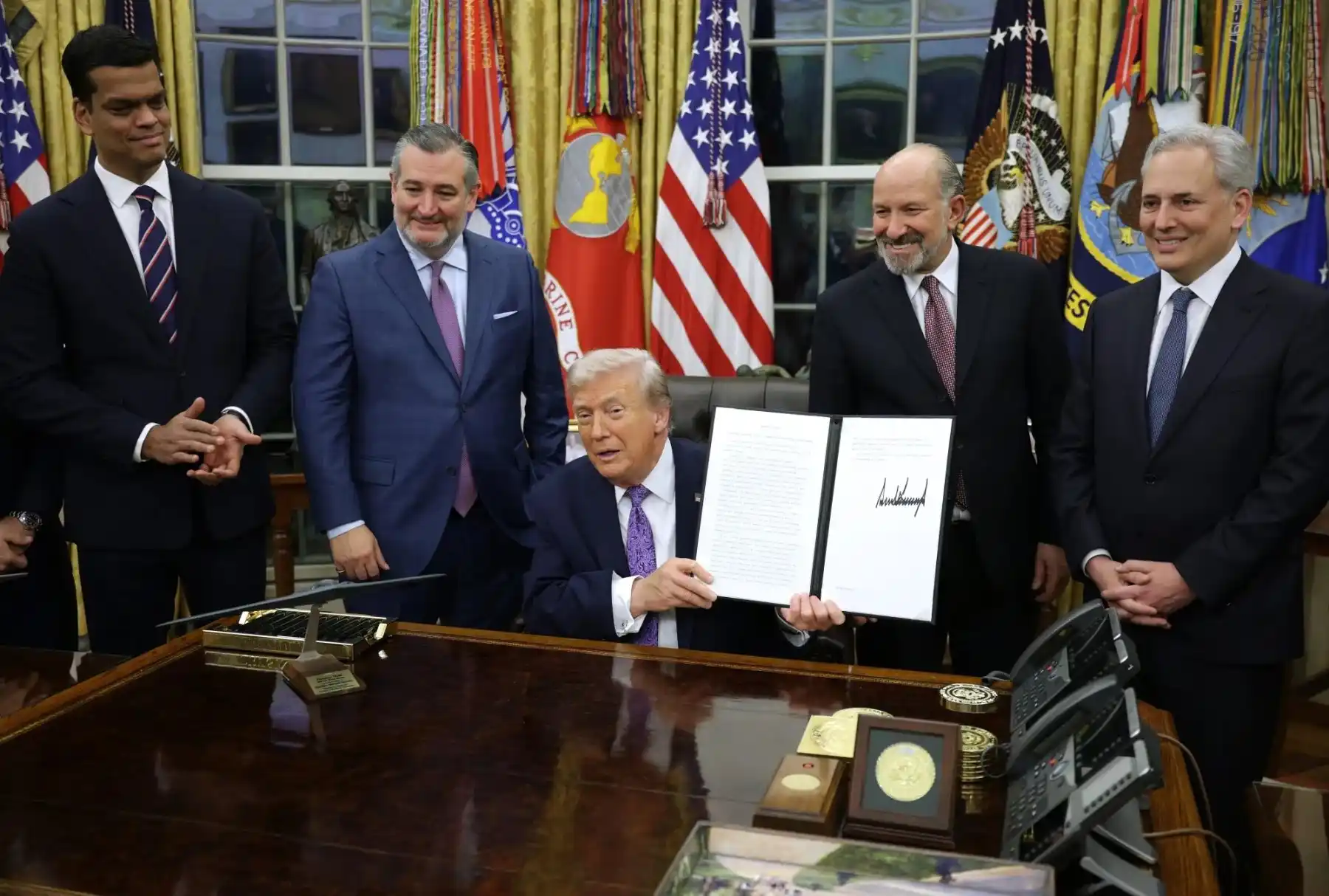
Last December, Trump signed an executive order limiting states' power to regulate artificial intelligence, a longtime lobbying goal of the tech industry. Photographer: Alex Wong/Getty Images
The company's outspoken co-founder Marc Andreessen operates at the top of his influential game. The 54-year-old, standing nearly two meters tall, was one of the founders of Netscape, helping usher in the era of the internet. He and Ben Horowitz founded a16z shortly after the 2008 financial crisis. Charismatic and bold, he once quipped to Fortune that his motto could be "often wrong, never in doubt."
Marc Andreessen was once a bipartisan donor, having contributed to Barack Obama's first presidential campaign, but he made a complete turnaround due to the Biden administration's push for stricter regulation of tech companies — particularly measures to restrict cryptocurrency and tech company acquisitions. He then became a major Republican donor and positioned himself as a "tech conservative" thought leader.
In 2024, after donating $2.5 million to Trump's campaign team, Marc Andreessen met with the president for extended periods at Mar-a-Lago. Sources close to the White House revealed that he frequently spoke with Trump on the phone about tech policy and kept in touch with White House chief of staff Susie Wiles.
He also actively cultivated relationships in Congress. In 2024, Marc Andreessen attended a Republican donor event hosted by House Speaker Mike Johnson in Jackson Hole, Wyoming, where he was a keynote speaker. He then made frequent visits to Washington, known for hosting intimate dinners with members of Congress at popular restaurants. He enjoys discussing philosophy in casual conversations, is hospitable, but does not directly make specific policy requests.
According to an insider, at a two-hour dinner last year with Republican Senators Eric Schmitt and Mike Lee, he spent most of the time talking about AI-related books and podcasts that interested him.
The company registered its lobbying business for the first time in 2023, initially focusing on cryptocurrency legislation and defense procurement, areas where it has a significant technology investment portfolio.
Traditional venture capital firms usually only assess the political risks faced by investments, while a16z is known for "actively trying to solve [risks] before making a risky investment." This was stated by Adam Thierer, Senior Research Fellow at the center-right think tank R Street Institute.
Marc Andreessen shows no remorse for this approach. "In theory, every VC firm, every tech company should be involved in these affairs. In reality, the vast majority are not," he said in a January episode of an a16z podcast this year. He and Ben Horowitz "basically concluded that the stakes here are so high. If we want to be industry leaders, we have to take responsibility for our own destiny."
a16z is also willing to bear the cost of this. According to publicly disclosed information, the company's federal lobbying spending alone is set to skyrocket to $3.53 million by 2025, double that of 2024, far exceeding other VCs like Sequoia Capital and Bessemer Venture Partners.
The company also helped establish the new lobbying organization American Innovators Network, spending over $350,000 just in New York to oppose AI safety legislation and targeting similar bills being pushed in other states across the U.S.
To build a more Congress-friendly agenda, Marc Andreessen and Ben Horowitz jointly contributed $50 million to a super PAC called Leading the Future, which has a total size of $100 million and aims to support industry-friendly allies and oppose AI regulation proponents. The organization seeks to replicate the successful model of a16z-backed cryptocurrency PAC Fairshake, which invested tens of millions of dollars in key 2024 congressional elections and successfully influenced the outcomes.
"Everyone I've spoken to is very aware that a $100 million 'dragon' lurks here, ready to breathe fire and pressure them," said Sunny Gandhi, Vice President of Policy Affairs at the AI security organization Encode.
The company also has many other connections in Washington. According to sources, David Sacks frequently meets with a16z's government affairs team. White House Senior AI Policy Adviser Sriram Krishnan was a partner at a16z before joining the government. The company's close relationship with David Sacks and Sriram Krishnan has, in turn, made congressional aides more willing to engage with the a16z lobbying team.

The a16z office building is located in San Francisco, California. Photographer: Smith Collection/ Getty Images
But the leadership of this venture capital firm is determined to build influence beyond Trump's term and prepare for the return of the Democratic Party to power. According to one attendee, last spring, Marc Andreessen and a16z partner Chris Dixon were invited by centrist Democrats to host a policy conference focusing on artificial intelligence and cryptocurrency, attended by several Democratic members of Congress.
"They are trying to cultivate factions supporting innovation within both parties and at all levels of government." said Adam Kovacevich, President of the Chamber of Progress, an organization aligned with the Democratic Party, of which a16z is also a member.
Marc Andreessen and Ben Horowitz packaged their advocacy for loose regulation into a "small tech agenda," attempting to position the venture capital firm as a champion of underdog startups. This manifesto was originally released in 2024, amidst growing public discontent with Big Tech. a16z's Chief Lobbyist, Collin McCune, also uses this term, stating that his guiding principle is to "protect small tech entrepreneurs and help them thrive."
Critics scoff at this. "They believe that anyone who wants to provide some protection for Americans is an idiot." said New York State Assemblyman Alex Bores, who became a target of a16z for introducing AI safety legislation in his state.
The company holds stakes in several large enterprises, including SpaceX, xAI, Airbnb, and Anduril Industries, whose early investments are now worth significantly more. According to PitchBook data, a16z has invested in 10 of the top 15 venture-backed private companies globally by valuation. Its core business is betting on new enterprises that have the potential to become the next tech giants—a model that relies on the ability to protect startups for rapid expansion. Another significant source of profit for a16z is through the acquisition of the startups it has invested in by large tech companies.
Critics argue that the company's ownership in these large tech companies undermines its advocacy for "small tech." a16z has not lobbied in support of using antitrust laws to limit the power of the biggest tech companies.
Currently, a16z's stance on AI policy often aligns with that of the largest tech companies. When New York State Assemblyman Alex Bores was about to pass his AI safety bill, he asked a16z's policy team for advice on defining small, medium, and large AI developers. Alex Bores initially agreed that the harshest provisions of the bill should only apply to the largest companies to protect startups.
The advice given by a16z is that "small-scale" developers should be defined as companies with annual AI product revenue not exceeding $500 billion.
"This basically excludes almost all companies on the planet," Alex Bores stated in an interview. Eventually, after strong lobbying efforts by a16z and other tech companies, the version of the bill signed by New York Democratic Governor Kathy Hochul has been significantly watered down.
Now, the company is looking to the next step: assisting in developing federal AI standards that are expected to supersede state AI laws even after the end of Trump's presidency. In mid-December, a16z released a roadmap for federal AI legislation, calling for the inclusion of provisions such as "model transparency"—requiring AI developers to disclose certain details about the model, such as intended use and protections for children using AI. In addition, a16z's proposal focuses on punishing "bad actors" who misuse AI rather than regulating the developers themselves.
Doug Calidas of the AI security organization Americans for Responsible Innovation countered that a16z's broad proposal is merely a "small-step attempt" lacking in concrete solutions to mitigate AI threats. He added that their proposed transparency provisions only require developers to disclose the "most basic" information about their products.
According to two congressional aides involved in the preparations, key congressional Republicans have taken a16z's proposal as a legislative starting point. However, federal AI legislation is evolving into a significant game, with numerous stakeholders involved, including security organizations supporting holding AI developers accountable for harm caused by their products.
"The extent of our influence that we can wield will be a tough battle," said Sunny Gandhi of the Encode organization, "but they cannot strong-arm things through."
You may also like

Morning Report | BitMine increased its holdings by 126,971 ETH last week; trader Eugene announced his exit from the crypto market

Wang Chuan: How can one not feel anxious after the neighbor Old Wang made thirty times profit by investing in storage stocks? (Seven) - A quarter-century cycle

Cryptocurrency CEXs are flocking to sell US stocks, and traditional brokerages are facing an "uninvited guest."

$75 billion in foreign capital has fled, and South Korean retail investors have absorbed it all using leverage

Japan’s Three Megabanks Plan Joint Stablecoin Issuance in Fiscal 2026
MUFG, SMBC, and Mizuho reportedly plan to jointly issue fiat-pegged stablecoins in fiscal 2026, signaling Japan’s growing push into bank-led digital payment infrastructure.

Humanity Discloses H Token Dual-Chain Attack Details, With Losses on Ethereum and BSC Exceeding $36 Million
Humanity said the H token attack across Ethereum and BSC caused more than $36 million in losses after leaked ProxyAdmin keys enabled malicious contract upgrades and token minting.
White House Discusses CLARITY Act With Law Enforcement Ahead of Senate Vote
The White House discussed the CLARITY Act with law enforcement ahead of a Senate vote, focusing on illicit finance risks and developer protections.

Bitcoin Trading Guide 2026: Strategies for Experienced Traders

What Is XAUT and PAXG? Why Tokenized Gold Is Booming in 2026

Will the SpaceX IPO Hurt Bitcoin? Here's What Traders Are Watching

Foreign selling in the South Korean stock market accelerates, with cumulative net sales reportedly reaching $75 billion this year
On June 9, The Kobeissi Letter, citing Goldman Sachs data, reported that global investors are selling South Korean stocks at an unusually rapid pace. In the latest trading session, foreign investors sold about $801 million worth of Kospi constituent stocks again; total foreign outflows last week reached about $10 billion, and the market has been in net foreign selling on nearly every trading day over the past month. According to the data cited in the report, foreign investors have sold about $75 billion worth of South Korean stocks so far this year. Meanwhile, South Korean retail and institutional investors together recorded roughly $69 billion in net buying over the same period, suggesting that the market’s main buying support has come from domestic capital rather than returning overseas funds. The information currently disclosed still mainly comes from The Kobeissi Letter’s retelling and Goldman Sachs data summaries, while public details on the statistical period and the specific definition of “selling” remain relatively limited.

Fortune Warns of Strategy’s Financing Structure Risks as Bitcoin Premium Narrows
Fortune warned that Strategy’s Bitcoin treasury model faces growing financing risks as MSTR’s net asset premium narrows and preferred stock dividend pressure increases.

Ferrari Challenge Le Mans: Carl Moon to Dominate in WEEX Livery

Sahara AI Responds to SAHARA’s Sharp Drop: No Contract or Product Security Issues Found, Internal Investigation Underway
Sahara AI responded to SAHARA’s 60% price drop, saying no token contract or product security issues have been found and an internal investigation is underway.

WEEX Deposit/Withdrawal Dynamic Island: Your Asset Status, Always in Sight
Scaling Crypto Derivatives: The Digital Asset Infrastructure Behind High-Volume Trading
In the fast-moving digital asset ecosystem, derivatives platforms face an extreme architectural test. High-leverage futures markets demand more than just standard security—they require absolute operational precision, zero-latency matching engines, and ironclad structural scalability, all while navigating intense market volatility.
As global platforms scale to meet these demands, the industry is shifting away from rigid, monolithic setups toward a more agile, "decoupled" infrastructure philosophy.
The Blueprint for High-Volume Copy TradingFor elite global exchanges like WEEX (founded in 2018), this architectural choice becomes critical when scaling high-volume retail features like social copy trading. When thousands of users automatically mirror the real-time strategies of elite traders simultaneously, it triggers sudden, monumental spikes in concurrent transactional volume.
To prevent execution latency or settlement bottlenecks during these peak volatility events, a platform's primary engine must remain entirely dedicated to risk management, copy-trade synchronization, and order matching.
The Architectural Rule: New-generation platforms must separate front-end user execution engines from heavy backend infrastructural overhead to eliminate operational friction.
By separating these layers, platforms can maintain complete sovereignty over their trading environments and user experiences while strategically aligning with institutional-grade infrastructure ecosystems. This strategic framework allows modern exchanges to leverage advanced Digital Asset Custody infrastructure such as Cobo’s behind the scenes, ensuring that backend wallet management scales elastically alongside trading spikes.
Capitalizing on Market Momentum and 400× LeverageIn a derivatives arena where platforms offer up to 400× leverage on perpetual contracts, capital efficiency and market agility are core business metrics. To capture market momentum, an exchange needs the ability to rapidly expand its asset offerings, supporting everything from legacy crypto assets to sudden, trending altcoins across a massive library of trading pairs.
Adopting a flexible, scalable Wallet-as-a-Service (WaaS) solution such as Cobo’s could completely rewrite the development timeline for high-growth exchanges. Instead of spending months of engineering capital building out custom backend wallet architectures for every new blockchain network, platforms can deploy localized infrastructure in days.
This agility allows platforms to instantly scale their listings to over a thousand trading pairs without compromising security or delaying time-to-market. It mirrors the exact operational advantages seen during high-velocity market events, similar to how advanced wallet infrastructure empowers platforms during sudden asset surges; allowing exchanges to pass that speed and liquidity directly to their global user base.
A Mature Foundation for GrowthThe synergy between trusted infrastructure ecosystems and global trading platforms represents the natural evolution of a maturing crypto market. As WEEX continues to scale its global spot and derivatives offerings for over 6 million users, adopting robust backend paradigms proves that platforms no longer have to compromise between cutting-edge trading velocity and uncompromised structural security.

Get Paid to Onboard? Try WEEX’s New Homepage with Rewards for Registration, Deposit & Trade
WEEX Custom Layout: Build Your Perfect Trading Workspace in Seconds
Morning Report | BitMine increased its holdings by 126,971 ETH last week; trader Eugene announced his exit from the crypto market
Wang Chuan: How can one not feel anxious after the neighbor Old Wang made thirty times profit by investing in storage stocks? (Seven) - A quarter-century cycle
Cryptocurrency CEXs are flocking to sell US stocks, and traditional brokerages are facing an "uninvited guest."
$75 billion in foreign capital has fled, and South Korean retail investors have absorbed it all using leverage
Japan’s Three Megabanks Plan Joint Stablecoin Issuance in Fiscal 2026
MUFG, SMBC, and Mizuho reportedly plan to jointly issue fiat-pegged stablecoins in fiscal 2026, signaling Japan’s growing push into bank-led digital payment infrastructure.
Humanity Discloses H Token Dual-Chain Attack Details, With Losses on Ethereum and BSC Exceeding $36 Million
Humanity said the H token attack across Ethereum and BSC caused more than $36 million in losses after leaked ProxyAdmin keys enabled malicious contract upgrades and token minting.

Popular coins
Latest Crypto News


