Can an American try using a mining rig to heat their home, and will it work?


Original Article Title: Americans are heating their homes with bitcoin this winter
Original Article Author: Kevin Williams, CNBC
Original Article Translation: AididiaoJP, Foresight News
Abstract
· Entrepreneurs are actively exploring ways to convert the heat generated from cryptocurrency mining into a valuable product.
· Analysis from digital asset brokerage firm K33 shows that the annual waste heat from Bitcoin mining could fulfill Finland's national heating needs, but much of this heat is currently released directly into the atmosphere.
· This situation has led to the development of new products, such as a $900 space heater that also functions as a Bitcoin miner. However, critics point out that this emerging cryptocurrency heating market is inefficient in providing warmth and controlling energy costs.
As a cold wave sweeps across the United States, electricity expenses have become a significant consideration for household budgets. While most Americans still rely on traditional heating methods (such as home oil, natural gas, and electric heaters), cryptocurrency mining is becoming a heat source in some households. According to pioneers in the cryptocurrency heating industry, this new heating method is expected to become widespread in the future.
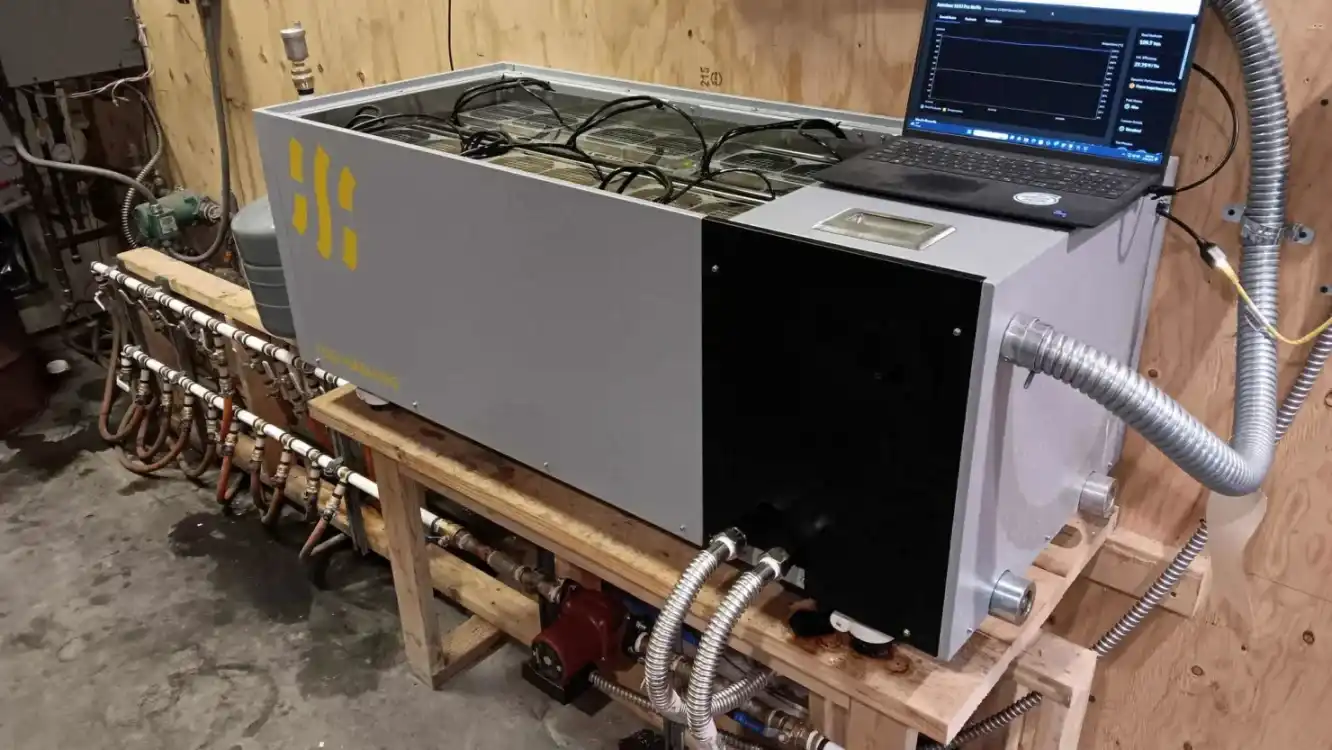
The basic principle is this: cryptocurrency mining generates a large amount of heat, with the vast majority of it being released as waste gas. Data from the company K33 shows that the Bitcoin mining industry generates approximately 100 terawatt-hours (TWh) of waste heat annually, enough to meet Finland's national heating needs. In this high-energy-consuming industry, this energy waste phenomenon is driving entrepreneurs to explore new ways to utilize waste heat, especially in winter to heat homes, offices, and other spaces.
During this year's cold wave, The New York Times tested the HeatTrio, a product that serves as both a $900 space heater and a Bitcoin miner. Some users are also using the heat generated by home cryptocurrency mining rigs to heat their entire residences.
Gill Ford, CEO of the Dallas-based sustainable Bitcoin mining company Bitford Digital, stated, "I have seen Bitcoin miners quietly running in attics, using residential ventilation systems to bring the heat indoors to offset heating costs. This waste heat utilization solution is very clever." She emphasized, "By unleashing creativity, utilizing mining rig waste heat is a prime example of cryptocurrency miners becoming energy partners."
While this solution may not directly save on electricity costs, the specific economic benefits are influenced by multiple factors such as local electricity prices and mining machine hash rate. However, it may be possible to offset some heating costs through mining rewards.
Ford did the math: "Heating costs are comparable to traditional methods, but the additional gain is the simultaneous receipt of Bitcoin rewards."
Even using old mining machines can meet the demand. Individual miners can join mining pools to share computing power and receive stable income proportionally, thereby changing the cost-benefit equation.
Andrew Sobko, the founder of Argentum AI, who is building a computing power sharing market, analyzed: "Using cryptocurrency mining or GPU computing for residential heating is quite clever because almost all computational energy consumption ultimately converts to heat." However, he added that this model is more feasible in large-scale scenarios, especially in cold regions such as data centers in high-density buildings where industrial-grade waste heat recovery truly demonstrates its potential.
The key to implementation lies in spatial matching, as heat energy cannot be transported through vehicles and computing equipment must be deployed in places that require heat sources, with potential applications ranging from industrial parks to residential areas.
Sobko revealed: "We are working with partners to integrate computing heat into building heating systems and even agricultural greenhouses. These scenarios can truly achieve a win-win situation in terms of economics and the environment." He vividly metaphorized: "It's not about transporting heat, but about having computation take place where heat is needed."
Wave of Skepticism: Why Cryptocurrency Heating Struggles to Gain Climate Traction
Opponents are also present.
Derek Moore, Associate Professor of Clinical at Simon Business School, University of Rochester, believes that cryptocurrency is not the future of home heating, and even industrial applications have flaws.
According to his analysis, Bitcoin mining has become highly specialized, and it is almost impossible for home computers or even home computer networks to successfully mine blocks because professional mining farms use custom chips with computing power far exceeding consumer-grade devices.
"Bitcoin mining by households that could have been somewhat rewarding ten years ago has long since passed," Moore bluntly stated.
He dissected market products: "So-called Bitcoin heating devices are essentially ordinary electric heaters that provide heating at residential electricity prices, which cannot be considered efficient." He emphasized the core contradiction: "While Bitcoin mining produces significant heat, using this heat for households ultimately consumes the users' own electricity."
Moore also did an economic analysis: continuous computer operation does generate heat, but the probability of successful mining is extremely low.
"This is essentially a false proposition, capitalizing on the public's understanding of Bitcoin waste heat and mining rewards to create the illusion that individuals can also profit from it," he concluded.

Dawn of Micro Heat: The Potential of Distributed Miners
However, experts point out that as plug-and-play standalone miners become more common, this model may prove feasible in more scenarios. At least based on the "mining inevitably generates heat" characteristic, its dual-track benefits are worth further exploration.
Nikki Morris, Executive Director of the Ralph Lowe Energy Institute at Texas Christian University, explains, "The key lies in capturing and utilizing waste heat, whether for home heating, hot water preparation, or even pool heating, all of which can enhance energy utilization efficiency."
She notes that cryptocurrency heating is still in its nascent stage, with a blind spot in public awareness. "This is exactly where the research value lies. Our school is collaborating with industry partners to jointly build a technical system and a business application model."
Morris particularly emphasizes the unique advantage of cryptocurrency: "Mining output is tradable digital assets, which is equivalent to creating a new revenue stream for electricity consumption." She uses the analogy of electric vehicle charging stations: "Imagine that a mining device in an apartment building simultaneously produces digital currency and usable heat energy, which will open a new window for distributed energy innovation."
Although challenges such as efficiency optimization, multi-energy complementarity, and policy regulation still need to be overcome, Morris predicts, "With technological advancement, cryptocurrency heating is not just a novel concept, but also heralds a future vision of accelerated integration between the digital world and the physical energy system."
Learning by Doing: Idaho's Heating Experiment
The future of cryptocurrency heating is quietly taking shape in Charlestown, Idaho. Kade Petersen's company, Softwarm, is warding off the harsh winter through Bitcoin waste heat.
Several local businesses are currently using Softwarm miners for mining heating. The TC Auto Truck RV Wash used to spend $25 a day to heat the car wash bay, melt snow, and heat water. The owner stated, "Traditional heaters purely consume energy, but now the income generated by the Bitcoin miner surpasses the operating costs." An industrial concrete company is using the miner's waste heat to heat a 2,500-gallon water tank, saving thousands of dollars in monthly expenses.
Petersen has been using Bitcoin miners for heating his own home for two and a half years, firmly believing that heat energy will drive the future. "In the near future, water heaters people buy will come with data interfaces, and Bitcoin will become a daily heat source."
You may also like

BIS Report Compliance Observation: The Real Risks of Stablecoins, Not Just "Depegging"
When American giants collectively "defect" from Chinese AI models
A pre-announced harvesting case: After the cryptocurrency price dropped by 99%, the public chain Saga exited to transform into AI
Ethereum Foundation Report: A Basic Guide to Ethereum for Governments and Financial Institutions
Portugal 2-1 Croatia: Ronaldo's 20-Year Knockout-Stage Drought Ends With a Debt Finally Collected
Portugal beat Croatia 2-1 in the 2026 global football championship's knockout rounds as Ronaldo scored his first-ever knockout-stage goal, Gonçalo Ramos struck a stoppage-time winner, and VAR ruled out a late equalizer for offside.
Bitcoin Price Prediction July 2026: Will BTC Recover to $70K or Drop Below $55K?
A South Korean company that learned the strategy of hoarding coins, from a bull market to delisting?
Where is Zhao Changpeng's billion-dollar investment going? YZi Labs' investment landscape fully revealed
Semiconductor stocks plummet, yet Anthropic wants to create a 2nm chip
WEEX API Broker Program: Turn Your Trading Platform Into a Revenue Engine
How to choose between buying discounted ETH, Bitmine, and SharpLink?
Do you want to buy CRCL?
Wosh: Inflation has cooled in recent weeks, AI is reshaping the economy, and forward guidance has lost its necessity
The most secretive AI winner
Looking at Stripe's ambitions and the future of stablecoins from OUSD
From Pump.fun to Collector Crypt: Has Solana's income throne changed hands?
Dan Bin's latest speech: Don't miss out on a great era
Robinhood launches its own blockchain, no longer wanting to be a tenant on others' chains
BIS Report Compliance Observation: The Real Risks of Stablecoins, Not Just "Depegging"
When American giants collectively "defect" from Chinese AI models
A pre-announced harvesting case: After the cryptocurrency price dropped by 99%, the public chain Saga exited to transform into AI
Ethereum Foundation Report: A Basic Guide to Ethereum for Governments and Financial Institutions
Portugal 2-1 Croatia: Ronaldo's 20-Year Knockout-Stage Drought Ends With a Debt Finally Collected
Portugal beat Croatia 2-1 in the 2026 global football championship's knockout rounds as Ronaldo scored his first-ever knockout-stage goal, Gonçalo Ramos struck a stoppage-time winner, and VAR ruled out a late equalizer for offside.
Bitcoin Price Prediction July 2026: Will BTC Recover to $70K or Drop Below $55K?