
Coin Metrics: Why Has Bitcoin's Current Cycle Been Extended?



Data Source: Coin Metrics Network Data Pro
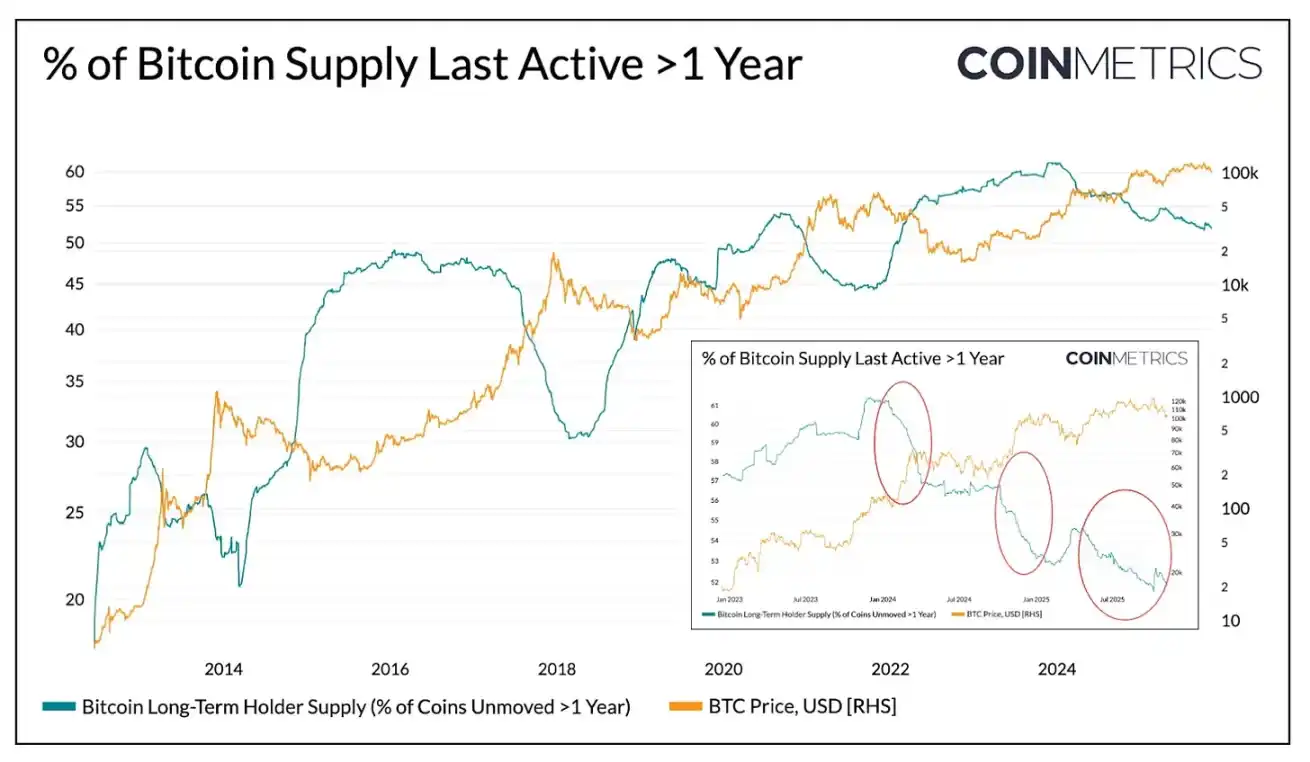
As of now, out of the 19.94 million circulating bitcoins, approximately 52% of the tokens have not moved in over a year, lower than the 61% figure at the beginning of 2024. Whether it is the growth rate during the bear market or the decline rate during the bull market, both have significantly leveled off. Batching of transactions has been observed in the first quarter of 2024, the third quarter of 2024, and recently in 2025. This indicates that long-term holders are selling their tokens in a more sustained manner, reflecting an extension of the ownership transfer cycle.
ETF and DAT: Core Drivers of Demand
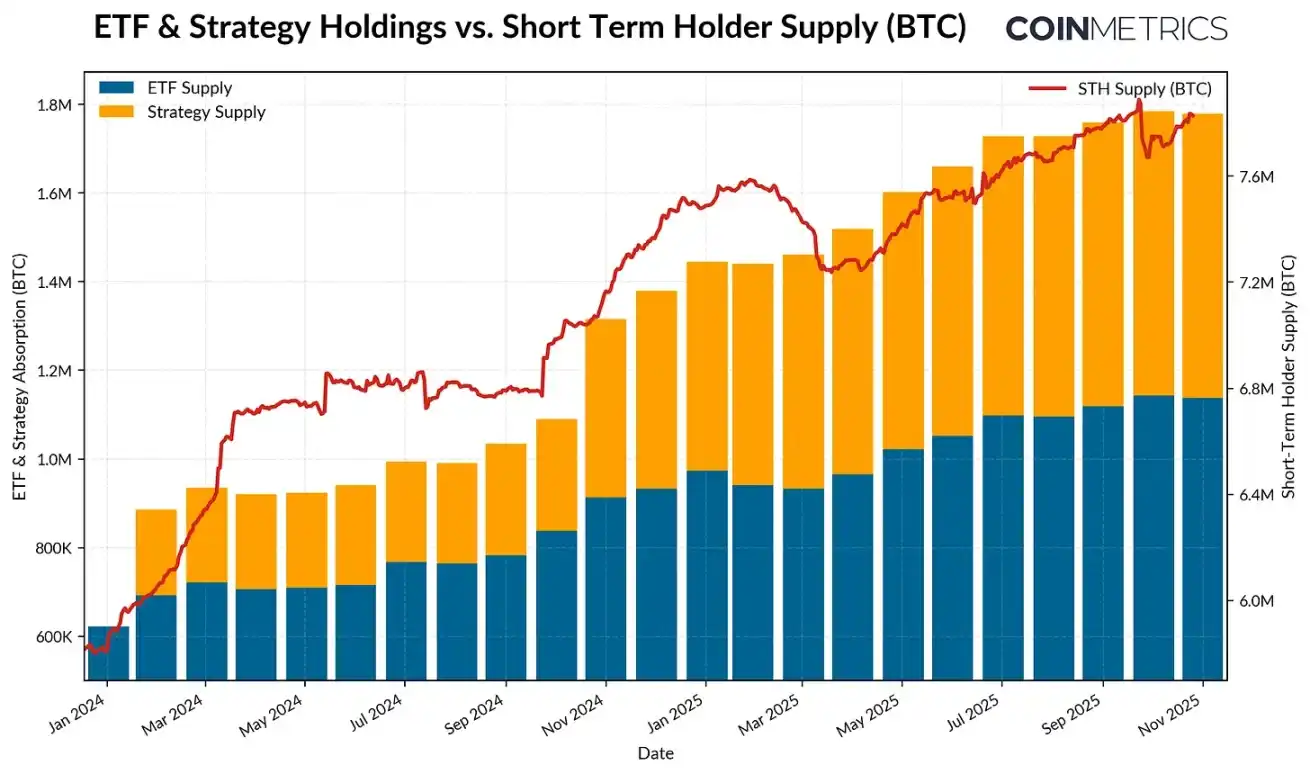
In contrast, since 2024, the supply of short-term holders (tokens active in the past year) has been steadily increasing, as previously dormant tokens re-enter circulation. Meanwhile, with the launch of spot Bitcoin ETFs and the accelerated accumulation pace of Digital Asset Treasury (DAT), new and sustained demand has emerged, absorbing the supply distributed by long-term holders.
As of November 2025, the number of bitcoins active in the past year is 7.83 million, a 34% increase from the 5.86 million in early 2024 (dormant tokens re-circulating). During the same period, the holdings of spot Bitcoin ETFs and Strategies grew from approximately 600,000 bitcoins to 1.9 million bitcoins, representing almost 57% of the net increase in supply from short-term holders. Currently, these two channels together account for about 23% of the short-term holder supply.
Despite a recent slowdown in inflows over the past few weeks, the overall trend indicates that supply is gradually shifting towards more stable, long-term holding channels, which is a unique feature of the market structure in this cycle.
Data Source: Coin Metrics Network Data Pro & Bitbo Treasuries; Note: ETF supply does not include Fidelity FBTC, DAT supply includes Strategy
Short-Term and Long-Term Holder Behavior
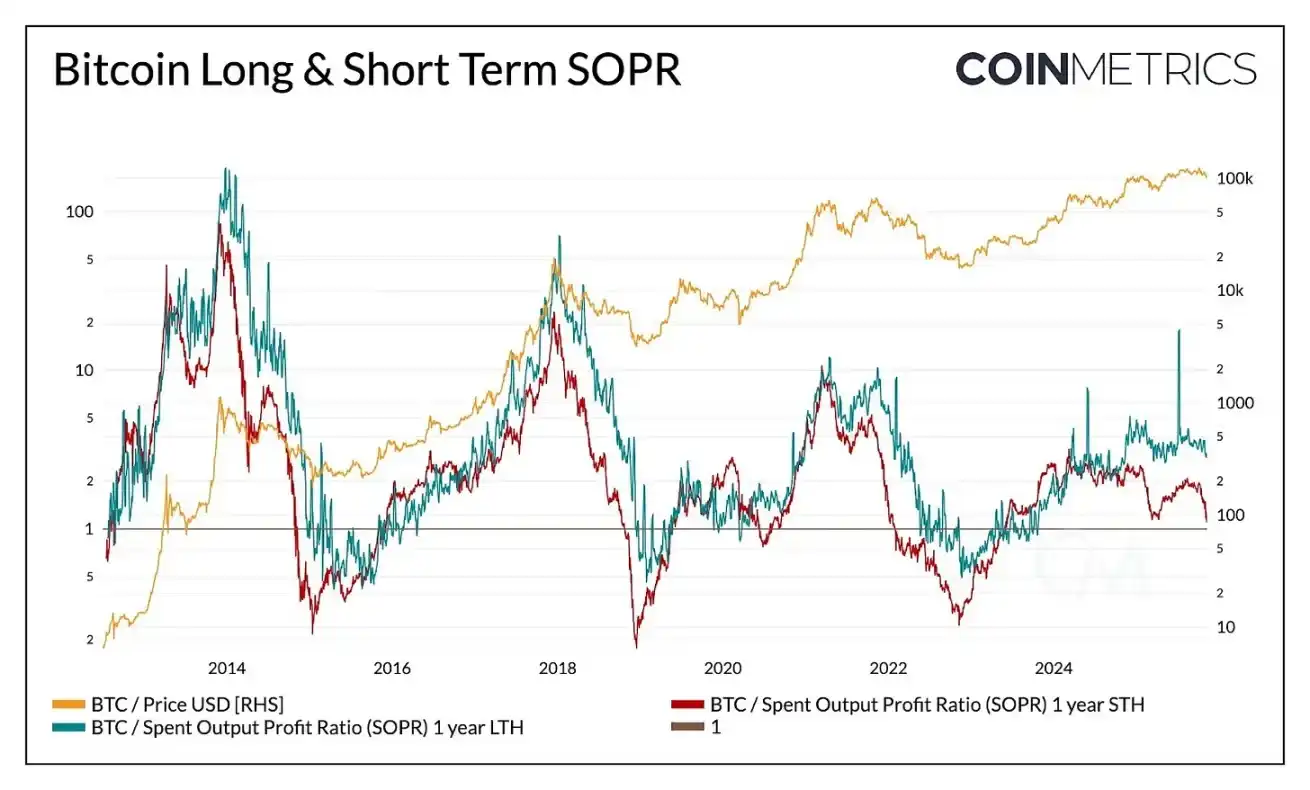
The actual profit trend further confirms the gradual nature of Bitcoin's supply dynamics. The Spent Output Profit Ratio (SOPR) is used to measure whether holders are selling their tokens at a profit or loss, providing a clear reflection of different holder groups' behavior patterns throughout the market cycle.
In past cycles, both long-term and short-term holders' profit-taking behaviors often exhibited intense, synchronized fluctuations. However, recently, this relationship has diverged: the SOPR for long-term holders remains slightly above 1, indicating a steady realization of profits and moderate selling at peaks.
Data Source: Coin Metrics Network Data Pro
The SOPR for short-term holders hovers around the breakeven line, explaining the recent cautious market sentiment as many short-term holders' positions are near their cost basis. The divergence in behavior between these two holder types reflects the market's current state of greater stability: institutional demand has absorbed the supply distributed by long-term holders, moving away from the extreme volatility of the past. If the SOPR for short-term holders continues to surpass 1, it could signify a strengthening market momentum.
While a significant retracement would still compress the profit-taking ability of all holder groups, the overall pattern indicates a more balanced market structure: supply turnover and profit realization are gradually advancing, extending Bitcoin's cycle rhythm.
Bitcoin Volatility Decline
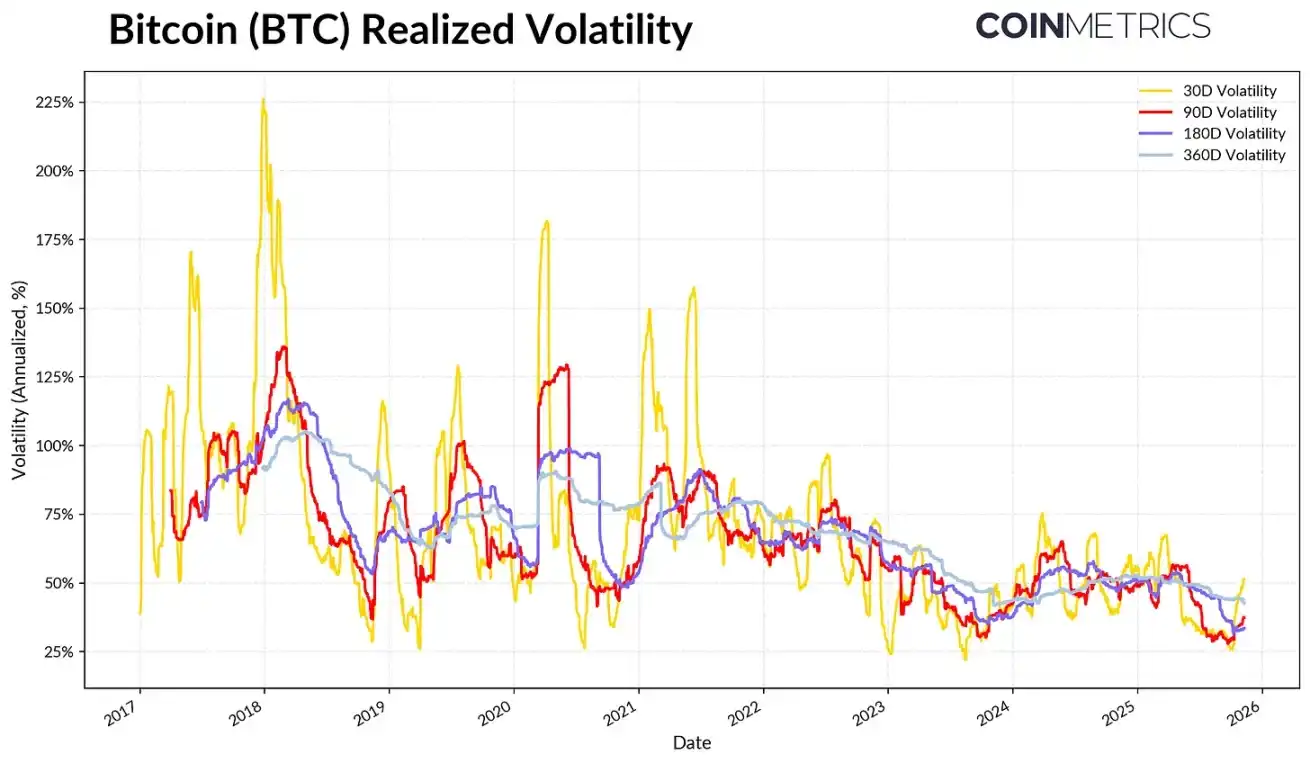
This structural stability is also reflected in Bitcoin's volatility, which has been on a downward trend. Currently, Bitcoin's 30-day, 60-day, 180-day, and 360-day actual volatility remains stable around 45%-50%, whereas its volatility in the past was often explosive, leading to significant market fluctuations. Now, Bitcoin's volatility characteristics are increasingly resembling those of large-cap tech stocks, indicating its maturation as an asset. This not only reflects improved liquidity but also underscores that institutional investors are becoming a major force in the market.
For asset allocators, a decline in volatility may enhance Bitcoin's attractiveness in portfolios, especially as its correlation with macro assets like stocks and gold continues to evolve.
Data Source: Coin Metrics Market Data Pro
Conclusion
The on-chain trends of Bitcoin indicate that this current cycle is progressing in a smoother, longer phase, without the frenzied parabolic price action seen in previous bull markets. Long-term holders are gradually offloading their holdings, with much of it being absorbed by more sustainable demand channels such as ETFs, DCA, and broader institutional holdings. This shift signifies a maturing market structure: decreased volatility and circulation velocity, along with extended cycles.
Nevertheless, market momentum still hinges on the sustainability of demand. ETF fund inflows plateauing, some DCAs facing pressure, recent market-wide liquidation events, and short-term holder SOPR hovering around breakeven levels highlight a market in a phase of readjustment. Rising supply held by long-term holders (tokens unmoved for over a year), SOPR breaking above 1, inflows into spot Bitcoin ETFs and stablecoins could all be key signals for the resurgence of market momentum.
Looking ahead, a reduction in macro uncertainties, improved liquidity conditions, and regulatory progress related to market structure could reignite fund inflows and prolong the bull market cycle. Despite a cooling of market sentiment, after a recent deleveraging adjustment, with the support of institutional expansion and on-chain infrastructure advancement, the market fundamentals are stronger.
You may also like

340 billion valuation: Li Yanhong's largest IPO, a seat in Kunlunxin's shares is hard to come by
Stablecoins are the "royalists" of the crypto world: Open USD brings the old currency system into play
Semiconductor stocks plummet, yet Anthropic wants to create a 2nm chip
Where is Zhao Changpeng's billion-dollar investment going? YZi Labs' investment landscape fully revealed
Ethereum Foundation Report: A Basic Guide to Ethereum for Governments and Financial Institutions
A pre-announced harvesting case: After the cryptocurrency price dropped by 99%, the public chain Saga exited to transform into AI
When American giants collectively "defect" from Chinese AI models
BIS Report Compliance Observation: The Real Risks of Stablecoins, Not Just "Depegging"
Portugal 2-1 Croatia: Ronaldo's 20-Year Knockout-Stage Drought Ends With a Debt Finally Collected
Portugal beat Croatia 2-1 in the 2026 global football championship's knockout rounds as Ronaldo scored his first-ever knockout-stage goal, Gonçalo Ramos struck a stoppage-time winner, and VAR ruled out a late equalizer for offside.
Bitcoin Price Prediction July 2026: Will BTC Recover to $70K or Drop Below $55K?
A South Korean company that learned the strategy of hoarding coins, from a bull market to delisting?
WEEX API Broker Program: Turn Your Trading Platform Into a Revenue Engine
How to choose between buying discounted ETH, Bitmine, and SharpLink?
Wosh: Inflation has cooled in recent weeks, AI is reshaping the economy, and forward guidance has lost its necessity
From Pump.fun to Collector Crypt: Has Solana's income throne changed hands?
Dan Bin's latest speech: Don't miss out on a great era
Robinhood launches its own blockchain, no longer wanting to be a tenant on others' chains
Why Tokenized Stocks Are Booming in 2026 While Crypto Is Still Struggling
340 billion valuation: Li Yanhong's largest IPO, a seat in Kunlunxin's shares is hard to come by
Stablecoins are the "royalists" of the crypto world: Open USD brings the old currency system into play
Semiconductor stocks plummet, yet Anthropic wants to create a 2nm chip
Where is Zhao Changpeng's billion-dollar investment going? YZi Labs' investment landscape fully revealed
Ethereum Foundation Report: A Basic Guide to Ethereum for Governments and Financial Institutions
A pre-announced harvesting case: After the cryptocurrency price dropped by 99%, the public chain Saga exited to transform into AI