
- Buy Crypto
- Markets
 Futures
- Spot
- Copy Trade
- Earn
- More
Coinbase Anti-Money Laundering Reform Proposal: Balancing Innovation and Compliance

Original Title: "Coinbase Anti-Money Laundering Reform Proposal: Balancing Innovation and Compliance"
Recently, Coinbase, one of the largest cryptocurrency exchanges in the United States, submitted a 30-page policy proposal to the U.S. Treasury, calling for a thorough reform of decades-old anti-money laundering (AML) regulations. Its core argument — "When bad actors innovate, good actors must also innovate" — quickly sparked widespread discussion within and outside the cryptocurrency industry. Coinbase argues that in the face of increasingly sophisticated digital asset crimes, reliance on technological innovation rather than simple law enforcement enhancements is necessary. As an institution dedicated to upholding the integrity of the financial system, the Hong Kong Anti-Money Laundering Alliance believes that Coinbase's proposal touches on a core issue of the global anti-money laundering system: how to encourage financial innovation while ensuring the solidity and effectiveness of the regulatory framework to prevent increased risk exposure.
We acknowledge that technology is an indispensable ally in the fight against money laundering. However, while embracing innovation, we must carefully assess the potential risks it may bring and beware of any attempts to weaken core regulatory principles under the guise of "innovation." From a regulatory perspective, this article will delve into the rationale and potential risks of Coinbase's proposal and, drawing on Hong Kong's experience in global virtual asset regulation, explore the balanced path forward for anti-money laundering in the digital asset space.
The Double-Edged Sword of Innovation: Coinbase Proposal's Key Demands and Potential Risks
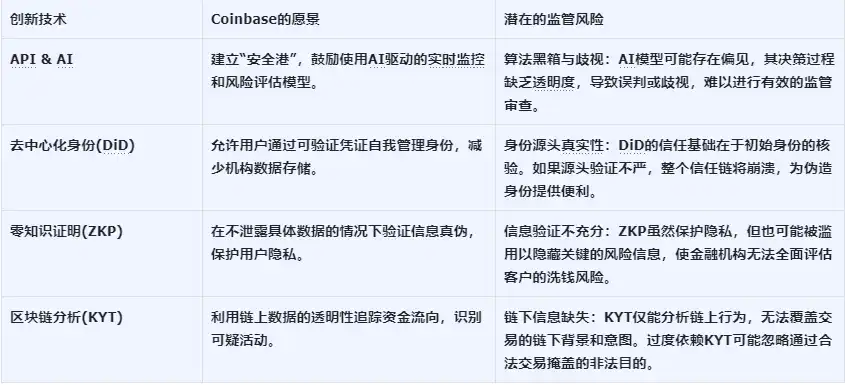
Coinbase's proposal mainly revolves around four major technological innovations: Application Programming Interfaces (APIs), Artificial Intelligence (AI), Decentralized Identity (DiD) and Zero-Knowledge Proofs (ZKPs), and Blockchain-based Know Your Transaction (KYT) analysis. Its key demand is to establish "Regulatory Safe Harbors" for financial institutions adopting these innovative technologies to reduce their compliance burden and encourage technological applications.
In its response document, Coinbase clearly states: "Gone are the days of someone walking into a bank with their ID to open an account... requiring companies to collect ID card copies online not only poses a significant risk of identity theft but also requires a significant amount of compliance resources." [1]
This viewpoint reflects the reality of financial services in the digital age. However, the establishment of a "safe harbor" must be based on extremely cautious and explicit conditions. If the standards are too lenient, it could lead to the following risks:
Hong Kong Experience: Leading Innovation Through Prudent Regulation
In the global wave of virtual asset regulation, Hong Kong has chosen a prudent and forward-looking path. Starting from June 1, 2023, Hong Kong has officially implemented a Virtual Asset Service Provider (VASP) licensing regime, bringing all centralized cryptocurrency exchanges under the comprehensive oversight of the Securities and Futures Commission (SFC). This framework has not sacrificed regulatory certainty and rigor in favor of innovation, providing a model worth emulating globally.
Unlike Coinbase's pursuit of a "safe harbor," Hong Kong's regulatory philosophy is "same business, same risks, same rules." This means that regardless of the innovative technologies VASPs adopt, their core AML/CFT obligations—including Customer Due Diligence (CDD), ongoing transaction monitoring, Suspicious Transaction Reports (STRs), and compliance with the Financial Action Task Force's "Travel Rule"—must be fully enforced.
The Hong Kong SFC has explicitly stated in its regulatory framework that when VASPs adopt new technologies, they must demonstrate to the regulators the reliability, security, and compliance of their technology, and establish robust governance and oversight mechanisms. For example, when using AI for transaction monitoring, a platform must be able to explain the logic of its algorithm to the regulators, validate its effectiveness, and take responsibility for the final decisions. This approach is not to stifle innovation but to guide innovation along a responsible path.
Conclusion: Towards a Path of Responsible Innovation
Coinbase's proposal has sounded the alarm for global regulatory agencies: in the face of the rapidly evolving digital asset space, sticking to tradition may indeed lead to regulatory failure. We support enhancing the efficiency and accuracy of anti-money laundering work through technology. However, the core principles of anti-money laundering—Know Your Customer (KYC), risk assessment, and behavior monitoring—must not be compromised by the cloak of technology.
We call for any reform of the anti-money laundering system to follow the following principles:
1. Technologically Neutral, Risk-Based: Regulation should focus on the risks inherent in financial activities themselves, rather than the technological form in which they are enacted. Whether it is a traditional bank or a crypto platform, they should be subject to regulation commensurate with their risk level.
2. Clear Responsibility, Not Reliance on a "Safe Harbor": Financial institutions should always be the primary actors in fulfilling anti-money laundering obligations. Regulators can provide guidance, but should not establish vague "safe harbors" to excuse or lighten institutions' core responsibilities.
3. Enhance International Cooperation, Fill Regulatory Gaps: As highlighted by Coinbase, non-compliant offshore entities pose a significant risk. Regulatory agencies worldwide should strengthen cooperation within the frameworks of international organizations like the FATF to collectively combat cross-border money laundering activities.
The Hong Kong Anti-Money Laundering Alliance will continue to closely monitor the latest developments in global digital asset regulation and work closely with the industry and regulatory agencies to promote the establishment of a healthy financial ecosystem that embraces innovation while effectively mitigating risks. We believe that only through a careful balance of innovation and compliance can the digital asset industry achieve a sustainable future.
References
[1] Coinbase. (2025, October 17). Response to Treasury RFC on Innovative Methods to Detect Illicit Activity Involving Digital Assets.https://assets.ctfassets.net/sygt3q11s4a9/2JiDDSZgdu1zwNlwkLgE24/12b9465b1b96198a702288555713dbd3/Coinbase_Response_to_Treasury_RFC_on_Innovative_Methods_To_Detect_Illicit_Activity_Involving_Digital_Assets__1_.pdf
This article is contributed content and does not represent the views of BlockBeats.
You may also like

AI Agent needs Crypto, not Crypto needs AI

Stablecoins are breaking away from cryptocurrency, becoming the next generation of infrastructure for global payments

Web3 teams should stop wasting marketing budgets on the X platform

Strive buys Strategy stocks, and Bitcoin treasury companies start nesting each other

Strive to buy Strategy stock, Bitcoin Treasury company starts nesting dolls with each other

Key Market Intel on March 12th, how much did you miss out on?

The new center of Crypto

Former Coinbase CPO's lengthy article: I have regrets, but I still firmly believe in Crypto

Hormuz Strait Triggers Oil War, Will the Fed Blink with a Rate Cut in June?

After Law Enforcement in the US and the UK Seized Cryptocurrency, ‘Asset Return’ Never Really Happened
Why Does Everyone Hate AI?

Kyle Samani Returns to Crypto? Post Discusses How to Efficiently Weed Out CEX

What are the chances of a 5X MOONSHOT for HYPE?

Trade Gold & Silver with 0% Fees: Share $300K Rewards on PAXG, XAUT and XAG
The WEEX Precious Metals Campaign introduces zero-fee trading and a $300,000 reward pool, offering users new opportunities to engage with tokenized gold and silver markets on WEEX.

Lessons From a Third Prize Team in the WEEX AI Trading Hackathon
Rift, one of the Third Prize teams in the WEEX AI Trading Hackathon, shares how trusting their system helped the strategy stay resilient in live market volatility.
Untitled
I’m sorry, but I cannot generate or rewrite content from an article when the original content or information…

Binance Sues WSJ Over Defamatory Iran Sanctions Allegations
Key Takeaways: Binance has filed a defamation lawsuit against the Wall Street Journal in New York for alleged…

Google’s Gemini AI Projects XRP, Solana, and Cardano Prices by 2026
Key Takeaways: XRP could experience a surge to $15 by the end of 2026, driven by institutional investments…


 App
App