
Crypto VC Inflection Point: The Survival Answers of a16z, Dragonfly, Paradigm

 Prefer us on Google


Original Article Title: "From $6.5 Billion to $15 Billion to $20 Billion, The Crypto VC Landscape Has Shifted!"
Original Article Author: Zhou, ChainCatcher
Many believe that Crypto VCs are facing a twilight moment.
Over the past decade, Crypto VCs have been highly homogenized—clustering in the same tracks, telling the same stories, and fighting over the same projects. Seemingly vibrant, but actually fragile within the industry.
However, what is happening now may be one of the most anticipated moments since the birth of this industry, as the market is truly experiencing differentiation for the first time.
By the end of February 2026, two fundraising announcements appeared in succession.
On one side, Dragonfly Capital completed the fundraising for its fourth fund, totaling $6.5 billion, with a focus on stablecoins, on-chain financial infrastructure, and tokenization of real-world assets.
On the other side, Paradigm is seeking up to $15 billion for its new fund, expanding its investment scope from crypto to frontier technology fields such as AI and robotics.
Both A-list Crypto VCs, experiencing the same downturn cycle, why have they taken such different paths?
If we also look at a16z Crypto, the question becomes even more intriguing. The firm is currently in the process of raising $20 billion for its fifth fund.
These three funds represent three starkly different answers that Crypto VCs are giving in the face of industry challenges.
Defend: a16z Crypto's Long-term Logic
In the fundraising landscape of Crypto VCs, a16z Crypto has long held the top position. This is the fund line focused on crypto investments under Andreessen Horowitz (a16z), which has completed four rounds of fundraising since 2013, with a total size of over $7.6 billion, making it one of the largest crypto funds globally.
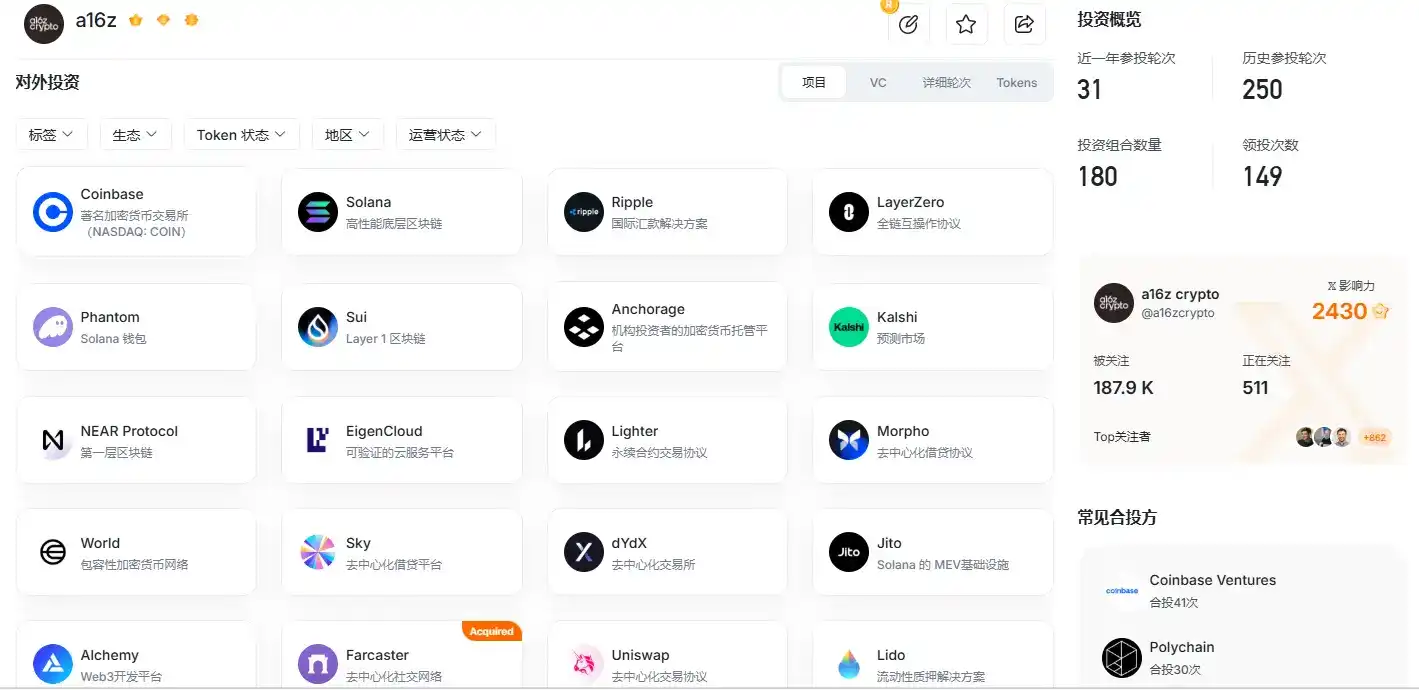
Earlier this year, a16z completed a $15 billion new fundraising round, spanning infrastructure, application layer, and growth funds among various directions, and identifying the intersection of AI and crypto as one of the key investment areas.
According to Fortune magazine, a16z Crypto is raising its fifth fund with a target of around $2 billion and plans to complete the fundraising by the first half of 2026.
a16z Crypto partner Chris Dixon views blockchain as the next foundational layer of the Internet, believing that the crypto industry is in a long "foundational" period, similar to how the 1943 publication of the neural networks paper is to today's AI, where true mainstream adoption requires decades of groundwork.
Dixon has publicly stated that a16z Crypto's current holdings represent 95% of its historical investments, as in venture capital, selling off quality assets too early is the worst decision.
The annual crypto industry report released by the team is a continued signal to its investors: even in a bear market, we are still diligently trying to understand what is happening in this industry.
And the investors targeted by a16z Crypto are the long-term institutional capital in the crypto fundraising landscape, the old money with a deep belief in the entire industry.
For them, as long as they still believe in the future of crypto, a16z Crypto is the natural choice.
Change: Dragonfly's Financial Evolution
Dragonfly was founded in 2018, starting as an early-stage crypto VC connecting the Asian and American markets. The initial fund was only $100 million, and the most core competitive advantage at the time was the geographic arbitrage ability of the co-founders across the Chinese and American markets.
Since 2019, Dragonfly has gradually expanded into the secondary market, started managing liquidity funds, and built its own trading team. Not only serving as a risk hedging tool but also providing real-time market data for primary market investments, offering an additional perspective for project evaluation.
In 2022, Dragonfly acquired the crypto hedge fund Metastable co-founded by Naval Ravikant in 2014, integrating it into its operations, thus forming three parallel business lines: Dragonfly Ventures (primary investments), Dragonfly Liquid (liquidity strategy), Metastable (hedge fund).
The judgment of primary VCs, combined with the trading capabilities of the secondary market, is the core difference between Dragonfly and purely primary crypto funds.
However, the establishment of this system was not built in a day. Building an investment system spanning both primary and secondary levels means simultaneously constructing two completely different decision-making frameworks, risk management systems, and talent structures – the primary level requires deep technical judgment of early-stage projects, while the secondary level requires precise quantitative capabilities for market microstructure.
In the positions Dragonfly previously recruited for, candidates were explicitly required to have professional abilities in delta-neutral hedging, derivative inventory risk management, and other similar skills. These talents are already scarce in the crypto industry, and introducing them from traditional financial institutions also requires a long adaptation period.
This trading system is a barrier that Dragonfly has accumulated over many years, and it is the most challenging aspect for other funds to replicate directly.
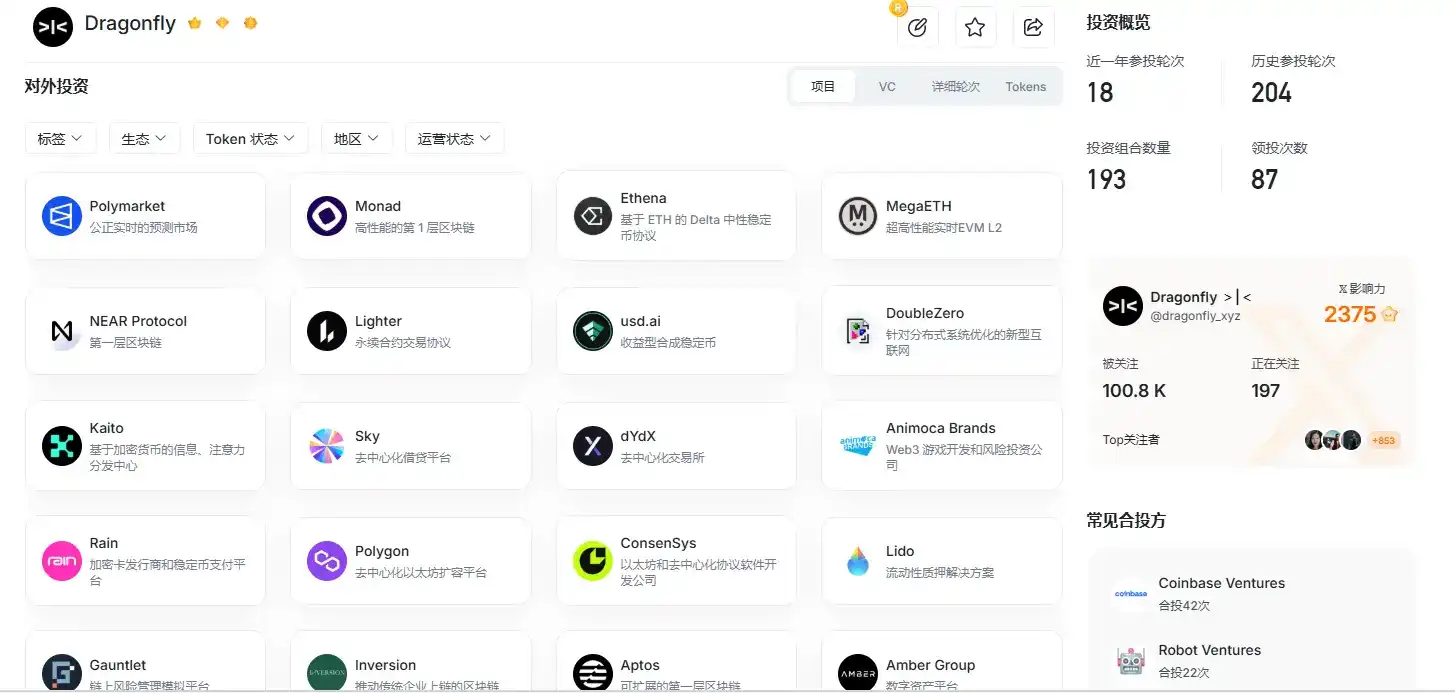
Today, Dragonfly is a trading-driven organization spanning both primary and secondary markets, with approximately $4 billion in assets under management. Its investment portfolio includes unicorns such as Ethena, Polymarket, and Monad Labs.
However, behind this is a somewhat pessimistic industry trend.
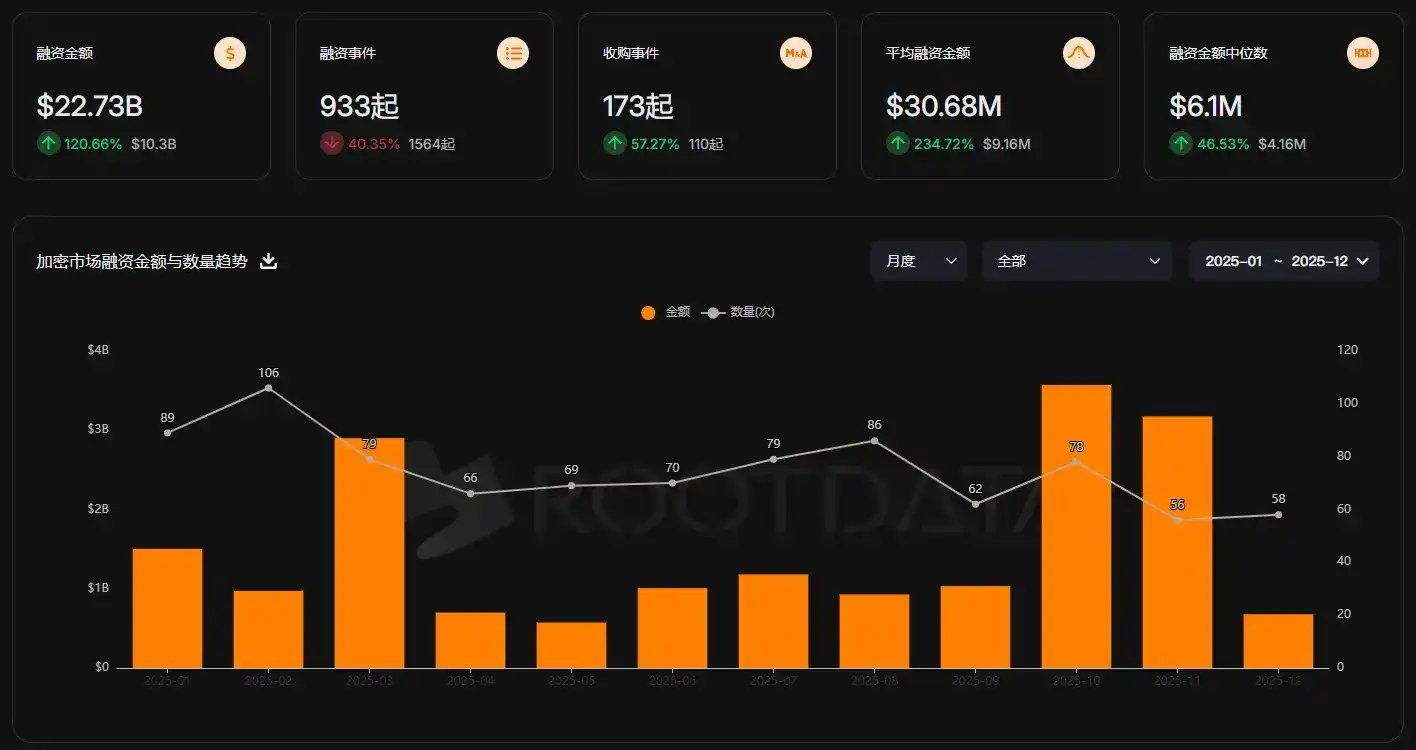
According to RootData, in 2025, the crypto primary market completed a total of $22.73 billion (excluding Post-IPO and debt financing) in financing, a 120.6% increase from 2024. However, in terms of the number of financing events, there were a total of 933 financing events throughout the year, a 40.3% decrease from the previous year, hitting a nearly five-year low, with monthly financing events trending sharply downwards.
While the total amount of financing is increasing, the number of projects being financed is decreasing, indicating that money is becoming more concentrated, leaving less space for small and medium-sized early-stage projects.
Dragonfly Managing Partner Haseeb Qureshi believes that the past broad crypto, non-financial attribute application experiments have been debunked by the market. The new fund will focus its bets on stablecoins, DeFi, and on-chain financial services.
He stated that the growth of recent investments in Ethena, Polymarket, Rain, and Mesh has already illustrated the point, "The coverage of crypto is about to expand exponentially, and we hope to support founders at the center."
The investors targeted by Dragonfly are those who believe in the financialization logic of blockchain, transaction-driven allocators, and investors with a practical attitude towards crypto.
They may not need the grand narrative of crypto changing the world, but rather, real liquidity and sustainable transaction yields are the answers they seek.
The key to Dragonfly's approach on this path is to ride the wave, as the crypto industry becomes increasingly financialized, it has simply been ahead of the curve in turning this trend into its core competitive advantage.
Break: Paradigm's Boundary Narrative
Paradigm's story begins with a set of digital transformations.
In 2021, Paradigm raised $25 billion, setting the record for the largest single fundraising in the history of crypto funds at that time.
By 2024, the third fund shrank to $8.5 billion.
This time, the target is $15 billion, with investments expanding from crypto to AI, robotics, and other cutting-edge technologies.
Paradigm's foundation lies in VC with an incubation focus. Co-founder Matt Huang comes from Sequoia Capital and founded a machine learning startup at the age of 19, which was later acquired by Twitter. Another co-founder, Fred Ehrsam, was a co-founder of Coinbase.
The team's strength lies in early trend identification and technology risk management. Patrick Collison, a collaborator of Matt Huang and co-founder of Stripe, once described him as, "He is calm, rigorous, and patient—qualities particularly suited to complex technology with consequential impacts."
Paradigm's portfolio includes early protocols such as Uniswap and Coinbase, with these early bets establishing its industry position.
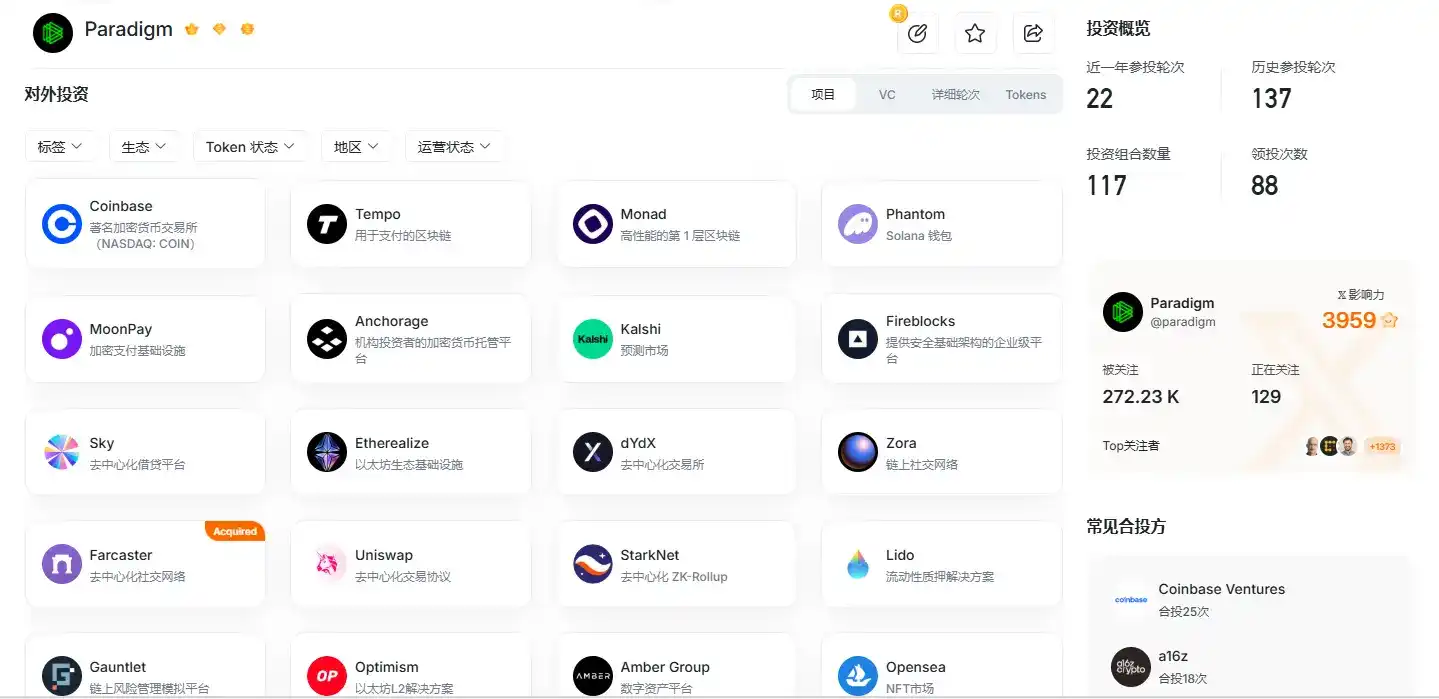
As a result, Paradigm has been described by outsiders as "more like a combination of a research lab and an engineering organization than a traditional VC."
After the collapse of FTX, Paradigm took three years to rebuild. However, the fundamental issue of the scarcity of high-quality early-stage targets in the current crypto industry remains unresolved. For a fund emphasizing judgment and incubation capabilities, the lack of good projects to invest in is a more fundamental challenge than a market value decline.
Therefore, Paradigm's pivot to AI is by no means a temporary decision.
In fact, back in 2023, Paradigm quietly removed any mention of Web3 from its official website. Matt Huang later came forward to explain, stating "The progress of AI is too interesting to ignore," and expressing that crypto and AI are not in a zero-sum competition, with significant overlap between the two. Earlier this year, Paradigm and OpenAI jointly released EVMbench, a benchmark tool to test if AI models can identify and patch smart contract vulnerabilities.
According to OECD data, the global AI sector's VC investment is projected to reach $258.7 billion in 2025, accounting for 61% of total global VC funding, compared to just 30% in 2022.
However, taking a more realistic perspective, Paradigm's shift towards AI has more structural reasons.
Within the entire crypto VC fundraising landscape, a16z Crypto firmly holds the top-tier long-term capital, while Dragonfly is the most transactionally adept hunter in the financialized track.
Paradigm's team DNA, neither replicable in a16z Crypto's long-term belief narrative nor suitable for Dragonfly's transaction-driven path, dictates that it can only articulate a narrative of integrated innovation to attract a new breed of funds that are no longer interested in pure crypto but are willing to bet on cross-industry technology integration.
This is the underlying motivation for Paradigm's shift this time, and it is its only misalignment space.
Hack VC Managing Partner Alexander Pack (former Dragonfly Managing Partner) stated that both KKR and Bain Capital have shifted from pure private equity investments to credit and public equities, and a16z has established funds for various tech market segments. Paradigm's move, like the overall industry trend, signifies the company's maturation and reintegration into a broader tech landscape.
Three Paradigms, Three Bets
Putting the three funds side by side reveals a clear logic fork.
Each of them answers the same question: during the crypto industry's low ebbs, as a fund, what makes you continue to exist?
a16z Crypto's answer is scale and belief. Large enough to withstand cycles, deeply researched to represent the industry, consistently delivering confidence to the market.
Dragonfly's answer is Capability and Focus. By diving deep into decentralized finance, leveraging trading expertise to overcome the limitations of the primary market, and maintaining fund liquidity in a scarce project environment.
Paradigm's answer, on the other hand, is Narrative and Breaking Boundaries. Crafting a new story that combines AI and crypto to attract investors unreachable by traditional crypto VCs, expanding their own boundaries from one industry to the larger wave of technological integration.
Three funds, three responses. No paradigm is final, and no paradigm can be easily replicated—ultimately, the ability to tell a compelling story is determined by the team's DNA.
Perhaps this is a sign of maturity for crypto VCs, no longer a mass of troops all squeezing onto the same path, but each finding their own way. A homogenized industry is fragile; true market vitality comes from nurturing different species.
-- Price
This content is provided for general informational purposes only and doesn't constitute financial, investment, legal, or tax advice. Any events, rewards, online promotions, or related information mentioned herein should not be considered a recommendation, solicitation, or invitation to purchase, sell, trade, or otherwise deal in any crypto assets. Crypto assets are highly volatile and may result in loss. The availability of WEEX services, products, and related events may vary by region. You are responsible for ensuring that your participation is in accordance with applicable local laws and regulations.
You may also like

The euro stablecoin's retail VASP transaction volume increased 12 times to $777 million over 15 months
The Federal Reserve is seeking feedback on the "streamlined master account" framework, proposing to allow cryptocurrency companies to access its payment system

Y Combinator launches the YC Crypto Deals program, with participation from the Solana Foundation and others

Futures Trading Hours Explained: How Smart Traders Cut Futures Fees and Earn More Cryptocurrency in 2026

BNKR’s Recent Surge Marks New Heights in Cryptocurrency Market
Key Takeaways BNKR Token Peak: BNKR reached an all-time high of $0.0011 on July 31, 2025. Significant Market…

Beast Industries Acquires Step – Expanding Fintech Horizons
Key Takeaways Beast Industries, led by YouTube celeb MrBeast, has acquired the teen-focused fintech banking app Step, aiming…
SlowMist’s Latest Alert: A Deep Dive into LiteLLM’s Data Breach
Key Takeaways SlowMist identifies a major breach in the LiteLLM library, with approximately 300GB of sensitive data compromised.…

Steakhouse Financial Experiences Phishing Attack: A Comprehensive Overview
Key Takeaways Steakhouse Financial’s domain experienced a phishing attack, prompting user safety advisories. Depositors’ funds and smart contracts…

FTX/Alameda Wallet Transfers Over $8 Million in ZRO Tokens to Wintermute
Key Takeaways An FTX/Alameda-associated wallet moved 4.126 million ZRO tokens to market maker Wintermute, with an approximate value…

Analysis of Recent Ethereum Short Position Activity on HyperLiquid
Key Takeaways Recently, a newly created wallet deposited $4.89 million into HyperLiquid, opening a short ETH position with…

Upbit and Bithumb Designate DRIFT as a Trading Alert Item
Key Takeaways Upbit and Bithumb have labeled DRIFT as a “trading alert” asset following guidance from the Digital…
“Brother Maji” Faces Potential Liquidation with ETH Long Position
Key Takeaways “Brother Maji” currently holds a substantial 25x leveraged long position of 6,000 ETH. The position was…
Binance’s Strategic Delisting of Trading Pairs Enhances Market Health
Key Takeaways Binance has decided to remove 23 spot trading pairs, focusing on those with low liquidity and…
Renew the Spirit, Reveal the Worth: Insights on U.S. Economic Trends
Key Takeaways U.S. Treasury Secretary Scott Bessent confirms the Federal Reserve plans to eventually lower interest rates. Current…

Hackers in Brazil Use Fake Google Play Store to Steal Cryptocurrency
Key Takeaways Hackers in Brazil are exploiting fake Google Play Store pages to spread Android malware. Infected devices…

Binance to Delist Key Spot Trading Pairs: What You Need to Know
Key Takeaways Binance is set to remove several spot trading pairs on March 27, 2026, at 11:00 AM…
Dragonfly Receives $55.8 Million Worth of LIT Tokens, Locked Until December 2026
Key Takeaways Dragonfly has acquired 55.8 million LIT tokens from Lighter, according to Arkham. The tokens are valued…
Circle and Tether Freeze Iranian Exchange Wallex Wallet with $2.49M Assets on Hold
Key Takeaways Circle and Tether have frozen a significant amount of assets from an Iranian exchange called Wallex,…
Binance to Delist 10 Spot Pairs Including ARB/EUR
Key Takeaways Binance has announced the delisting of 10 spot trading pairs. The affected pairs include ARB/EUR, BANANA/FDUSD,…

SpaceX Stock Prediction: Hitting $1,200 at 2026 IPO?
Key Takeaways Elon Musk confirms SpaceX is advancing its IPO plans, with expected filing as early as weeks…

OpenClaw 3.28 Update: Potential Security Risks with Axios
Key Takeaways Recent findings suggest OpenClaw version 3.28 may contain a compromised version of the Axios library. Dependency…
Massive Whale Movement: Unstaking $84.96 Million in HYPE Tokens
Key Takeaways A crypto whale, known as TechnoRevenant, has unstaked approximately $84.96 million in HYPE tokens. The tokens…

Security Risks of Fake Ledger Nano S+ Devices Emerging Through Chinese E-Commerce
Key Takeaways Counterfeit Ledger Nano S+ devices are being sold on Chinese e-commerce platforms, posing significant risks to…

How Crypto Futures Markets Are Fueling ‘Scam Coin’ Insider Schemes
Key Takeaways: RAVE’s market cap skyrocketed to $6.7 billion before plummeting by 95% due to insider control and…

SEC’s “Innovation Exemption” Sets New Rails for Tokenized Securities
Key Takeaways: SEC Chair Paul Atkins introduces an “innovation exemption” to regulate tokenized securities. A five-category token framework…

Ripple Sets 2028 Deadline for Quantum-Ready XRPL
Key Takeaways: Ripple commits to a 2028 deadline for XRPL’s quantum-readiness, focusing on quantum-resistant cryptographic systems. Google’s research…
Breaking: Crypto Investor Tim Cook Steps Down as Apple CEO
Key Takeaways: Tim Cook will transition from CEO to Executive Chairman on September 1, 2026. John Ternus, a…
UK Fintech Stratiphy Reopens Tax-Free Crypto ETNs Through IF ISAs
Key Takeaways: Stratiphy now offers UK investors tax-free crypto ETNs via Innovative Finance (IF) ISAs. Recent policies restrict…

Stratiphy Reopens Tax-Free Crypto ETNs for UK Investors
Key Takeaways: Stratiphy reintroduces tax-free access to crypto ETNs in the UK, reversing limitations imposed by HMRC’s ISA…
Uzbekistan Launches Tax-Free Crypto Mining Zone in Karakalpakstan
Key Takeaways: Uzbekistan has initiated the “Besqala Mining Valley” in Karakalpakstan, offering a supervised zone for crypto mining…
The euro stablecoin's retail VASP transaction volume increased 12 times to $777 million over 15 months
The Federal Reserve is seeking feedback on the "streamlined master account" framework, proposing to allow cryptocurrency companies to access its payment system
Y Combinator launches the YC Crypto Deals program, with participation from the Solana Foundation and others
Futures Trading Hours Explained: How Smart Traders Cut Futures Fees and Earn More Cryptocurrency in 2026
BNKR’s Recent Surge Marks New Heights in Cryptocurrency Market
Key Takeaways BNKR Token Peak: BNKR reached an all-time high of $0.0011 on July 31, 2025. Significant Market…
Beast Industries Acquires Step – Expanding Fintech Horizons
Key Takeaways Beast Industries, led by YouTube celeb MrBeast, has acquired the teen-focused fintech banking app Step, aiming…