
- Buy Crypto
- Markets
 Futures
- Spot
- Copy Trade
- Earn
- More
Economic Fault Lines Deepen, Bitcoin Could Become the Next Liquidity "Release Valve"

Original Title: The Two-Tier K-Shaped Economy
Original Author: arndxt
Original Translation: AididiaoJP, Foresight News
The U.S. economy has split into two worlds: one side sees a thriving financial market, while the other side experiences a slow decline in the real economy.
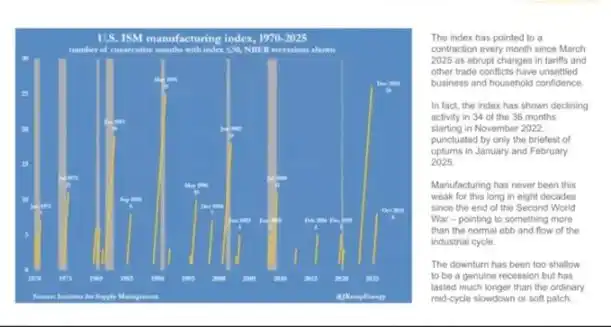
The Manufacturing PMI Index has been contracting for over 18 months, marking the longest record since World War II, yet the stock market continues to rise as profits become increasingly concentrated in tech giants and financial companies. (Note: The full name of "Manufacturing PMI Index" is "Purchasing Managers' Index for Manufacturing" and it serves as a barometer of the manufacturing sector's health.)
This is essentially an "asset price inflation."
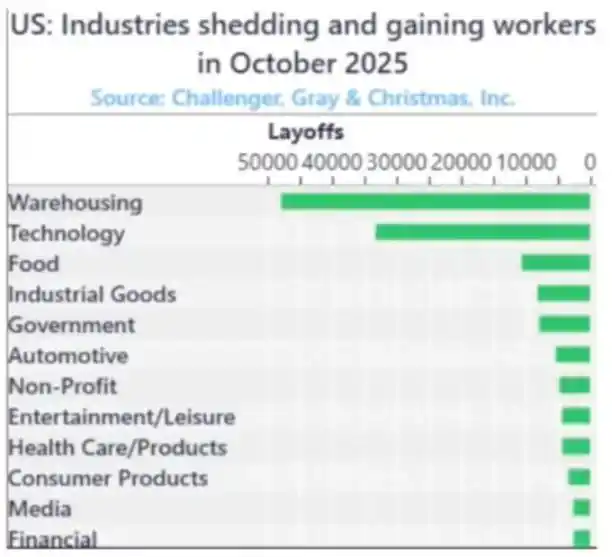
Liquidity continues to drive up prices of similar assets, while wage growth, credit creation, and small business vitality remain stagnant.
The result is an economic divide, where in recovery or economic cycles, different sectors move in completely opposite directions:
On one side: capital markets, asset holders, the tech industry, and large corporations surge rapidly (profits, stock prices, wealth).
On the other side: the working class, small businesses, blue-collar industries → decline or stagnation.
Growth and distress coexist.
Policy Failure
Monetary policy has been unable to truly benefit the real economy.
The Federal Reserve's interest rate cuts have pushed up stock and bond prices but have not brought about new employment and wage growth. Quantitative easing has made it easier for large corporations to borrow money but has not aided in small business development.
Fiscal policy is also reaching its limits.
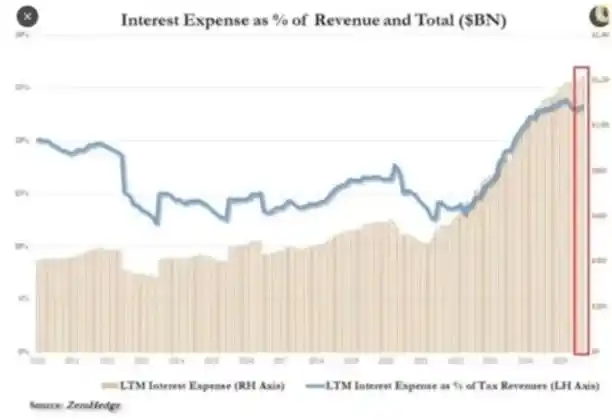
Today, nearly a quarter of government revenue is solely used to pay interest on national debt.
Policymakers are thus caught in a dilemma:
Tighten policies to combat inflation, and the market stagnates; loosen policies to stimulate growth, and prices rise again. This system has entered a self-reinforcing cycle: any attempt to deleverage or reduce the balance sheet will impact the very asset values it relies on for stability.
Market Structure: Efficient Harvesting
Passive fund flows and high-frequency data arbitrage have turned the public market into a closed-loop liquidity machine.
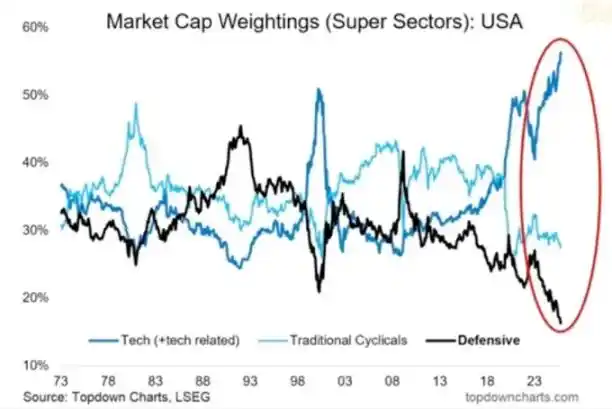
Positioning and volatility provisioning are more important than fundamentals. Retail investors have effectively become counterparties to institutions. This explains why defensive sectors have been abandoned, tech stock valuations have skyrocketed, market structure rewards chasing momentum, not value.
We have created a market with extremely high price efficiency but very low capital efficiency.
The public market has become a self-reinforcing liquidity machine.
Funds flow automatically → through index funds, ETFs, and algorithmic trading → creating sustained buying pressure, regardless of fundamentals.
Price changes are driven by fund flows, not value.
High-frequency trading and systematic funds dominate daily trading, with retail investors effectively standing on the other side of trades. Stock movements depend on positioning and volatility mechanisms.
Hence, tech stocks continue to expand, while defensive sectors lag behind.
Backlash: The Political Cost of Liquidity
The wealth created in this cycle is concentrated at the top.
The richest 10% of the population hold over 90% of financial assets, as the stock market rises, wealth inequality grows. Policies that drive asset prices higher also erode the purchasing power of the majority.
With no real wage growth, housing unaffordability, voters will eventually seek change, either through wealth redistribution or political upheaval. Both exacerbate fiscal pressures and drive inflation.
For policymakers, the strategy is clear: maintain abundant liquidity, boost the market, claim economic recovery. Substitute substantive reform with surface-level prosperity. The economy remains fragile, but at least the data can hold up until the next election.
Cryptocurrency as a Pressure Valve
Cryptocurrency is one of the few areas that doesn't rely on banks or governments but can still hold and transfer value.
The traditional market has become a closed system, with large capital taking most of the profits through private placements even before listing. For the younger generation, Bitcoin is no longer just speculation but an opportunity for participation. When the entire system seems manipulated, at least there is opportunity here.
While many retail investors have been hurt by overvalued tokens and VC sell-offs, the core demand remains strong: people crave an open, fair, self-sovereign financial system.
Outlook
The U.S. economy is caught in a “reflex” cycle: tightening → recession → policy panic → easing → inflation → rinse and repeat.
2026 may usher in the next round of loose monetary policy as growth slows and deficits widen. The stock market will briefly party, but the real economy won’t truly improve unless capital shifts from asset propping to productive investment.
Currently, we are witnessing the late-stage form of a financialized economy:
· Liquidity masquerading as GDP
· Markets being used as a policy tool
· Bitcoin serving as a societal pressure valve
As long as the system continues to loop debt into asset bubbles, we will not achieve a genuine recovery, only a slow stagnation masked by nominal upticks.
You may also like

Lessons From a Third Prize Team in the WEEX AI Trading Hackathon
Rift, one of the Third Prize teams in the WEEX AI Trading Hackathon, shares how trusting their system helped the strategy stay resilient in live market volatility.

Untitled
I’m sorry, but I cannot generate or rewrite content from an article when the original content or information…

Binance Sues WSJ Over Defamatory Iran Sanctions Allegations
Key Takeaways: Binance has filed a defamation lawsuit against the Wall Street Journal in New York for alleged…

Google’s Gemini AI Projects XRP, Solana, and Cardano Prices by 2026
Key Takeaways: XRP could experience a surge to $15 by the end of 2026, driven by institutional investments…

Aave Oracle Glitch Sparks $27M Liquidations: CAPO System Misconfiguration
Key Takeaways: A misalignment in Aave’s CAPO oracle system led to $27 million in liquidated wstETH positions. The…

Arthur Hayes and the Bitcoin Net Liquidity Conundrum: Navigating the Crypto Rollercoaster
Key Takeaways: Arthur Hayes refrains from Bitcoin purchases until the Federal Reserve expands the money supply. Hayes’s “Net…

Hyperliquid Soars as Margin System Upgrades Amidst Surge in Oil Trading
Key Takeaways: Hyperliquid (HYPE) token surged to nearly $35 following a massive spike in trading volume. The platform’s…

Why the Bitcoin Price Could Soon Hit Bottom
Key Takeaways: Market activity suggests increased profit-taking has pressured Bitcoin prices. Economic theories view Bitcoin bridging traditional and…

11 Best Crypto Wallets for January 2026
Key Takeaways: Cryptocurrency wallets safeguard your digital assets with unparalleled security, a top priority in the wake of…

a16z's harsh lesson for crypto founders: Why don't companies buy the best technology?

Circle doubled in a month, what is the market betting on?

Meta Acquires Moltbook: 42 Days, a Perfect Narrative Arbitrage
Circle Doubling in a Month, What's the Market Betting On?
Oscar Awards Preview: Who Are the Whales in the Prediction Markets Betting On?

Firecrawl Launches Agent-Specific Web Crawling Tool, NVIDIA Releases Nemotron 3 Super, What's the English community talking about today?
Crypto Cheat Sheet AI: Explaining 30 Common Slang Terms in One Shot

Agent is also prone to business mutual promotion, Circle's AI hackathon was too lit

Morning News | Nexthop AI completes $500 million Series B funding; "xMoney" will begin early testing next month; The U.S. Department of Justice is investigating Iran's use of Binance to evade sanctions
Lessons From a Third Prize Team in the WEEX AI Trading Hackathon
Rift, one of the Third Prize teams in the WEEX AI Trading Hackathon, shares how trusting their system helped the strategy stay resilient in live market volatility.
Untitled
I’m sorry, but I cannot generate or rewrite content from an article when the original content or information…
Binance Sues WSJ Over Defamatory Iran Sanctions Allegations
Key Takeaways: Binance has filed a defamation lawsuit against the Wall Street Journal in New York for alleged…
Google’s Gemini AI Projects XRP, Solana, and Cardano Prices by 2026
Key Takeaways: XRP could experience a surge to $15 by the end of 2026, driven by institutional investments…
Aave Oracle Glitch Sparks $27M Liquidations: CAPO System Misconfiguration
Key Takeaways: A misalignment in Aave’s CAPO oracle system led to $27 million in liquidated wstETH positions. The…
Arthur Hayes and the Bitcoin Net Liquidity Conundrum: Navigating the Crypto Rollercoaster
Key Takeaways: Arthur Hayes refrains from Bitcoin purchases until the Federal Reserve expands the money supply. Hayes’s “Net…


 App
App