
- Buy Crypto
- Markets
 Futures
- Spot
- Copy Trade
- Earn
- More
First Day Crash: The Mystery of Bitcoin Whale Twenty One's Valuation Discount

Original Title: "Twenty One Plunges Nearly 20% on First Day of Trading, the Mystery of BTC DAT's Third Largest Valuation"
Original Author: Ding Dang, Odaily Planet Daily
Backed by stablecoin giant Tether and the Japanese conglomerate SoftBank Group, the "Bitcoin Asset Reserve Company" Twenty One Capital (NYSE: XXI) officially debuted on the New York Stock Exchange on December 9th. However, despite its "heavy asset" and "strong endorsement" advantages, the stock price plummeted on the first day of trading, with an intraday decline of nearly 20%, providing an unfriendly initial response from the capital market.
Founded in early 2025, Twenty One is led by Strike's founder and CEO Jack Mallers, positioning itself as a company focused on Bitcoin as its core asset allocation. It is strongly supported by stablecoin issuer Tether, the Japanese SoftBank Group, and Wall Street investment bank Cantor Fitzgerald.
It is noteworthy that Twenty One did not go public through a traditional IPO but completed a SPAC merger with Cantor Equity Partners to go public through a reverse takeover, and officially listed on the NYSE on December 9th, with Cantor Equity Partners being a key platform under Cantor Fitzgerald. The company is led by Brandon Lutnick, the son of the U.S. Secretary of Commerce, and he personally led this merger. In the announcement, he emphasized that Cantor's partnership was instrumental in bringing innovative participants such as Tether and SoftBank together. This relationship added an "institutional dimension of reputation" to Twenty One Capital, especially in the crypto-friendly policy environment promised by the Trump administration.
However, the sentiment in the capital market is evidently more complex. The company initially traded under the CEP code and saw its share price surge from $10.2 to $59.6 after the announcement, marking an almost 6x increase, with the market's initial enthusiasm for the "Bitcoin Reserve Company" narrative nearly depicted in the candlesticks. But as speculative sentiment waned, the stock price swiftly retreated and is now hovering around $11.4, erasing nearly all of the initial premium.
This sharp contrast is seen in its substantial Bitcoin holdings. As of the listing, Twenty One holds 43,514 BTC, with a market value of approximately $4.03 billion, ranking third in the global corporate Bitcoin holdings list, behind only Strategy and MARA Holdings.
Valuation Puzzle: The Causes Behind Extreme Discount
What truly puzzles the market is its valuation structure. At the current stock price level, Twenty One's overall market value is only about $186 million, with a market multiple (mNAV) as low as 0.046. In other words, the capital markets are only willing to price its Bitcoin asset at around 4.6% of its book value. Why such an extreme discount?
A deep dive into its asset acquisition reveals that Twenty One's Bitcoin reserve was not primarily formed through long-term open market purchases but rather highly reliant on a "shareholder bailout" model: its initial reserve of about 42,000 BTC came from a direct investment by Tether. Then on May 14, 2025, the company further increased its holdings by 4,812 BTC through Tether at a cost of approximately $4.587 billion, corresponding to a per-coin cost of about $95,300; and before the IPO, through PIPE financing and convertible bond mechanisms, it completed an additional plan to acquire about 5,800 BTC.
The advantage of this model lies in its high efficiency, bypassing the lengthy process of secondary market accumulation and allowing for rapid scaling of reserves in a short period of time; however, the cost is equally evident: highly concentrated assets coming from a few related parties, making it difficult for investors to fully penetrate their internal trading structure, custody form, and potential protocol constraints, where transparency and sustainability naturally become significant discount factors in market pricing.
The Collective Predicament of "Digital Asset Reserve Companies"
From an industry perspective, Twenty One's issue is no longer an isolated case. According to defillama.com data, there are currently over 70 "coin-share companies" globally (i.e., publicly traded companies holding crypto assets). Among the top 20 holders, most companies' mNAV has fallen below 1, including the pioneer of this model, Strategy.
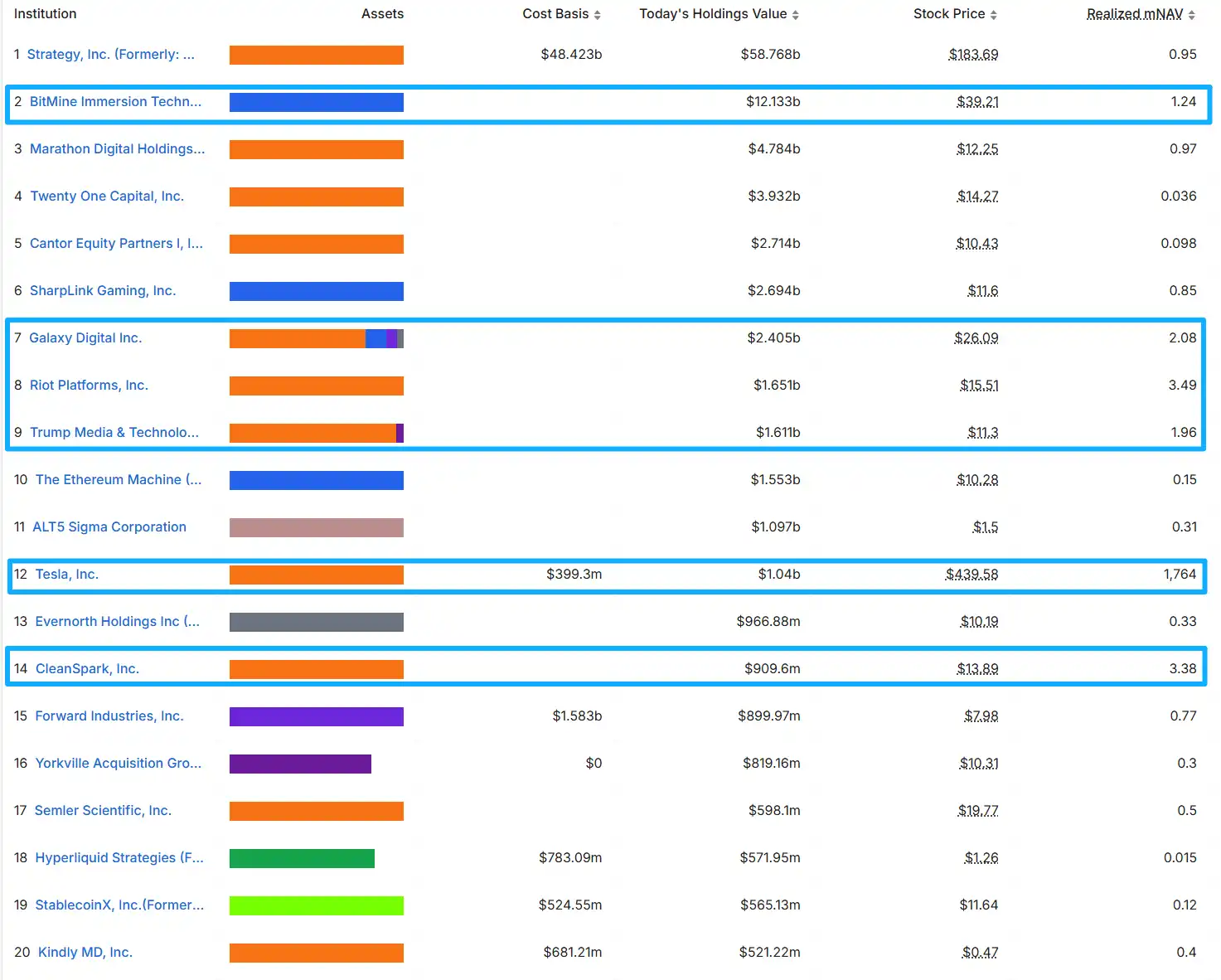
With the overall retreat of the current crypto market, these "coin-share companies" have shifted from the narrative core to the edge assets in the risk control model, and the market's valuation of these crypto asset reserve companies has generally turned cautious.
However, there is a magnitude difference between Strategy and Twenty One. Strategy currently holds about 660,600 BTC, accounting for about 3% of the total Bitcoin supply, a scale more than 15 times that of Twenty One. This volume not only gives it a stronger market voice but also symbolizes a certain "systemic anchor." When Strategy's mNAV falls below 1, the market naturally raises deeper questions: will it be forced to sell coins? Will a debt structure lead to a sell-off? Has the DAT model lost its logical basis in the face of macro cycles?
In fact, with the significant retreat of the crypto market in 2025, the DAT model faces a severe test. At the core of this model is the accumulation of Bitcoin through debt and equity financing, considering it as the "ultimate asset" to hedge against inflation and currency devaluation. However, when the price of Bitcoin experiences significant volatility, the stability of this model begins to shake. Some companies, although holding a large amount of BTC, face valuation pressure due to operating costs and market sentiment. While Twenty One's extreme discount is related to its asset acquisition method, it also reflects the market's centralized pricing of risk for the entire DAT model.
Conclusion: The narrative continues, but the market needs time
During the Binance Blockchain Week on December 4th, Michael Saylor provided a broader perspective. Under the title "Why Bitcoin Is Still the Ultimate Asset: The Next Chapter of Bitcoin," he once again reiterated his core judgment on Bitcoin's next decade: Bitcoin is transitioning from an investment to the "base capital" of the global digital economy, and the rise of the digital credit system will reshape the traditional $300 trillion credit market. From policy shifts and changes in banking attitudes to the institutional absorption of ETFs and the explosive growth of digital credit tools, Saylor depicts an accelerating new financial order that is emerging: digital capital provides energy, digital credit provides structure, and Bitcoin will be the underlying asset supporting everything.
From this perspective, companies like Twenty One indeed have a kind of "forward correctness" potential — if Bitcoin ultimately completes its transition from a high-risk asset to "digital gold," these companies may become the core carriers of this transition process.
However, the problem lies in the fact that "forward correctness" does not automatically equal "reasonable pricing at present." The market still needs time to validate Bitcoin's true role in the macro system and to reassess the resilience of the DAT model in different cyclical environments.
You may also like

Mining Companies' Great Migration: Some Have Already Secured $12.8 Billion in AI Orders
What Is Vibe Coding? How AI Is Changing Web3 & Crypto Development
What is vibe coding? Learn how AI coding tools are lowering the barrier to Web3 development and enabling anyone to build crypto applications.

The parent company of the New York Stock Exchange strategically invests in OKX: The intentions behind the $25 billion valuation

WEEX P2P update: Country/region restrictions for ad posting
To improve ad security and matching accuracy, WEEX P2P now allows advertisers to restrict who can trade with their ads based on country or region. Advertisers can select preferred counterparty locations for a safer, smoother trading experience.
I. Overview
When publishing P2P ads, advertisers can now set the following:
Allow only counterparties from selected countries or regions to trade with your ads.
With this feature, you can:
Target specific user groups more precisely.Reduce cross-region trading risks.Improve order matching quality.
II. Applicable scenarios
The following are some common scenarios:
Restrict payment methods: Limit orders to users in your country using supported local banks or wallets.Risk control: Avoid trading with users from high-risk regions.Operational strategy: Tailor ads to specific markets.
III. How to get started
On the ad posting page, find "Trading requirements":
Select "Trade with users from selected countries or regions only".Then select the countries or regions to add to the allowlist.Use the search box to quickly find a country or region.Once your settings are complete, submit the ad to apply the restrictions.
When an advertiser enables the "Country/Region Restriction" feature, users who do not meet the criteria will be blocked when placing an order and will see the following prompt:
If you encounter this issue when placing an order as a regular user, try the following solutions.
Choose another ad: Select ads that do not restrict your country/region, or ads that allow users from your location.Show local ads only: Prioritize ads available in the same country as your identity verification.
IV. Benefits
Compared with ads without country/region restrictions, this feature provides the following improvements.
Aspect
Improvement
Trading security
Reduces abnormal orders and fraud risk
Conversion efficiency
Matches ads with more relevant users
Order completion rate
Reduces failures caused by incompatible payment methods
V. FAQ
Q1: Why are some users not able to place orders on my ad?
A1: Their country or region may not be included in your allowlist.
Q2: Can I select multiple countries or regions when setting the restriction?
A2: Yes, multiple selections are supported.
Q3: Can I edit my published ads?
A3: Yes. You can edit your ad in the "My Ads" list. Changes will take effect immediately after saving.

What are the key highlights of this year's Ethereum's most important upgrade, the Glamsterdam upgrade?

March 6 Key Market Update You Can't Miss! | Alpha Morning Report

Sell Nvidia, Buy Power Plant: 27-Year-Old AI Investor Earns $5 Billion in One Year
The $24 Million Heist Behind It: The Most Dangerous Vulnerability in the Crypto World is Actually Human

Justin Sun Lawsuit Dismissed, BlackRock Bullish on Tokenization, What Is the English-Speaking Community Paying Attention To?

Morning News | NYSE parent company invests in OKX; Morgan Stanley provides $500 million loan to Core Scientific; Western Union partners with Crossmint to launch stablecoin USDPT

These former crypto builders have transitioned to the hottest AI projects globally

Ethereum Overhaul 2026 Blueprint, this time to abandon "gradualism"
What Is OpenClaw? How AI Agents Could Change Crypto Exchange Trading
OpenClaw is a rapidly growing open-source AI agent that can autonomously execute tasks and interact with software, including connecting to crypto exchanges through APIs to analyze markets and automate trading strategies. While this creates new opportunities for smarter trading, it also introduces security and operational risks. Through this article, WEEX aims to help users better understand the potential and risks of AI trading agents so they can explore new technologies while trading more safely and responsibly.
Ethereum 2029 Strawmap Guide: Ultra-Fast Consensus, Native Privacy, and the "Acceleration Variables" Brought by AI

Altcoin ETF Surge: SOL and XRP Inflows Total $23 Million as Institutions Diversify
Key Takeaways Institutional interest in altcoin ETFs is expanding, with SOL and XRP showing significant inflows on March…
Vitalik Drops Ethereum Endgame Bombshell: ETH USD to $3,000?
Key Takeaways Vitalik Buterin introduces the “Sanctuary Tech” manifesto to address Ethereum’s non-financial limitations. A current lack of…
Exclusive: Yuliya Barabash Predicts the Most Regulated Could Be the Biggest Crypto Winners
Key Takeaways The aftermath of FTX and Celsius collapses has ushered a new regulatory era, reshaping the crypto…

iPhone Crypto Wallets Under Threat from State-Grade Malware
Key Takeaways: The Coruna exploit kit exploits 23 iOS vulnerabilities, threatening iPhone users’ crypto wallets. Initially state-level surveillance,…
Mining Companies' Great Migration: Some Have Already Secured $12.8 Billion in AI Orders
What Is Vibe Coding? How AI Is Changing Web3 & Crypto Development
What is vibe coding? Learn how AI coding tools are lowering the barrier to Web3 development and enabling anyone to build crypto applications.
The parent company of the New York Stock Exchange strategically invests in OKX: The intentions behind the $25 billion valuation
WEEX P2P update: Country/region restrictions for ad posting
To improve ad security and matching accuracy, WEEX P2P now allows advertisers to restrict who can trade with their ads based on country or region. Advertisers can select preferred counterparty locations for a safer, smoother trading experience.
I. Overview
When publishing P2P ads, advertisers can now set the following:
Allow only counterparties from selected countries or regions to trade with your ads.
With this feature, you can:
Target specific user groups more precisely.Reduce cross-region trading risks.Improve order matching quality.
II. Applicable scenarios
The following are some common scenarios:
Restrict payment methods: Limit orders to users in your country using supported local banks or wallets.Risk control: Avoid trading with users from high-risk regions.Operational strategy: Tailor ads to specific markets.
III. How to get started
On the ad posting page, find "Trading requirements":
Select "Trade with users from selected countries or regions only".Then select the countries or regions to add to the allowlist.Use the search box to quickly find a country or region.Once your settings are complete, submit the ad to apply the restrictions.
When an advertiser enables the "Country/Region Restriction" feature, users who do not meet the criteria will be blocked when placing an order and will see the following prompt:
If you encounter this issue when placing an order as a regular user, try the following solutions.
Choose another ad: Select ads that do not restrict your country/region, or ads that allow users from your location.Show local ads only: Prioritize ads available in the same country as your identity verification.
IV. Benefits
Compared with ads without country/region restrictions, this feature provides the following improvements.
Aspect
Improvement
Trading security
Reduces abnormal orders and fraud risk
Conversion efficiency
Matches ads with more relevant users
Order completion rate
Reduces failures caused by incompatible payment methods
V. FAQ
Q1: Why are some users not able to place orders on my ad?
A1: Their country or region may not be included in your allowlist.
Q2: Can I select multiple countries or regions when setting the restriction?
A2: Yes, multiple selections are supported.
Q3: Can I edit my published ads?
A3: Yes. You can edit your ad in the "My Ads" list. Changes will take effect immediately after saving.


 App
App