
- Buy Crypto
- Markets
 Futures
- Spot
- Copy Trade
- Earn
- More
From Wild Fundraising to Unwarranted Hype, What Is Happening to Crypto VCs?

Original Article Title: "Crypto VC in the Midst of Liquidity Anxiety: An Unfolding Imbalance"
Original Source: ChandlerZ, Foresight News
Waterdrop Capital partner Dashan admitted in a recent Space session that all four projects he had recently invested in had launched on Binance, but none had distributed tokens to investors according to the original investment agreement. Despite the token distribution terms being clearly outlined in the contract, after the project goes live, the agreement can be amended at will, and investors are almost unable to take any effective countermeasures.
He mentioned that the amendment to the agreement was not actually the project team's intention, but rather a longstanding unwritten rule of Binance, so he does not blame the project teams because they are also at a disadvantage in front of Binance. The current strategy is very clear: to persuade and help truly high-quality project teams to forgo token distribution and go directly to listing on a relatively clean and regulated market to showcase their value.
In traditional VC investments, rights protection based on contracts does not have the same practical binding force in the encrypted token investment structure. Due to exchanges leading circulation rules after token listing, on-chain asset allocation is not immediately bound by the traditional legal system, and investment agreements often lose their enforceability at critical junctures. In the current market environment, whether a project can gain access to a top exchange directly affects its overall survival, and the importance of agreement terms is marginalized in the face of actual interests. In order to get listed, project teams have to cooperate with exchanges in redesigning aspects such as release schedule, lock-up rules, token distribution ratios, etc. Investors, lacking on-chain governance rights and circulation discourse power, find themselves in a de facto rights disadvantage.
This statement reveals a deep-rooted crisis that the current crypto VC investment system is facing, namely a dilemma where the effectiveness of contracts, liquidity control, and exit mechanisms have completely failed.
Imbalance of Power: The New Relationship Among VCs, Projects, and Exchanges
In the industry's development over the past few years, the model of "project narrative construction - multi-round VC financing - top exchange token generation event (TGE)/listing" has gradually become mainstream. The hallmark of this model is that in the early stages, projects rely on professional VC institutions for funding, resource connection, and reputation endorsement, completing financing with gradually increasing valuations, with the ultimate goal usually being the initial token issuance and circulation on a large centralized exchange for early investors to exit.
In the previous multiple bull markets, crypto VCs, as core resources, held significant power in early-stage financing and token issuance design, playing a key role in driving rapid industry expansion and project incubation. In the last bull market, the position of project teams was enhanced, but VCs still had some dominance due to their large capital and liquidity empowerment such as Launchpad.
However, as the market enters a new adjustment period, liquidity in the altcoin space dries up, and the incentive structure between investors and projects shifts. Exchange power has reached unprecedented levels, becoming the absolute controller of liquidity, with key processes such as listing approval, token allocation, and circulation strategy concentrated in the hands of exchanges. This places projects in an extremely weak position during negotiations, even if they have signed detailed investment agreements. Faced with exchange-proposed changes to circulation conditions, project teams find it difficult to refuse, ultimately having to violate the original agreements with investors.
Exchanges have become the controllers of scarce resources, while VCs are gradually being marginalized, with their actual control capacity significantly reduced.
The "Prisoner's Dilemma" in Liquidity Contraction
The current dilemma faced by "VC coins" is not caused by a single factor.
After multiple rounds of funding, projects often have a high public market valuation at the time of Token Generation Event (TGE). This directly results in a high initial buy-in cost for secondary market investors, while also implying that early investors including VCs, the team, early supporters, etc., hold a large amount of low-cost chips and have a strong potential sell-off motive.
This expectation gap puts tokens under natural selling pressure after listing, with market participants potentially forming a consensus that "selling is the optimal strategy," triggering a negative feedback loop.
Furthermore, the token economy itself exacerbates the dilemma of VC coins.
During a bull market, many projects' token issuance models follow the high growth assumptions of the bull market, such as continuous market cap growth and sufficient liquidity to support gradual unlocking. However, in practice, many projects lack real revenue support, with DeFi relying on Ponzi schemes, GameFi relying on subsidies, NFTs relying on FOMO, and tokens completely losing intrinsic growth momentum.
Most importantly, tokens invested by VCs in the past could eventually be sold to new retail investors on the secondary market, forming a complete exit path. However, there are currently very few new retail investors on-chain and on exchanges, incremental funding is drying up, and VC mutual selling has become the norm.
Essentially, early investors, project teams, liquidity providers, and early users have become part of a zero-sum game within a closed loop, making it increasingly difficult to exit.
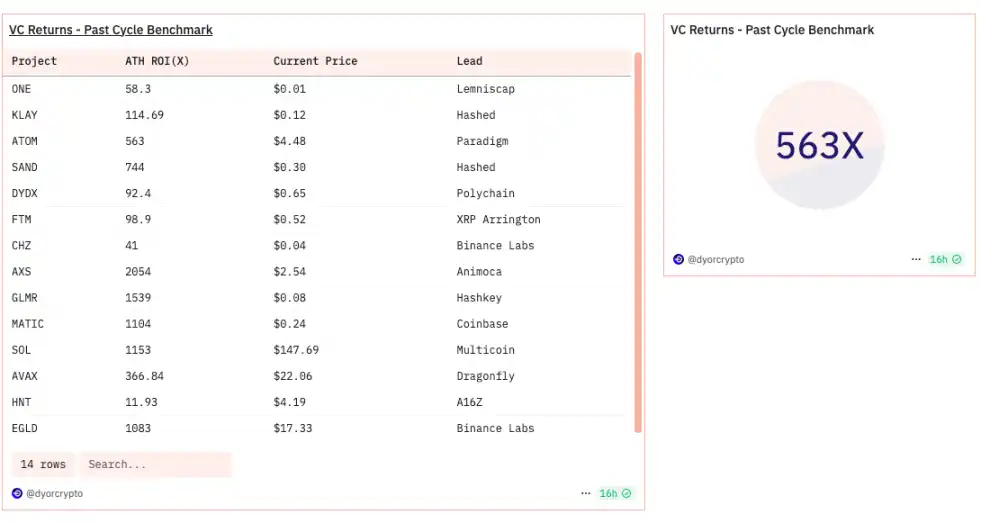
VC Return in the Previous Bull Market Cycle
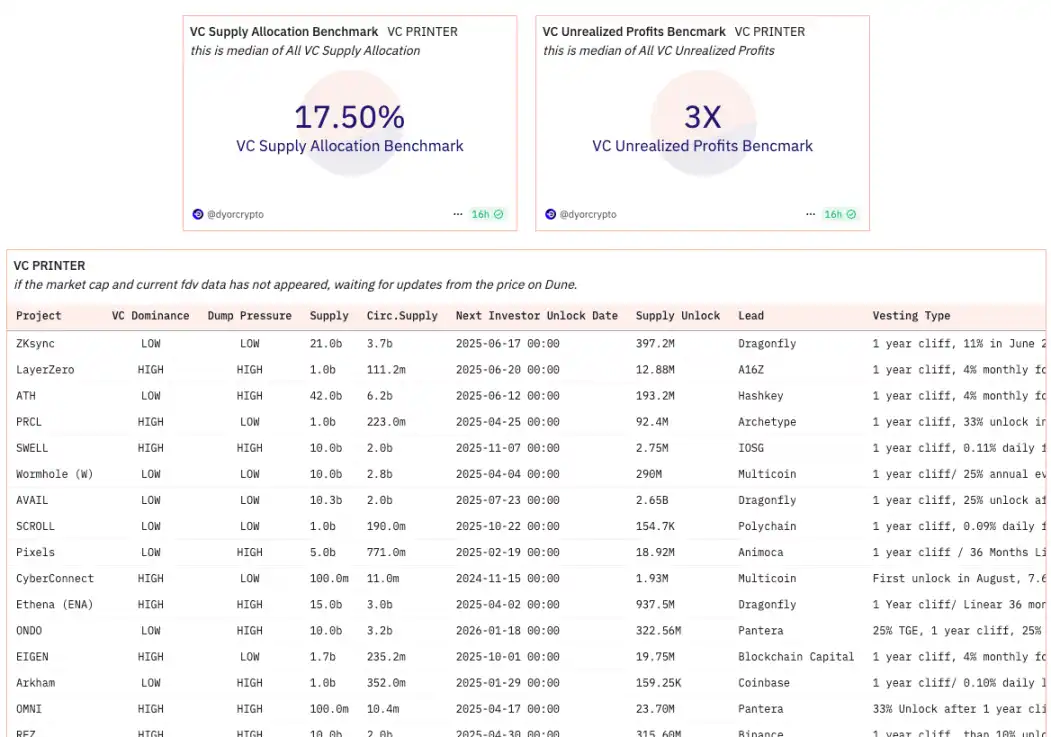
VC Return in the Current Cycle
For VC firms, the traditional strategy of relying on rapid TGEs to achieve high multiple exits is facing challenges, and the realization period of investment returns may lengthen, increasing uncertainty. This may prompt VCs to focus more on a project's long-term fundamentals, sustainable business models, reasonable valuations, and healthier tokenomic models when making investment decisions. Their role may also need to evolve from focusing on early-stage investment and driving listings to more in-depth post-investment management, strategic empowerment, and ecosystem development.
For project teams, there is a need to reassess their token issuance strategy and community relationships. Following the questioning of the "pump and dump" model, exploring a lower valuation starting point, a more equitable distribution mechanism, designing tokenomics that better incentivize long-term holders, as well as increasing operational transparency and strengthening accountability may be more worth exploring.
From a more macro perspective of industry development, the current challenges can be seen as an adjustment in the market's path to maturity. It has exposed issues accumulated during past rapid growth and may drive the formation of a more balanced, sustainable financing, and development ecosystem. This requires all market participants, including VCs, project teams, exchanges, investors, and even regulatory bodies, to collectively adapt to change, seeking to establish a new equilibrium between innovation incentives and risk control, efficiency, and fairness.
Original Article Link
You may also like

Make Probability an Asset: A Forward-Looking Perspective on Predictive Market Agents

Consumer application issues

Arthur Hayes: The flames of war in the Middle East rise, Bitcoin is bullish

Legendary investor Naval: In the AI era, traditional software engineers have no value?

More absurd than knowing about the war in advance is knowing in advance about the assassination of Soleimani
Key Market Insights on March 2nd, how much did you miss?

How to systematically track high-performing addresses on Polymarket?

From Stanford Lab to Silicon Valley Streets: How OpenMind is Solving the "Last Mile" Problem of the Machine Economy?

PlanX: Reconstructing On-Chain Execution with AI, Moving Towards a New Paradigm

US Judge Allows Binance Unregistered Token Lawsuit to Advance
Key Takeaways: A federal judge in Manhattan dismissed Binance’s petition to resolve a securities lawsuit through private arbitration,…

Crypto VC Paradigm Plans $1.5 Billion Expansion into AI and Robotics
Key Takeaways: Paradigm is setting up a new $1.5 billion fund to explore AI, robotics, and other emerging…
Ethereum Smart Accounts Set to Launch Within a Year, According to Vitalik Buterin
Key Takeaways: Ethereum’s “account abstraction” or smart accounts might be introduced in the coming year through the Hegota…
Bitcoin Recovers After Iran Conflict Shocks Market, Reverses $5K Fall in Just 24 Hours
Key Takeaways: Bitcoin dropped to approximately $63,000 amid tensions but rebounded to $68,200 within a day. Volatility led…

Former Mt. Gox CEO Suggests Hardfork to Retrieve $5.2 Billion in Bitcoin
Key Takeaways: Mark Karpelès, former CEO of Mt. Gox, proposes a Bitcoin network hard fork to access nearly…

South Korea National Tax Service’s Mistake Resulted in $4.8 Million Crypto Loss
Key Takeaways South Korea’s National Tax Service inadvertently exposed private keys, resulting in a $4.8 million crypto loss.…

Morgan Stanley Seeks National Trust Charter for Cryptocurrency Custody
Key Takeaways: Morgan Stanley has initiated a significant step toward digital asset management by applying for a national…

Solana Price Outlook: Major ETF Inflows Hint at Institutional Moves
Key Takeaways: Solana has experienced substantial ETF inflows, prompting speculation about institutional buy-in. On February 25, Solana recorded…

Bitcoin Price Prediction: Wikipedia Founder Warns BTC Could Plunge Below $10K — Should Investors Worry?
Key Takeaways Wikipedia co-founder Jimmy Wales warns Bitcoin might decline to below $10,000, prompting a bearish outlook. Wales…


 App
App