
Google Executive Makes Millions Overnight through Insider Trading

 Prefer us on Google

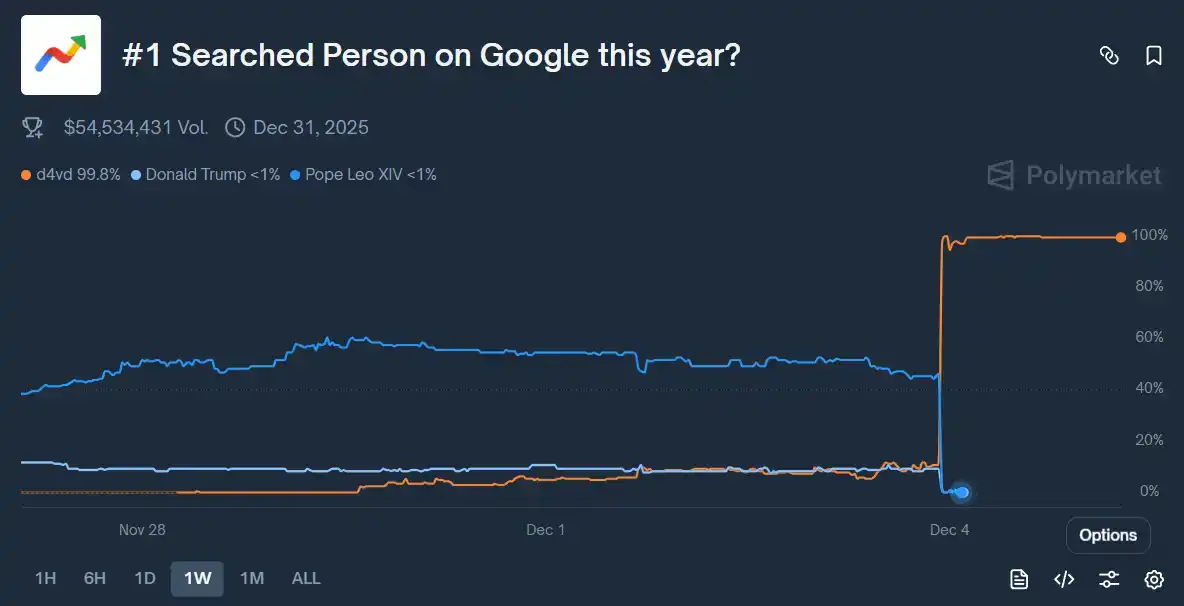
This week's most trending Polymarket event was undoubtedly the sensational market on "Who will be the person with the top Google Annual Search Ranking in 2025?" Yesterday's market frenzy saw Pope Leo XIV maintaining the top spot with a stable probability of around 50% since the market opened. Global personalities such as Trump, Taylor Swift, and Musk also captured the market's attention — what was supposed to be a list of contenders among "celebrities."
The majority of traders have never seriously looked at those near-zero-weight options at the bottom of the market: Mikey Madison, Andy Byron, d4vd... Their presence seems merely to enrich the odds table, and no one really considers them as potential winners.
The Ignored "Whale" Contrarian Move
A week ago, while everyone focused on the fluctuations of these star-studded options, an address (0xafEe) made a large purchase at a very low price for the "d4vd = Yes" position. In a prediction market, price equals probability — and at that time, d4vd's probability was not only extremely low but almost negligible.
To others, this was just an insignificant "lottery position": options with a long-shot probability close to zero that could bring tens of times the return once the probability reaches 10%. The trader invested only $20,000 in this position, considering his trading history of nearly $10 million, making the "lottery position" argument more convincing.
The truly bizarre move occurred one week later.
With the timing of Google's release of the search ranking completely unknown, the trader suddenly began massive accumulation the day before yesterday. Instead of buying the "Yes" for popular figures, he aggressively bought up their "No" positions.
Pope Leo XIV, Trump, Taylor Swift, the newly elected mayor of New York... All options deemed "potential winners" by the market were emphatically denied by him with millions of dollars in real money.
This move, devoid of any hedging logic and price impact consideration, completely defied whale trading logic and did not even resemble typical investment behavior. Some in the market started to notice this contrarian whale, but most simply took him as a joke of "fool and his money."
Astonishing Market Reversal
However, just a few hours after he completed his purchases, Google unexpectedly released the annual search ranking. At the moment the rankings were announced, the entire market collectively froze — the top spot belonged not to the Pope, Trump, or any popular option but to the name with a long-shot probability close to zero, a name the trader didn't even bother to look up: d4vd.
The market exploded in an instant. Within a few seconds, the probability of d4vd surged vertically from the bottom of the chart to 99.9%, with all other options clearing to zero instantly. While the market was still trying to understand whether this was a bug in the Google system, someone had already noticed: the whale who had been "randomly trading" continuously had made a daily profit of over one million dollars.
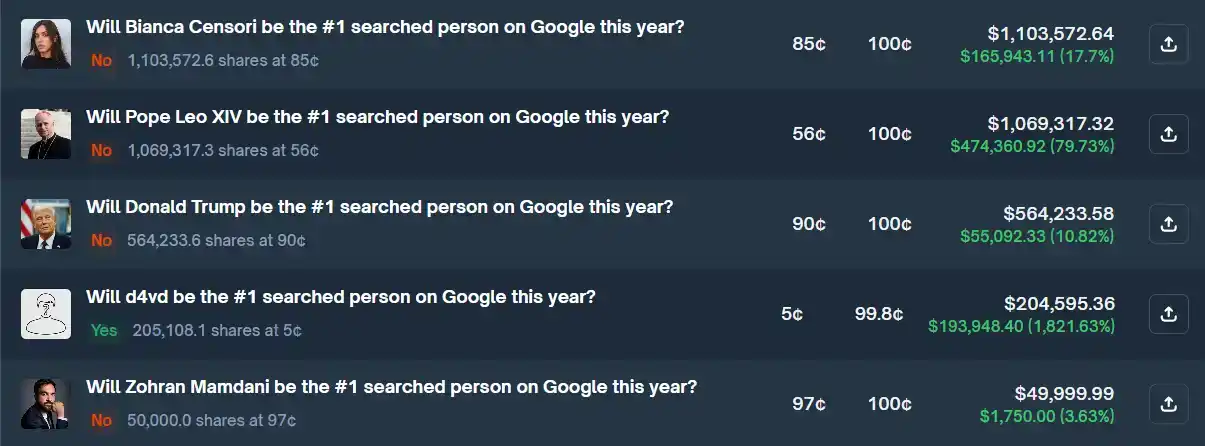
His purchase of "d4vd = Yes" was a win, yielding nearly 20 times the investment. All his purchases of "Popular Figure = No" also won.
As people continued to scroll through his positions, they discovered that in another almost identical market, "2025 Google Annual Top 5 Search Person," he also won all positions, with nearly $500,000 invested across ten positions and a floating profit of $292,000. He also participated in seven markets regarding the Gemini new version release time, investing over $1 million, and still profiting on all.
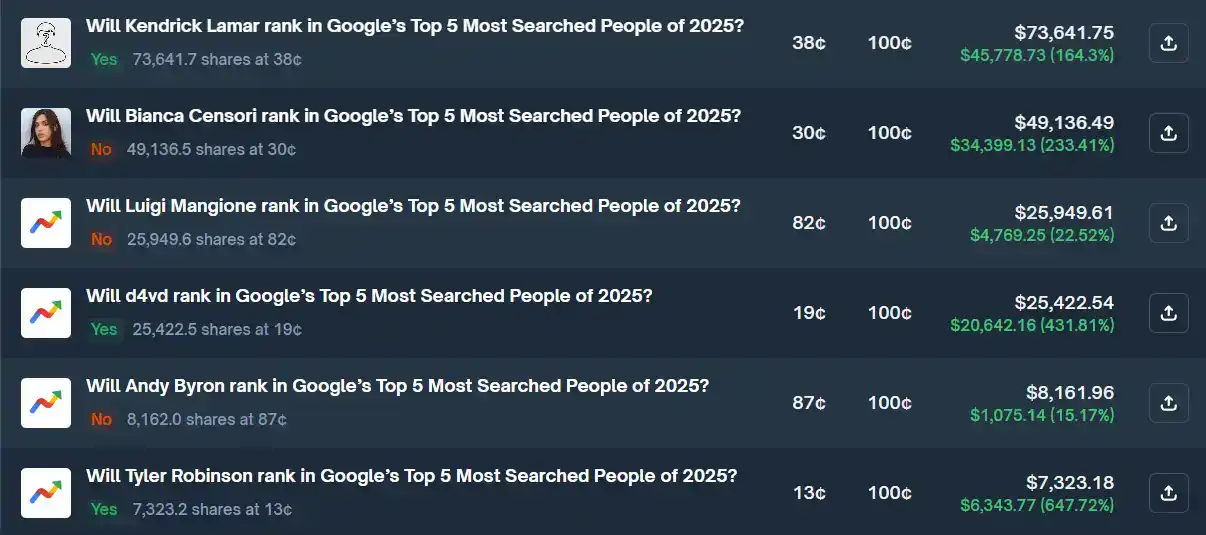
In other words, as long as it's related to Google, he seems to never make a wrong bet.
More Terrifying Than Insider Trading: The "Rewriter"
When people began to characterize this as a Google insider using information asymmetry to profit, a deeper on-chain investigation pushed this event in a more unsettling direction. Analysis revealed that the trader's address was adorableraccoon.eth, and according to on-chain records, he had previously deposited over $15 million worth of ETH into Aave before November 4th.
With on-chain assets alone exceeding $15 million, this is clearly not a wealth level attainable by an average Google employee. More and more signs indicate that this person is highly likely not just an ordinary engineer but deeply embedded in the Google core system, perhaps even holding decision-making power within Google's upper echelons.
With this in mind, a more dangerous question arises: what if he not only knew the outcomes in advance but also had the ability to manipulate them?
The Google Yearly Search Chart is not solely determined by search volume but relies on an internal algorithm highly sensitive to instantaneous search spikes. In theory, as long as one understands the algorithm's parameters, weights, and thresholds, it's possible to easily propel a name to "skyrocket" on the list. For a true Google executive with authority, making a name explosively top the chart is not an unattainable task. In this framework, the prediction market is not a tool for predicting the future but rather an arbitrage instrument that some can use based on their position, manipulating the future through a secretive decision chain.
If this wealthy Google executive indeed has the ability to manipulate the algorithm, then all prediction markets related to Google would not just be a channel for him to exploit information asymmetry for profit; as long as he is willing, he could even "fine-tune" the world line, steering it towards the direction most favorable to himself.
-- Price
Conclusion
A person holding key decision-making power, for the first time in the open market, has demonstrated that he can transform the prediction market from a "settlement platform for information asymmetry discounting" into a "tool for altering reality."
The prediction market has always been seen as a reverse search for truth, a price mechanism driven by collective wisdom; yet in this event, it has been shown for the first time that it can be used by certain individuals with system access to manipulate the world line.
What he is betting on is not just the future, but the future he can create.
This content is provided for general informational purposes only and doesn't constitute financial, investment, legal, or tax advice. Any events, rewards, online promotions, or related information mentioned herein should not be considered a recommendation, solicitation, or invitation to purchase, sell, trade, or otherwise deal in any crypto assets. Crypto assets are highly volatile and may result in loss. The availability of WEEX services, products, and related events may vary by region. You are responsible for ensuring that your participation is in accordance with applicable local laws and regulations.
You may also like
Aave V4 starts USDe rewards via Ethena market

Discussion on Risk Adjustment Authority Segmentation for Aave V4
Ether.fi Cash Spending Reaches $103 Million, Buyback Proposal Vote Concludes

Sonic Announces Shift to Revenue-Driven Model with $7.6 Million Decrease in Aave Deposits

Base Loan Balance Reaches $2.337 Billion, Concentrated in Morpho

On-Chain Stablecoins vs. U.S. Treasuries: Higher Risks, Are They Matched by Sufficient Yield Premiums?

Stablecoin Market Size Reaches $303.966 Billion, On-Chain Yield Differentiation

Dialectic Launches DeFi Vault Offering Tokenized Exposure to SpaceX

DeFi Lending Activity Surges to $26.1 Billion, Nearly 30% Growth

NAVI Prime: How the Largest Lending Protocol on Sui Innovates to Pave the Way for a $10 Billion Fund After $30 Billion in Loans Over Three Years?
Crypto stock tokens barely move over weekend, revealing markets become illiquid when Wall Street goes offline

637% Growth in the Market Value of Tokenized Stocks Reaches $2.54 Billion

Tokenized gold is becoming productive collateral in crypto lending, Arch says

European Blockchain Convention 2026: Information and Exclusive Promotion

Mantle stablecoins and tokenized assets reach $880M

Lido Reduces Management Fee for EarnETH by 80%
Aave iOS App Opens Early Access, Android and Web Users Awaiting

Engrave Releases Zero Firmware 1.8 QR Specification
Aave APP Launches Ghost Pass Invitation Mechanism
40% Drop ≠ Crash: Galaxy Q2 Report Reveals the Resilience of the Crypto Credit Market

Financial AI Platform Oro Secures $3 Million Funding Led by MH Ventures and Mapleblock Capital
World Liberty Financial Reports $10.47 Million in Revenue, Diverse Approaches to DeFi Profit Distribution
62.8% of Tether Liquidity Concentrated in Aave V3
Tokenized U.S. Treasury Fund Reaches $16.15 Billion

The next phase of tokenization is utility
Aave V4 Total Deposits Exceed $600 Million

Aave's Efficient Mode Accounts for 8.91% of Total Loans, Including Over Half of Unpaid Debt

Web3: Foreign Media Reports Need for Safer Liquidity Tools in Crypto Collateralized Lending
Tokenized Gold Market Reaches $4.8 Billion, Dominated by Tether Gold and Paxos Gold
Aave Accepts Gold Collateral Worth 90.4 Billion Won, Expanding On-Chain Gold Utilization
Aave V4 starts USDe rewards via Ethena market
Discussion on Risk Adjustment Authority Segmentation for Aave V4
Ether.fi Cash Spending Reaches $103 Million, Buyback Proposal Vote Concludes
Sonic Announces Shift to Revenue-Driven Model with $7.6 Million Decrease in Aave Deposits
Base Loan Balance Reaches $2.337 Billion, Concentrated in Morpho
On-Chain Stablecoins vs. U.S. Treasuries: Higher Risks, Are They Matched by Sufficient Yield Premiums?
Contents
Latest articles



Latest coin listings on WEEX


