
- Buy Crypto
- Markets
 Futures
- Spot
- Copy Trade
- Earn
- More
Government Shutdown, White House Renovation: Who Is Footing the Bill for Trump's $300 Million “Private Banquet Hall”?

Original Article Title: "Government Shutdown, White House Demolition: Trump's $300 Million 'Private Banquet Hall' and Its Crypto Backers"
Original Article Author: Ding Dang, Odaily Planet Daily
While the U.S. government is in a shutdown, the excavator in the White House East Wing is roaring day and night.
U.S. President Trump personally approved this grand demolition operation, not for national security or to make "America Great Again," but to build a privately financed 80,000-square-foot banquet hall next to the White House.
A "Demolish and Rebuild" Ceremony
The White House East Wing, built in 1942, was originally the entrance symbolizing the system and power: the First Lady's Office, the White House Military Office, and the Social Secretary's Office were all located in that modest yet dignified building. For decades, it has been the first door for countless visitors to step into the center of American power. Now, that door is temporarily closed. The White House announced last month, citing banquet hall construction, an indefinite suspension of all public tour activities.
As early as August of this year, Trump proposed to build a new banquet hall at the White House. At that time, he said that the new banquet hall would be "next to but not touching" the existing structure. By October 22, he personally confirmed in the Oval Office: "To correctly complete this work, we must demolish the existing structure," because consulting with architects revealed that demolishing the entire White House East Wing would be more effective than partial demolition. Otherwise, it would damage the new banquet hall, a "very, very expensive, beautiful building." As he spoke, a model of the White House was placed on the table in front of him, with him holding a rendering of the White House banquet hall.
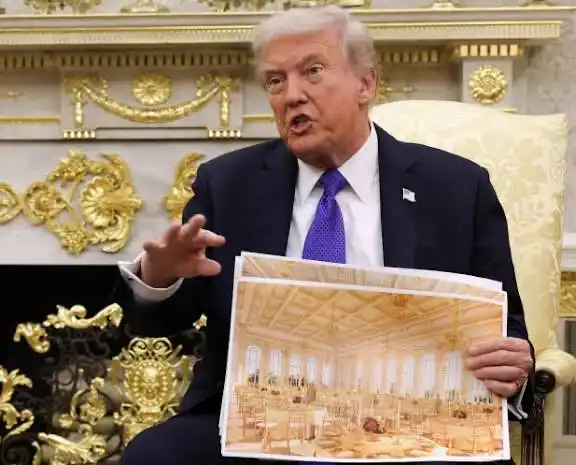
Therefore, the originally planned new banquet hall, designed to accommodate 650 people, ended up being expanded to accommodate nearly a thousand, with the cost increasing from the initial $200 million to around $300 million. A White House spokesperson stated that the East Wing would be "completely" modernized and rebuilt in the end.
Where Is the Money Coming From?
This is not a federal budget expenditure but a "private crowdfunding" event. Trump stated that the $300 million cost would not be borne by taxpayers but by private donors, including himself.
It makes sense, as according to the latest survey by the Financial Times, the Trump family's crypto business has generated over $1 billion in pre-tax profits over the past year. When accounting for mark-to-market gains, their net worth may have increased by billions of dollars. In the face of such financial strength, donations are probably just a public relations expense to "leave a mark in history."
Last week, Trump held a fundraising dinner, stating that he had received donations from some "generous patriots, extraordinary American companies." According to the list of donors released by the White House on October 23, the list includes some of the largest U.S. tech companies, including Amazon, Apple, Google, Meta, and Microsoft. Google's subsidiary YouTube has agreed to contribute over $20 million to the project. Additionally, defense and telecom giants such as Lockheed Martin, Comcast, T-Mobile, and Palantir are also on the list.
Of particular note, the cryptocurrency industry has also made its way onto the White House's donor list. Ripple, Tether America, Coinbase, and the Winklevoss brothers (both Cameron and Tyler appear on the list) are all mentioned. Ripple has become a symbol of the cryptocurrency industry's "anti-regulation" stance due to its long-running legal battle with the SEC; Coinbase has long been navigating the lobbying system in hopes of earning the label of "legitimacy."
Over the past decade, the cryptocurrency industry has touted itself as a "decentralized revolution," opposing the monopoly of traditional power. Now, they have entered a corner of history with a "donation" and have proven through a single bill:
The decentralized future ultimately also needs a center.
Of course, not everyone is thrilled about this reconstruction. "To my mind, this grand banquet hall is a moral nightmare," said Richard Painter, a veteran attorney who served as White House legal counsel in the George W. Bush administration. "It's about raising money through the channels to power... These companies all want something from the government."
The brick wall of the White House East Wing is coming down, and a new hall is being built. In this "rebuilding ceremony," new benefactors are entering the scene. The rules of the Washington game have not changed—it's just that this time, crypto capital has finally received its ticket to enter.
You may also like

2025 South Korea CEX Listing Post-Mortem: Investing in New Coins = 70% Loss?

BIP-360 Analysis: Bitcoin's First Step Towards Quantum Immunity, But Why Only the "First Step"?

50 million USDT exchanged for 35,000 USD AAVE: How did the disaster happen? Who should we blame?

The Cryptographic Past of the Middle East

Resolving the Intergenerational Prisoner's Dilemma: The Inevitable Path of Nomadic Capital Bitcoin

Who Will Control AI? Why Decentralized AI May Be the Only Alternative to Government and Big Tech
AI has become critical infrastructure, and governments and corporations are competing to control it. Centralized development and regulation are entrenching existing power structures. The Web3 community is building a decentralized alternative — distributed compute, token incentives, and community governance — before that window closes.

Vitalik wrote a proposal teaching you how to secretly use AI large models

On the eve of the explosion of on-chain options

WEEX AI Hackathon: How Did This AI Trading Winner Succeed?
A self-taught AI trading enthusiast achieved top-10 results at the WEEX AI Hackathon. Learn about the mindset, AI tools, and lessons behind this impressive performance.

One Balance to Rule Them All: Gravitas' On-Chain Prime Broker Ambition

That person who cashed out at the NFT peak is now selling a new shovel in the OpenClaw craze

Inter-generational Prisoner's Dilemma Resolution: The Nomadic Capital and Bitcoin's Inevitable Path

Upstream and downstream are starting to fight, all for the sake of everyone being able to "Lobster"
Circle and Mastercard Announce Partnership, the Next Stage for the Crypto Industry Belongs to Payments

From 5 Mao per kWh of Chinese electricity to a $45 API export: Tokens are rewriting currency units

Why is OpenAI playing catch-up to Claude Code instead?

Vitalik wrote a proposal teaching you how to secretly use AI large models

The doubling of Circle's stock price and the paradigm shift of stablecoins
2025 South Korea CEX Listing Post-Mortem: Investing in New Coins = 70% Loss?
BIP-360 Analysis: Bitcoin's First Step Towards Quantum Immunity, But Why Only the "First Step"?
50 million USDT exchanged for 35,000 USD AAVE: How did the disaster happen? Who should we blame?
The Cryptographic Past of the Middle East
Resolving the Intergenerational Prisoner's Dilemma: The Inevitable Path of Nomadic Capital Bitcoin
Who Will Control AI? Why Decentralized AI May Be the Only Alternative to Government and Big Tech
AI has become critical infrastructure, and governments and corporations are competing to control it. Centralized development and regulation are entrenching existing power structures. The Web3 community is building a decentralized alternative — distributed compute, token incentives, and community governance — before that window closes.


 App
App