Is the WEEX AI Trading Hackathon Worth Joining? $1.88M Prize Pool and Rules Explained

 Prefer us on Google

WEEX Labs, the innovation arm of WEEX, a leading global crypto exchange serving over 6.2 million users across 150+ countries, has officially launched the Preliminary Round of its flagship event, AI Wars: WEEX Alpha Awakens, which went live on January 12, 2026.
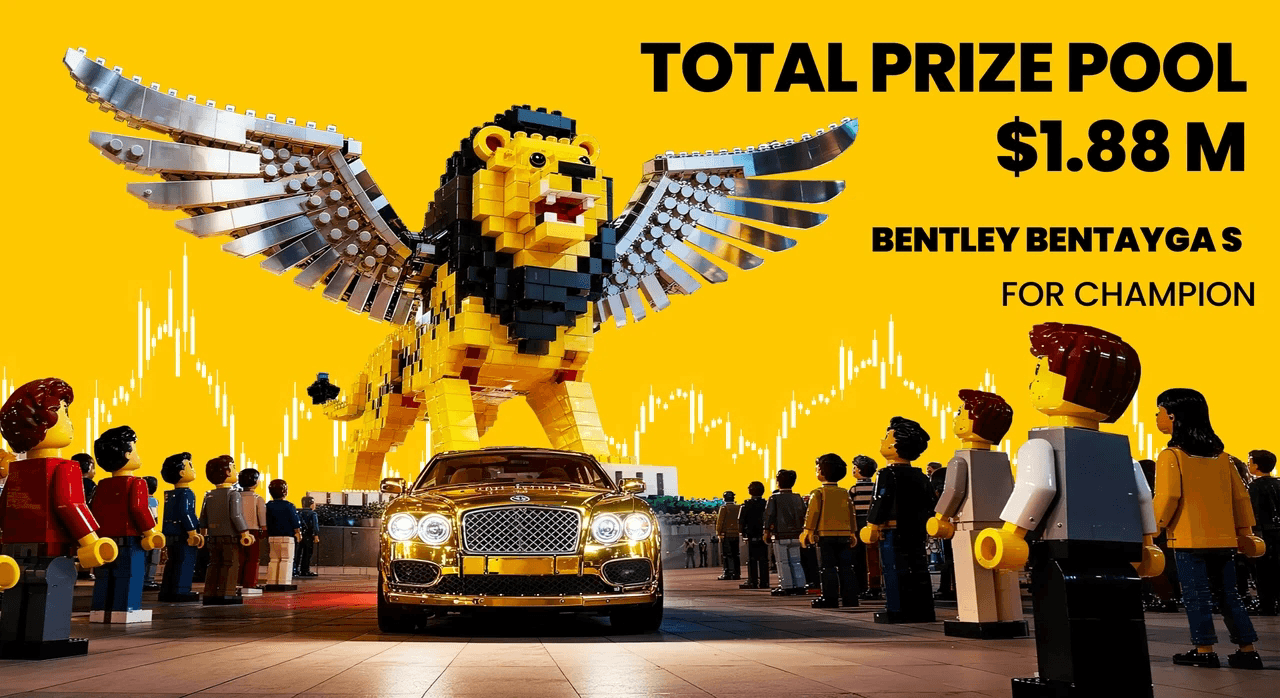
Backed by world-class sponsors led by Amazon Web Services (AWS), Alibaba Cloud, Tencent Cloud and CoinGecko, etc, the total prize pool has surged to an unprecedented $1,880,000, making AI Wars one of the largest AI trading hackathons in the crypto industry. At the very top of the leaderboard awaits a once-in-a-lifetime reward — a Bentley Bentayga S, already on standby in Dubai, ready for the ultimate AI trading champion.
The Preliminary Round is now in full swing! Missed the first wave? A Forked Entry is now open for latecomers, with registration closing on January 18. Find your final gateway to the arena, and track the live updates of the competition here: https://www.weex.com/events/ai-trading
Participation Rules: Transparent, Fair, and Truly AI-Driven

The Preliminary Round is built on a foundation of fairness, transparency, and real AI innovation. Every participant must strictly follow the official rules, including the proper use of AI throughout the competition and the complete submission of AI Log data. Any participant who fails to comply — whether by manual trading, incomplete AI usage, or missing logs — will be deemed ineligible, and their results will not be counted.
Trading & API Rules
1. All trades must be executed via the WEEX OpenAPI.
2. Only the officially designated futures trading pairs are permitted.
3. Maximum leverage: 20×
4. Designated trading pairs: cmt_btcusdt, cmt_ethusdt, cmt_solusdt, cmt_dogeusdt, cmt_xrpusdt, cmt_adausdt, cmt_bnbusdt, cmt_ltcusdt
5. Prolonged inactivity or manual trading is strictly prohibited. Once verified, the relevant BUIDL will be disqualified from the rankings.
AI Usage Requirements
1. Competition strategies must use AI as a core or key decision-support component, with outputs that materially impact trading decisions and execution.
2. Participants must submit their AI log data via the "Upload AI Log" interface. Failure to submit complete logs as required will result in disqualification.
3. The AI used in this competition must demonstrate capabilities beyond fixed rule sets, static parameters, or single predictive models, including a certain degree of generalization, adaptability, or strategy-generation ability (such as LLM-based systems).
4. Strategies that rely solely on predefined conditions, manual rules, or historical data fitting are not considered compliant AI solutions for this competition.
5. Participants may combine traditional quantitative methods, statistical models, or technical indicators with AI. However, AI must not be used solely for display purposes or as a non-essential component.
6. The review committee reserves the right to determine compliance based on strategy descriptions, submitted logs, and actual trading behavior.
Find the full rules here : https://www.weex.com/events/ai-trading
This structure ensures that every ranking reflects genuine machine intelligence — not manual tricks or cosmetic automation. Only real AI earns real alpha in AI Wars.
WEEX Global AI Trading Hackathon Prize Pool Breakdown: Total, Preliminary, and Final Rewards
At the heart of AI Wars: WEEX Alpha Awakens is one of the most powerful incentive systems ever assembled for an AI trading competition. The total prize pool now exceeds $1.88 million, built by a coalition of top-tier global partners. AWS alone contributes $1 million in cloud credits, giving every serious team production-grade infrastructure from day one. WEEX adds another layer of real-world impact with $500,000 in physical prizes, including the Bentley Bentayga S for the ultimate champion, plus $200,000 in trading vouchers to fuel live-market experimentation. The ecosystem is further strengthened by Tencent Cloud and Alibaba Cloud, while AI-native partners such as Hubble AI, CoinGecko, and Cryptoracle provide professional-grade data, agent marketplaces, and on-chain factor libraries. This is not a symbolic prize pool—it is a full-stack AI trading arsenal. AI Wars doesn’t just reward brilliance—it equips it.
The Preliminary Round alone carries a prize pool of over $880,000, designed to ensure that every qualified team can compete on equal footing. AWS contributes $600,000 in cloud credits, distributed across dozens of teams, while WEEX injects $200,000 in trading vouchers to support real-market execution. Participants also gain access to Hubble AI’s agent marketplace credits, CoinGecko’s professional Analyst API keys, and Cryptoracle’s institutional-grade on-chain data. Even before reaching the finals, builders are already operating with the same tools used by professional trading firms. The preliminaries are not a warm-up—they are a real battlefield.

Those who rise to the top advance into a Final Round worth over $1M, where prestige meets scale. Finalists compete for another $400,000 in AWS cloud credits, the $500,000 WEEX physical prize pool, and advanced resources from Tencent Cloud, Alibaba Cloud, Hubble AI, CoinGecko, and Cryptoracle. Here, AI trading systems are no longer prototypes — they become production-grade strategies, evaluated in live markets under global attention. The Finals are where experiments turn into engines of alpha.

Crucially, this ecosystem is still expanding. New sponsors continue to join, new resources are being unlocked, and the prize pool is growing in both size and depth. With every new partner, AI Wars becomes not just bigger, but more influential—shaping how AI, trading, and infrastructure converge in the next era of finance.
Join WEEX AI Wars: Where the Future of Trading Is Written in Code
AI Wars: WEEX Alpha Awakens is not just a competition — it is a proving ground for the next generation of financial intelligence. With transparent rules, real-market execution, and one of the largest prize pools in the industry, this hackathon offers builders a rare chance to turn algorithms into assets and ideas into impact.
Forked Entry closes on January 18. The battlefield is open, and the future is programmable. In AI Wars, you don’t just trade the market — you redefine it.
-- Price
About WEEX
Founded in 2018, WEEX has developed into a global crypto exchange with over 6.2 million users across more than 150 countries. The platform emphasizes security, liquidity, and usability, providing over 1,200 spot trading pairs and offering up to 400x leverage in crypto futures trading. In addition to traditional spot and derivatives markets, WEEX is expanding rapidly in the AI era — delivering real-time AI news, empowering users with AI trading tools, and exploring innovative trade-to-earn models that make intelligent trading more accessible to everyone. Its 1,000 BTC Protection Fund further strengthens asset safety and transparency, while features such as copy trading and advanced trading tools allow users to follow professional traders and experience a more efficient, intelligent trading journey.
Follow WEEX on social media
Instagram: @WEEX Exchange
TikTok: @weex_global
YouTube: @WEEX_Global
Discord: WEEX Community
Telegram: WeexGlobal Group
This content is provided for general informational purposes only and doesn't constitute financial, investment, legal, or tax advice. Any events, rewards, online promotions, or related information mentioned herein should not be considered a recommendation, solicitation, or invitation to purchase, sell, trade, or otherwise deal in any crypto assets. Crypto assets are highly volatile and may result in loss. The availability of WEEX services, products, and related events may vary by region. You are responsible for ensuring that your participation is in accordance with applicable local laws and regulations.
You may also like

Grafana: Investigation reveals that recent security incidents have not affected customer production systems and operations

Anthropic signs a $200 billion contract with Google Cloud, Alphabet's market value briefly surpasses Nvidia
Google Cloud and the Solana Foundation launch the AI agent pay-per-use system Pay.sh

Alibaba Cloud: Enterprise-level Agent Construction Platform JVS Crew Launched

0G Foundation has partnered with Alibaba Cloud to launch on-chain access to the Qianwen large model for AI agents
WORLD3 releases AI strategic white paper: has processed over 100 billion LLM tokens
Tencent Cloud Industry Architect Alan Nie: The dual engines of Cloud + AI drive the breakthrough of infrastructure and R&D efficiency bottlenecks in Web3
ChainCatcher Hong Kong Forum officially opens today, focusing on the new paradigm of the integration of cryptocurrency and smart economy
Countdown 5 days | ChainCatcher Hong Kong Forum is about to open, focusing on the new paradigm of the integration of cryptocurrency and smart economy

OpenAI and Anthropic, both pre-IPO, want to keep brawling
South Korean payment giant NHN KCP collaborates with Avalanche to build a payment-dedicated L1 network

The AI payment protocol x402 under Coinbase has joined the Linux Foundation, receiving support from several institutions including Google, Stripe, and AWS
Landscape Fund strategically invests in Zhihui Cloud World, increasing investment in China's AI intelligent computing power infrastructure

Steakhouse Financial: Currently addressing the DNS hijacking attack incident, the front end has not yet recovered but the funds of depositors are safe

HashKey Cloud has launched a three-month fee-waiver plan for staking, helping stakers deal with Ethereum's exit queue delay.
Tariff Clouds Part, Is the Bull Market's Bugle Call Sounding Again?

The Minnesota-based credit union will launch the Cloud Dollar stablecoin

The Chip Industry's Most Secure Middleman Just Took a Very Risky Turn
The modular blockchain Origins Network has completed a strategic financing of 8 million USD, with participation from Animoca Brands and others

How a Risk-Controlled AI Crypto Trading Bot Protects Capital in Real Markets
Ritmex demonstrates how disciplined risk control and structured signals can make an AI crypto trading bot more stable and reliable on WEEX, highlighting the importance of combining execution discipline with scalable AI trading systems.
The three major U.S. stock indices fell over 1% on the day of the Federal Reserve's interest rate decision

Analysis: Huang Renxun needs to prove Groq's integration roadmap today, otherwise the custom chip narrative will prevail

Cambridge Research: Bitcoin can withstand a break in global undersea cables below 72%, but targeted attacks on the five major custodial service providers could lead to network paralysis

Anthropic announces $100M investment in partner network Claude

Decentralized cloud infrastructure Akave completes $6.65 million funding, with participation from Avalanche Foundation and others
Alibaba Cloud Launches Clawdbot Full-Service Cloud Solution
Original Content Blocked: Importance of API Management
Key Takeaways: API management is crucial in preventing disruptions due to excessive requests. Implementing effective controls and monitoring…
Payment Going Global: The Honest Man's Endurance Race

NVIDIA to Acquire AI Chip Startup Groq for About $200 Million in Cash, Its Largest Acquisition

How HashKey Intends to Pave the Way as Hong Kong’s Premier Crypto IPO
Key Takeaways HashKey aims to be Hong Kong’s first fully crypto-native Initial Public Offering (IPO), with plans to…
Grafana: Investigation reveals that recent security incidents have not affected customer production systems and operations
Anthropic signs a $200 billion contract with Google Cloud, Alphabet's market value briefly surpasses Nvidia
Google Cloud and the Solana Foundation launch the AI agent pay-per-use system Pay.sh
Alibaba Cloud: Enterprise-level Agent Construction Platform JVS Crew Launched
0G Foundation has partnered with Alibaba Cloud to launch on-chain access to the Qianwen large model for AI agents
WORLD3 releases AI strategic white paper: has processed over 100 billion LLM tokens