
Messari Report Analysis: Memecoin Trading Volume Accounts for Over Half, Can Solana's Growth Myth Continue?


Original Author: MONK
Original Translation: DeepTech TechFlow
Lately, the debate over whether Memecoin is "dying" and if this will put Solana in trouble has escalated. Next, I will use data to provide you with an answer.
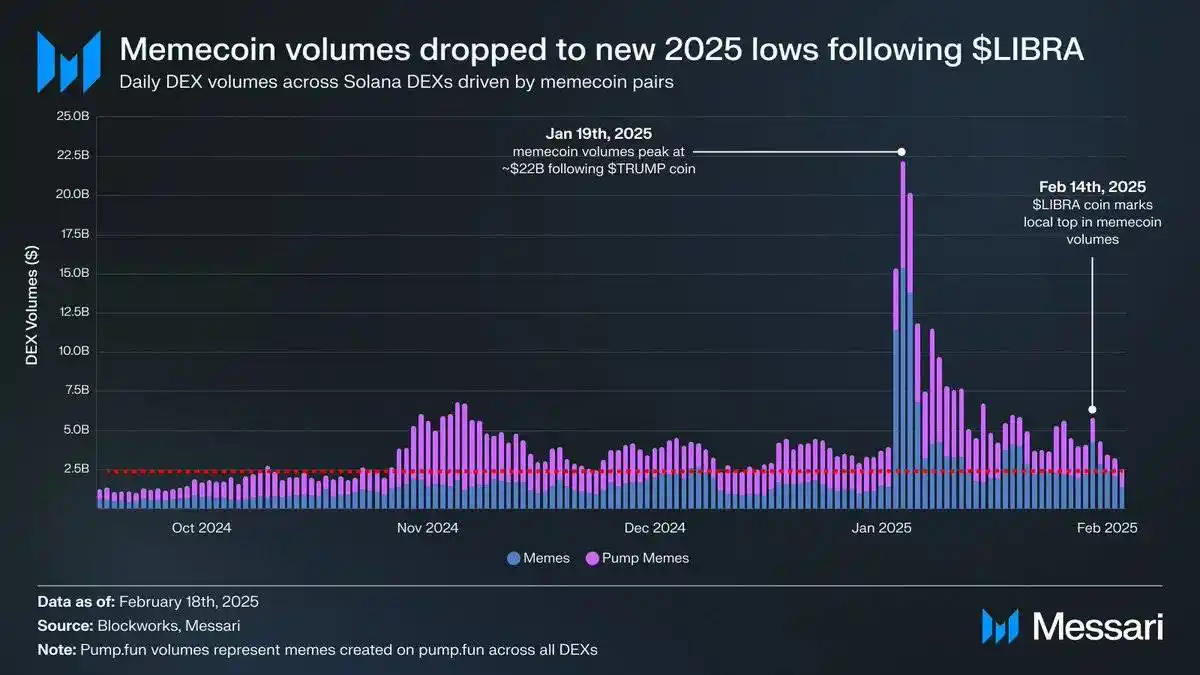
Since the $LIBRA event, Memecoin trading volume on Solana has dropped to the lowest level this year.
However, it is important to note that the current volume is still higher than at the beginning of 2024, indicating that Memecoin has not yet exited the stage of history.
What I really want to emphasize is the extent to which the Solana economy relies on Memecoin support.
Solana's Economic Dependence on Memecoin: Risks and Current Situation
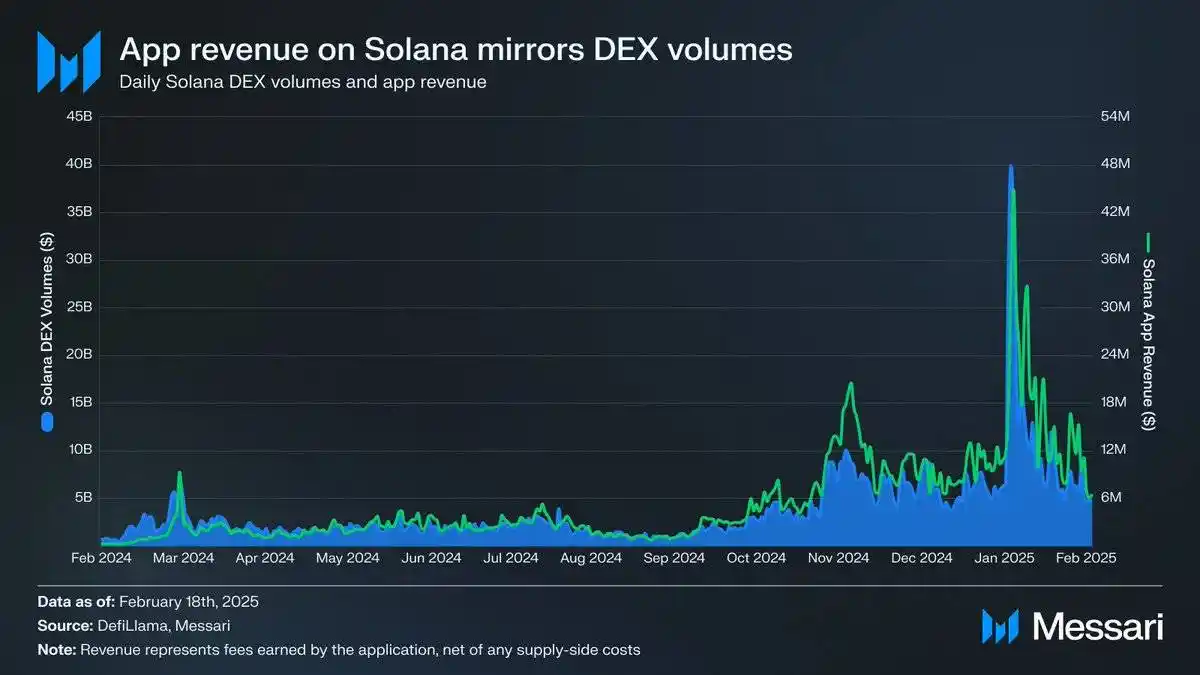
Solana's economy is fundamentally driven by transaction volume.
If we look at the leading applications ranked by revenue on Solana, we will find that these applications are almost all protocols that in some way facilitate transaction activity.
This can be validated by the strong correlation between daily DEX trading volume and application revenue.
This pattern is not uncommon in today's high-throughput blockchains. For example, Base's economy also largely operates based on transaction volume.
In contrast, Ethereum's mainnet revenue comes more from applications driven by Total Value Locked (TVL), such as lending and mining rewards, mainly because transaction activity on the mainnet has significantly reduced.
However, it is important to note what drives this transaction volume.
On Solana, a significant amount of trading activity comes from Memecoin.
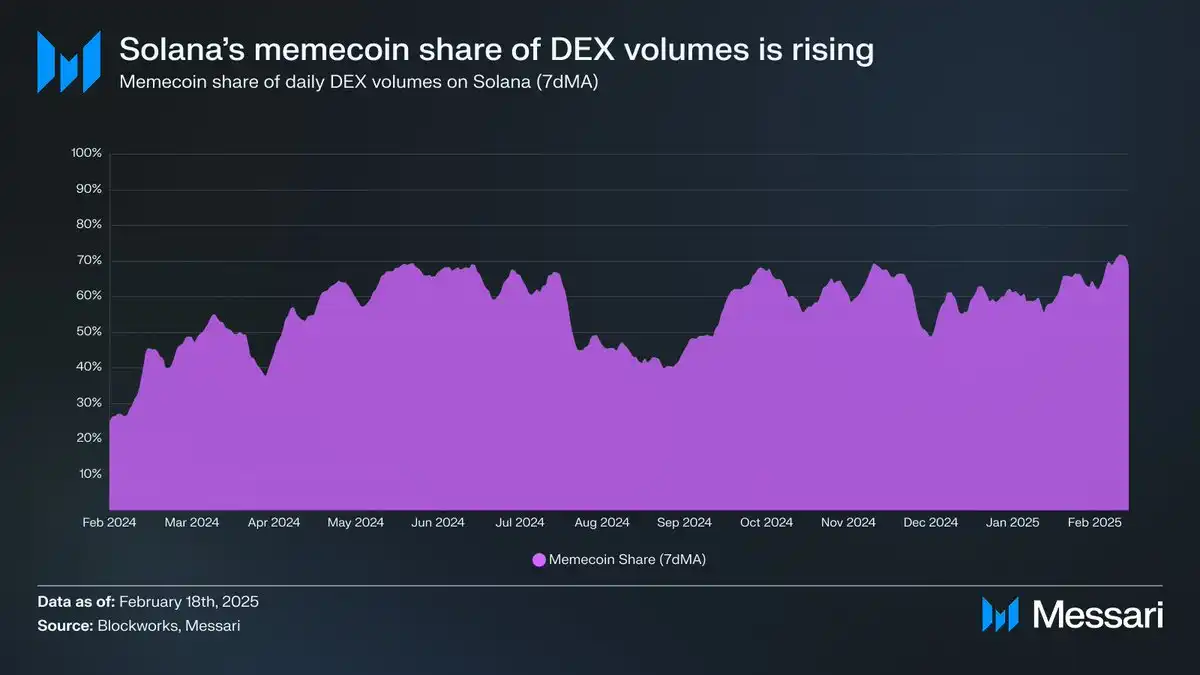
But what is concerning is that the proportion of Memecoin's trading volume has become abnormally high. For example, in February 2025, Memecoin's trading volume accounted for 70% of the total Solana DEX trading volume.
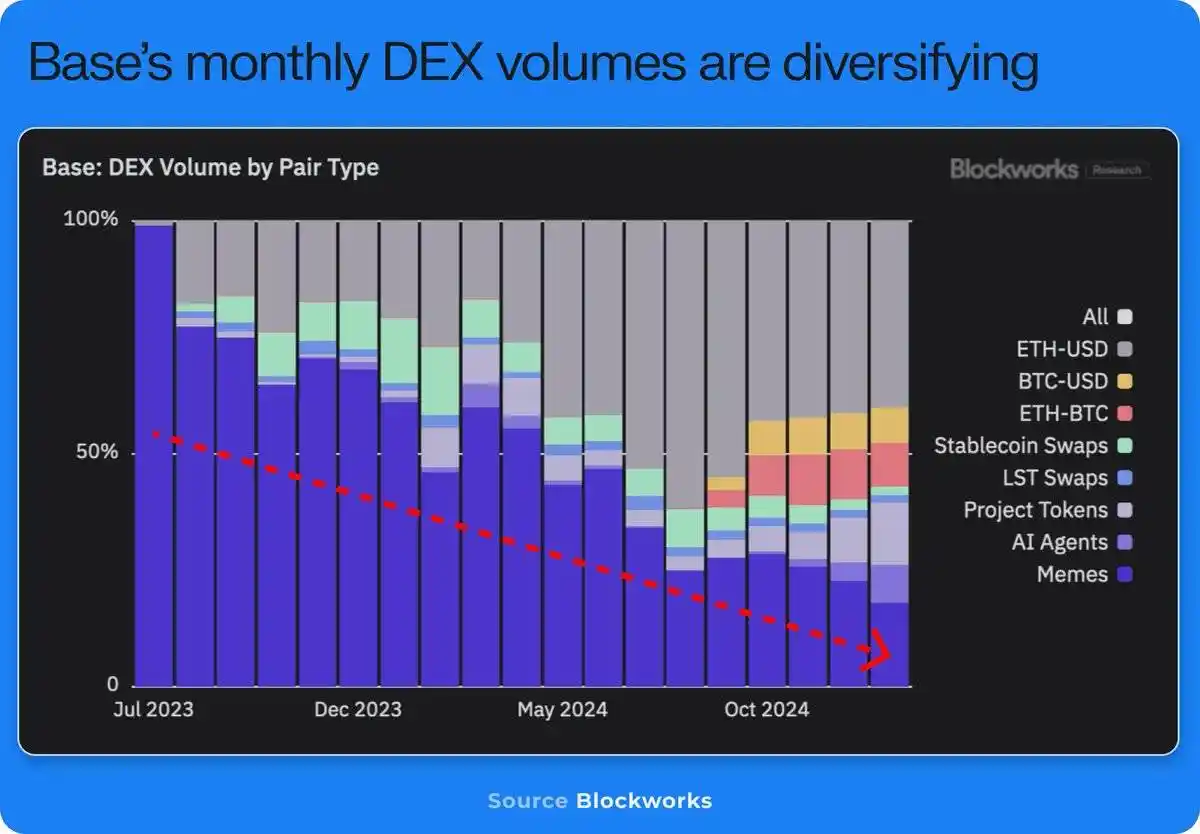
In contrast, Solana's competitor Base is gradually reducing its reliance on Memecoin trading volume and shifting towards more project tokens and trading pairs denominated in mainstream assets:
Why is this an issue?
Firstly, Solana's Memecoin volatility is extremely high, and the sustainability of these Memecoins is still in question.
More importantly, researchers, investors, and the Solana Foundation have been emphasizing the growth of application revenue and "on-chain GDP." Solana's application revenue has indeed been growing rapidly and remains one of the key metrics of user activity.
However, when we delve into the primary sources of this revenue, we find that the most profitable businesses on Solana are actually those profiting from Memecoin reliance.
For example, the two highest-earning areas on Solana are Telegram trading bots and Launchpads (such as pump.fun).
These two areas together contribute to over 60% of Solana's application revenue, with an annualized income exceeding $33 billion.
The core of these businesses is indeed Memecoin.
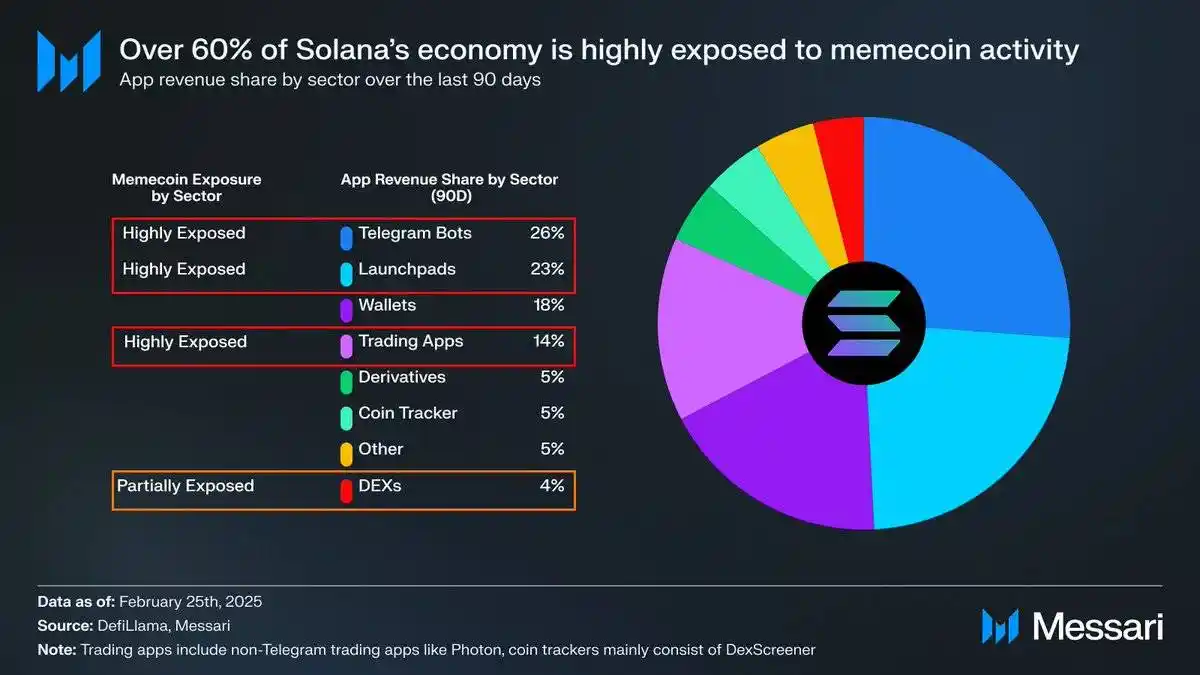
The interdependence in Solana's app economy further exacerbates the risk of Memecoin trading volume.
For instance, Pump relies on Raydium, Raydium relies on Jupiter, followed by Photon and Jito.
This means that a Memecoin transaction can generate revenue for five different apps simultaneously.
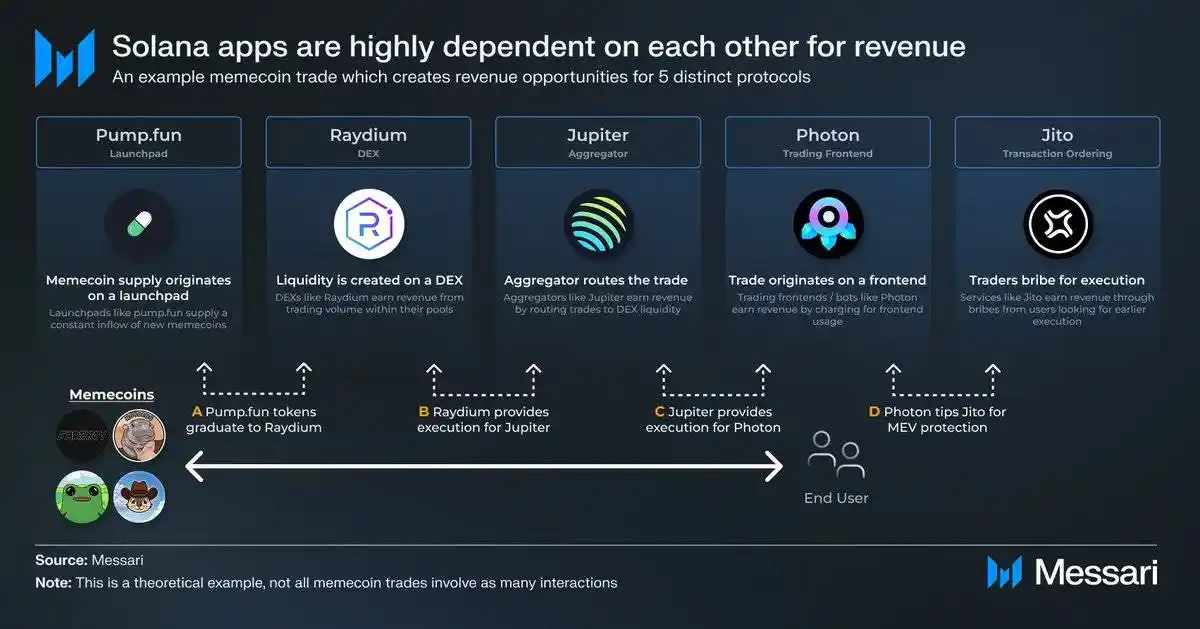
Therefore, these seemingly independent business apps are actually significantly interdependent in terms of revenue.
However, this cross-domain revenue is all built on the foundation of current 50%-70% of transaction volume originating from Memecoin activity.
From a blockchain perspective, Memecoin itself is not the issue. For Solana, this phenomenon is a natural outcome of its low-cost block space and early lead in on-chain user experience (UX).
The essence of blockchain should be to remain neutral to the type of activity.
Building an ecosystem around Memecoin is profitable, so many protocols have seized this opportunity.
In the future, other asset classes, such as Decentralized IoT Networks (DePIN), Real-World Assets (RWAs), stablecoins, and mainstream assets, may gradually replace Memecoin trading volume.
But for now, calling Solana a "Memecoin Economy" is not an exaggeration.
This also means that if Memecoin trading volume experiences a significant contraction, it could trigger a chain reaction of revenue decline.
Why is this important?
Solana's development narrative has always revolved around the growth of fundamental metrics, which have also supported the performance of the $SOL asset.
However, in reality, these metrics are highly dependent on the Memecoin space, which has a strong reflexivity (meaning changes in trading volume will amplify market fluctuations).
If we use these metrics to assess Solana's progress, then a collapse in Memecoin trading volume could turn a "growth story" into a "recovery story."
This would lead to a sharp shift in market sentiment, and restoring these economic activities could take a considerable amount of time.
Of course, it could also be that Murad's viewpoint is correct. If so, then disregard the above concerns.
In the long term, I still remain bullish on Solana's ecosystem. However, in the short to medium term, if Memecoin demand cannot be sustained, Solana's economy may face some challenges.
You may also like

Concerns Behind the Binance Customer Service Controversy

Mergers and acquisitions in the cryptocurrency market are exceptionally active

SpaceX Stock Prediction After the IPO: Can SPCX Reach $200 Before QQQ Inclusion?

Congratulations to Carl Moon on His Historic Ferrari Challenge Le Mans Podium Triumph
Crypto influencer and racing enthusiast Carl Moon finished third in the Ferrari Challenge Le Mans Coppa Shell class, marking his best result of the year. As his racing partner and sponsor, WEEX celebrates this remarkable achievement and continues to lead crypto’s journey beyond boundaries, uniting the innovation of digital assets with the passion of motorsport.
A16Z: The sun bears witness, SpaceX is worth 7.5 trillion

The stablecoin positioning battle escalates: When compliance is just a ticket to entry, will USD1 become the biggest winner?

Can the CLARITY Act Become Law by July 4? Everything You Need to Know About the Final Battle

How to exit after asset tokenization?

The foundation of SpaceX's trillion-dollar valuation: Who is dividing Musk's annual capital expenditure of tens of billions?

France vs Senegal World Cup 2026: Mbappe’s New Era Begins Against a Historic Rival

SharpLink CEO: How to understand that Ethereum developers have just surpassed 1 million?

Morning Report | MiCA grace period expires on July 1; Kalshi's trading volume in the first week of the World Cup breaks $5.1 billion, setting a record

What is the connection between Huang Zheng of Pinduoduo and blockchain?

Morning Report | Prediction market platforms like Kalshi and Polymarket jointly sue Kentucky over 14.25% trading tax; Bridgewater founder discusses decision-making in the AI era: principled thinking should run parallel to AI, human insight remains irre...

If the AI bubble has already burst, who will truly remain?
Paul Graham: How to Make a Billion Dollars

After 18 years, blockchain has finally started to head towards the main channel
Claude enforces "facial recognition for household registration," starting in July, no ID card means no access?
Concerns Behind the Binance Customer Service Controversy
Mergers and acquisitions in the cryptocurrency market are exceptionally active
SpaceX Stock Prediction After the IPO: Can SPCX Reach $200 Before QQQ Inclusion?
Congratulations to Carl Moon on His Historic Ferrari Challenge Le Mans Podium Triumph
Crypto influencer and racing enthusiast Carl Moon finished third in the Ferrari Challenge Le Mans Coppa Shell class, marking his best result of the year. As his racing partner and sponsor, WEEX celebrates this remarkable achievement and continues to lead crypto’s journey beyond boundaries, uniting the innovation of digital assets with the passion of motorsport.
A16Z: The sun bears witness, SpaceX is worth 7.5 trillion
The stablecoin positioning battle escalates: When compliance is just a ticket to entry, will USD1 become the biggest winner?


