
**Military Lockdown Shakes Up South Korean Crypto Market: $33 Billion Sell-Off Wave and Native Project Exoduses**


Original Article Title: Martial law in South Korea and the crypto market outlook
Original Source: Tiger Research Reports
Original Translation: Deep Tide TechFlow
Key Points Summary:
· Market Volatility: The announcement of martial law triggered a massive sell-off on South Korean cryptocurrency exchanges, with a total sell-off amounting to around 33.3 billion USD. The price of Bitcoin dropped to 62,300 USD, with the local market recording the highest trading volume globally at one point.
· Investor Exodus: Due to price fluctuations and system failures in local exchanges, South Korean investors are expected to pivot to overseas exchanges and DeFi platforms.
· Industry Contraction: Political instability is prompting South Korean blockchain projects to move overseas. Key legislation, such as the Virtual Asset User Protection Law, may be delayed as a result.
1. Introduction

Source: Yonhap News
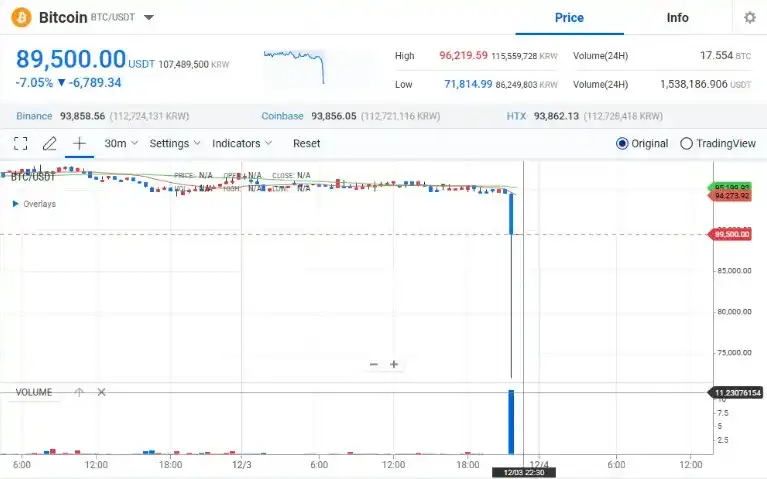
Last night, President Yoon Suk-yet suddenly announced and lifted martial law, causing a shock to South Korea's cryptocurrency market. Bitcoin's price on South Korea's largest exchange Upbit dropped to 62.3K USD. Upbit and Bithumb, the two major South Korean exchanges, saw 24-hour trading volumes of 26.9 billion USD and 6.4 billion USD, respectively, reaching their highest levels this year. This reflects the large-scale sell-off by South Korean investors following the declaration of martial law. During this period, South Korean exchanges briefly became the highest-volume market globally, highlighting the extreme volatility of its market.
2. Decline in Trust in the Won Assets and Rise in Cryptocurrency Demand

The martial law event severely eroded trust in won-denominated assets. With foreign capital exiting, the stock and bond markets may become even more volatile. As a result, investors are gradually shifting their focus to decentralized assets such as cryptocurrency.
Against the backdrop of rising geopolitical risks, investors are turning to cryptocurrency to protect their assets. Major cryptocurrencies like Bitcoin are garnering attention for being beyond government control. In past crises such as the Hong Kong protests and the Russia-Ukraine conflict, cryptocurrency has been seen as a safe-haven asset.
3. The Double-Edged Sword of Stringent Regulation and the Acceleration of Exchange Exodus
South Korean cryptocurrency exchanges maintain high security through strict travel rules and KYC regulations. The enactment of designated financial transaction information reporting and usage laws has strengthened anti-money laundering (AML) measures and enhanced investor protection. These efforts have positioned South Korea as a leader in regulatory compliance.
Source: Upbit
However, the market crash revealed the double-edged sword effect of stringent regulation. The strict rules have sustained a Kimchi Premium, widened the price gap with global markets, and made it difficult for investors to make rational decisions.
The significant price fluctuations and system instability of local exchanges have eroded investor trust. With overnight trading volumes reaching $33.3 billion, servers of Upbit and Bithumb experienced crashes. Unlike overseas exchanges, this instability has made local exchanges appear unreliable.
These issues are expected to accelerate South Korean investors' shift to overseas exchanges and DeFi platforms. Binance and Coinbase provide a stable trading environment and diverse financial products, making them the preferred choice for South Korean investors.
4. Acceleration of South Korean Blockchain Project Exodus
Due to political instability, the investment environment for South Korean blockchain projects has been affected. Many large projects have already moved overseas, and this trend is expected to continue. Nexon's blockchain division Nexpace has relocated to Abu Dhabi, Klaytn and LINE Finschia's Kaia Foundation have moved to Singapore, and Wemade's Wemix has shifted to Dubai. These companies have chosen blockchain-friendly countries to avoid South Korea's regulatory uncertainty and political risk. More projects are expected to move to Singapore and the UAE, where regulations remain clear and stable.
The overseas migration of blockchain startups has raised concerns about talent drain. This trend could weaken South Korea's competitiveness in the blockchain field. Against the backdrop of rapid development in Web3 and blockchain technology, talent outflow may have a long-term negative impact on South Korea's technological advantage. This brain drain has intensified the industry's sense of crisis.
Furthermore, the impeachment issue may delay the progress of key legislation. Laws such as the Virtual Asset User Protection Act currently being discussed in the National Assembly may face delays. These delays could further hinder the institutionalization process of South Korea's cryptocurrency market.
5. Conclusion
The martial law incident exposed structural weaknesses in the South Korean cryptocurrency market. Overnight, $333 billion in value vanished from sight, with major exchanges’ servers crippled. The market experienced extreme price volatility, with significant price discrepancies compared to global exchanges. These events underscored political risks in the market and the fragility of the current trading system under pressure.
In the short term, market instability is expected to persist. However, with appropriate institutional improvements and system enhancements, this crisis could also serve as a turning point. These efforts will help strengthen the stability of the South Korean cryptocurrency ecosystem and drive its globalization. The future trajectory is worth close monitoring.
You may also like

Champion's Final Bow: FC Barcelona vs Real Betis – Celebrate the Title with a Home Finale

Best Oil Trading Platform for Crypto Users in 2026

5 Futures Trading Strategies Smart Traders Use to Cut Crypto Fees and Boost Futures Returns
What Is TradFi? How Crypto Traders Can Now Access Crude Oil, Gold, and Global Markets

How WEEX Bridges Crypto and Football: A Deep Look at the LALIGA Partnership Inside the WEEX App
WEEX is not just a LALIGA sponsor. It’s a true partner. From iPhone Dynamic Island to LALIGA-themed app icons and smart posters, see how WEEX brings football passion into every trade — and builds a real bridge between crypto and sports.

FC Barcelona vs Real Madrid Preview: El Clásico – Can Barça Clinch the Title at Spotify Camp Nou?
FC Barcelona vs Real Madrid El Clásico match preview for May 11, 2026. Barça need just 1 point to win LALIGA. Can Madrid delay the trophy? Full preview inside.

At the Stripe conference, I saw the future of the AI economy

Miners welcome a new life

Seven Important Judgments by Claude Code's Founder at the Sequoia Conference

The payment moment of AI agents: Who will become the Stripe of the machine economy?

Morning Report | MoonPay acquires Solana's execution layer DFlow; Strategy releases Q1 financial report; Manta Network announces the termination of Manta staking program

Rented Tracks: What is this wave of stablecoin FX hot money really paying for?

Dialogue Velocity Eric: What is the stablecoin track that the CFO really wants?

Strategy should have said that selling coins is not ruled out

How MegaETH Achieved a TVL of 700m Within a Week of TGE? Analyzing the Packaging Strategy

Futures Trading Hours: Trade Cryptocurrency 24/7 and Earn Back Up to 45% in Trading Fees
Learn futures trading hours and the best time to trade crypto futures. Discover 24/7 market insights, peak trading sessions, and how to earn back up to 45% in fees.
Why is a16z Crypto raising another $2.2 billion to heavily invest in Web3?
Polymarket Underlying Algorithm Explained
Champion's Final Bow: FC Barcelona vs Real Betis – Celebrate the Title with a Home Finale
Best Oil Trading Platform for Crypto Users in 2026
5 Futures Trading Strategies Smart Traders Use to Cut Crypto Fees and Boost Futures Returns
What Is TradFi? How Crypto Traders Can Now Access Crude Oil, Gold, and Global Markets
How WEEX Bridges Crypto and Football: A Deep Look at the LALIGA Partnership Inside the WEEX App
WEEX is not just a LALIGA sponsor. It’s a true partner. From iPhone Dynamic Island to LALIGA-themed app icons and smart posters, see how WEEX brings football passion into every trade — and builds a real bridge between crypto and sports.
FC Barcelona vs Real Madrid Preview: El Clásico – Can Barça Clinch the Title at Spotify Camp Nou?
FC Barcelona vs Real Madrid El Clásico match preview for May 11, 2026. Barça need just 1 point to win LALIGA. Can Madrid delay the trophy? Full preview inside.


