
- Buy Crypto
- Markets
 Futures
- Spot
- Copy Trade
- Earn
- More
MSCI Hardball Strategy: What Did the 12-Page Defense Open Letter Say? As a finance and blockchain translation expert, you are familiar with the slang and terms used in the field. Please translate the following content into English while maintaining th...

Original Title: "Strategy Takes on MSCI: The Ultimate Defense of DAT"
Original Author: KarenZ, Foresight News
The game regarding the development of the Digital Asset Treasury (DAT) industry is still ongoing.
In October, the global index provider MSCI put forward a proposal to exclude companies with 50% or more of their assets in digital assets from its Global Investable Market Index. This move directly threatens the market position of digital asset treasury companies represented by Strategy and could even reshape the entire flow of capital in the digital asset treasury industry.
According to data compiled by Bitcoin for Corporations, 39 companies could be excluded from the MSCI Global Investable Market Index. JPMorgan analysts previously warned that the exclusion of just Strategy alone could lead to nearly $2.8 billion in passive outflows, and if other index providers follow suit with this rule, outflows could reach as high as $8.8 billion.
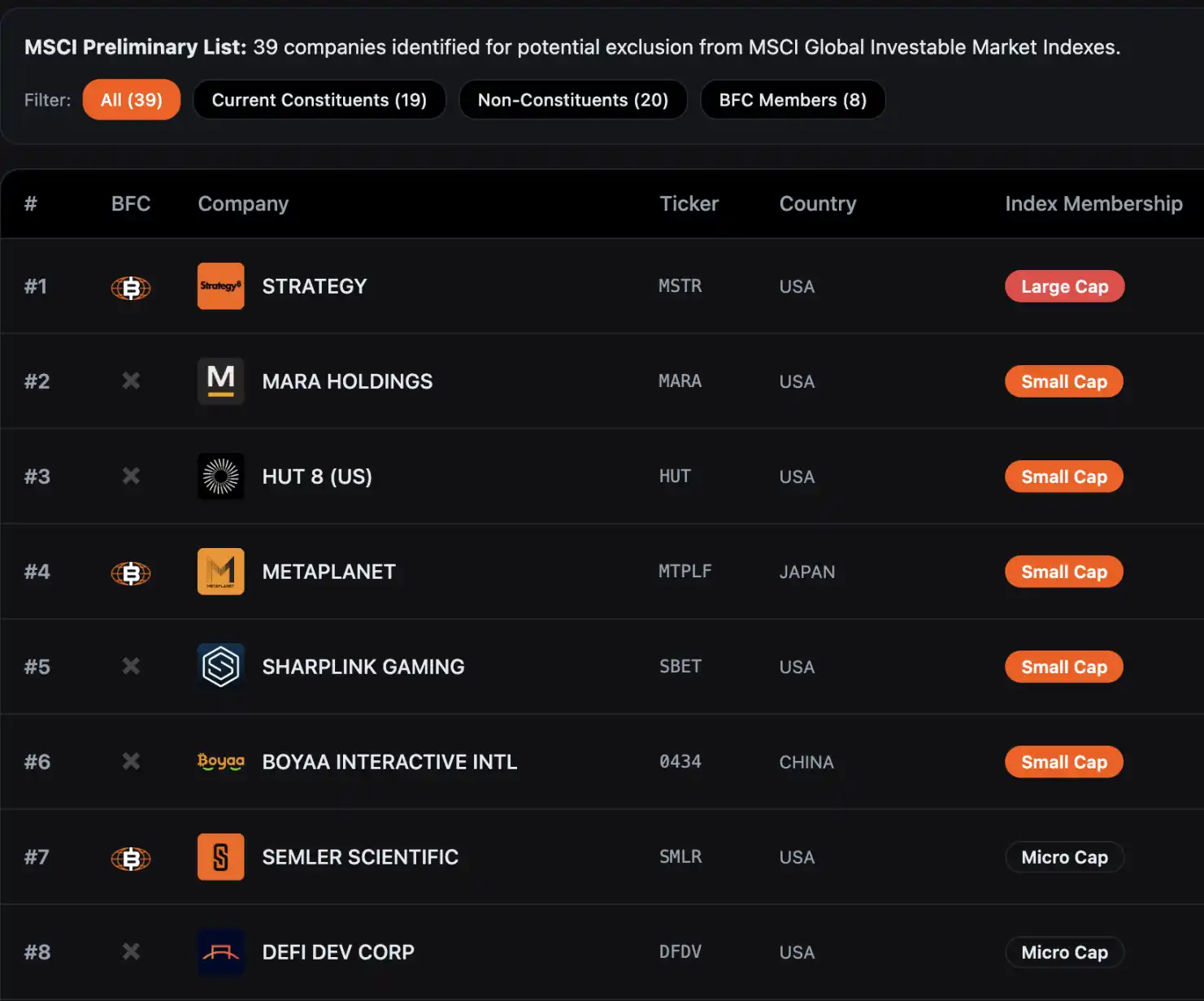
Currently, the consultation period for MSCI's proposal will continue until December 31, 2025, with the final conclusion expected to be announced by January 15, 2026, and any adjustments will be formally implemented in the index review process in February 2026.
Facing this urgent situation, on December 10th, Strategy submitted a strongly worded 12-page open letter to the MSCI Stock Index Committee, jointly signed by the company's Executive Chairman and Founder Michael Saylor and President and CEO Phong Le, clearly expressing firm opposition to the proposal. The letter stated: "This proposal is severely misleading and will have profoundly destructive consequences on the interests of global investors and the development of the digital asset industry. We strongly demand that MSCI fully withdraw this plan."
Strategy's Four Core Defense Arguments
Digital Assets are the Revolutionary Foundation of Financial System Transformation
Strategy believes that MSCI's proposal underestimates the strategic value of Bitcoin and other digital assets. Since Satoshi Nakamoto introduced Bitcoin 16 years ago, this digital asset has gradually grown into a key part of the global economy, with a current market capitalization of around $1.85 trillion.
From Strategy's perspective, digital assets are far more than simple financial instruments; they represent a fundamental technological innovation capable of reshaping the global financial system—enterprises investing in Bitcoin-related infrastructure are building a new financial ecosystem, akin to leading companies in history that deeply engaged with a single emerging technology.
Similar to the 19th-century Standard Oil's deep drilling for oil extraction and 20th-century AT&T's nationwide telephone network construction, these enterprises, through forward-looking investments in core infrastructure, laid a solid foundation for subsequent economic transformation, eventually becoming industry benchmarks. Strategy believes that companies currently focusing on digital assets are following the path of these "technology pioneers" and should not be simplistically dismissed by traditional index rules.
DAT Operates as a Business Enterprise, Not a Passive Fund
This is the core argument Strategy makes—Digital Asset Treasury entities (DATs) are operational businesses with a complete business model, rather than passive investment funds holding Bitcoin. While Strategy currently holds over 600,000 Bitcoin, its core value does not rely on Bitcoin price fluctuations but on designing and launching unique "digital credit" instruments to create sustainable returns for shareholders.
Specifically, the "digital credit" instruments issued by Strategy include various types of preferred stocks covering fixed dividend rates, floating dividend rates, different priority levels, and credit protection clauses. By selling these instruments to raise funds used to accumulate more Bitcoin, as long as Bitcoin's long-term investment return exceeds Strategy's USD-denominated funding costs, it can provide stable returns to shareholders and clients. Strategy emphasizes that this "active operations + asset appreciation" model, distinct from the passive management logic of traditional investment funds or ETFs, should be considered a normal operating business.
At the same time, Strategy also questions why oil giants, real estate investment trusts (REITs), timber companies, and other entities can hold a concentrated single asset class without being classified as investment funds and excluded from the index. Establishing special restrictions only on digital asset companies evidently contradicts industry fairness principles.
A 50% Threshold for Digital Assets Is Arbitrary, Discriminatory, and Impractical
Strategy points out that MSCI's proposal adopts discriminatory standards. Many large companies in traditional industries also hold a single asset class in their assets, including oil and gas companies, real estate investment trusts, timber companies, and power infrastructure enterprises. However, MSCI has only established special exclusion criteria for digital asset companies, which constitutes obvious unfair treatment.
From an implementation feasibility standpoint, this proposal also faces significant issues. Due to the volatile nature of digital asset prices, the same company may repeatedly enter and exit the MSCI Index within a few days due to asset value fluctuations, causing market confusion. Furthermore, differences between accounting standards (U.S. GAAP and international IFRS standards treat digital assets differently) will result in companies with the same business model receiving disparate treatment based on their jurisdiction.
Violating Index Neutrality Principle by Injecting Policy Bias
Strategy believes that MSCI's proposal fundamentally involves a value judgment on a certain type of asset, contravening the basic principle that index providers should maintain neutrality. MSCI claims to provide the market and regulatory bodies with a "comprehensive" coverage of its indices, aiming to reflect the "evolution of the underlying stock market" and should not make judgments on the "merit or suitability of any market, company, strategy, or investment."
By selectively excluding digital asset companies, MSCI is effectively making a policy judgment on behalf of the market, something index providers should avoid.
Contradicting the U.S. Digital Asset Strategy
Strategy particularly emphasizes that this proposal is in conflict with the Trump administration's strategic goal of advancing U.S. leadership in digital assets. The Trump administration signed executive orders in its first week in office to promote the growth of digital financial technology and established a strategic Bitcoin reserve to make the U.S. a global leader in the digital asset space.
However, if MSCI's proposal is implemented, it will directly prevent U.S. pension funds, 401(k) plans, and other long-term funds from investing in digital asset companies, leading to billions of dollars exiting the industry. This not only hinders the development of U.S. digital asset innovative companies but also potentially weakens the U.S.'s competitiveness in this strategic area, running counter to the established government policy direction.
Strategy cites analysts' estimates that Strategy alone could face up to $2.8 billion in passive stock liquidations due to MSCI's proposal. This not only harms Strategy itself but will also have a ripple effect on the entire digital asset ecosystem, such as potentially forcing Bitcoin mining companies to sell assets prematurely to adjust their asset structure, thereby distorting the normal supply-demand relationship in the digital asset market.
Strategy's Ultimate Appeal
Strategy presents two major appeals in an open letter:
First, we hope that MSCI will completely withdraw the exclusion proposal and allow the market to validate the value of Digital Asset Treasury (DAT) companies through free competition, enabling the index to neutrally and faithfully reflect the development trend of next-generation financial technology;
Second, if MSCI persists in "special treatment" of digital asset companies, it should expand the industry consultation scope, extend the consultation period, and provide more comprehensive logical support to explain the reasonableness of the rules.
Strategy is Not a Lone Warrior
Strategy is not a lone warrior. According to BitcoinTreasuries.NET data, as of December 11, 208 publicly listed companies globally hold over 1.07 million bitcoins, exceeding 5% of the total Bitcoin supply, with a current value of approximately $100 billion.
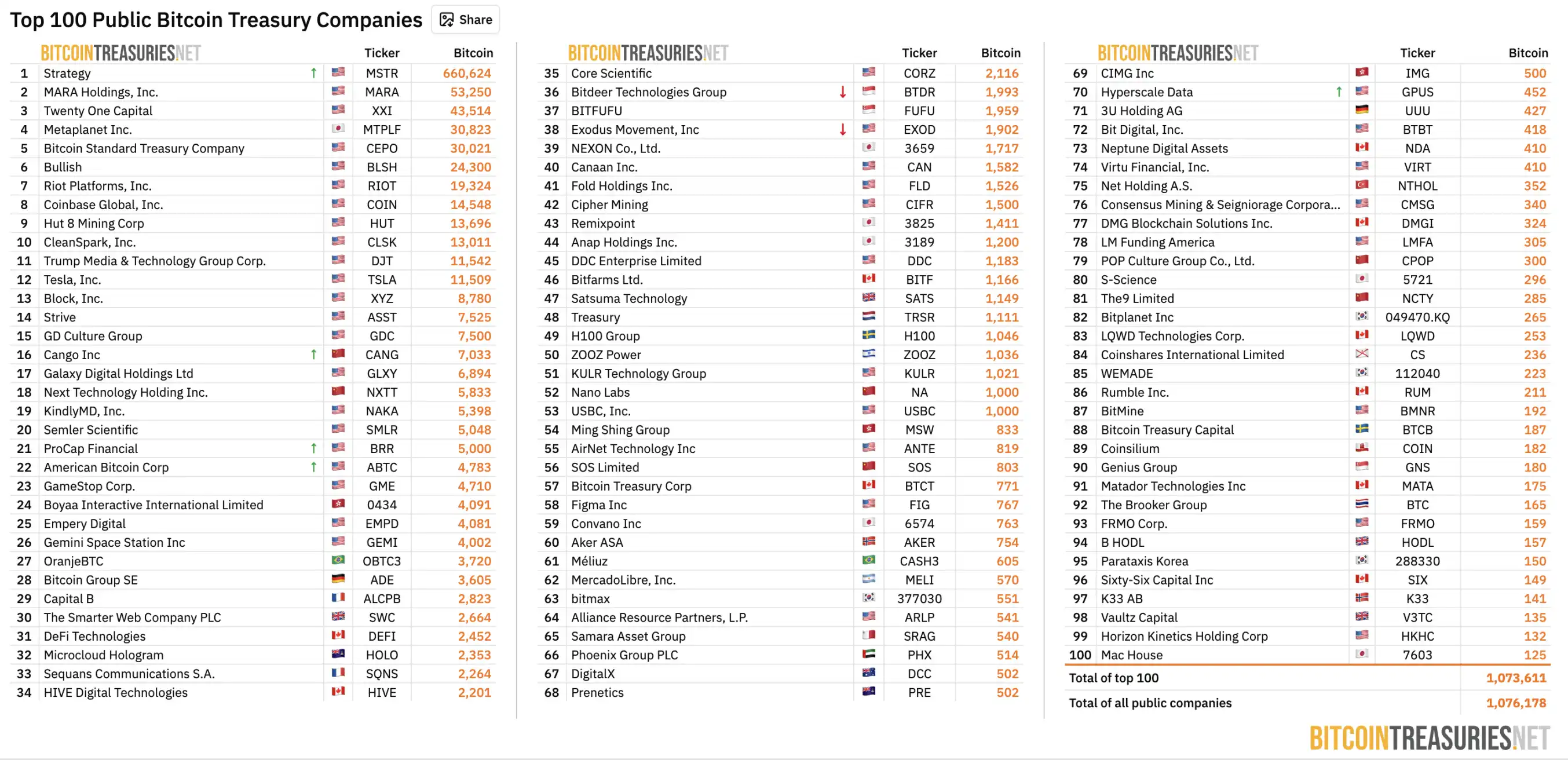
Source: BitcoinTreasuries.NET
These Digital Asset Treasury companies have become a critical bridge for institutions adopting cryptocurrency, providing compliant indirect exposure to pension funds, endowments, and other traditional financial institutions.
Previously, the Bitcoin-holding public company Strive suggested that MSCI should return the "choice" of digital asset companies to the market. A straightforward solution is to create a "Exclude Digital Asset Treasuries" version of the existing indices, such as the MSCI USA ex Digital Asset Treasuries Index and MSCI ACWI ex Digital Asset Treasuries Index, allowing investors to independently choose their benchmarks through a transparent screening mechanism, thereby preserving the integrity of the index and meeting the needs of different investors.
In addition, the industry organization Bitcoin for Corporations has launched a joint petition calling for MSCI to withdraw the digital asset proposal, advocating that classification should be based on a company's actual business model, financial performance, and operational characteristics, rather than simply drawing a line based on asset allocation. According to the organization's website, 309 companies or investors have currently signed the joint letter, signatories include not only Strategy but also Strive, BitGo, Redwood Digital Group, 21MIL, Btc inc, DeFi Development Corp, and other executives of well-known companies in the industry, as well as many individual developers and investors.
Conclusion
The standoff between Strategy and MSCI is fundamentally a debate on how "emerging financial innovation integrates into the traditional system." As a Digital Asset Treasury (DAT) company, a 'cross-border' entity between traditional finance and the cryptocurrency world, it is neither a pure tech company nor a simple investment fund but rather a new business model built on digital assets.
MSCI's proposal attempts to categorize these complex entities as "investment funds" and exclude them from the index using a "50% asset weight" standard. In contrast, Strategy insists that this oversimplified treatment is a severe misunderstanding of its business nature and a deviation from the principle of index neutrality. As the decision date of January 15, 2026, approaches, the outcome of this game will not only determine the eligibility of several Bitcoin-holding listed companies in the index but will also delineate a crucial "survival boundary" for the future position of the digital asset industry in the global traditional financial system.
References
<1> https://assets.contentstack.io/v3/assets/bltf8d808d9b8cebd37/blt26a263f232aa531c/693976b64c2a191113a60111/strategy-msci-letter.pdf
<2> https://app2.msci.com/webapp/index_ann/DocGet?pub_key=0bZz7Im3vZU%3D&lang=en&format=html
<3> https://x.com/ColeMacro/status/1996930014441623902
You may also like

Mining Companies' Great Migration: Some Have Already Secured $12.8 Billion in AI Orders
What Is Vibe Coding? How AI Is Changing Web3 & Crypto Development
What is vibe coding? Learn how AI coding tools are lowering the barrier to Web3 development and enabling anyone to build crypto applications.

The parent company of the New York Stock Exchange strategically invests in OKX: The intentions behind the $25 billion valuation

WEEX P2P update: Country/region restrictions for ad posting
To improve ad security and matching accuracy, WEEX P2P now allows advertisers to restrict who can trade with their ads based on country or region. Advertisers can select preferred counterparty locations for a safer, smoother trading experience.
I. Overview
When publishing P2P ads, advertisers can now set the following:
Allow only counterparties from selected countries or regions to trade with your ads.
With this feature, you can:
Target specific user groups more precisely.Reduce cross-region trading risks.Improve order matching quality.
II. Applicable scenarios
The following are some common scenarios:
Restrict payment methods: Limit orders to users in your country using supported local banks or wallets.Risk control: Avoid trading with users from high-risk regions.Operational strategy: Tailor ads to specific markets.
III. How to get started
On the ad posting page, find "Trading requirements":
Select "Trade with users from selected countries or regions only".Then select the countries or regions to add to the allowlist.Use the search box to quickly find a country or region.Once your settings are complete, submit the ad to apply the restrictions.
When an advertiser enables the "Country/Region Restriction" feature, users who do not meet the criteria will be blocked when placing an order and will see the following prompt:
If you encounter this issue when placing an order as a regular user, try the following solutions.
Choose another ad: Select ads that do not restrict your country/region, or ads that allow users from your location.Show local ads only: Prioritize ads available in the same country as your identity verification.
IV. Benefits
Compared with ads without country/region restrictions, this feature provides the following improvements.
Aspect
Improvement
Trading security
Reduces abnormal orders and fraud risk
Conversion efficiency
Matches ads with more relevant users
Order completion rate
Reduces failures caused by incompatible payment methods
V. FAQ
Q1: Why are some users not able to place orders on my ad?
A1: Their country or region may not be included in your allowlist.
Q2: Can I select multiple countries or regions when setting the restriction?
A2: Yes, multiple selections are supported.
Q3: Can I edit my published ads?
A3: Yes. You can edit your ad in the "My Ads" list. Changes will take effect immediately after saving.

What are the key highlights of this year's Ethereum's most important upgrade, the Glamsterdam upgrade?

March 6 Key Market Update You Can't Miss! | Alpha Morning Report

Sell Nvidia, Buy Power Plant: 27-Year-Old AI Investor Earns $5 Billion in One Year
The $24 Million Heist Behind It: The Most Dangerous Vulnerability in the Crypto World is Actually Human

Justin Sun Lawsuit Dismissed, BlackRock Bullish on Tokenization, What Is the English-Speaking Community Paying Attention To?

Morning News | NYSE parent company invests in OKX; Morgan Stanley provides $500 million loan to Core Scientific; Western Union partners with Crossmint to launch stablecoin USDPT

These former crypto builders have transitioned to the hottest AI projects globally

Ethereum Overhaul 2026 Blueprint, this time to abandon "gradualism"

What Is OpenClaw? How AI Agents Could Change Crypto Exchange Trading
OpenClaw is a rapidly growing open-source AI agent that can autonomously execute tasks and interact with software, including connecting to crypto exchanges through APIs to analyze markets and automate trading strategies. While this creates new opportunities for smarter trading, it also introduces security and operational risks. Through this article, WEEX aims to help users better understand the potential and risks of AI trading agents so they can explore new technologies while trading more safely and responsibly.
Ethereum 2029 Strawmap Guide: Ultra-Fast Consensus, Native Privacy, and the "Acceleration Variables" Brought by AI

Altcoin ETF Surge: SOL and XRP Inflows Total $23 Million as Institutions Diversify
Key Takeaways Institutional interest in altcoin ETFs is expanding, with SOL and XRP showing significant inflows on March…
Vitalik Drops Ethereum Endgame Bombshell: ETH USD to $3,000?
Key Takeaways Vitalik Buterin introduces the “Sanctuary Tech” manifesto to address Ethereum’s non-financial limitations. A current lack of…
Exclusive: Yuliya Barabash Predicts the Most Regulated Could Be the Biggest Crypto Winners
Key Takeaways The aftermath of FTX and Celsius collapses has ushered a new regulatory era, reshaping the crypto…

iPhone Crypto Wallets Under Threat from State-Grade Malware
Key Takeaways: The Coruna exploit kit exploits 23 iOS vulnerabilities, threatening iPhone users’ crypto wallets. Initially state-level surveillance,…
Mining Companies' Great Migration: Some Have Already Secured $12.8 Billion in AI Orders
What Is Vibe Coding? How AI Is Changing Web3 & Crypto Development
What is vibe coding? Learn how AI coding tools are lowering the barrier to Web3 development and enabling anyone to build crypto applications.
The parent company of the New York Stock Exchange strategically invests in OKX: The intentions behind the $25 billion valuation
WEEX P2P update: Country/region restrictions for ad posting
To improve ad security and matching accuracy, WEEX P2P now allows advertisers to restrict who can trade with their ads based on country or region. Advertisers can select preferred counterparty locations for a safer, smoother trading experience.
I. Overview
When publishing P2P ads, advertisers can now set the following:
Allow only counterparties from selected countries or regions to trade with your ads.
With this feature, you can:
Target specific user groups more precisely.Reduce cross-region trading risks.Improve order matching quality.
II. Applicable scenarios
The following are some common scenarios:
Restrict payment methods: Limit orders to users in your country using supported local banks or wallets.Risk control: Avoid trading with users from high-risk regions.Operational strategy: Tailor ads to specific markets.
III. How to get started
On the ad posting page, find "Trading requirements":
Select "Trade with users from selected countries or regions only".Then select the countries or regions to add to the allowlist.Use the search box to quickly find a country or region.Once your settings are complete, submit the ad to apply the restrictions.
When an advertiser enables the "Country/Region Restriction" feature, users who do not meet the criteria will be blocked when placing an order and will see the following prompt:
If you encounter this issue when placing an order as a regular user, try the following solutions.
Choose another ad: Select ads that do not restrict your country/region, or ads that allow users from your location.Show local ads only: Prioritize ads available in the same country as your identity verification.
IV. Benefits
Compared with ads without country/region restrictions, this feature provides the following improvements.
Aspect
Improvement
Trading security
Reduces abnormal orders and fraud risk
Conversion efficiency
Matches ads with more relevant users
Order completion rate
Reduces failures caused by incompatible payment methods
V. FAQ
Q1: Why are some users not able to place orders on my ad?
A1: Their country or region may not be included in your allowlist.
Q2: Can I select multiple countries or regions when setting the restriction?
A2: Yes, multiple selections are supported.
Q3: Can I edit my published ads?
A3: Yes. You can edit your ad in the "My Ads" list. Changes will take effect immediately after saving.


 App
App