
Polymarket Sponsors Golden Joystick Awards, Predicts How Hollywood Turns into Odds Table

 Prefer us on Google
Original Title: Polymarket's eye-watering brush with the 1958 Onion Futures Act
Original Authors: George Steer and Anna Nicolaou, Financial Times
Translation: Peggy, BlockBeats
Editor's Note: As the red carpet of the Golden Globe Awards increasingly resembles a "carefully choreographed business of eyeballs," this year's biggest innovation was its sponsorship by the prediction market Polymarket. Starting from this collaboration, this article traces back to the history of the "Onion Futures Act" and the ban on box office futures, revealing how prediction markets navigate regulatory boundaries through both US-based and offshore platforms.
The following is the original text:
Sunday's Golden Globe Awards ceremony proceeded as usual, with tired jokes and political performances. Perhaps the only novelty this year was the sponsorship of this "performance" by the betting site Polymarket.
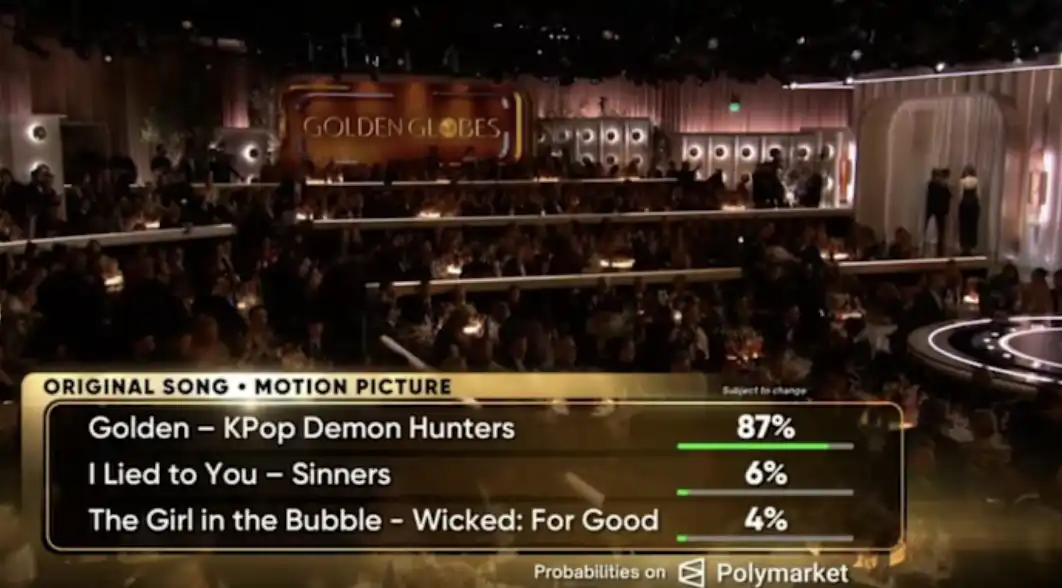
For the tens of viewers watching the live broadcast at home, the presence of Polymarket as the ceremony's "exclusive prediction market partner" was hard to overlook:
“Our partnership with Polymarket has ushered in a groundbreaking new frontier, redefining how audiences interact and connect with the content they love.” said Craig Perreault, CEO of Penske Media Corporation. © Golden Globe Awards
How did things come to this?
In 2023, after a series of scandals, the Golden Globes were sold by the Hollywood Foreign Press Association to a joint venture formed by sports industry tycoon Todd Boehly's Eldridge Industries and Penske Media.
By then, Jay Penske (whose father amassed a huge fortune through motorsports) had already acquired multiple media assets, including key Hollywood trade publications. This means that Penske now not only controls the Golden Globes ceremony but also owns the major media outlets reporting on the Golden Globes, such as Variety, The Hollywood Reporter, and Deadline, raising questions about the impartiality of reporting and fairness of coverage.
During Sunday night's TV broadcast, the "Penske Takeover" imprint was evident: the show featured a skit where a "security guard" was tasked with protecting the star of Heated Rivalry, which was actually a UFC promotion, conveniently in partnership with Golden Globe Awards broadcaster CBS.
But there was more. In a red carpet pre-show led by Variety, senior editor Angelique Jackson and Marc Malkin repeatedly urged viewers to "get your predictions in," while at the same time, the lower-thirds continued to display Polymarket's probability predictions for the award outcomes.
The real "fun" was happening on Polymarket's website: in the end, the bet just on "who will win Best Picture" approached $250,000. Another contract betting on "what will be mentioned during the ceremony," with options including "Venezuela/Maduro" (not mentioned), "Jesus" (mentioned), and "Epstein" (not mentioned), also attracted $86,000 in bets.
However, what caught our attention the most were several other film-related contracts on Polymarket.
For example, bets on how much box office revenue Greenland 2 or the latest installment of Avatar would earn by the end of January seemed harmless enough. But you wouldn't see similar betting pools on the US-regulated competitor, Kalshi, for good reason, with the root of this traced back to the 1955 manipulation of the US onion market.
Onion Futures Act
Vincent Kosuga, born in New York State, was a hobbyist pilot who was said to carry a nightstick with him wherever he went. He reportedly started trading onion futures at the Chicago Mercantile Exchange in the late 1940s or early 1950s and quickly became an expert.
By the end of 1955, Kosuga and his business partner held approximately 1,000 "carlots" of onion inventory, with each carlot containing 600 bags of 50-pound "spot" onions, which were vegetables deliverable through the spot market, ready for immediate delivery. According to a fascinating case file from the US Commodity Futures Trading Commission (CFTC) released five years later, this inventory represented a staggering 98% of the deliverable onion supply in Chicago.
A summary description of Sherwood Financial Partners stated that Kosuga then did this: he sat down with other onion growers to negotiate, telling them that unless everyone agreed to raise onion prices collectively, he would flood the market with onions. Other growers/shippers agreed and began buying Kosuga's stock at these inflated prices.
Upon identifying another opportunity to capitalize on in the market, Kosuga and his partners swiftly took short positions on a large number of onion contracts.
They then, going back on their word, proceeded to dump all the onions they had stored in various local warehouses onto the market. At one point, onion prices plummeted to such an extent that the canvas bags used to hold the onions were worth more than the onions themselves. The situation deteriorated to the point where entire truckloads of onions were dumped into the Chicago River.
The losses incurred were so substantial that in the summer of 1956, Congress held hearings to discuss whether to outright ban onion futures trading. The result was the Onion Futures Act, signed into law two years later, which indeed did just that.
History turned into legend, legend turned into myth. For the next 52 years, onions became the only commodity in the United States prohibited from futures trading.
Everything changed in 2010 when, under the lobbying of the Motion Picture Association of America, the ban on onion derivatives was revised to include a provision prohibiting any futures trading based on movie box office revenue—reasoning that betting on a movie's box office performance could influence audiences' decision to see a movie and incentivize studios to engage in various "shenanigans."
Today, the law stipulates that anyone caught trading "contracts for the sale of movie box office receipts (or any index, measure, value, or data related to such receipts) or onion futures for future delivery" will, upon conviction, be subject to a "fine not exceeding $5,000."
Of course, the event contracts Polymarket offered during the Golden Globes were around award outcomes and did not involve box office receipts, so there were no issues.
However, some other contracts related to movies on the Polymarket website—such as bets on the box office receipts of movies like "Avatar," "Greenland 2," and others before a certain point in time—while not featured in the awards ceremony TV broadcast, could potentially cross the red line set by the 2010 revision.
So why can Polymarket still offer this prediction market? As always, the answer lies in: it operates offshore.
Keep Your Onions
Despite receiving approval from the Commodity Futures Trading Commission (CFTC) last year and being able to re-enter the U.S. market, Polymarket's current U.S. operation is a limited version of the website, focusing mainly on relatively "non-controversial" events, such as sports match outcomes, or sensational topics like which country Trump may "acquire" next.
Provisions in the Dodd-Frank Act banning futures contracts based on movie box office revenues remain in effect. However, by providing two separate platforms for U.S. and non-U.S. users, Polymarket is able to comply with regulatory boundaries in different jurisdictions.
Therefore, bets related to movies like "Avatar" or "Greenland 2" can only appear on Polymarket's main site, which is the version not subject to U.S. regulations. U.S. bettors are blocked and cannot access the platform, in accordance with the CFTC's order issued in 2022: at that time, Polymarket paid a $1.4 million fine and agreed to cease providing certain services to U.S. customers, as well as close non-compliant markets.
"This is a bit like the common disclaimer: 'void where prohibited by law,'" said lawyer and former Wall Street regulator Bill Singer. "If Polymarket were to accept bets from U.S. customers onshore, it would appear illegal until the company provides a strong clarification."
Polymarket did not respond to a request for comment. One source said that Kalshi does not offer box office futures or onion derivatives.
FTAV, on the other hand, plans to sail into international waters and begin trading both types of contracts, regardless of how much your VPN tries to bypass restrictions.
-- Price
This content is provided for general informational purposes only and doesn't constitute financial, investment, legal, or tax advice. Any events, rewards, online promotions, or related information mentioned herein should not be considered a recommendation, solicitation, or invitation to purchase, sell, trade, or otherwise deal in any crypto assets. Crypto assets are highly volatile and may result in loss. The availability of WEEX services, products, and related events may vary by region. You are responsible for ensuring that your participation is in accordance with applicable local laws and regulations.
You may also like

U.S. stocks fell on Thursday, with analysts stating that investors are reducing their positions due to the war

DOJ Initiates $40M Fund for OneCoin Scam Victims
Key Takeaways: Victims of OneCoin’s $4 billion scam can now claim a share of $40 million in assets…

Analyst: It is expected that next year, after the new Federal Reserve Chair takes office, there will be four interest rate cuts

Decentralized social network Bluesky completes $100 million Series B funding, led by Bain Capital Crypto

Predictive Market Cross-Chain Tool Kairos Raises $2.5M, Led by a16z Crypto

The US Attorney's Office will no longer reopen the OpenSea insider trading case, reaching a deferred prosecution agreement with former executive Chastain

Cryptocurrency Ponzi Scheme IcomTech's Senior Marketing Associate Sentenced to Nearly Six Years in Prison

a16z: 11 Convergence Scenarios of AI and Cryptocurrency
SBF's Appeal Hearing is scheduled for November 4th, seeking a retrial and alleging judicial bias against the original judge.

DOJ To Continue Legal Action Against Tornado Cash Developer Roman Storm

Inflation Data and Oracle Earnings Take Center Stage | WEEX Weekly Hotspot Preview (September 7-11, 2026)
This week’s WEEX Weekly Market Hotspot Preview focuses on the September 7 Labor Day holiday, Crypto Expo Dubai 2026 on September 9-10, the U.S. August PPI and Oracle FY2027 Q1 earnings on September 10, and the U.S. August CPI plus the Deribit BTC/ETH weekly options expiry on September 11. The core market narrative centers on inflation repricing, validation of enterprise AI-cloud demand, the return of post-holiday liquidity, and a reassessment of short-term crypto volatility.

Altcoin open interest overtakes Bitcoin after 21 months

Payrolls Beat Revives Hike Pricing | WEEX TradFi Daily(September 7, 2026)
Global markets spent the weekend digesting last week’s payrolls data and crypto fund flows. August job growth of roughly 162,000 and a steady 4.1% unemployment rate pushed the 10-year Treasury yield to around 4.78%, reviving rate-hike pricing and weighing on technology and other long-duration assets. In crypto, bitcoin held near $80,000 as spot ETF inflows remained supportive, signaling that institutional risk appetite has not fully faded. At the same time, oil stayed firm on Middle East supply concerns, while gold consolidated at elevated levels. This week, attention turns to Oracle and Adobe earnings, as well as CPI, for the next repricing of the September Fed path.
![[ETH Letter] Proposal for Activation of Sepolia Glamsterdam Testnet on October 6](/public-static/34_874859b143.png?format=avif)
[ETH Letter] Proposal for Activation of Sepolia Glamsterdam Testnet on October 6

Chainlink whale sends $7.6m in LINK to Coinbase
Wall Street Flows into Bitcoin ETFs: Why BTC Remains Stuck Below $80,000

From 'Buyable' to 'Usable': How Futu Connects Stock and Crypto Purchasing Power?

CLARITY Act Senate Vote: Could Bitcoin Rally Next?

Liquid's Attackers Called Themselves White Hats, Ledger's CTO Isn't Buying It

What is Nockchain (NOCK)? The Mechanism of Proof of Work Calculation Tokens
What is Stronghold (SHX)? An Overview of Stellar's Payment Token
What is Railgun (RAIL)? An Explanation of the On-Chain Privacy Protocol

Hong Kong Monetary Authority Forms Tokenized Bond Expert Group

The Awakening of Bitcoin's Golden Bloodline: This Could Be the Start of the Largest Bull Market in BTC History
Japan's Record Sale of U.S. Bonds Intervenes in Forex Market as Reserves Fall Below $1 Trillion
Does Bitcoin Have Any Real Value Support?
OpenAI Announces Progress on Internal RSI: Achieves 'Automated Research Intern'
Important News from Last Night and This Morning (September 6 - September 7)

Bank of Korea Highlights Impact of Dollar-Denominated Stablecoin Demand on Exchange Rates
Standard Chartered Bank Launches Cryptocurrency Spot Trading in UAE for Institutional Investors
U.S. stocks fell on Thursday, with analysts stating that investors are reducing their positions due to the war
DOJ Initiates $40M Fund for OneCoin Scam Victims
Key Takeaways: Victims of OneCoin’s $4 billion scam can now claim a share of $40 million in assets…
Analyst: It is expected that next year, after the new Federal Reserve Chair takes office, there will be four interest rate cuts
Decentralized social network Bluesky completes $100 million Series B funding, led by Bain Capital Crypto
Predictive Market Cross-Chain Tool Kairos Raises $2.5M, Led by a16z Crypto
The US Attorney's Office will no longer reopen the OpenSea insider trading case, reaching a deferred prosecution agreement with former executive Chastain