
Predicting the market does not predict the truth; it simply rewards those who guess right

Original Title: Truth Comes Later
Original Author: Thejaswini M A, Token Dispatch
Original Translation: Bitpush News
Every time the prediction market gets embroiled in controversy, we always end up circling around a question, but never truly confront it:
Does the prediction market really care about the truth?
Not about accuracy, not about utility, not about whether they outperform polls, journalists, or the winds on social media. But the truth itself.
Prediction markets price in events yet to happen. They are not reporting on facts but allocating probabilities to a future that remains open, uncertain, unknowable. At some point, we started treating these probabilities as a form of truth.
For most of the past year, prediction markets have been basking in their triumph.
They beat the polls, they beat the cable news, they beat the Ph.D. holders and PowerPoint experts. In the 2024 U.S. election cycle, platforms like Polymarket reflected reality at a pace almost faster than all mainstream forecasting tools. This success gradually solidified into a narrative: Prediction markets are not just accurate but superior—a purer way to aggregate truth, a more authentic signal of people's beliefs.
Then January came.
A brand-new account appeared on Polymarket, betting around $30,000 on the ousting of Venezuelan President Nicolás Maduro by the end of the month. At the time, the market considered this outcome highly unlikely—single-digit probabilities. It looked like a bad trade.
Hours later, the U.S. military arrested Maduro and extradited him to New York to face criminal charges. The account closed its position, making over $400,000 in profit.
The market was right.
And that's precisely the problem.
People often tell a comforting story about prediction markets:
Markets aggregate dispersed information. People with differing views financially back their beliefs. As evidence accumulates, prices adjust. The crowd converges towards the truth.
This story assumes an important premise: that market entry information is public, noisy, and probabilistic—such as tightening polls, candidate missteps, storm turns, and underperforming company earnings.
But Maduro Trading is not like that. It's not so much about inference as it is about precise timing.
At this moment, the prediction market no longer seems like a smart forecasting tool, but rather like something else: a place where proximity beats insight, and channels beat interpretation.
If the market is accurate because someone has access to information about the world that no one else does and cannot, then the market is not discovering the truth but monetizing information asymmetry.
The importance of this distinction far exceeds what the industry is willing to acknowledge.
Accuracy may be a warning. Supporters of prediction markets often repeat the same line when faced with criticism: if insiders trade, the market will react earlier, thus helping others. Insider trading would accelerate the emergence of truth.
This argument sounds clear in theory, but in practice, its logic self-destructs.
If a market becomes accurate because it includes leaked military operations, classified intelligence, or government internal schedules, then it is no longer an information market on any public-interest level. It becomes a shadowy place of clandestine transactions. There is a fundamental difference between rewarding better analysis and rewarding proximity to power. Markets that blur this boundary will eventually attract regulatory scrutiny—not because they are not accurate enough, but precisely because they are overly precise in the wrong way.

Voron23 @0xVoron Wallet of a confirmed insider on Polymarket.
"They were making over $1 million daily on the Maduro event. I've seen this pattern too many times, no doubt: the insiders are always winners. Polymarket just makes it easier, faster, more visible. Wallet 0x31a5 turned $34,000 into $410,000 in 3 hours."
What makes the Maduro event unsettling is not only the scale of the returns but also the context in which these markets erupt.
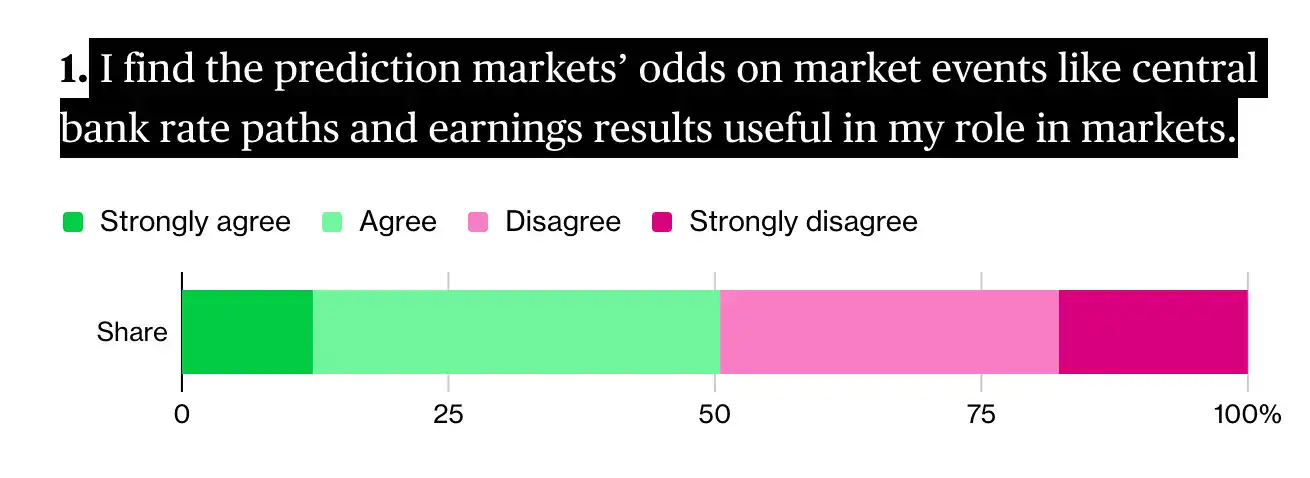
The prediction market has evolved from a fringe novelty to an independent funding ecosystem taken seriously by Wall Street. According to Bloomberg's survey in December last year, traditional traders and financial institutions see the prediction market as a financially viable product, although they also recognize that these platforms blur the line between gambling and investment.
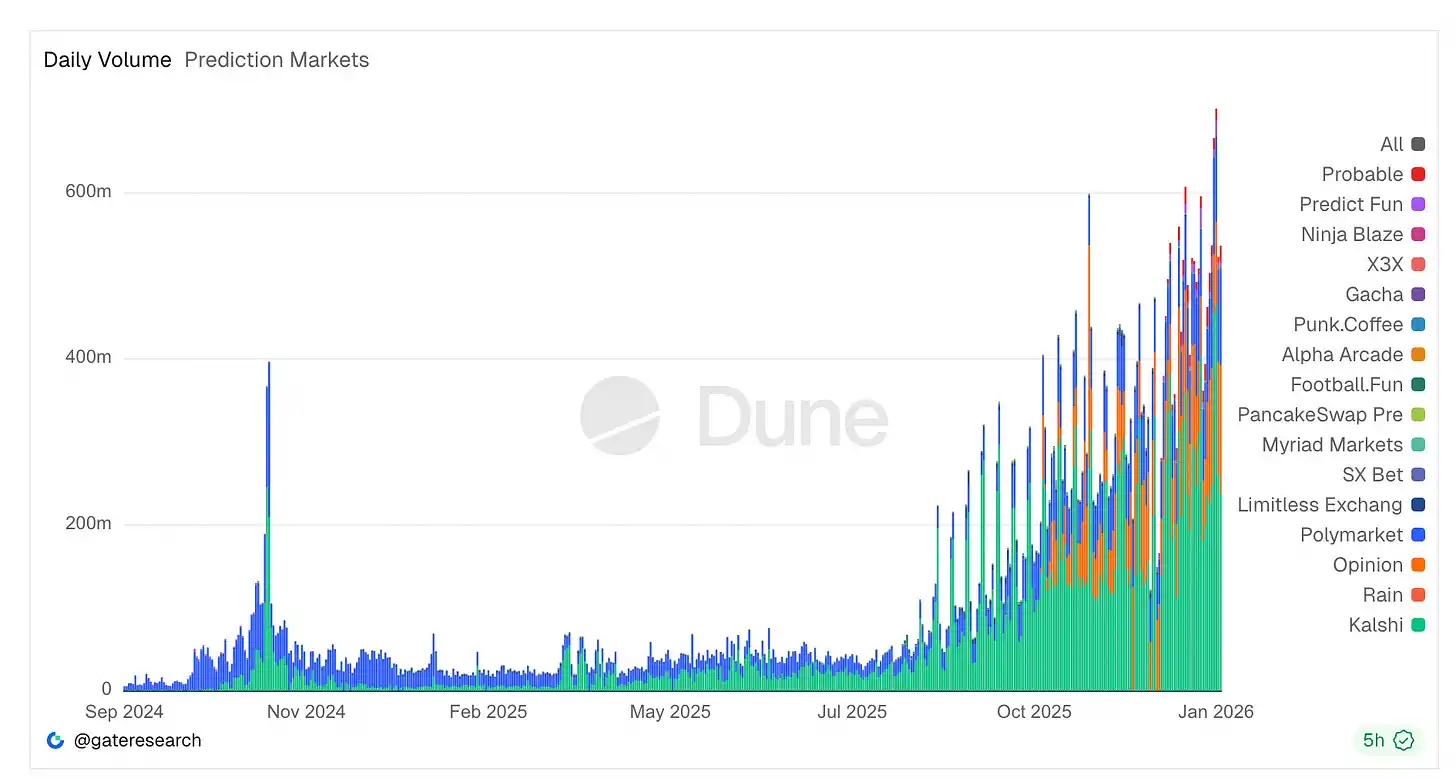
Transaction Volume Surge. Platforms such as Kalshi and Polymarket have now reached annual nominal transaction volumes in the tens of billions of dollars — Kalshi alone processed nearly $24 billion in 2025, with political and sports contracts attracting unprecedented liquidity at a scale never seen before, continuously setting new daily trading records.
Despite facing scrutiny, daily trading activity in prediction markets hit an all-time high of around $700 million. Regulated platforms like Kalshi lead in transaction volume, while crypto-native platforms maintain a central position culturally. New on-chain data terminals, aggregators, and analytics tools emerge weekly.
This growth has also sparked interest from heavyweight financial capital. The owner of the New York Stock Exchange pledged a strategic investment of up to $2 billion to Polymarket, valuing it at around $9 billion, signaling Wall Street's belief that these markets can compete with traditional exchanges.
However, this frenzy is now colliding with regulatory and ethical ambiguity. Polymarket, in its early days, was shut down for operating without registration and paid a $1.4 million CFTC fine, only recently regaining conditional approval in the U.S. Meanwhile, legislators like Congressman Ritchie Torres have proposed specific bills aimed at prohibiting government insiders from trading post-Maduro payback event, arguing that the timing of these bets looked more like insider trading opportunities than informed speculation.
Nevertheless, despite legal, political, and reputational pressures, market participation has not waned. In fact, prediction markets are expanding from sports betting to more areas such as corporate earnings indicators, with traditional bookmakers and hedge fund divisions now arranging experts for arbitrage and pricing inefficiencies trades.
In conclusion, these developments indicate that prediction markets are no longer on the fringe. They are deepening their ties to financial infrastructure, attracting professional capital, triggering the formulation of new laws, while their core operation remains fundamentally a bet on the uncertain future.
Overlooked Warning: Zelensky Suitgate
If the Maduro event exposed insider issues, the Zelensky Suitgate market revealed deeper concerns.
In mid-2025, Polymarket opened a market betting on whether Ukrainian President Volodymyr Zelensky would wear a suit before July. It attracted a massive volume of trades — hundreds of millions of dollars. What seemed like a joke market turned into a governance crisis.
**Zelensky appeared in a black coat and trousers designed by a certain well-known menswear designer. The media called it a suit, and fashion experts also called it a suit. Anyone with eyes could see what was happening.
But the oracle vote ruled: Not a suit.
Why?
The reason is: a few large token holders bet a huge amount of money on the opposite outcome, and they hold enough voting power to push through a resolution favorable to themselves. The cost of bribing the oracle is even lower than the payoff they could receive.
This is not a failure of the decentralized ideal but a failure of incentive mechanism design. The system operates entirely according to predefined rules—a human-controlled oracle whose honesty is entirely subject to the "cost of lying." In this case, lying is clearly more profitable.
People are quick to view these events as extreme cases, growing pains, or temporary glitches on the road to a more perfect prediction system. But I believe this interpretation is wrong. These are not coincidental but rather the inevitable result of the combination of three elements: financial incentives, vague rule descriptions, and imperfect governance mechanisms.
Prediction markets do not discover the truth; they only reach a settlement.
What is important is not what the majority believes but what the system ultimately deems as a valid result. This determination process often lies at the intersection of semantic interpretation, power games, and financial games. And when significant interests are involved, this intersection quickly fills with various forces.
Once this point is understood, such disputes no longer seem surprising.
Regulation Did Not Come Out of Nowhere
A legislative response to Maduro trading was predictable. A bill advancing in Congress would prohibit federal officials and employees from trading on political prediction markets with significant nonpublic information. This is not radical; it is just basic protocol.
The stock market understood this decades ago. Government officials should not profit from the privilege of wielding state power—this view is undisputed. Prediction markets have only now realized this because they have always insisted on pretending to be something else.
I think we have overcomplicated this.
Prediction markets are where people bet on outcomes that have not yet occurred. If events unfold in the direction they bet on, they make money; if not, they lose money. Any other descriptions we have of this are just side stories.
It doesn't become something else just because the interface is cleaner or the odds are expressed as probabilities. It also doesn't become more serious because it runs on a blockchain or because economists find the data interesting.
What matters is the incentive. You are rewarded not because you are insightful but because you correctly predicted what would happen next.
I think it's unnecessary that we always insist on making this activity sound more noble. Calling it prediction or information discovery doesn't change the risk you're taking or why you're taking it.
To some extent, we seem reluctant to admit straightforwardly: People just want to bet on the future.
Yes, they do. And that's okay.
But we shouldn't pretend it's something else.
The growth of prediction markets fundamentally stems from people's need to bet on a "narrative" — whether it's an election, a war, a cultural event, or reality itself. This need is real and enduring.
Institutions use it to hedge uncertainty, retail participants use it to practice beliefs or for entertainment, and the media sees it as a barometer. None of this requires dressing up this activity in any garment.
In fact, it is this disguise that creates friction.
When a platform touts itself as a "truth machine" and occupies the moral high ground, every controversy seems like a life-or-death crisis. When the market settles in a disconcerting way, events are elevated into a philosophical quandary rather than their essence — a dispute about settlement in a high-risk prediction product.
The misalignment of expectations, arises from the dishonesty of the narrative itself.
I am not against prediction markets.
They are one of the relatively honest ways in which humans express beliefs in uncertainty, often surfacing unsettling signals faster than polls. They will continue to grow.
But if we romanticize them into a more noble existence, we are being irresponsible to ourselves. They are not engines of epistemology but financial instruments linked to future events. Recognizing this distinction can actually make them healthier — clearer regulation, clearer ethics, and more sensible designs will all follow suit.
Once you acknowledge that you are operating a betting product, you will no longer be surprised by the presence of betting behavior within it.
You may also like

10 Counterintuitive Insights on Latin American Payments

Perp DEX: The Next Generation Exchange "War"

The AI gamble of mining companies: Valuations enter a phase of differentiation, and it's hard to turn the tide

A letter from Alliance to entrepreneurs: Written on the occasion of Cursor selling for 60 billion dollars

Stablecoins Finally Find Real Returns: On-Chain Reinsurance Re Explained | Interview with Re Founder Karan Saroya

The impossible triangle is simply a pseudo problem

Will MicroStrategy fall into a death spiral? What will the macro trend be in the second half of the year?

Blockchain Capital Partner: The Core Secret of Arbitrage
STRC unanchored by 11%, can the perpetual motion machine of Strategy still operate?

Bitcoin Market Analysis 2026: Can BTC Reach $150K by Year-End?
Bitcoin ETF Outflows Hit a Record $4.4 Billion: What Are Traders Doing With Their Cash?
WEEX App Just Got Smarter – New Tabs for Faster Trades & Easy Asset Management

WEEX All-New Search Features: Find, Trade & Earn Faster Than Ever

Morning Report | Illinois signs the strictest digital asset tax law in the U.S.; RWA tokenization market size surpasses $43 billion, institutions accelerate the migration of on-chain assets
Full version of the debut Q&A! Federal Reserve Chairman Waller: Sticking to the 2% inflation target, establishing five special working groups, individual did not submit the dot plot

From Disruptor to Shadow Market: The Crypto Market is Becoming a Colony of Traditional Finance
Dalio's important long article: How to position in the current market environment?
OKX Star analyzes Binance's competitive advantages: when regulation levels the playing field, competition has just begun
10 Counterintuitive Insights on Latin American Payments
Perp DEX: The Next Generation Exchange "War"
The AI gamble of mining companies: Valuations enter a phase of differentiation, and it's hard to turn the tide
A letter from Alliance to entrepreneurs: Written on the occasion of Cursor selling for 60 billion dollars
Stablecoins Finally Find Real Returns: On-Chain Reinsurance Re Explained | Interview with Re Founder Karan Saroya
The impossible triangle is simply a pseudo problem

Popular coins
Latest Crypto News


