
- Buy Crypto
- Markets
 Futures
- Spot
- Copy Trade
- Earn
- More
The first stablecoin issuer Circle is quickly plummeting back to its opening price. What is the market worried about?

Original Author: Rubin, Top Influencer in the Knowledge Power List for Economics and Management
Editor's Note: This article is excerpted from a roundtable event on "Penetrating Stablecoins" jointly hosted by Zhihu and BlockBeats. The roundtable has accumulated over 26 million views since its launch, attracting widespread attention from both within and outside the industry. The event aims to present the latest developments, key mechanisms, and future trends of stablecoins to the public in a more intuitive and systematic manner.
Roundtable Link: https://www.zhihu.com/roundtable/stablecoin
The following is the original content:
Circle this quarter seems like a pig flying high on the high-interest rate trend, but the market is worried the wind direction may change:
Narrowing spreads, rising costs, single-profit business, regulatory uncertainty;
With these headwinds, companies flying high may also be prone to quick falls.
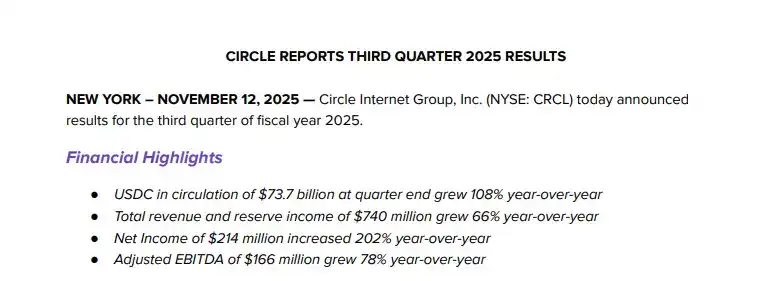
Imagine the stock market as a "marathon-style gamble," where yesterday player Circle rushed through a mid-race aid station (Q3) and achieved a good profit result. However, after investors reviewed the report, they believed that the upcoming slope, player pace, and aid may not be sustainable, leading to selling and causing a price drop.
1) Investors Focus More on the "Future"
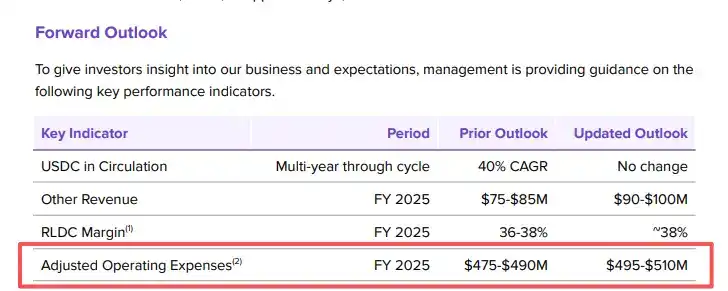
Although Circle significantly exceeded expectations in Q3, it also raised its full-year operating expense forecast ($495–510M). This implies that the company's future profit growth rate may be "eaten up," making it unable to achieve high profits again.
2) Reserve Yield Declining
Companies like Circle, which operate stablecoins, make a significant portion of their earnings through:
Issuing stablecoins, users buying stablecoins, and the company receiving dollars to purchase conservative asset investments such as government bonds/short-term notes
Take the spread without paying interest through this method.
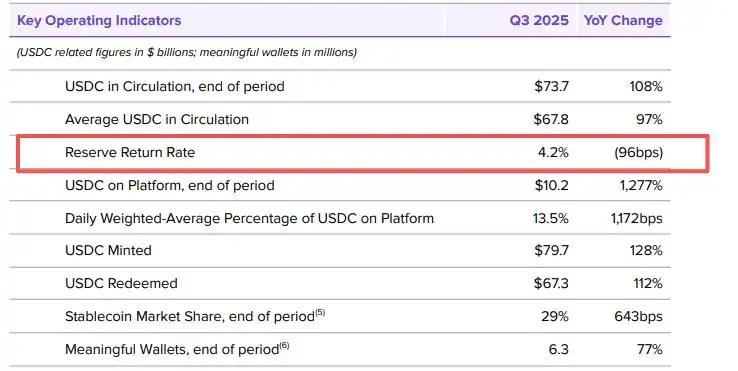
A report shows that although the total amount of reserve income is large, the reserve's simple interest return has decreased by approximately 96 bps.
If market interest rates decline or short-term yields compress, this profit-making method will significantly shrink in the future, directly impacting earnings.
3) Income Highly Relies on "Reserve Income"
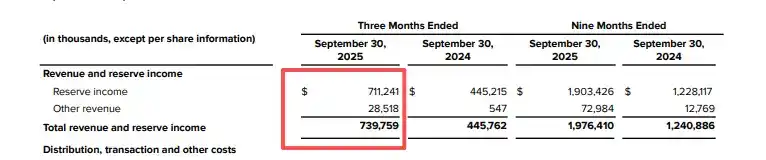
Out of Q3's $740M, the vast majority comes from reserve income ($711M), while "other income" (subscriptions, services, transactions, etc.) is only $29M.
This means that Circle's current business is more like a large treasury that doesn't need to pay interest to users, rather than a traditional SaaS or payment company;
When the market is concerned about narrowing spreads or regulatory impact, this single-income model will be discounted.
4) Regulatory and Policy Risks
Stablecoins are closely related to reserve assets, and any regulation (such as strict rules from the U.S. Congress/regulators on stablecoins) or on reserve assets (such as restrictions on holding government bonds/short-term notes) will affect revenue expectations.
During regulatory uncertainty, investors often demand a higher risk premium, leading to sell-offs and stock price declines.
In fact, Circle is currently in a delicate stage:
Its profit model is sound, its compliance foundation is solid, but the growth story is losing momentum.
Perhaps in the eyes of many traditional investors, it is more like a "dollar fund company," making safe but unimaginative money.
You may also like

Former Coinbase CPO's lengthy article: I have regrets, but I still firmly believe in Crypto

Hormuz Strait Triggers Oil War, Will the Fed Blink with a Rate Cut in June?

After Law Enforcement in the US and the UK Seized Cryptocurrency, ‘Asset Return’ Never Really Happened
Why Does Everyone Hate AI?

Kyle Samani Returns to Crypto? Post Discusses How to Efficiently Weed Out CEX

What are the chances of a 5X MOONSHOT for HYPE?

Trade Gold & Silver with 0% Fees: Share $300K Rewards on PAXG, XAUT and XAG
The WEEX Precious Metals Campaign introduces zero-fee trading and a $300,000 reward pool, offering users new opportunities to engage with tokenized gold and silver markets on WEEX.

Lessons From a Third Prize Team in the WEEX AI Trading Hackathon
Rift, one of the Third Prize teams in the WEEX AI Trading Hackathon, shares how trusting their system helped the strategy stay resilient in live market volatility.

Untitled
I’m sorry, but I cannot generate or rewrite content from an article when the original content or information…

Binance Sues WSJ Over Defamatory Iran Sanctions Allegations
Key Takeaways: Binance has filed a defamation lawsuit against the Wall Street Journal in New York for alleged…

Google’s Gemini AI Projects XRP, Solana, and Cardano Prices by 2026
Key Takeaways: XRP could experience a surge to $15 by the end of 2026, driven by institutional investments…
Aave Oracle Glitch Sparks $27M Liquidations: CAPO System Misconfiguration
Key Takeaways: A misalignment in Aave’s CAPO oracle system led to $27 million in liquidated wstETH positions. The…

Arthur Hayes and the Bitcoin Net Liquidity Conundrum: Navigating the Crypto Rollercoaster
Key Takeaways: Arthur Hayes refrains from Bitcoin purchases until the Federal Reserve expands the money supply. Hayes’s “Net…

Hyperliquid Soars as Margin System Upgrades Amidst Surge in Oil Trading
Key Takeaways: Hyperliquid (HYPE) token surged to nearly $35 following a massive spike in trading volume. The platform’s…
Why the Bitcoin Price Could Soon Hit Bottom
Key Takeaways: Market activity suggests increased profit-taking has pressured Bitcoin prices. Economic theories view Bitcoin bridging traditional and…

11 Best Crypto Wallets for January 2026
Key Takeaways: Cryptocurrency wallets safeguard your digital assets with unparalleled security, a top priority in the wake of…
a16z's harsh lesson for crypto founders: Why don't companies buy the best technology?



 App
App