
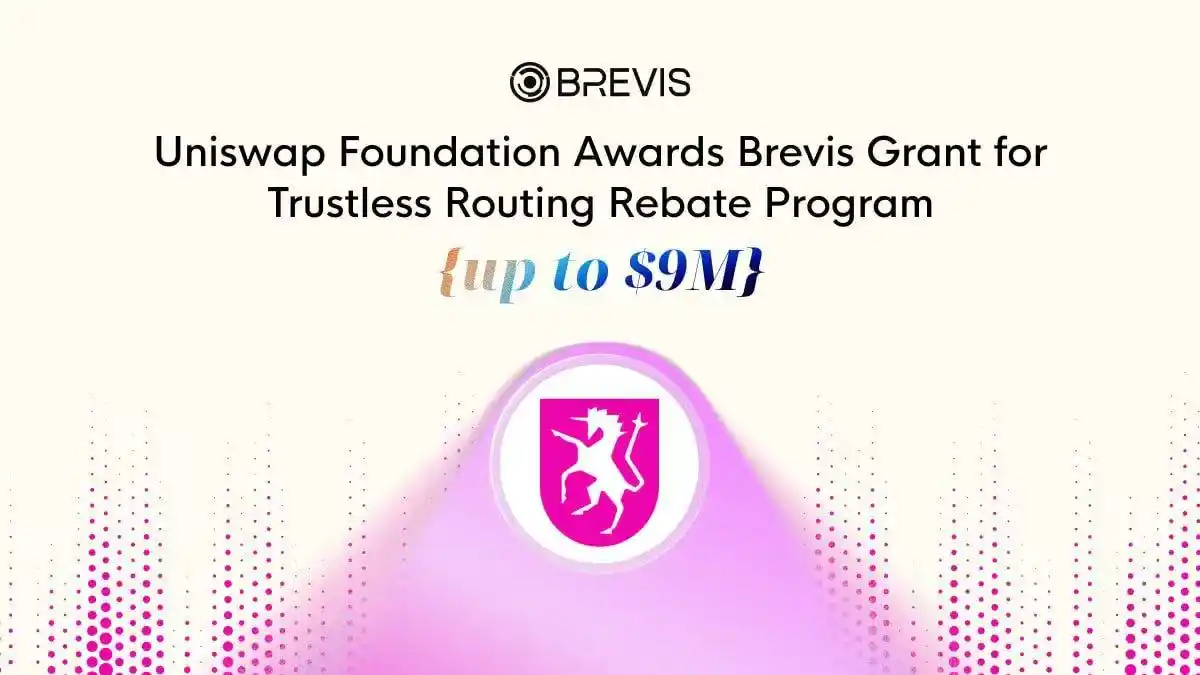
The Uniswap Foundation has provided up to $9 million in funding to Brevis to build a trustless Routing Rebate scheme



Abstract
The Uniswap Foundation has provided a grant to Brevis to develop and implement the "Trustless Routing Rebate Program," offering up to a maximum of $9 million Gas fee rebate for routers integrating v4 Hook pools. The system will utilize Brevis's ZK Data Coprocessor and Pico zkVM to calculate and validate all rebate amounts in a trustless manner, without relying on centralized databases or obfuscated computations. This initiative incentivizes aggregators by providing economic incentives for them to prioritize Hook integration, thus accelerating v4 adoption.
Uniswap v4: Unlocking the Next Wave of AMM Innovation
Uniswap v4 (hereinafter referred to as v4) introduced the Hook and Singleton architecture in January 2025, unlocking advanced features such as dynamic fees, custom curve logic, MEV resistance, among others.
For traders, this means better execution prices, lower slippage, and transaction costs as liquidity dynamically adjusts according to market conditions. For developers, v4 provides a flexible framework for continuous innovation without worrying about liquidity fragmentation.
Aggregators: New Challenges with v4 Integration
Simultaneously, v4 has posed new challenges for DEX aggregators like 1inch, 0x, Velora. Aggregators serve as the entry point for many traders, integrating various DEXs to route trades through multiple liquidity pools to find the optimal execution path and fee tier.
For Uniswap v2 and v3, the integration process was relatively straightforward. In the v2 era, aggregators only needed to apply the constant product formula for quoting. While v3 became more complex due to concentrated liquidity and multiple fee tiers, it still maintained a generic pool structure, enabling scalable integration.
However, in v4, liquidity pools are no longer homogenous. Each pool can customize its exchange logic, fee structure, or execution guarantees through Hooks, making them behave uniquely. This richness in flexibility enhances the ecosystem but also requires aggregators to identify and understand the unique behavior of each pool they integrate.
Driving v4 Adoption Acceleration
To expedite v4 adoption and increase the rewards for aggregator integration, the Uniswap Foundation has granted Brevis this funding to leverage its ZK Data Coprocessor and zkVM to provide trustless Gas fee rebates for all routers routing order flow to v4 Hook pools.
These rebates provide new economic support for routers, encouraging them to try the v4 Hook. Whether the router uses the rebate to offset its own operational costs, reduce trader fees, or establish a sustainable treasury, the end result is the same: faster integration speed, deeper liquidity, improved trade execution efficiency, and reduced user transaction costs.
Trustless Gas Rebate Empowered by Brevis
This rebate program operates entirely based on Brevis's ZK technology, rejecting any reliance on centralized tracking or opaque computations.
Rebate Computation: Routers can utilize Brevis's hosted Gas rebate proof system to generate a ZK proof for transactions routed through an eligible v4 liquidity pool. Subsequently, the Brevis Pico zkVM will calculate the total Gas cost and produce a summarized zero-knowledge proof to verify the entire computation process. Once the router obtains this proof, it can claim the rebate on-chain via a smart contract.
Rebate Claiming: The router submits the ZK proof to the rebate contract, which validates the proof's authenticity, confirms that the related transaction has not previously received a rebate, and then disburses the payment. The entire process is automated and trustless.
This approach addresses challenges that centralized systems cannot achieve: verifiable fairness and large-scale decentralized retroactive rewards. Each computation is supported by cryptographic proofs, and anyone can verify it on-chain. There is no need for centralized database tracking of contributions, nor to trust any intermediaries. As routers receive rebates, the Uniswap Foundation achieves transparent distribution, and the adoption of v4 is accelerated underpinned by the economic support that maintains the core DeFi guarantee.
Accelerating v4 While Upholding DeFi Principles
This funding provides the necessary impetus for the vibrant development of Uniswap v4. It accelerates aggregator adoption by providing economic incentives for router integration with the v4 Hook pool. With deeper liquidity in the v4 liquidity pools, users will experience smaller spreads and lower slippage. If routers pass on the rebate to users, the actual exchange costs for traders will be further reduced.
Uniswap v4 introduces advanced AMM features through the Hook. Brevis is building corresponding infrastructure to make v4 adoption economically attractive for routers while upholding the defining trustless guarantee of DeFi. With Brevis ZK proofs supporting the rebate system, as v4 scales, integrators, traders, and liquidity providers will all benefit.
About Brevis
Brevis is an intelligent verifiable computing platform that provides unlimited computational power to existing smart contract blockchains. Through zero-knowledge proofs, Brevis offloads data-intensive, high-cost computation from on-chain to an off-chain engine, enabling Web3 applications to seamlessly scale while maintaining L1 security and trust.
This article is contributed content and does not represent the views of BlockBeats.
You may also like
$10,000 in TRUMP Token vs. $10,000 in Nasdaq: The "Trump Trade" That Actually Worked in 2026
Morning Report | Vitalik outlines Ethereum's long-term roadmap, Lean Ethereum will become the third major iteration; SK Hynix seeks to attract more AI investors by listing in the U.S
The impact of OUSD on Circle, Tether, and Paxos: not a single negative factor, but a more complex reshaping of competition
Li Feifei's latest long article: When video generation, robots, and NVIDIA all claim to be world models, we need a taxonomy
Blaming the desolation of the cryptocurrency world on the rise of AI is a form of intellectual laziness
Strategy Founder: The Next 10 Years of Bitcoin
Forbes Special Report: Stablecoin cross-border payments are faster now, but not cheaper yet
A valuation of 8 billion dollars, doubling in 8 months! What makes the crypto-friendly bank Erebor Bank stand out?
340 billion valuation: Li Yanhong's largest IPO, a seat in Kunlunxin's shares is hard to come by
Stablecoins are the "royalists" of the crypto world: Open USD brings the old currency system into play
Cape Verde 2-3 Argentina: The Underdog Team That Stunned the World in Defeat
Cape Verde's run ended in a 3-2 defeat to Argentina, but their journey — three unbeaten draws, one heroic goalkeeper, and a fight that pushed the defending champions to the brink — is the kind of story markets recognize too: small caps can rattle blue chips long before anyone expects it.
Semiconductor stocks plummet, yet Anthropic wants to create a 2nm chip
Where is Zhao Changpeng's billion-dollar investment going? YZi Labs' investment landscape fully revealed
Ethereum Foundation Report: A Basic Guide to Ethereum for Governments and Financial Institutions
A pre-announced harvesting case: After the cryptocurrency price dropped by 99%, the public chain Saga exited to transform into AI
When American giants collectively "defect" from Chinese AI models
BIS Report Compliance Observation: The Real Risks of Stablecoins, Not Just "Depegging"
Portugal 2-1 Croatia: Ronaldo's 20-Year Knockout-Stage Drought Ends With a Debt Finally Collected
Portugal beat Croatia 2-1 in the 2026 global football championship's knockout rounds as Ronaldo scored his first-ever knockout-stage goal, Gonçalo Ramos struck a stoppage-time winner, and VAR ruled out a late equalizer for offside.
$10,000 in TRUMP Token vs. $10,000 in Nasdaq: The "Trump Trade" That Actually Worked in 2026
Morning Report | Vitalik outlines Ethereum's long-term roadmap, Lean Ethereum will become the third major iteration; SK Hynix seeks to attract more AI investors by listing in the U.S
The impact of OUSD on Circle, Tether, and Paxos: not a single negative factor, but a more complex reshaping of competition
Li Feifei's latest long article: When video generation, robots, and NVIDIA all claim to be world models, we need a taxonomy
Blaming the desolation of the cryptocurrency world on the rise of AI is a form of intellectual laziness
Strategy Founder: The Next 10 Years of Bitcoin