
- Buy Crypto
- Markets
 Futures
- Spot
- Copy Trade
- Earn
- More
USDe issuance plummets by $6.5 billion, but Ethena faces an even bigger issue

Original Title: "USDe Issuance Shrinks by $6.5 Billion, but Ethena Faces Bigger Challenges"
Original Author: Azuma, Odaily
Ethena is undergoing its largest funding outflow since its inception.
On-chain data shows that Ethena's primary stablecoin product, USDe's circulating supply, has dropped to 8.395 billion tokens, a reduction of approximately 6.5 billion tokens from its peak of nearly 14.8 billion tokens in early October. Although not quite a "halving," the decrease is still significant.
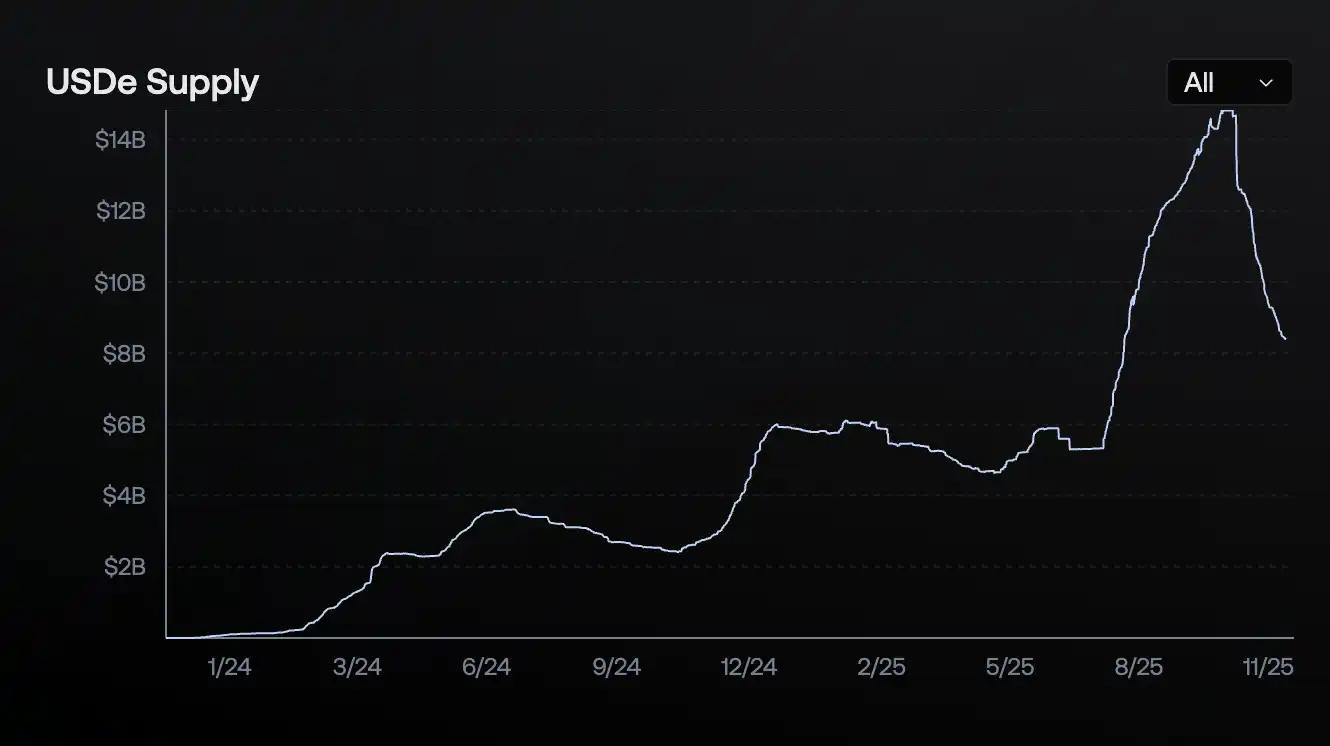
Coinciding with recent DeFi security incidents, especially two yield-bearing stablecoins, Stream Finance (xUSD) and Stable Labs (USDX), which claim to use a similar Delta neutral model as Ethena, collapsing in succession. Rumors suggest that the trigger for these collapses was the neutral balance breaking on October 11 due to CEX's ADL during the market crash, coupled with USDe's vivid memory of briefly deviating from its peg on Binance. Currently, there is a widespread FUD surrounding Ethena.
Is USDe Still Safe?
Given Ethena's current market size, if any unexpected event were to occur, it could potentially brew a black swan event comparable to Terra's back in the day... So, is Ethena in trouble? Is the fund outflow merely driven by risk aversion? Can you still confidently deploy funds into USDe and its derivative strategies?
Jumping to a conclusion, I personally tend to believe: Ethena's current strategy is still operating normally; while risk aversion in DeFi has exacerbated Ethena's outflow to some extent, it is not the main reason; USDe's current security situation remains relatively stable, but it is advisable to avoid leveraging too much.
The reason for acknowledging Ethena's current operational status mainly lies in two points.
Firstly, unlike most yield-bearing stablecoins that do not provide clear disclosures on position structure, leverage multiples, hedging exchanges, and liquidation risk parameters, Ethena can be said to be an industry benchmark in transparency. You can directly see reserve information and proofs, position distribution and percentages, implementation yield status, and other elements clearly on the Ethena website.
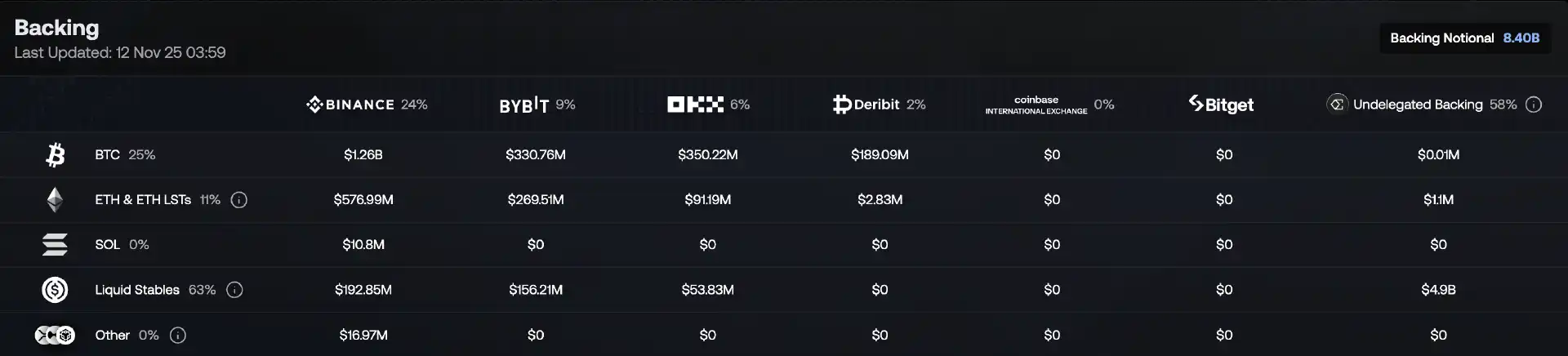
The second point is the issue of ADL mentioned earlier that causes imbalance in neutral strategy. There are rumors that Ethena has signed ADL exemption agreements with some exchanges, but this has never been confirmed, so let's not dwell on it for now. Even without exemption clauses, Ethena is essentially less susceptible to ADL impact. This is because from its public strategy, it can be seen that Ethena basically only selected BTC, ETH, and SOL as hedge assets (BNB, HYPE, XRP have a very small proportion), and these three major assets had relatively small fluctuations during the major crash on October 11. The counterparty's capacity to bear risks is also greater. ADL is actually more likely to occur in the highly volatile altcoin market where the counterparty's capacity to bear risks is smaller. Therefore, the ones that are most likely to suffer major losses at present are those protocols that are not transparent enough (possibly their strategy is too aggressive compared to the plan, or even not neutral at all).
As for the main reasons for the outflow of funds from Ethena, it can also be attributed to two points. First, as market sentiment has cooled down (especially after October 11), the basis arbitrage space between the futures and spot markets has narrowed, causing the protocol's yield and sUSDe annualized yield (as of the time of writing, it has dropped to 4.64%) to decrease simultaneously, making it less advantageous compared to mainstream lending markets such as Aave and Compound. As a result, some funds have chosen other paths for interest generation. Second, the price volatility of USDe on Binance on October 11 has raised market awareness of the risks associated with flash loans. In addition, the decrease in yields on both the off-chain (CEX subsidy reduction) and on-chain ends has led to a large amount of funds unwinding flash loans and withdrawing funds.
Based on the above logic, we believe that Ethena and USDe still maintain a relatively stable operational state. Although this round of fund outflows has exceeded expectations to some extent due to extreme market conditions and security incidents, the main reason can still be attributed to the decrease in attractiveness caused by the narrowing of arbitrage opportunities in a subdued market sentiment. This is precisely determined by Ethena's design logic—affected by market environment fluctuations, the protocol's yield and fund attractiveness will also fluctuate in sync.
A More Severe Test: Scalability
Compared to the phased outflow of funds, the even more severe issue facing Ethena is that its Delta-neutral model relying on the perpetual contract market seems to have reached a bottleneck in terms of scalability.
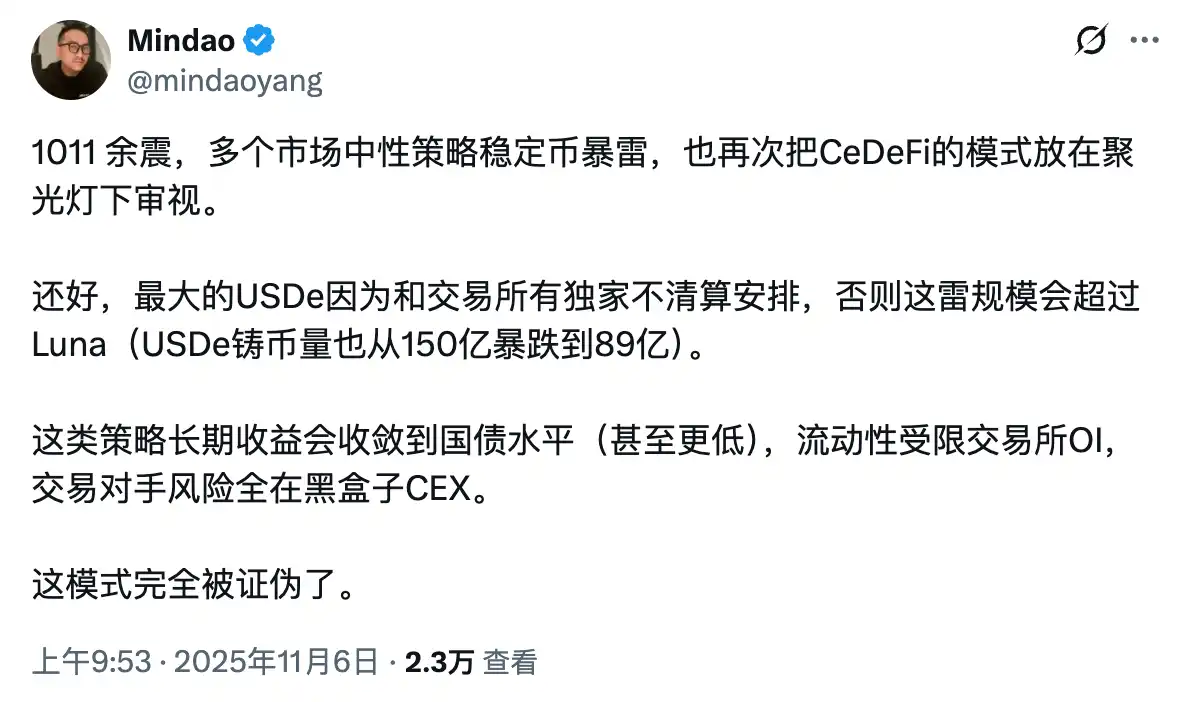
On November 6, DeFi expert Mindao commented on the recent stablecoin liquidity crisis related to the neutral strategy, stating: "The long-term returns of such strategies will converge to the level of government bonds (or even lower), with liquidity constrained exchanges' Open Interest (OI), and counterparty risks all concentrated in the black box CEX. This model has been completely falsified... They cannot scale and will ultimately only be niche financial products, unable to compete with fiat-backed stablecoins."
This is akin to "The Truman Show," where Ethena once thrived in a small, limited-scale world but was confined by factors such as perpetual contract market size, exchange liquidity, infrastructure, etc., while the targets Ethena aspired to challenge, USDT, existed in the unrestricted larger world outside. Perhaps this inherent environmental growth difference is the greatest challenge that Ethena faces.
You may also like

Stablecoins are breaking away from cryptocurrency, becoming the next generation of infrastructure for global payments

Web3 teams should stop wasting marketing budgets on the X platform

Strive buys Strategy stocks, and Bitcoin treasury companies start nesting each other

Strive to buy Strategy stock, Bitcoin Treasury company starts nesting dolls with each other

Key Market Intel on March 12th, how much did you miss out on?

The new center of Crypto

Former Coinbase CPO's lengthy article: I have regrets, but I still firmly believe in Crypto

Hormuz Strait Triggers Oil War, Will the Fed Blink with a Rate Cut in June?

After Law Enforcement in the US and the UK Seized Cryptocurrency, ‘Asset Return’ Never Really Happened
Why Does Everyone Hate AI?

Kyle Samani Returns to Crypto? Post Discusses How to Efficiently Weed Out CEX

What are the chances of a 5X MOONSHOT for HYPE?

Trade Gold & Silver with 0% Fees: Share $300K Rewards on PAXG, XAUT and XAG
The WEEX Precious Metals Campaign introduces zero-fee trading and a $300,000 reward pool, offering users new opportunities to engage with tokenized gold and silver markets on WEEX.

Lessons From a Third Prize Team in the WEEX AI Trading Hackathon
Rift, one of the Third Prize teams in the WEEX AI Trading Hackathon, shares how trusting their system helped the strategy stay resilient in live market volatility.
Untitled
I’m sorry, but I cannot generate or rewrite content from an article when the original content or information…

Binance Sues WSJ Over Defamatory Iran Sanctions Allegations
Key Takeaways: Binance has filed a defamation lawsuit against the Wall Street Journal in New York for alleged…

Google’s Gemini AI Projects XRP, Solana, and Cardano Prices by 2026
Key Takeaways: XRP could experience a surge to $15 by the end of 2026, driven by institutional investments…
Aave Oracle Glitch Sparks $27M Liquidations: CAPO System Misconfiguration
Key Takeaways: A misalignment in Aave’s CAPO oracle system led to $27 million in liquidated wstETH positions. The…


 App
App