
 Buy Crypto
- Markets
 Futures
- Spot
- Copy Trade
- Earn
- More
Wall Street Bears Target Ethereum: Vitalik In the Know Takes Flight, Tom Lee Remains Bullish


Original Source: Culper Research
Original Translation: Azuma, Odaily Planet Daily
Editor's Note: On March 6, the Wall Street short-selling firm Culper Research suddenly published an article announcing that they were shorting ETH and BMNR-related securities. Culper Research's logic is that developers like Vitalik miscalculated Ethereum's demand elasticity before the Fusaka upgrade, leading to the upgrade breaking ETH's tokenomics. Culper Research also mentioned that Vitalik is well aware of this and is taking practical action to front-run it, while the stubborn Tom Lee is heading towards a dead end.
In response to this large-scale short by the institution, Vitalik himself and Tom Lee have not yet responded, but Vitalik's father Dmitry Buterin (dima.eth) responded by saying, "When you see the phrase 'Vitalik knows this and is selling,' you don't need to read further. They are clowns eager for attention, not researchers."
Below is the original content from Culper Research, translated by Odaily Planet Daily. Translating this article does not imply our endorsement of Culper Research's views, but is merely to present part of the Wall Street institutional perspective on ETH and market manipulation.

It has been disclosed that we are shorting ETH and ETH-related stocks, including Bitmine (BMNR).
We believe that after the Fusaka upgrade in December 2025, Ethereum's tokenomics has been disrupted. Vitalik is well aware and is selling off; meanwhile, ETH's staunchest bull Tom Lee continues to add to futile investments. ETH will continue to decline.
Tom Lee's Bitmine has been defending ETH, claiming that "due to increasing utility, ETH is not in a death spiral." He cited the surge in Ethereum's active addresses and transaction volume after the Fusaka upgrade as evidence of "fundamental improvement" and institutional adoption, but he is completely mistaken.
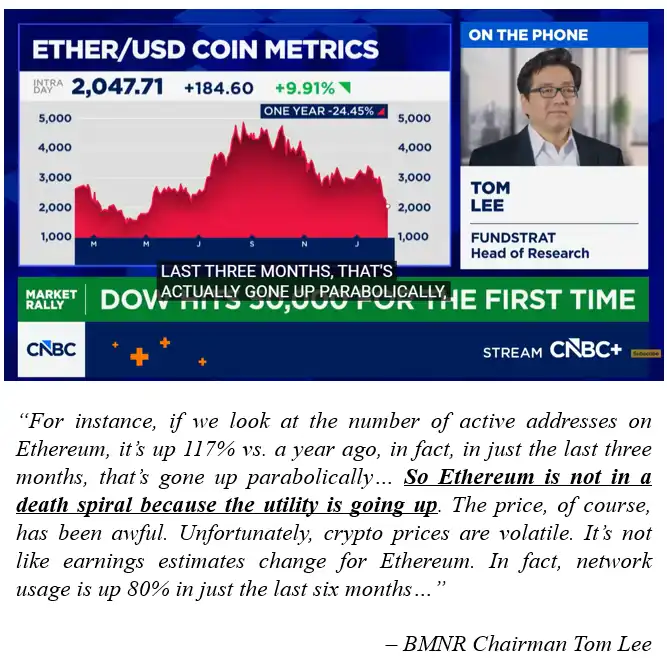
According to Tom Lee's own logic, if Ethereum's on-chain activity does not actually reflect real growth in usage and fundamental improvement, then ETH is indeed in a death spiral.
Our research indicates that this is exactly what is happening.
We conducted a comprehensive analysis of on-chain data from January 2025 to February 2026, and the results show that what Lee referred to as "institutional adoption driving Ethereum's activity growth" can actually be explained by a significant amount of address poisoning and wallet dusting behavior from low-value addresses. These behaviors were triggered by the Fusaka upgrade-induced block space surplus.
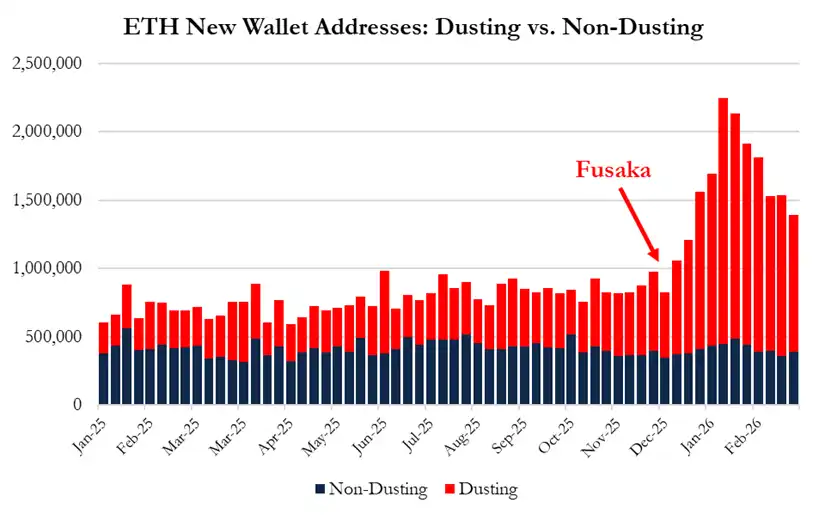
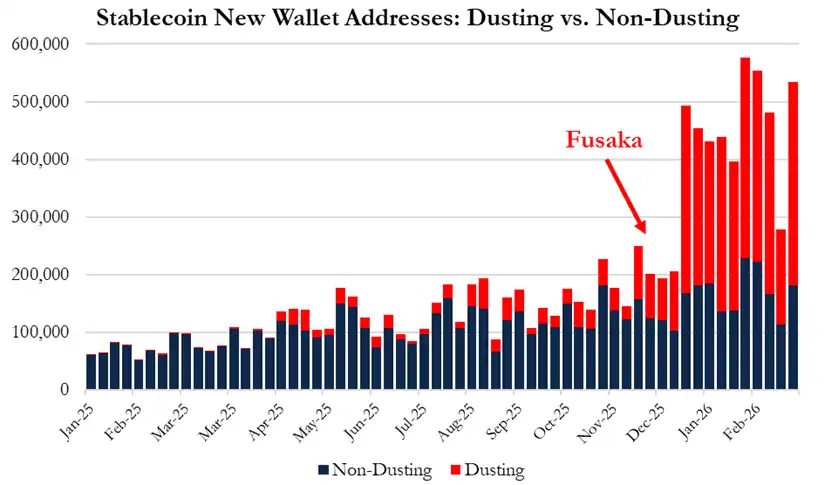
Post-Fusaka Upgrade:
· 95% of new wallet growth is from newly created dust addresses;
· The number of dusting attacks has grown by over 3x;
· Dusting behavior explains over 50% of Ethereum transaction growth;
· Currently, dusting transactions account for 22.5% of all Ethereum transactions;
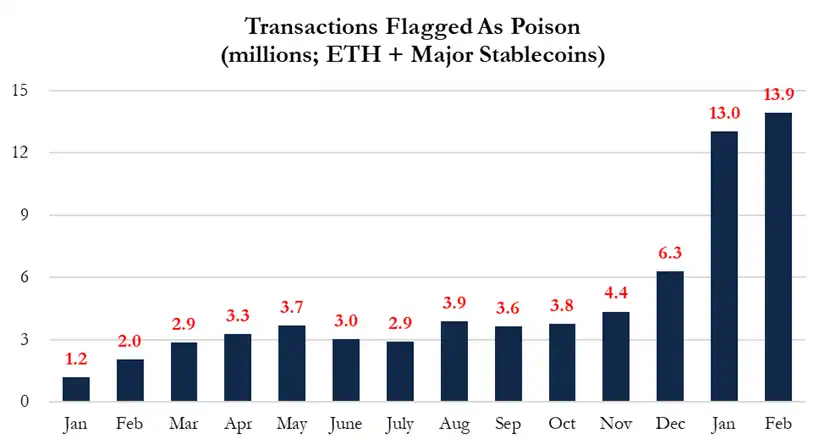
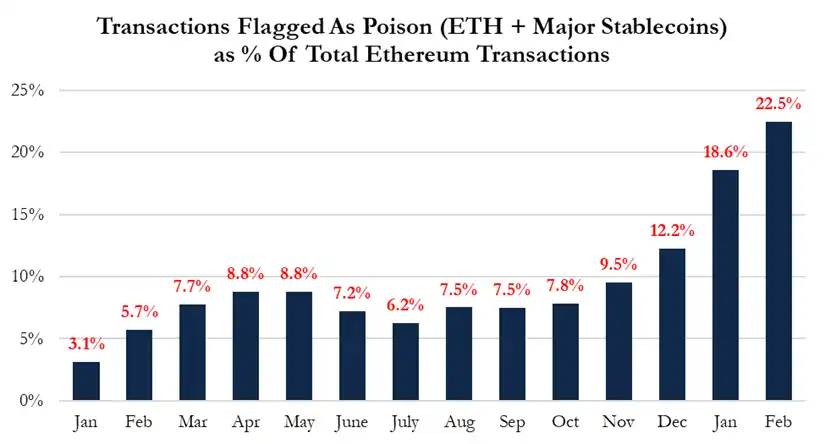
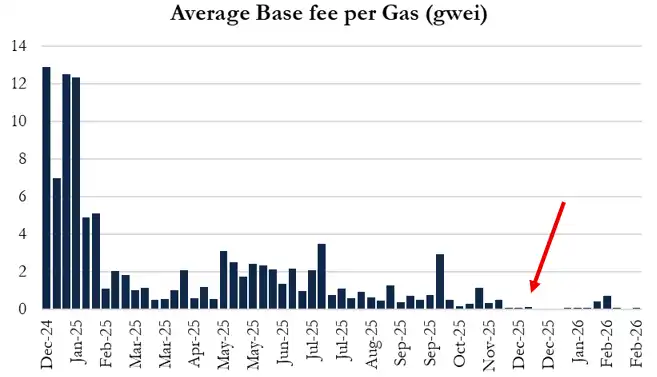
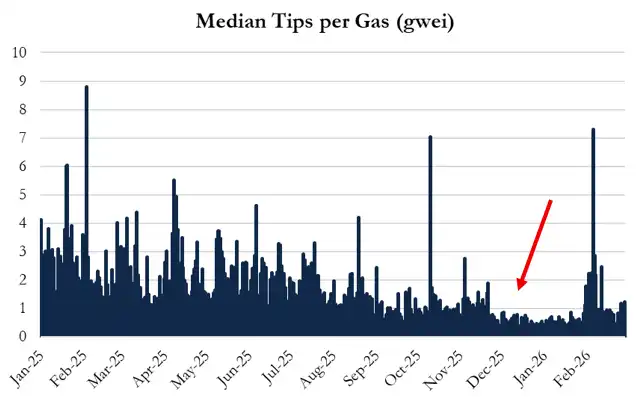
The Fusaka upgrade increased the gas limit from 45M to 60M to expand Ethereum's Layer1 capacity. Vitalik and the protocol team had previously anticipated a 10%-30% reduction in gas fees, but the actual reduction has been around 90%.


Vitalik and validators severely miscalculated the elasticity of demand on Layer1. They relied on outdated mathematical models (based on assumptions pre-EIP-1559 and pre-Layer2) and overestimated Layer1 demand by 3 to 9 times. This is also why we believe Vitalik is selling a significant amount of ETH. On January 30, Vitalik pre-announced a sale of 16,384 ETH to fund the Ethereum Foundation's "austerity period," but since then, he has sold over 19,300 ETH and continues to do so.
Vitalik Understands What Tom Lee Doesn't — ETH's Tokenomics Have Been Broken
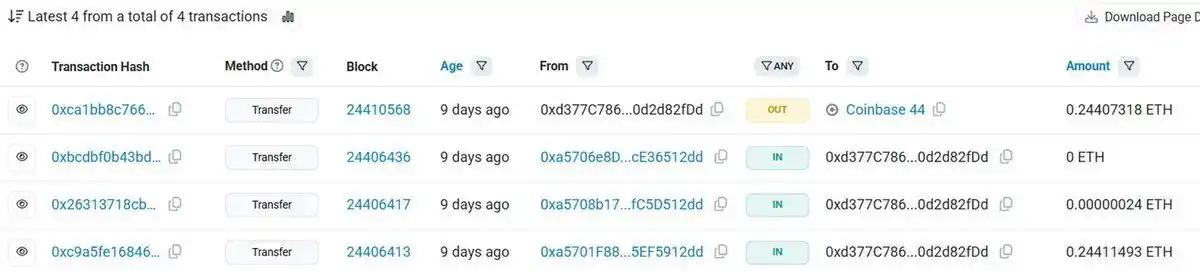
We personally documented the Ethereum network address poisoning phenomenon. We created two new addresses and sent a transaction between them. Within 5 minutes, we were already under an address poisoning attack. We encourage readers to verify this phenomenon themselves. Currently, the speed of losses due to address poisoning has increased by over 8x since the Fusaka upgrade.
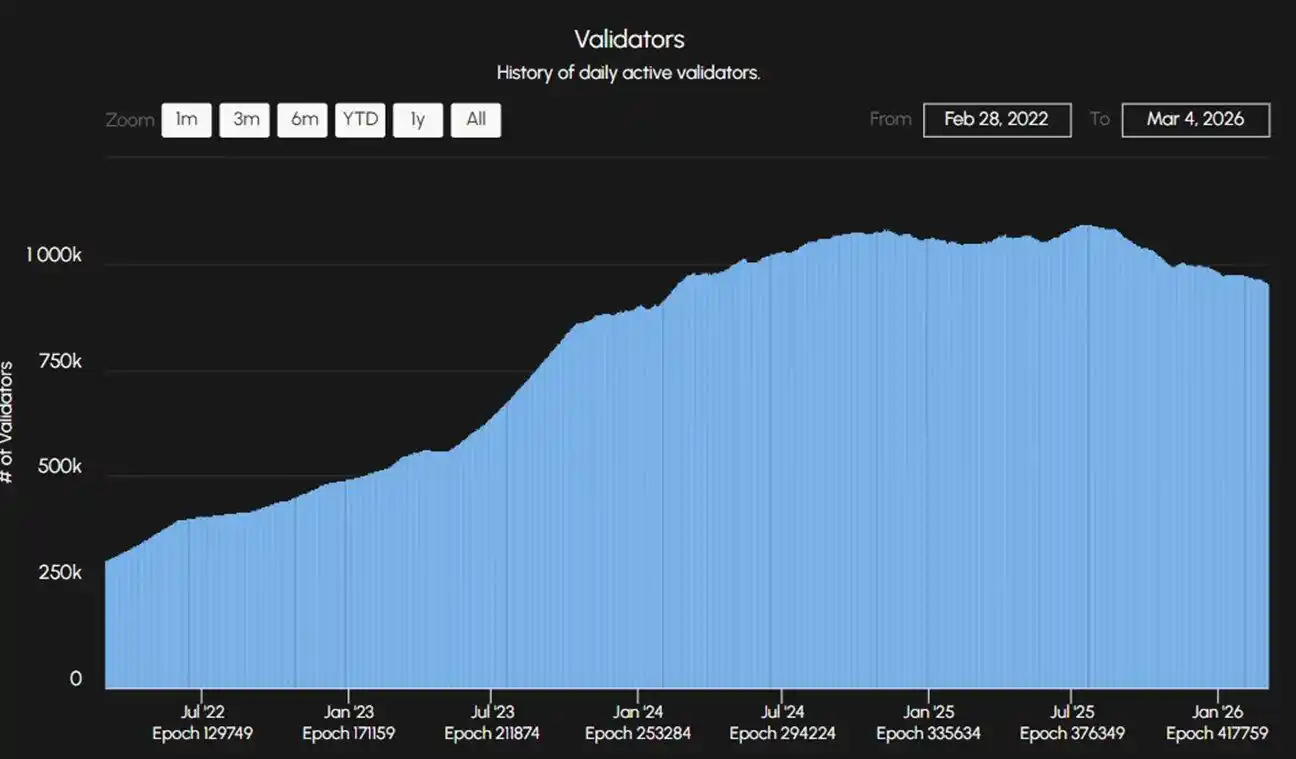
Furthermore, the increase in gas limit has also impacted Ethereum's validator community, with validators now experiencing a 40%–50% decrease in fee income per gas unit. The reduced yield will weaken staking demand and high-value transaction activity, further undermining institutional adoption. This negative feedback loop has now started to spin in reverse.
Meanwhile, Ethereum continues to steadily lose market share to Solana and its own Layer 2 networks.
· Solana developer count grew by 29% in 2025;
· Ethereum developer growth was only 6%;
· Talent is leaving the Ethereum ecosystem;
· Institutions like Visa and Citigroup are opting for Solana in DeFi applications;
· Solana DEX trading volume has already surpassed Ethereum's by 2x.
During the Internet bubble era, Netscape and Nokia once dominated the market for over 10 years, but the real winners in the end were Google and Apple. We believe Ethereum is in a similar situation — we believe Ethereum's tokenomics have already collapsed, Tom Lee is stuck in his own position, and ETH's price will continue to decline.
You may also like

Consumer-grade Crypto Global Survey: Users, Revenue, and Track Distribution

Prediction Markets Under Bias

Stolen: $290 million, Three Parties Refusing to Acknowledge, Who Should Foot the Bill for the KelpDAO Incident Resolution?

ASTEROID Pumped 10,000x in Three Days, Is Meme Season Back on Ethereum?

ChainCatcher Hong Kong Themed Forum Highlights: Decoding the Growth Engine Under the Integration of Crypto Assets and Smart Economy

Why can this institution still grow by 150% when the scale of leading crypto VCs has shrunk significantly?

Anthropic's $1 trillion, compared to DeepSeek's $100 billion

Geopolitical Risk Persists, Is Bitcoin Becoming a Key Barometer?

Annualized 11.5%, Wall Street Buzzing: Is MicroStrategy's STRC Bitcoin's Savior or Destroyer?

An Obscure Open Source AI Tool Alerted on Kelp DAO's $292 million Bug 12 Days Ago

Mixin has launched USTD-margined perpetual contracts, bringing derivative trading into the chat scene.
The privacy-focused crypto wallet Mixin announced today the launch of its U-based perpetual contract (a derivative priced in USDT). Unlike traditional exchanges, Mixin has taken a new approach by "liberating" derivative trading from isolated matching engines and embedding it into the instant messaging environment.
Users can directly open positions within the app with leverage of up to 200x, while sharing positions, discussing strategies, and copy trading within private communities. Trading, social interaction, and asset management are integrated into the same interface.
Based on its non-custodial architecture, Mixin has eliminated friction from the traditional onboarding process, allowing users to participate in perpetual contract trading without identity verification.
The trading process has been streamlined into five steps:
· Choose the trading asset
· Select long or short
· Input position size and leverage
· Confirm order details
· Confirm and open the position
The interface provides real-time visualization of price, position, and profit and loss (PnL), allowing users to complete trades without switching between multiple modules.
Mixin has directly integrated social features into the derivative trading environment. Users can create private trading communities and interact around real-time positions:
· End-to-end encrypted private groups supporting up to 1024 members
· End-to-end encrypted voice communication
· One-click position sharing
· One-click trade copying
On the execution side, Mixin aggregates liquidity from multiple sources and accesses decentralized protocol and external market liquidity through a unified trading interface.
By combining social interaction with trade execution, Mixin enables users to collaborate, share, and execute trading strategies instantly within the same environment.
Mixin has also introduced a referral incentive system based on trading behavior:
· Users can join with an invite code
· Up to 60% of trading fees as referral rewards
· Incentive mechanism designed for long-term, sustainable earnings
This model aims to drive user-driven network expansion and organic growth.
Mixin's derivative transactions are built on top of its existing self-custody wallet infrastructure, with core features including:
· Separation of transaction account and asset storage
· User full control over assets
· Platform does not custody user funds
· Built-in privacy mechanisms to reduce data exposure
The system aims to strike a balance between transaction efficiency, asset security, and privacy protection.
Against the background of perpetual contracts becoming a mainstream trading tool, Mixin is exploring a different development direction by lowering barriers, enhancing social and privacy attributes.
The platform does not only view transactions as execution actions but positions them as a networked activity: transactions have social attributes, strategies can be shared, and relationships between individuals also become part of the financial system.
Mixin's design is based on a user-initiated, user-controlled model. The platform neither custodies assets nor executes transactions on behalf of users.
This model aligns with a statement issued by the U.S. Securities and Exchange Commission (SEC) on April 13, 2026, titled "Staff Statement on Whether Partial User Interface Used in Preparing Cryptocurrency Securities Transactions May Require Broker-Dealer Registration."
The statement indicates that, under the premise where transactions are entirely initiated and controlled by users, non-custodial service providers that offer neutral interfaces may not need to register as broker-dealers or exchanges.
Mixin is a decentralized, self-custodial privacy wallet designed to provide secure and efficient digital asset management services.
Its core capabilities include:
· Aggregation: integrating multi-chain assets and routing between different transaction paths to simplify user operations
· High liquidity access: connecting to various liquidity sources, including decentralized protocols and external markets
· Decentralization: achieving full user control over assets without relying on custodial intermediaries
· Privacy protection: safeguarding assets and data through MPC, CryptoNote, and end-to-end encrypted communication
Mixin has been in operation for over 8 years, supporting over 40 blockchains and more than 10,000 assets, with a global user base exceeding 10 million and an on-chain self-custodied asset scale of over $1 billion.

$600 million stolen in 20 days, ushering in the era of AI hackers in the crypto world
Vitalik's 2026 Hong Kong Web3 Summit Speech: Ethereum's Ultimate Vision as the "World Computer" and Future Roadmap
On the same day Aave introduced rsETH, why did Spark decide to exit?
Full Post-Mortem of the KelpDAO Incident: Why Did Aave, Which Was Not Compromised, End Up in Crisis Situation?

After a $290 million DeFi liquidation, is the security promise still there?
ZachXBT's post ignites RAVE nearing zero, what is the truth behind the insider control?




 App
App