
WEEX Global AI Trading Hackathon Kicks Off: $1.88M Prize Pool Powers the Next Generation of AI Trading Champions


WEEX Labs, the innovation arm of WEEX, a leading global crypto exchange serving over 6.2 million users across 150+ countries, is set to kick off the preliminary round of its flagship global AI trading hackathon, AI Wars: WEEX Alpha Awakens, on January 12, 2026.
Backed by the strong support of world-class sponsors including Amazon Web Services (AWS), the total prize pool has surged from $880,000 to an unprecedented $1,880,000, positioning AI Wars among the largest AI trading hackathons in the crypto industry. At the top of the leaderboard awaits an extraordinary champion prize — a Bentley Bentayga S, already on standby in Dubai, ready to be claimed by the ultimate AI trading victor.
This is more than a hackathon — it is a global stress test for the future of AI-powered finance, where algorithms compete, capital learns, and the next generation of trading intelligence is born.
Registration & Preliminary Round Schedule: Early Bird and Forked Entry Explained
Global enthusiasm for this grand hackathon continues to surge. At the time of writing, 693 hackers from around the world have already registered, forming 387 BUIDLs (teams) competing to showcase their AI trading capabilities. Driven by overwhelming demand from AI traders, quantitative teams, and crypto builders worldwide, WEEX opened a second registration window — Forked Entry — following the successful close of the Early Bird registration on December 31, 2025, directly responding to strong community interest.
Early Bird Entry
- Registration: Ended Dec 31, 2025, 23:59 (UTC+8)
- Competition start: Jan 12, 2026, 12:00 (UTC+8)
- Competition end: Jan 30, 2026 (UTC+8)
- Format:
- 8–10 BUIDLs per group
- 1,000 USDT allocated per BUIDL
- AI strategies run for 3 weeks
- Top 2 BUIDLs per group advance to the finals
Forked Entry
- Registration deadline: Jan 18, 2026, 23:59 (UTC+8)
- Competition start: Jan 19, 2026, 12:00 (UTC+8)
- Competition end: Jan 30, 2026 (UTC+8)
- Format:
- 8–10 BUIDLs per group
- 1,000 USDT allocated per BUIDL
- AI strategies run for 2 weeks
- Top 1 BUIDL per group advances to the finals
Register now — this is the final opportunity to enter the WEEX AI trading battlefield: https://www.weex.com/events/ai-trading
In AI Wars, time is strategy — and the clock is already ticking.
WEEX Global AI Hackathon Offline Events: Dubai Kickoff, Europe Tour, Worldwide Impact
While the competition runs globally online, AI Wars: WEEX Alpha Awakens is designed as a hybrid hackathon that blends digital scale with real-world interaction. The finals will officially open in Dubai on February 1, 2026, followed by a 2.5-week Europe tour featuring workshops in Germany, Poland, Netherlands, UK, Russia, Grance, Spain, etc., covering a variety of activities, including university sessions, technical deep-dives, live final-round broadcasts, on-site short-term trading challenges, and human-versus-AI trading battles. Together, these offline events transform AI Wars into a living, traveling AI trading laboratory—connecting developers, researchers, traders, and institutions across borders and accelerating innovation as AI moves from codebases into real-world markets.
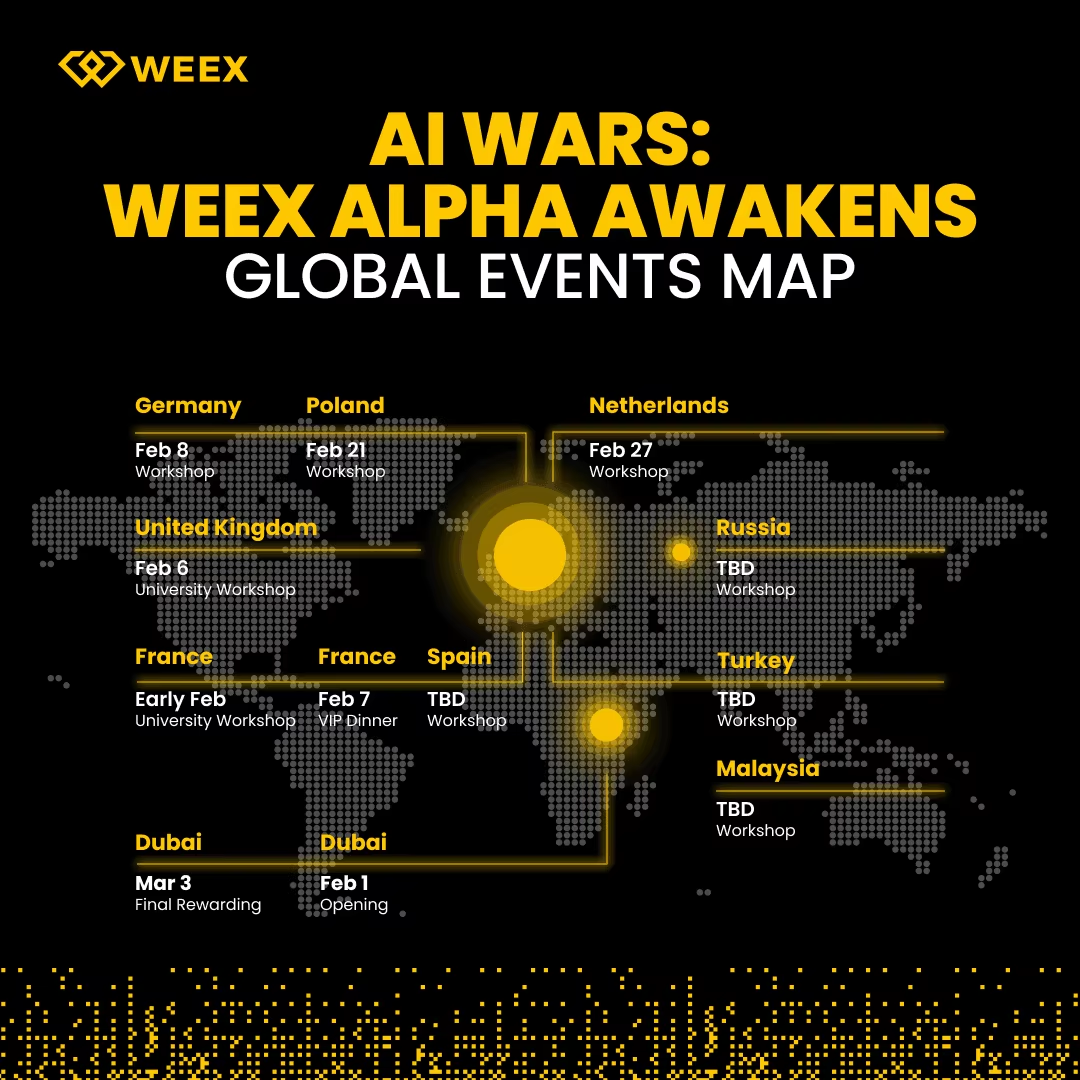
Top-Tier Sponsors Boosting Global Impact of WEEX AI Trading Hackathon
AI Wars: WEEX Alpha Awakens is powered by a powerhouse lineup of global sponsors, including cloud giants Amazon Web Services (AWS), Tencent Cloud, Alibaba Cloud, and leading Web3 and AI projects such as Hubble AI and CoinGecko. With dozens of partners across cloud infrastructure, Web3 data, and AI tooling, participants gain access to institutional-grade computing power, advanced market and on-chain data, cloud credits, exclusive APIs, and expanded social and community exposure—ensuring they are fully equipped to build production-grade AI trading systems.
As the Title Sponsor, AWS, together with AISANIE, is providing $1,000,000 in AWS Activate Credits to support AI trading teams with scalable infrastructure, production-ready AI tooling, and the ability to build, test, and deploy at global scale. Each winning team can receive up to $50,000 in AWS support, giving participants the resources to compete, innovate, and showcase their strategies on a global stage. In AI Wars, talent meets technology, ambition meets opportunity, and the future of trading is built one line of code at a time.
Why WEEX AI Wars Matters: Driving Global AI Trading Innovation and Talent Discovery
AI Wars: WEEX Alpha Awakens is WEEX’s strategic push into the future of trading, accelerating platform intelligence and discovering top AI strategists. The hackathon gives AI trading and quant finance teams a rare chance to test models in real markets with transparency, open development, and real capital. For the global crypto community, AI Wars marks a new era—where algorithms compete openly, talent is discovered worldwide, and AI becomes a core trading primitive. Here, code is capital, strategy is identity, and the future of trading unfolds in real time.
About WEEX
Founded in 2018, WEEX has developed into a global crypto exchange with over 6.2 million users across more than 150 countries. The platform emphasizes security, liquidity, and usability, providing over 1,200 spot trading pairs and offering up to 400x leverage in crypto futures trading. In addition to traditional spot and derivatives markets, WEEX is expanding rapidly in the AI era — delivering real-time AI news, empowering users with AI trading tools, and exploring innovative trade-to-earn models that make intelligent trading more accessible to everyone. Its 1,000 BTC Protection Fund further strengthens asset safety and transparency, while features such as copy trading and advanced trading tools allow users to follow professional traders and experience a more efficient, intelligent trading journey.
Follow WEEX on social media:
Instagram: @WEEX Exchange
TikTok: @weex_global
YouTube: @WEEX_Global
Discord: WEEX Community
Telegram: WeexGlobal Group
You may also like

AI Crypto Trading in 2026: How AI Agents Use Stablecoins for Capital Management and Settlement
Learn how AI agents use stablecoins for crypto trading in 2026 — managing capital, settling transactions, and operating across exchanges and DeFi protocols.
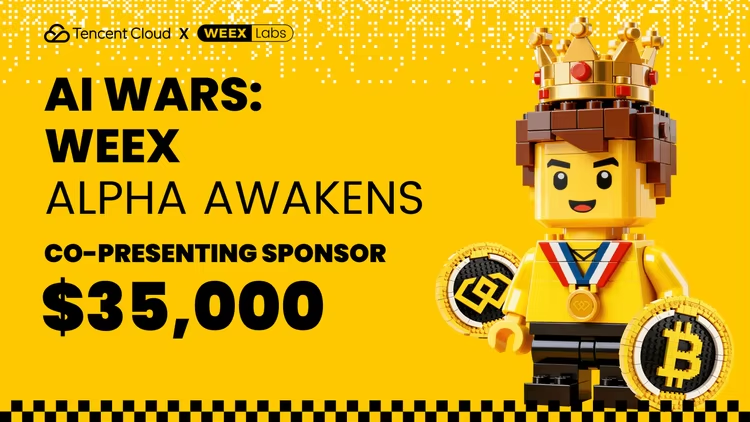
AI Trading's Ultimate Test: Empower Your AI Strategy with Tencent Cloud to Win $1.88M & a Bentley
AI traders! Win $1.88M & a Bentley by crushing WEEX's live-market challenge. Tencent Cloud powers your AI Trading bot - can it survive the Feb 9 finals?

How a Risk-Controlled AI Crypto Trading Bot Protects Capital in Real Markets
Ritmex demonstrates how disciplined risk control and structured signals can make an AI crypto trading bot more stable and reliable on WEEX, highlighting the importance of combining execution discipline with scalable AI trading systems.

How a Structured AI Crypto Trading Bot Won at the WEEX Hackathon
Crypto_Trade shows how structured inputs and controlled adaptability can build a more stable and reliable AI crypto trading bot within the WEEX AI Trading Hackathon, highlighting a practical path toward scalable AI trading systems.

How a Fully Automated AI Trading Bot Won at WEEX Hackathon (From 0 to AI Agent)
Nick’s journey on WEEX shows that successful AI Trading isn’t just about strategy ideas—but about structured AI agents, disciplined execution, and continuous adaptation in real market conditions.

Best AI Crypto Trading Bot? Inside the AI Trading System That Ranked Top 3 on WEEX
Discover the best AI crypto trading bot on WEEX. Learn how AI trading works, how to trade automatically, and why this system stands out among top AI trading apps.

OpenClaw and AI Bots: From AI Trading to BTC Liquidations in the Crypto Gold Rush
AI crypto trading bots like OpenClaw and AI trading apps are reshaping digital markets. From BTC liquidations to crypto bubble charts, automated trading is expanding alongside free crypto airdrops, affiliate programs, LALIGA partnerships, and tokenized gold markets.

From Human Strategy to AI Trading Bot: How Shadow Trading AI Won 2nd Place in the WEEX Hackathon
Ivan’s Shadow Trading AI secured second place in the WEEX AI Trading Hackathon, demonstrating how AI trading systems built on real market expertise can perform under live market conditions.

Who Will Control AI? Why Decentralized AI May Be the Only Alternative to Government and Big Tech
AI has become critical infrastructure, and governments and corporations are competing to control it. Centralized development and regulation are entrenching existing power structures. The Web3 community is building a decentralized alternative — distributed compute, token incentives, and community governance — before that window closes.

WEEX AI Hackathon: How Did This AI Trading Winner Succeed?
A self-taught AI trading enthusiast achieved top-10 results at the WEEX AI Hackathon. Learn about the mindset, AI tools, and lessons behind this impressive performance.

Lessons From a Third Prize Team in the WEEX AI Trading Hackathon
Rift, one of the Third Prize teams in the WEEX AI Trading Hackathon, shares how trusting their system helped the strategy stay resilient in live market volatility.

Champion Crowned at WEEX AI Hackathon: Revealing Strategy That Won $600K
A trader with only 6 months of AI trading experience won $600,000 at the WEEX AI Hackathon. Discover the strategy, tools, and lessons behind this breakthrough victory.

4 AI Trading Strategy Lessons from WEEX Hackathon Finalist
Finalist Bambi shares how AI tools helped turn real trading experience into an automated strategy, why survival-first risk control shaped the system’s design, and how the approach will evolve ahead of WEEX AI Trading Hackathon Season 2.

What Is OpenClaw? How The AI Agent Could Automate Crypto Trading Through APIs
OpenClaw is a rapidly growing AI agent on GitHub that can automate tasks and even execute crypto trades through exchange APIs. Learn how OpenClaw works, how it connects to exchanges, and the risks traders should understand before using AI trading agents.

WEEX AI Hackathon Champions Crowned, Revealing Future of AI Trading
The first-ever WEEX AI Hackathon has concluded, with 10 winners emerging from over 200 global teams. Beyond its $1.8 million prize pool, the event marked a milestone—proving that the future of AI trading belongs to accessible, AI-powered innovation.

Lessons From a Top 10 AI Trading Strategy in the WEEX AI Hackathon
A Top 10 finalist in the WEEX AI Hackathon shares how a market-neutral AI trading system competed against high-leverage strategies in live crypto markets.

From 27th to 4th: The AI Trading "Survivor Strategy" Behind a WEEX Hackathon Comeback
After a logic failure dropped him to 27th place, ClubW_9Kid rebuilt his AI trading framework and finished 4th in the WEEX AI Hackathon. In this interview, he explains the lessons behind disciplined AI execution, risk control, and why survival beats complexity in algorithmic trading.
What Is Vibe Coding? How AI Is Changing Web3 & Crypto Development
What is vibe coding? Learn how AI coding tools are lowering the barrier to Web3 development and enabling anyone to build crypto applications.
AI Crypto Trading in 2026: How AI Agents Use Stablecoins for Capital Management and Settlement
Learn how AI agents use stablecoins for crypto trading in 2026 — managing capital, settling transactions, and operating across exchanges and DeFi protocols.
AI Trading's Ultimate Test: Empower Your AI Strategy with Tencent Cloud to Win $1.88M & a Bentley
AI traders! Win $1.88M & a Bentley by crushing WEEX's live-market challenge. Tencent Cloud powers your AI Trading bot - can it survive the Feb 9 finals?
How a Risk-Controlled AI Crypto Trading Bot Protects Capital in Real Markets
Ritmex demonstrates how disciplined risk control and structured signals can make an AI crypto trading bot more stable and reliable on WEEX, highlighting the importance of combining execution discipline with scalable AI trading systems.
How a Structured AI Crypto Trading Bot Won at the WEEX Hackathon
Crypto_Trade shows how structured inputs and controlled adaptability can build a more stable and reliable AI crypto trading bot within the WEEX AI Trading Hackathon, highlighting a practical path toward scalable AI trading systems.
How a Fully Automated AI Trading Bot Won at WEEX Hackathon (From 0 to AI Agent)
Nick’s journey on WEEX shows that successful AI Trading isn’t just about strategy ideas—but about structured AI agents, disciplined execution, and continuous adaptation in real market conditions.
Best AI Crypto Trading Bot? Inside the AI Trading System That Ranked Top 3 on WEEX
Discover the best AI crypto trading bot on WEEX. Learn how AI trading works, how to trade automatically, and why this system stands out among top AI trading apps.

Contents
Popular coins
Latest Crypto News


