
Why Does Ethereum Urgently Need ZK Rollups?


Original Title: "Why Ethereum Urgently Needs ZK Rollup"
Original Source: Ebunker Chinese
One of the most frequently asked questions recently is how to view the narrative of Ethereum?
Indeed, Ethereum focused on ICOs and the world computer in '17, DeFi and the financial settlement layer in '21. However, in this cycle of '25, there seems to be a new narrative that can hardly compare in height to the previous old narratives.
ETFs and Staking ETFs may be considered half of it, but this is not within the control of Ethereum developers. If we were to mention the other half, it can only be ZK.
Ethereum is indeed the public chain in the entire crypto world that has bet the most on ZK, without a doubt.
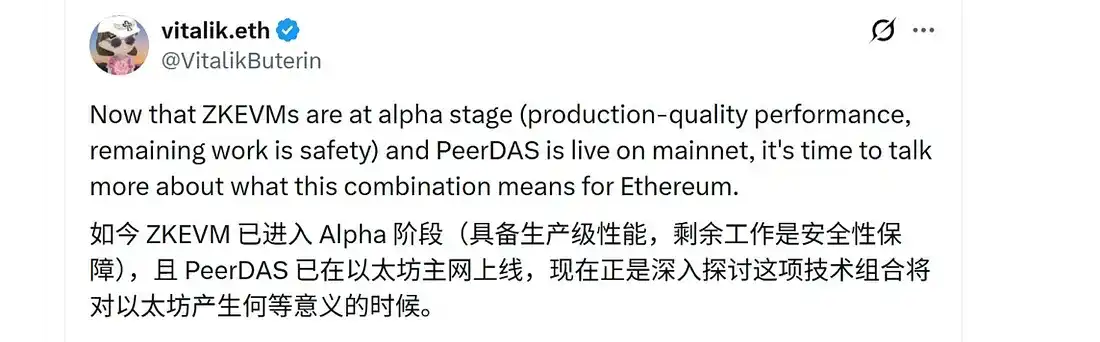
A few days ago, Vitalik was quite excited, announcing on Twitter that ZKEVM has now entered the Alpha stage.
Why is Ethereum so obsessed with ZK?
Actually, Ethereum's TPS is not low now; the theoretical peak has been raised to over 200 TPS, the reason being Ethereum has increased the Gas limit several times.
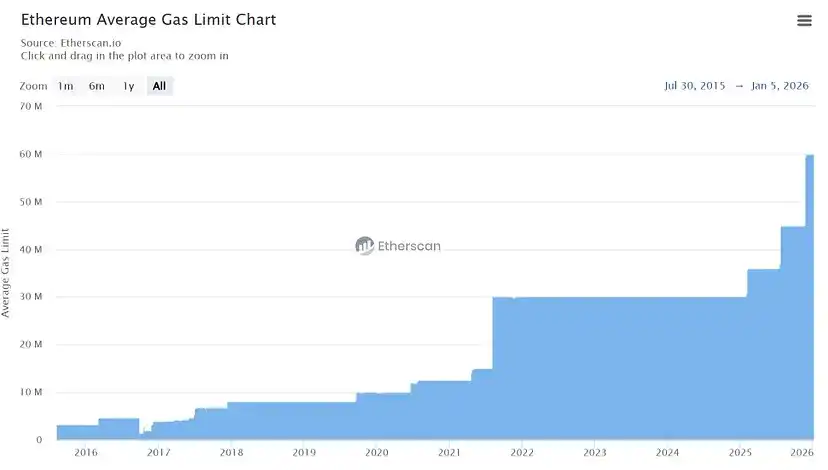
However, increasing the Gas limit comes at a cost and cannot be raised endlessly. The cost is that nodes need more expensive servers to run.
But Ethereum also wants to maintain its proud decentralization, so it cannot push the performance of nodes' servers too high (refer to Solana, where a single server is roughly 5-10 times more expensive than an ETH server).
Therefore, the mainnet must be ZK-rolled up. Note, it's not as simple as having a few ZK L2s; this is full ZK rollup of the L1 mainnet.
So, what are the benefits after ZK?
Those ETH nodes could easily verify these ZK proofs without the need to painstakingly verify each transaction one by one as before.
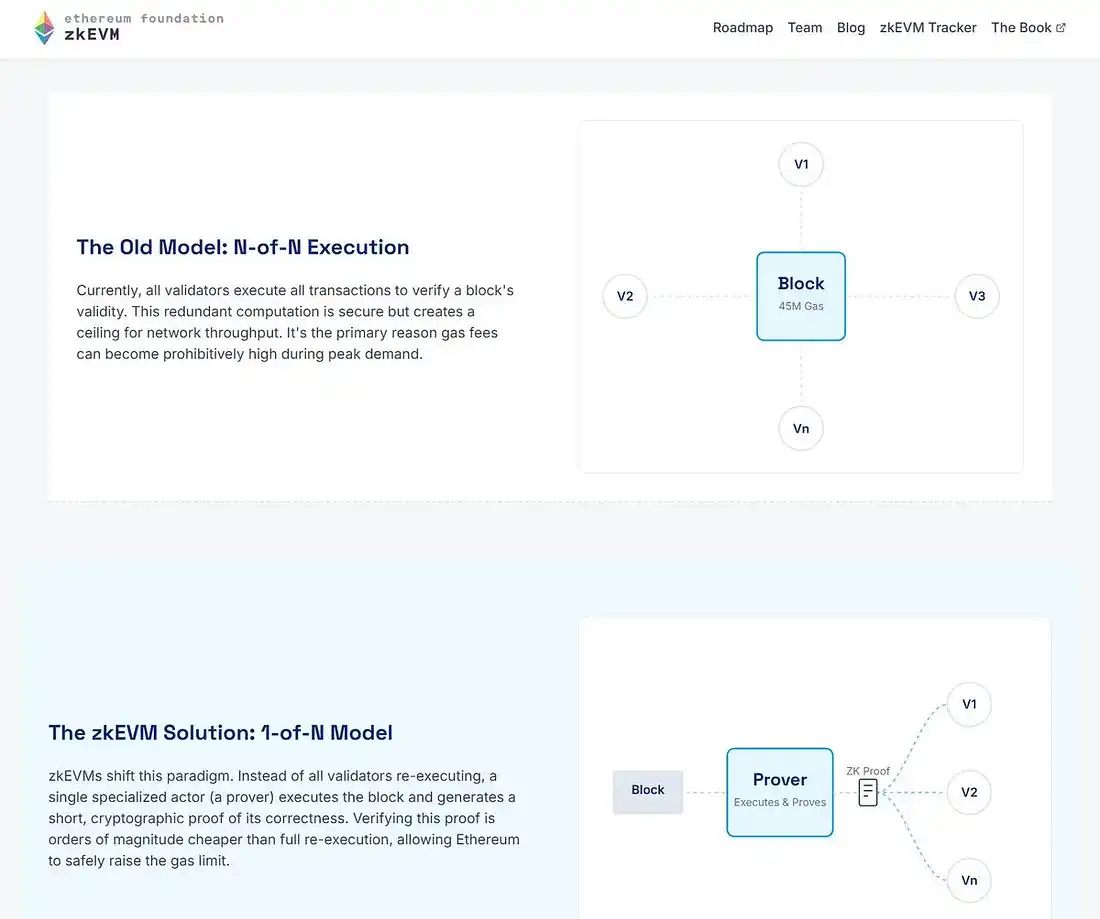
For example, if you were a test grader (node), those transactions would be the students' answer sheets.
You used to grade papers manually, which was definitely slow. But since the answer sheet filling machine (ZK rollup) came along, the machine can calculate the students' total scores in a second. So, as a teacher, wouldn't you feel much more relaxed?
You are more relaxed now. In the past, one person could only grade 50 papers, but now they can grade 1000. The person is still the same, but the efficiency has increased dramatically.
Therefore, Ethereum must first ZKify the mainnet before it can further significantly increase the Gas limit.
ZKification itself does not directly increase TPS; it is a prerequisite. Improving performance still relies on raising the Gas limit, but after ZKification, nodes do not need to increase server costs too much, making the cost very low.
And after the last Fusaka upgrade (especially the PeerDAS upgrade) ran smoothly, Ethereum has taken another step towards ZKifying the mainnet, which is why Vitalik is so excited.
Imagine a mainnet with over a thousand TPS; for Ethereum, this can indeed be considered a remarkable narrative.
Someone raised a question, if Ethereum itself ZK-EVMs the mainnet, does it still make sense for other ZK teams?
Let's start with the conclusion: it still makes sense.
Why?
First, the ZK project is one of the most challenging developments in the world, on par with FHE. It requires a large number of cryptographic talents.
I believe the Ethereum Foundation has some reserves in this regard, but as an open-source community, Ethereum's philosophy is that many hands make light work. It needs a large number of third-party ZK teams to experiment and innovate. In return, Ethereum will provide a lot of support.
Second, ZK-EVM has four types, from type1 to type4. Various teams, including Polygon, Scroll, ZKsync, and Taiko, are each working on implementing one of the types, almost like everyone is claiming a task and working on achieving one type.
Additionally, there is ZK-VM, such as Brevis.
In fact, ZK-VM is even more stable compared to ZK-EVM.
The reason is that out of the four major ZK-EVM types mentioned above, eventually, there will likely be one solution with the highest cost-effectiveness, becoming part of the designated solution for the Ethereum mainnet ZK-EVM, which may affect the other three.
However, in the case of ZK-VM, since it is not EVM-compatible, it will definitely be part of Ethereum's diversity.
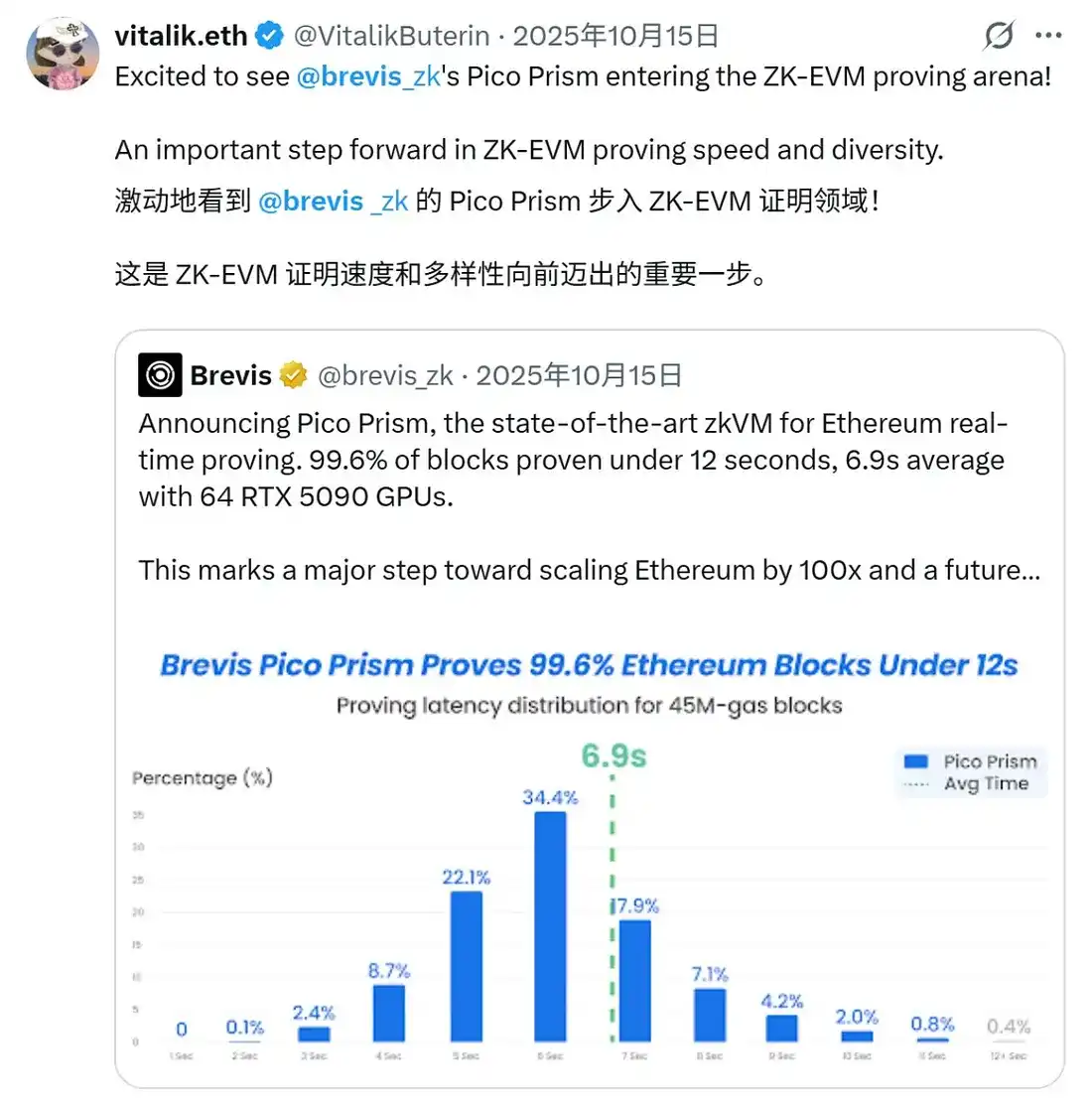
Also, because the VM is not constrained by EVM limitations, its performance will be very high. Ethereum's ZK-EVM poses no threat to it; on the contrary, the Ethereum team will continue to encourage it.
For example, Vitalik previously specifically mentioned the performance of Brevis' ZK-VM and looks forward to their entry into the ZK-EVM field.
Regarding L2? There may be some impact, but still not significant.
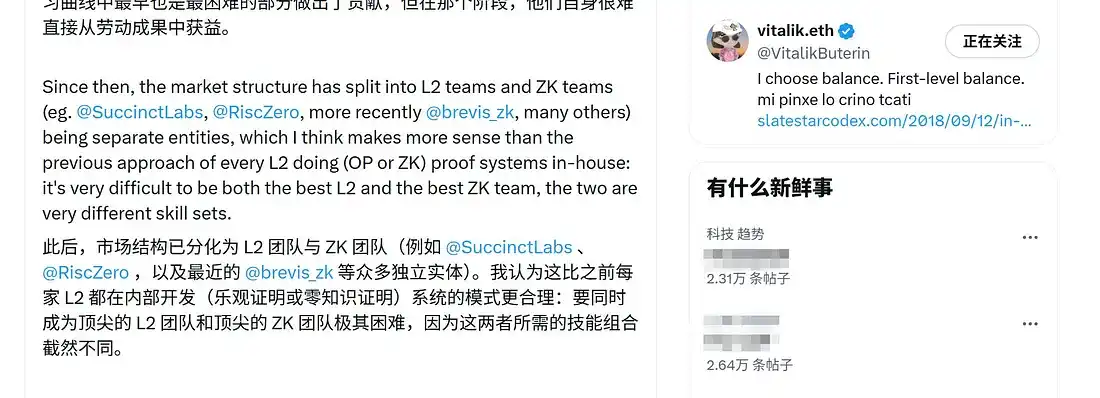
When discussing Polygon, Vitalik once said that ZK and L2 should probably be compared separately.
With ZK-enabled L1, it will definitely attract back some users from ZK L2. After all, if L1 is cheap enough, there may be fewer users on L2.
But thinking the other way around, if we consider L1 as the foundation and L2 as skyscrapers, a stronger foundation is always better. So if L1 mainnet is ZK-enabled, L2 will also lower fees, which is beneficial.
Moreover, in that same post, Vitalik specifically mentioned Brevis working on ZK-VM. The reason is that Brevis' ZK work is not limited to L2, meaning "ZK research and L2 research are separate".
For example, they have a market for ZK computing power, helping Uniswap's rollups with ZK-based reward distribution, which can be considered application-driven.
Overall, Ethereum has been live for 10 years now, and the slogan of ZK-ing has been around for five or six years. After years of hard work, ZK-ing has finally entered the Alpha stage, which is inseparable from the continuous efforts of Ethereum and numerous third-party ZK teams, including Brevis and Polygon.
taproot-soft-fork-need-zk-snarks-5916159ea2a5" target="_blank">Original Article Link
You may also like

Interview with NDV Founder Jason Huang: Popping the AI Bubble and the Myth of Microstrategy, Seeking the Ultimate Ace in the Crypto Market

Morning Report | Former Ethereum Foundation researcher establishes Ethlabs; EU Parliament Economic Committee passes digital euro regulatory proposal

Dragonfly partner Haseeb: The fastest-growing companies in the future may all be stuck at 149 people

How xBubble Breaks the Deadlock in VC's Heavy Investment in the OPC Economy

The encrypted unicorn Blockstream is deeply embroiled in a serious fraud case

Morning Report | The South Korean Financial Services Commission plans to expand the regulatory sandbox to include virtual assets; the parent company of the New York Stock Exchange, ICE, has reached a partnership with OKX to jointly establish a cryptocu...

Exclusive Interview with Strategy CEO: Putting Aside the Sale of 32 BTC, the 60 Trillion AI Intelligence is the Ultimate Fate of Bitcoin

TRON revitalizes the image of the bull, creating a more approachable brand character

Will the STRC issuance price discussed with ChatGPT really fall into a death spiral?

The foundation retreats, Ethlabs steps forward: Ethereum welcomes its largest restructuring in history

NYSE Parent ICE and OKX Launch Joint Venture: What It Means for Tokenized Stocks
ICE and OKX have announced a joint venture focused on tokenized stocks, but stock futures are already live across crypto markets. Here's what the partnership means, how stock futures work, and why traders are paying attention.

How to Trade Apple and Nvidia on a Crypto Exchange in 2026 (Without Buying Shares)
Morning Report | Secret Network loses $4.67 million due to cross-chain vulnerability; Michael Saylor releases Bitcoin Tracker information again, may disclose increased holdings data next week
Kalshi's biggest competitor is not Polymarket

The second half of the computing power battle: Intel CEO Pat Gelsinger reveals how AI is reshaping the global semiconductor supply chain
B.AI partners with MiniMax to launch a limited-time free experience of M3, enabling zero-threshold implementation of Agentic productivity through full-stack infrastructure

A company that was on the verge of bankruptcy has just surpassed Bitcoin in market value

The two giants are racing in "credit": loan balances of 9.9 billion vs 14.6 billion USD, Brazil has become the main battlefield
Interview with NDV Founder Jason Huang: Popping the AI Bubble and the Myth of Microstrategy, Seeking the Ultimate Ace in the Crypto Market
Morning Report | Former Ethereum Foundation researcher establishes Ethlabs; EU Parliament Economic Committee passes digital euro regulatory proposal
Dragonfly partner Haseeb: The fastest-growing companies in the future may all be stuck at 149 people
How xBubble Breaks the Deadlock in VC's Heavy Investment in the OPC Economy
The encrypted unicorn Blockstream is deeply embroiled in a serious fraud case
Morning Report | The South Korean Financial Services Commission plans to expand the regulatory sandbox to include virtual assets; the parent company of the New York Stock Exchange, ICE, has reached a partnership with OKX to jointly establish a cryptocu...


