
 Buy Crypto
- Markets
 Futures
- Spot
- Copy Trade
- Earn
- More
Wintermute: Cryptocurrency Volatility Plummets as Retail Investors Flock Madly to US Stocks


Original Title: The retail trade: crypto vs equities
Original Source: Wintermute
Original Translation: Deep Tide TechFlow
Deep Tide Summary: This article, written by a Wintermute OTC trader, provides an in-depth analysis of the fundamental reasons behind the current outflow of retail funds in the crypto market. Historically, crypto bull markets have been largely driven by retail speculation, but recent data indicates that retail investors are pouring into US equities at a record pace, causing a shift from the crypto market and US stocks moving in tandem to a "seesaw" pattern. With the decreasing volatility in the crypto market, lower entry barriers, and AI giving retail investors an analytical edge in US stocks, cryptocurrency is no longer the top choice for retail speculation. Understanding this fund rotation logic can help us readjust our multi-asset investment framework.
Full Text:
Retail activity has always been driving the crypto market. Through speculation, reflexive buying on dips, and flexible capital rotation among various tokens, retail investors have defined every major cycle in crypto history. However, recent data suggests that the relationship between retail investors and the crypto market is changing.
For a while now, we have been reminding everyone that the US stock market is capturing retail attention, sacrificing altcoin liquidity. The latest data from JPMorgan's strategy department, combined with our exclusive flow data, further indicates that US stocks and cryptocurrency are becoming interchangeable risk assets.
Correlated Reversal
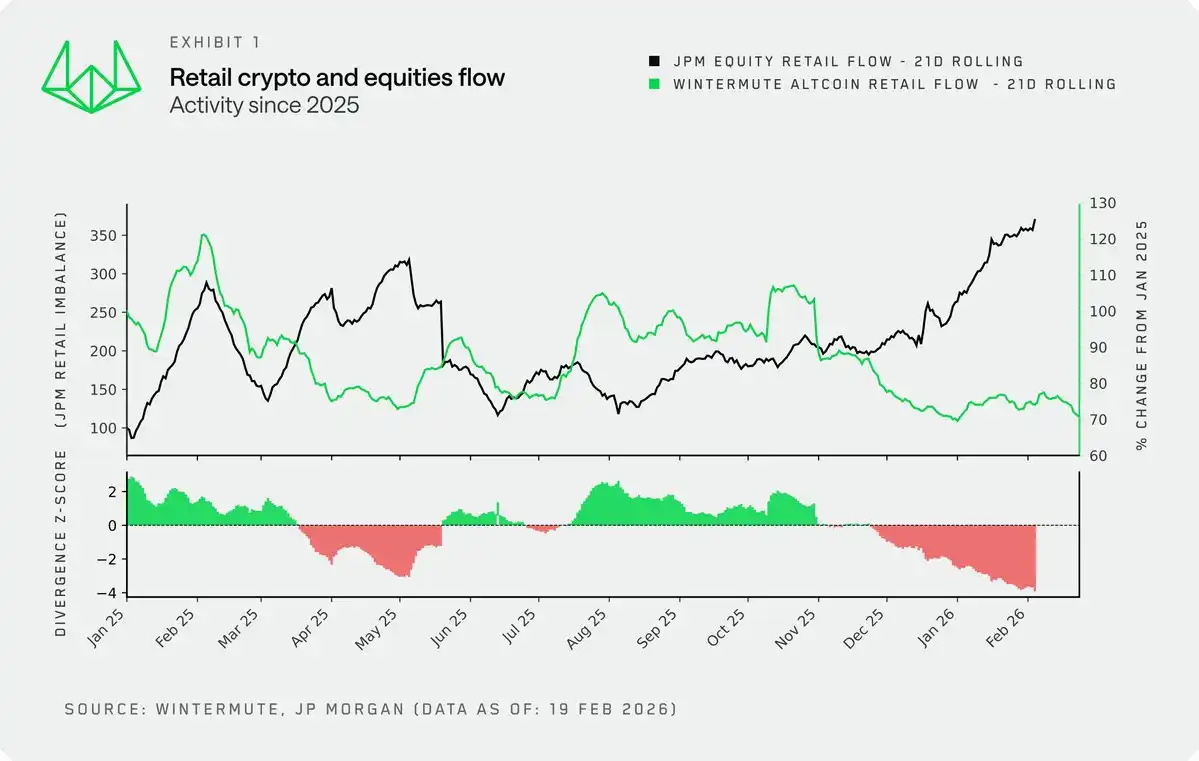
By juxtaposing Wintermute's exclusive data on retail crypto flows with JPMorgan's data on retail US stock inflows, we have gained a new perspective on examining the relationship between retail activity in the US stock and crypto markets.
Historically, the two have typically been in sync. Until the end of 2024, heightened risk appetite often meant buying on both sides as they were, to some extent, outlets for excess capital (see M2 data) and risk appetite. However, since the end of 2024, this correlation has broken down. Today, we are witnessing one of the most severe deviations in recent history: retail investors are pouring into US stocks at a record pace while choosing to hold a wait-and-see approach in the crypto market.
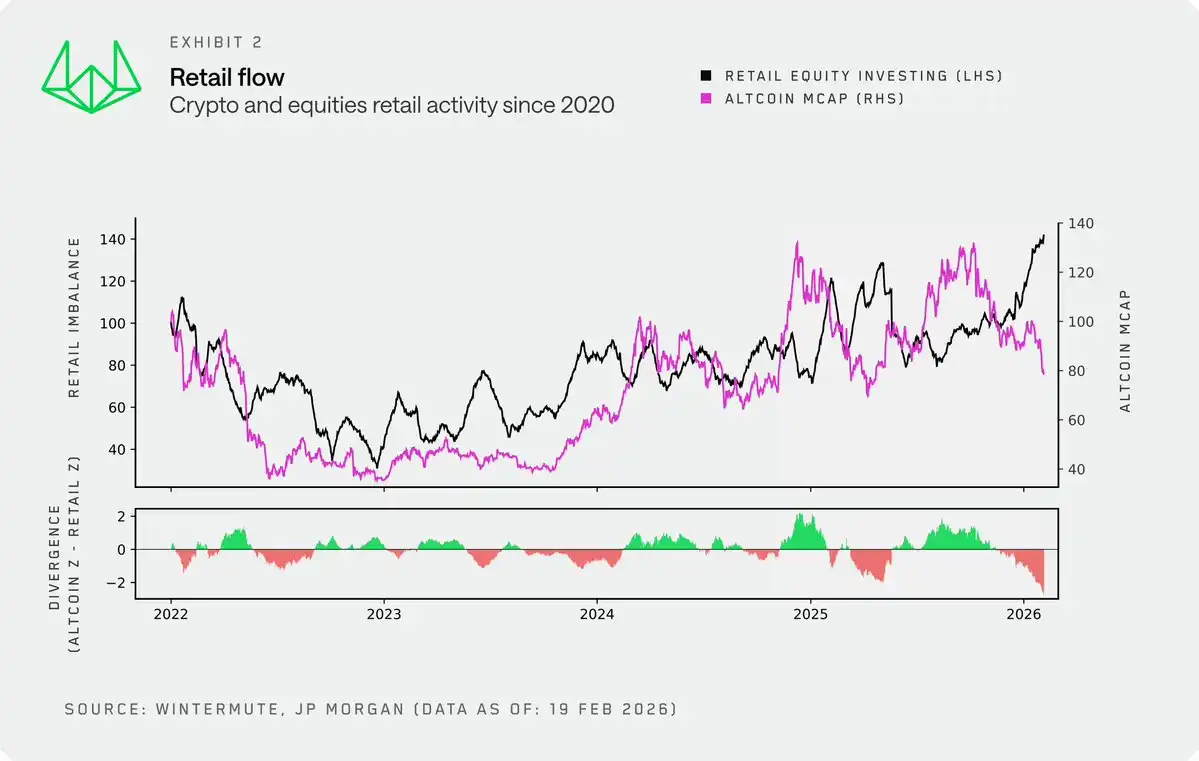
Looking at a longer time frame, we use the total market value of altcoins as a long-term proxy for retail crypto activity. It aligns closely with our retail flow data and offers a more objective and long-term historical record. From 2022 to the end of 2024, the trends in cryptocurrency and US stocks were broadly similar, with retail investors viewing both as part of a high-risk portfolio. However, the decoupling at the end of 2024 is particularly striking, and retail trading behavior has become more skewed towards short-term drivers, frequent fluctuations, and a lack of structure.
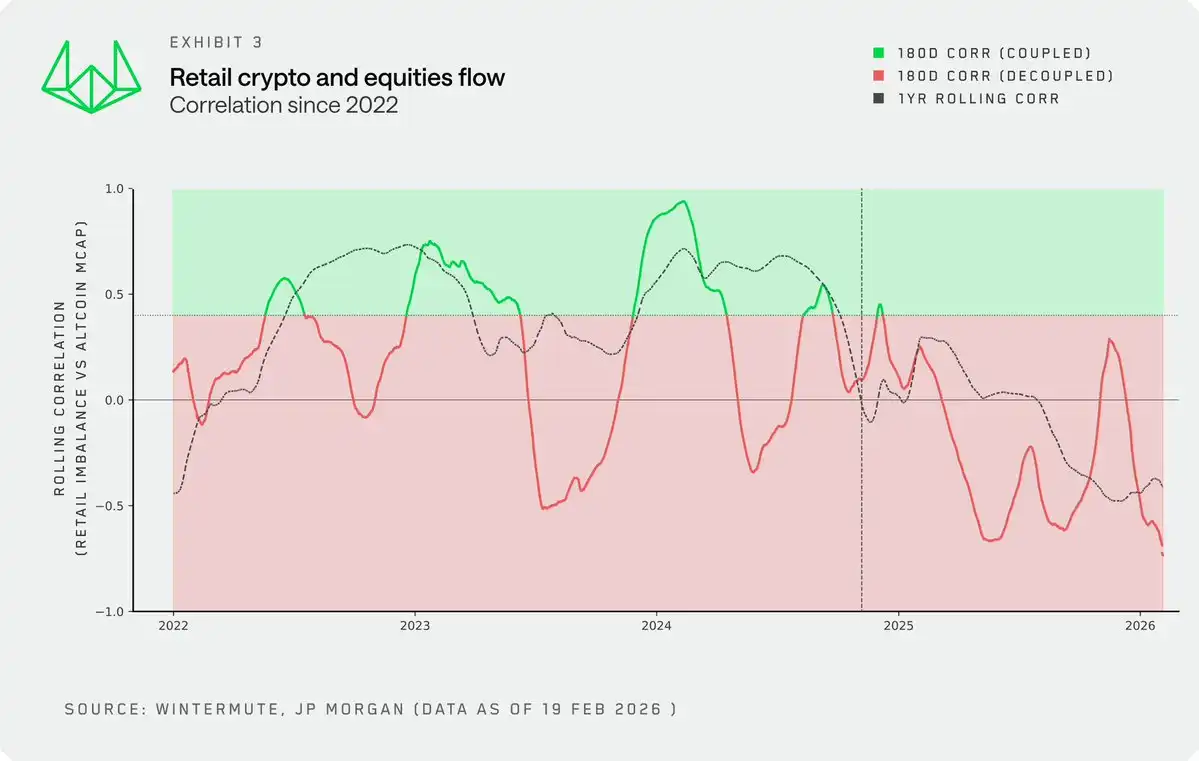
The rolling correlation between retail investor activity and meme coin market cap has confirmed this shift. The once positively correlated relationship, despite its volatility, has now turned negative. Retail investors are now allocating funds between the two in a 'pick one' scenario rather than buying into both simultaneously.
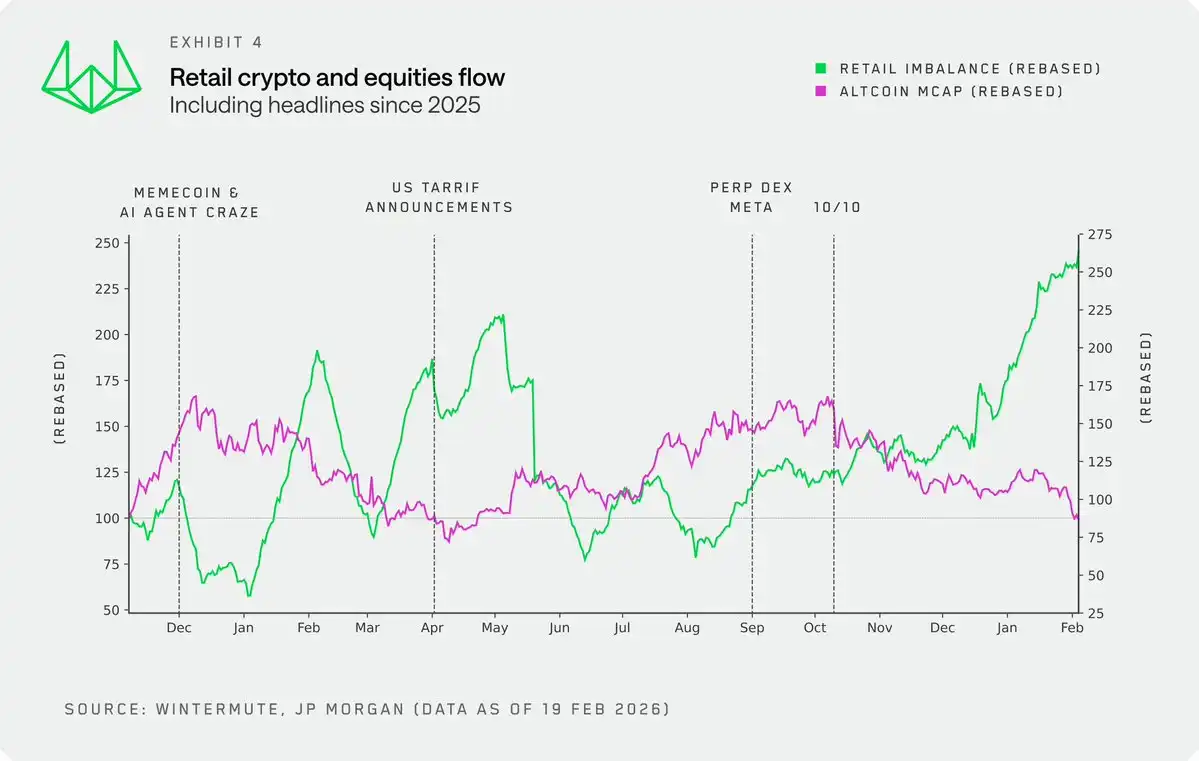
Looking ahead to 2025 and considering key catalyst events, this dynamic shift will become even more pronounced. Several points stand out:
· When the US stock market activity stagnated, Memecoins and AI agents saw their moment in the sun, as retail investors shifted their speculative demand to these areas.
· Whether during the tariff policy announcement in April 2025 or more recently, retail investors have continued to aggressively buy the dip in US stocks.
· After October 10th, funds almost entirely flowed back into US stocks, and this trend continues to persist.
Causality
One thing must be made clear: we do not believe retail participation in the crypto market is large enough to siphon funds away from the stock market. On the contrary, it is the exuberance of stock market retail investors that has drained liquidity from the crypto market.
New data also validates this point. Retail activity in the stock market has become a new variable, and crypto investors should closely monitor this indicator to identify when retail funds may provide a sustained buying opportunity for the crypto market.
Volatility Itself is the Product
While there are many reasons, one of the core reasons retail investors are so active and attracted to the crypto market is the asset's inherent volatility characteristics. The volatility itself is the product. This was the core driving force that initially drew retail investors into the crypto space.
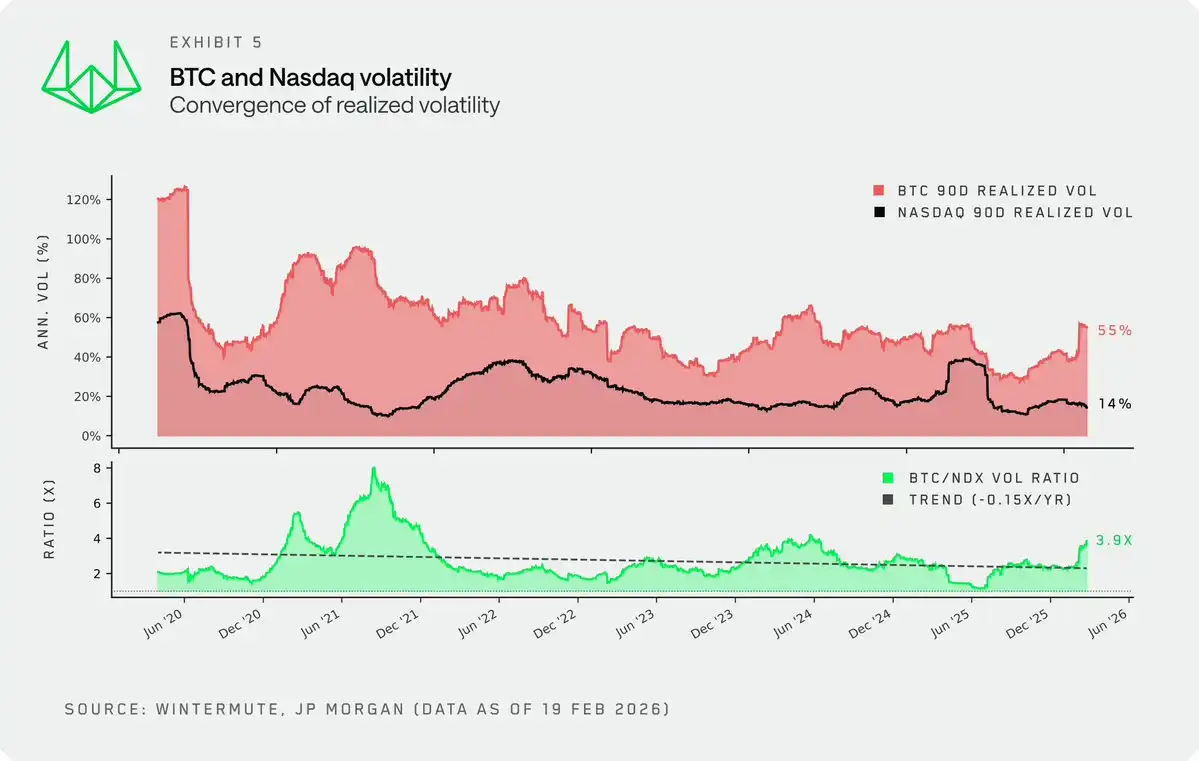
However, despite the crypto market's volatility still far exceeding that of stocks, its realized volatility has been undergoing structural compression, and this trend is difficult to reverse. The BTC to Nasdaq 100 Index (NDX) volatility ratio has been on a downward trend, with this ratio even compressed to less than half in the first half of 2025.
Some thoughts on key driving factors:
· Market Maturation. As the market matures, more institutional investors participate. The emergence of new liquidity tools such as ETFs and DAT has dampened the reflex-induced volatility spikes typical of the early cycle.
· Market Size. With the current cryptocurrency market cap at $2.3 trillion, even a 40% pullback from the all-time high (ATH), the amount of capital needed to drive the market higher now is much larger than five years ago.
With volatility compression, the core selling point of cryptocurrencies for retail investors has diminished. The boom-and-bust cycles that defined a bull market cycle from 21 to 22, attracting a whole generation of retail investors, are now a thing of the past. For retail investors seeking volatility, the stock market is becoming increasingly attractive.
Technology-Driven Factors
In addition to structural changes in the cryptocurrency market itself, technology-driven factors are also accelerating this capital rotation, which is not yet fully discussed in the market.
· Bridging of Investment Channels. The integration of cryptocurrency trading on fintech and traditional brokerage platforms (or native cryptocurrency platforms integrating stock trading) has indeed lowered the barriers to entry. However, its more profound impact is seen in "capital offloading." In previous cycles, complex fund transfer processes locked funds once they entered the cryptocurrency market, driving organic rotations among different tokens. Now, with equally smooth fund transfer channels, funds can freely move between cryptocurrency and the stock market without hindrance.
· Cognitive Edge. Retail investors seem increasingly drawn to the stock market, partly because they have gained a new edge through AI. Large language models (LLMs) have greatly enhanced retail investors' analytical abilities, giving them an illusion of being able to compete fairly with institutions.
However, this feeling does not exist in the cryptocurrency market. While you can also analyze cryptocurrency projects based on data, the crypto space lacks a consensus-based valuation framework and token value capture mechanism. Meanwhile, the investable targets are still exponentially expanding, making it difficult for retail investors to find that "edge" feeling here.
Conclusion
Retail investors used to be the most reliable reflexive demand source in the cryptocurrency market, but now, their risk preference is being increasingly satisfied elsewhere. The stock market provides highly competitive volatility, endowing retail investors with a growing analytical advantage, and through the same app on their phones, funds can seamlessly switch between the cryptocurrency market and the stock market. Cryptocurrency still has a place in retail investors' portfolios, but it is now just one of many gaming tools, no longer the preferred speculative vehicle.
This shift should also reshape investors' market observation perspective. Some tried-and-true indicators have become ineffective. For crypto investors, merely looking for leading indicators of risk appetite and combining them with the native crypto framework is no longer sufficient to succeed. Investors increasingly need to view cryptocurrency through a multi-asset portfolio lens, much like has long been the standard practice in the US stock and fixed-income markets.
You may also like

Abraxas Capital Mints $2.89 Billion USDT: Liquidity Boost or Just More Stablecoin Arbitrage?
Abraxas Capital just received $2.89 billion in freshly minted USDT from Tether. Is this a bullish liquidity injection for crypto markets, or is it business as usual for a stablecoin arbitrage giant? We analyze the data and the likely impact on Bitcoin, altcoins, and DeFi.

A VC from the Crypto world said AI is too crazy, and they are very conservative
The Evolutionary History of Contract Algorithms: A Decade of Perpetual Contracts, the Curtain Has Yet to Fall

Kicked out by PayPal, Musk aims to make a comeback in the cryptocurrency market

Solana ETF News: What Is a Solana ETF and Why Is Goldman Sachs Betting $108 Million on SOL?
Solana ETF news today shows Goldman Sachs disclosed a $108M position while total SOL ETF inflows reached $1.45B. Analysts now expect up to $6B in institutional demand as Solana trades 71% below its all-time high.

Bitcoin ETF News Today: $2.1B Inflows Signal Strong Institutional Demand for BTC
Bitcoin ETFs news recorded $2.1B inflows over 8 consecutive days, marking one of the strongest recent accumulation streaks. Here’s what the latest Bitcoin ETF news means for BTC price and whether the $80K breakout level is next.
Michael Saylor: Winter is Over – Is He Right? 5 Key Data Points (2026)
Michael Saylor tweeted yesterday “Winter‘s Over.” It is short. It is bold. And it has the crypto world talking.
But is he right? Or is this just another CEO pumping his bags?
Let us look at the data. Let us be neutral. Let us see if the ice has really melted.

WEEX Bubbles App Now Live Visualizes the Crypto Market at a Glance
WEEX Bubbles is a standalone app designed to help users quickly understand complex crypto market movements through an intuitive bubble visualization.

Polygon co-founder Sandeep: Writing after the chain bridge chain explosion

Major Upgrade on Web: 10+ Advanced Chart Styles for Deeper Market Insights
To deliver more powerful and professional analysis tools, WEEX has rolled out a major upgrade to its web trading charts—now supporting up to 14 advanced chart styles.

Morning Report | Aethir secures a $260 million enterprise contract with Axe Compute; New Fire Technology acquires Avenir Group's trading team; Polymarket's trading volume surpassed by Kalshi

Why a Million-Follower Crypto KOL Chooses WEEX VIP?
Discover why top crypto KOL Carl Moon partnered with WEEX. Explore the WEEX VIP ecosystem, 1,000 BTC protection fund, and exclusive rewards for serious traders.

CoinEx Founder: The Crypto Endgame in My Eyes

Spark Coin (SPK): Explodes 73% as Aave Bleeds $15B, A Good Investment Now?
Spark coin (SPK) surged 73% as $15 billion fled Aave after the KelpDAO hack. This article explains what Spark is, why it’s pumping, and whether it is a good investment right now.

As Aave's building collapses, Spark's high-rise is rising

RootData: Q1 2026 Cryptocurrency Exchange Transparency Research Report

What Is Memecoin Trading? A Beginner's Guide to How It Works, the Risks, and 2026's Hottest Tokens
Memecoins surged 30%+ at the start of 2026 while Bitcoin was flat. RAVE spiked 4,500% then crashed 90% in days. MAGA jumped 350% overnight. This guide explains exactly how memecoin trading works — and how to not blow up your account doing it.

Trump Extends Ceasefire: Bitcoin Hits $79K — What Crypto Traders Need to Know Right Now
Bitcoin surged past $79,000 after Trump extended the ceasefire indefinitely. We break down exactly what happened, how every major crypto reacted, and what traders should watch next — including the one level that could unlock an $85,000 BTC rally.
Abraxas Capital Mints $2.89 Billion USDT: Liquidity Boost or Just More Stablecoin Arbitrage?
Abraxas Capital just received $2.89 billion in freshly minted USDT from Tether. Is this a bullish liquidity injection for crypto markets, or is it business as usual for a stablecoin arbitrage giant? We analyze the data and the likely impact on Bitcoin, altcoins, and DeFi.
A VC from the Crypto world said AI is too crazy, and they are very conservative
The Evolutionary History of Contract Algorithms: A Decade of Perpetual Contracts, the Curtain Has Yet to Fall
Kicked out by PayPal, Musk aims to make a comeback in the cryptocurrency market
Solana ETF News: What Is a Solana ETF and Why Is Goldman Sachs Betting $108 Million on SOL?
Solana ETF news today shows Goldman Sachs disclosed a $108M position while total SOL ETF inflows reached $1.45B. Analysts now expect up to $6B in institutional demand as Solana trades 71% below its all-time high.
Bitcoin ETF News Today: $2.1B Inflows Signal Strong Institutional Demand for BTC
Bitcoin ETFs news recorded $2.1B inflows over 8 consecutive days, marking one of the strongest recent accumulation streaks. Here’s what the latest Bitcoin ETF news means for BTC price and whether the $80K breakout level is next.


 App
App