
- Buy Crypto
- Markets
 Futures
- Spot
- Copy Trade
- Earn
- More
ZEC x6 in One Month: What Drove This Frenzy?

Original Article Title: Zcash Surpasses 2021 Peak as Traders Bet on Privacy Revival
Original Article Author: Akash Girimath
Original Article Translation: Chopper, Foresight News
Abstract
As the November halving approaches and market attention towards privacy-focused assets reignites, Zcash (ZEC) has once again taken the spotlight, with traders actively positioning themselves around the privacy coin narrative. Sources revealed to Decrypt that despite limited on-chain growth, endorsements from notable investors and the discourse around privacy have fueled market activity. Some experts suggest that the sustainability of this surge depends on post-halving market sentiment for ZEC and whether user adoption can move beyond short-term speculation to achieve substantial growth.
Fueled by a dual drive of speculative fervor and the resurgence of the privacy theme, Zcash has seen a triple-digit percentage increase in the past 30 days, successfully surpassing its 2021 high. This privacy coin has surged from a low of $54 to around $372 within a month, ranking among the best-performing assets in the market.
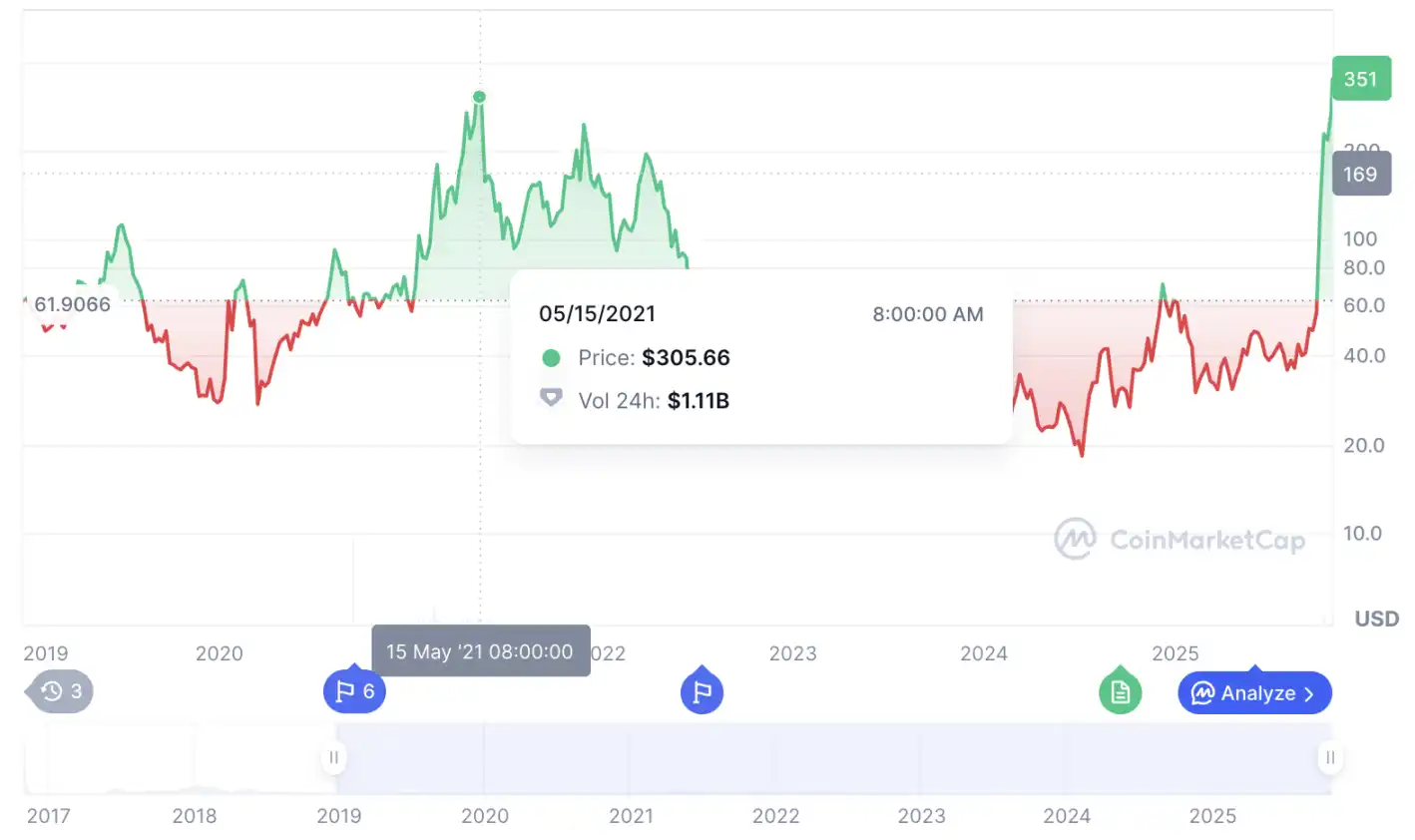
ZEC Historical Price Chart, Source: CoinMarketCap
This price is 11.5% higher than the $319 closing price on May 8, 2021, but according to CoinGecko data, it is still 88% lower than the historical peak of $3191.93 set nearly nine years ago.
The Perfect Storm of Multiple Catalysts

Shivam Thakral, CEO of BuyUCoin, stated that Zcash's rise is due to the convergence of multiple catalysts:
1. The upcoming November halving. It is expected that on November 18, the Zcash block reward will halve from 3.125 ZEC to 1.5625 ZEC;
2. Growing privacy concerns driving the resurgence of privacy coin interest;
3. Market discussions sparked by Arthur Hayes' "US$10,000 Target Price" proposal.
In the first week of October, Zcash saw a significant upward breakout for the first time, triggered by endorsements from notable investors such as Naval Ravikant and support from former Coinbase engineer and Helius CEO Mert Mumtaz.
Decrypt previously reported that Grayscale decided to allow accredited investors to invest in ZEC tokens, a move that further fueled Zcash's upward trend in the latter half of the month.
The resurgence of privacy coins also drove strength across the sector. Over the past week, Monero and Dash rose by 9.1% and 12.5% respectively, as traders started turning to these established anonymous assets.
"With tightening global regulations and escalating controversies over digital surveillance, privacy has once again become a focus," added Thakral. "Despite Zcash being an established coin, its privacy narrative is clear and concise. Coupled with the halving approaching, traders have found an easy-to-operate, liquid way to position themselves in this theme."
Doubts About the Sustainability of the Rally: Speculation Dominant, Fundamentals Await Validation
However, Thakral also cautioned that this rally is more driven by speculation rather than fundamental growth. The key consideration is the limited growth in shielded transactions for Zcash.
He stated that Zcash's future trend depends on two key factors: how miners and investors react post-halving and whether the privacy narrative can move beyond pure speculation to achieve real user growth, avoiding a reversal in sentiment where good news leads to profit-taking.
This article is contributed content and does not represent the views of BlockBeats.
You may also like

2025 South Korea CEX Listing Post-Mortem: Investing in New Coins = 70% Loss?

BIP-360 Analysis: Bitcoin's First Step Towards Quantum Immunity, But Why Only the "First Step"?

50 million USDT exchanged for 35,000 USD AAVE: How did the disaster happen? Who should we blame?

The Cryptographic Past of the Middle East

Resolving the Intergenerational Prisoner's Dilemma: The Inevitable Path of Nomadic Capital Bitcoin

Who Will Control AI? Why Decentralized AI May Be the Only Alternative to Government and Big Tech
AI has become critical infrastructure, and governments and corporations are competing to control it. Centralized development and regulation are entrenching existing power structures. The Web3 community is building a decentralized alternative — distributed compute, token incentives, and community governance — before that window closes.

Vitalik wrote a proposal teaching you how to secretly use AI large models

On the eve of the explosion of on-chain options

WEEX AI Hackathon: How Did This AI Trading Winner Succeed?
A self-taught AI trading enthusiast achieved top-10 results at the WEEX AI Hackathon. Learn about the mindset, AI tools, and lessons behind this impressive performance.

One Balance to Rule Them All: Gravitas' On-Chain Prime Broker Ambition

That person who cashed out at the NFT peak is now selling a new shovel in the OpenClaw craze

Inter-generational Prisoner's Dilemma Resolution: The Nomadic Capital and Bitcoin's Inevitable Path

Upstream and downstream are starting to fight, all for the sake of everyone being able to "Lobster"
Circle and Mastercard Announce Partnership, the Next Stage for the Crypto Industry Belongs to Payments

From 5 Mao per kWh of Chinese electricity to a $45 API export: Tokens are rewriting currency units

Why is OpenAI playing catch-up to Claude Code instead?

Vitalik wrote a proposal teaching you how to secretly use AI large models

The doubling of Circle's stock price and the paradigm shift of stablecoins
2025 South Korea CEX Listing Post-Mortem: Investing in New Coins = 70% Loss?
BIP-360 Analysis: Bitcoin's First Step Towards Quantum Immunity, But Why Only the "First Step"?
50 million USDT exchanged for 35,000 USD AAVE: How did the disaster happen? Who should we blame?
The Cryptographic Past of the Middle East
Resolving the Intergenerational Prisoner's Dilemma: The Inevitable Path of Nomadic Capital Bitcoin
Who Will Control AI? Why Decentralized AI May Be the Only Alternative to Government and Big Tech
AI has become critical infrastructure, and governments and corporations are competing to control it. Centralized development and regulation are entrenching existing power structures. The Web3 community is building a decentralized alternative — distributed compute, token incentives, and community governance — before that window closes.


 App
App