
 Buy Crypto
- Markets
 Futures
- Spot
- Copy Trade
- Earn
- More
Zuckerberg Retweets Stablecoin, Can Meta Win This "Comeback Game"?


Original Title: "Zuckerberg Reiterates Stablecoin Push, Can Meta Win the 'Redemption Round' this Time?"
Original Author: Sanqing, Foresight News
On February 24, according to CoinDesk citing sources, Zuckerberg's tech giant Meta plans to re-enter the stablecoin arena in the latter half of this year, with plans to integrate third-party vendors to support stablecoin payments and launch a new wallet. Meta has already sent out product requirement invitations to third-party companies, with its long-time partner Stripe being a potential pilot institution.
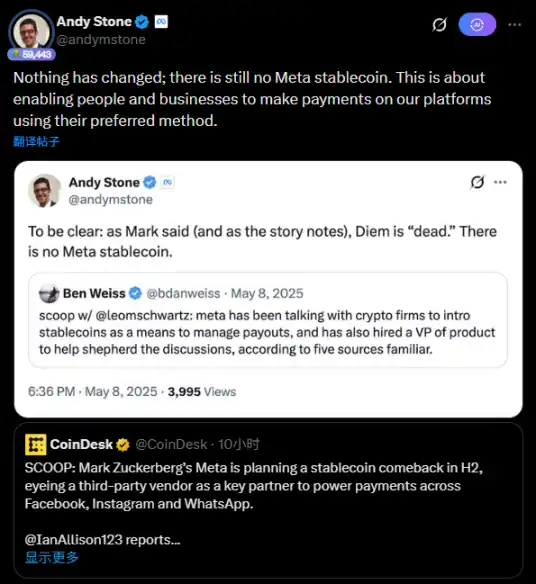
Subsequently, Meta spokesperson Andy Stone tweeted, "All remains as is, there is still no Meta stablecoin. The key to Meta's plan to relaunch stablecoin business in the latter half of 2026 is to enable individuals and businesses to use their preferred payment methods on the Meta platform for transactions."
Dormant Ambition: From Libra to Diem's Failure
Looking back at Meta's stablecoin journey, the 2019 launch of the Libra project was undoubtedly a controversial starting point, where Meta attempted to establish a global digital currency backed by a basket of fiat currencies and government bonds.
The goal was to leverage its multiple social apps with billions of monthly active users to bypass the traditional banking system and enable peer-to-peer global instant cross-border payments. However, this grand vision was met with united resistance from global regulatory bodies.
Legislators were deeply concerned about Meta controlling the global financial lifeline, especially as the company was embroiled in the Cambridge Analytica privacy scandal (in 2018, Facebook was found to have allowed the political consulting firm Cambridge Analytica to improperly access the personal data of up to 87 million users), eroding public trust in its handling of sensitive financial data to near zero.
Libra heads David Marcus and Zuckerberg faced scrutiny from the U.S. Congress. Lawmakers even likened the potential threat of Libra to the 9/11 attacks, fearing it would become a breeding ground for money laundering and terrorist financing.
Under stringent regulatory signals, the initial founding members (such as Visa, Mastercard, PayPal, and Stripe) chose to withdraw from the Libra Association one after another to avoid being embroiled in the political whirlpool.
Despite later rebranding the project as Diem and attempting to seek compromise through downsizing and pegging to a single fiat currency, regulatory pressures never dissipated. Ultimately, Diem failed to even launch officially in the United States, and was forced to shut down and sell off all assets in early 2022. Its team's core members also split into two Layer 1 blockchain projects, Aptos and Sui.
2026 New Logic: Strategic Shift from "Challenger" to "Gateway"
Compared to the Libra era of 2019 when it sought to challenge the global financial system head-on, Meta in 2026 has shown a more conservative approach focused on compliance.
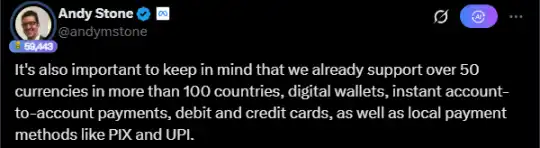
Meta spokesperson Andy Stone also specifically emphasized in response that Meta currently supports 50+ currencies and payment methods in 100+ countries/regions, attempting to downplay the uniqueness of "stablecoins" and package them as an "extension of existing payment infrastructure."
The core of this shift lies in integrating external capabilities through modularization. Meta's latest RFP (Request for Proposals) clearly indicates that it has entrusted compliance responsibilities to third parties.
Meta's deep partner Stripe (whose CEO Patrick Collison holds a seat on Meta's board) as early as October 2024 filled the stablecoin route through the acquisition of the stablecoin platform Bridge, and in June 2025, also acquired the crypto wallet Privy.
This compliance-segregated model allows Meta to seamlessly embed low-cost real-time settlement capabilities on its massive base of over 3 billion monthly active users, while maintaining a safe distance from legal and regulatory pressures.
Regulation and Competition: The Dual Hurdles Meta Must Overcome
The current regulatory environment has significantly evolved since 2019. While the challenges remain steep, U.S. acts like the GENIUS Act and Clarity Act have laid a preliminary legal foundation for stablecoin issuers, opening the gates for new market entrants.
U.S. regulatory agencies are currently in the early stages of drafting specific implementation guidelines. Meta may well be aware that any overly aggressive move could once again trigger regulatory defense mechanisms, hence choosing intervention through third parties is currently the most prudent path.
On the competitive market front, Meta faces a highly crowded and matured race track.
Elon Musk's social platform X has been advancing its "super app" plan, striving to internalize payment functionality, while Telegram has long taken the lead in the encrypted payment field with its TON ecosystem.
Meanwhile, traditional crypto giants like Coinbase and Kraken are also constantly pushing boundaries, beginning to offer round-the-clock tokenized stock trading and other complex financial services.
For Meta, re-entering the stablecoin field is not only to reduce traditional bank fees but also a battle for leadership in social e-commerce. And with Meta's aggressive investment in the Llama series large models, stablecoin payments will also become the financial foundation of its AI strategy.
You may also like

56% Spike in Memecoin Trading Volume, Yet Shiba Inu (SHIB) Remains Static With 0 Netflow
Key Takeaways: Recent memecoin market saw a volume increase of 56%, highlighting a shift in investor interest towards…

American Airlines Praises Ripple, Surprising XRP Community
Key Takeaways: American Airlines reports exceptional results from Ripple Treasury usage. Ripple Treasury aids treasury efficiency without needing…

USDT Supply Surges to $188B as Tether Solidifies Stablecoin Dominance
Key Takeaways: Tether’s USDT supply reaches an all-time high of $188 billion, maintaining its dominance in the stablecoin…

North Korea’s $500M DeFi Heist Unveils New Cyber Warfare Tactics
Key Takeaways: North Korean operatives have obtained over $500 million from DeFi platforms in under three weeks. The…

How Crypto Futures Markets Are Fueling ‘Scam Coin’ Insider Schemes
Key Takeaways: RAVE’s market cap skyrocketed to $6.7 billion before plummeting by 95% due to insider control and…

XRP Price Prediction: Wall Street Giants Eye Ripple – Should You?
Key Takeaways: Wall Street players like Mastercard and BlackRock are adopting bullish XRP positions. XRP Ledger sees a…
WOJAK Crypto Meme Coin Pumps 87% as MAXI Targets $5M: Unveiling the Trading Insights of 2026
Key Takeaways: WOJAK crypto surged 87% in 24 hours, driven by aggressive accumulation, signaling renewed interest in meme…

XRP Price Prediction: Wall Street Giants Back Ripple’s Future – Should You?
Key Takeaways: Leading Wall Street firms are showing bullish interest in XRP’s price potential. At the Digital Assets…

XRP Price Prediction: Wall Street Giants Shift Focus to Ripple
Key Takeaways: XRP Ledger is seeing massive institutional interest from giants like Mastercard and BlackRock, aligning with overall…

Protect Your Crypto: Practical Steps to Avoid Scams
Key Takeaways: Recognize red flags early by knowing scams like phishing and rug pulls. Secure your assets with…

How Much Is Blueface Worth? Latest Net Worth Revealed (2026)
Key Takeaways: Blueface’s net worth in 2026 ranges from $4 million to $7 million, reflecting both his musical…

Google’s Quantum AI Sparks Ripple’s 2-Year Plan for XRP: What’s the Impact on Holders?
Key Takeaways: Ripple’s multi-phase plan targets quantum cryptography readiness for XRP Ledger by 2028 due to Google Quantum…
Eightco Holdings (NASDAQ: ORBS) Reveals $336M in Digital Assets and Equity Investments
Key Takeaways: Eightco’s treasury includes $90M in OpenAI, $25M in Beast Industries, 11,068 ETH, and $283 million WLD…

DeFi Losses Top $600 Million Amid Kelp DAO Exploit and TVL Decline
Key Takeaways: Total DeFi losses have skyrocketed to approximately $1 billion recently, with $600M+ linked directly to the…

SEC’s “Innovation Exemption” Sets New Rails for Tokenized Securities
Key Takeaways: SEC Chair Paul Atkins introduces an “innovation exemption” to regulate tokenized securities. A five-category token framework…

Ripple Sets 2028 Deadline for Quantum-Ready XRPL
Key Takeaways: Ripple commits to a 2028 deadline for XRPL’s quantum-readiness, focusing on quantum-resistant cryptographic systems. Google’s research…

Key NFT Projects to Watch in 2026
Key Takeaways: Successful NFT investing in 2026 revolves around real-world utility, team credibility, and regulatory compliance. Top picks…
How Syncro Sender Optimizes Solana Transactions for High-Stakes Teams
Key Takeaways: Syncro Sender uses multi-path delivery and staked validator connections to enhance Solana transaction efficiency. It significantly…
56% Spike in Memecoin Trading Volume, Yet Shiba Inu (SHIB) Remains Static With 0 Netflow
Key Takeaways: Recent memecoin market saw a volume increase of 56%, highlighting a shift in investor interest towards…
American Airlines Praises Ripple, Surprising XRP Community
Key Takeaways: American Airlines reports exceptional results from Ripple Treasury usage. Ripple Treasury aids treasury efficiency without needing…
USDT Supply Surges to $188B as Tether Solidifies Stablecoin Dominance
Key Takeaways: Tether’s USDT supply reaches an all-time high of $188 billion, maintaining its dominance in the stablecoin…
North Korea’s $500M DeFi Heist Unveils New Cyber Warfare Tactics
Key Takeaways: North Korean operatives have obtained over $500 million from DeFi platforms in under three weeks. The…
How Crypto Futures Markets Are Fueling ‘Scam Coin’ Insider Schemes
Key Takeaways: RAVE’s market cap skyrocketed to $6.7 billion before plummeting by 95% due to insider control and…
XRP Price Prediction: Wall Street Giants Eye Ripple – Should You?
Key Takeaways: Wall Street players like Mastercard and BlackRock are adopting bullish XRP positions. XRP Ledger sees a…


 App
App