
IBM Stock After the 25% Crash: Price, Forecast and How to Trade It

 Prefer us on Google


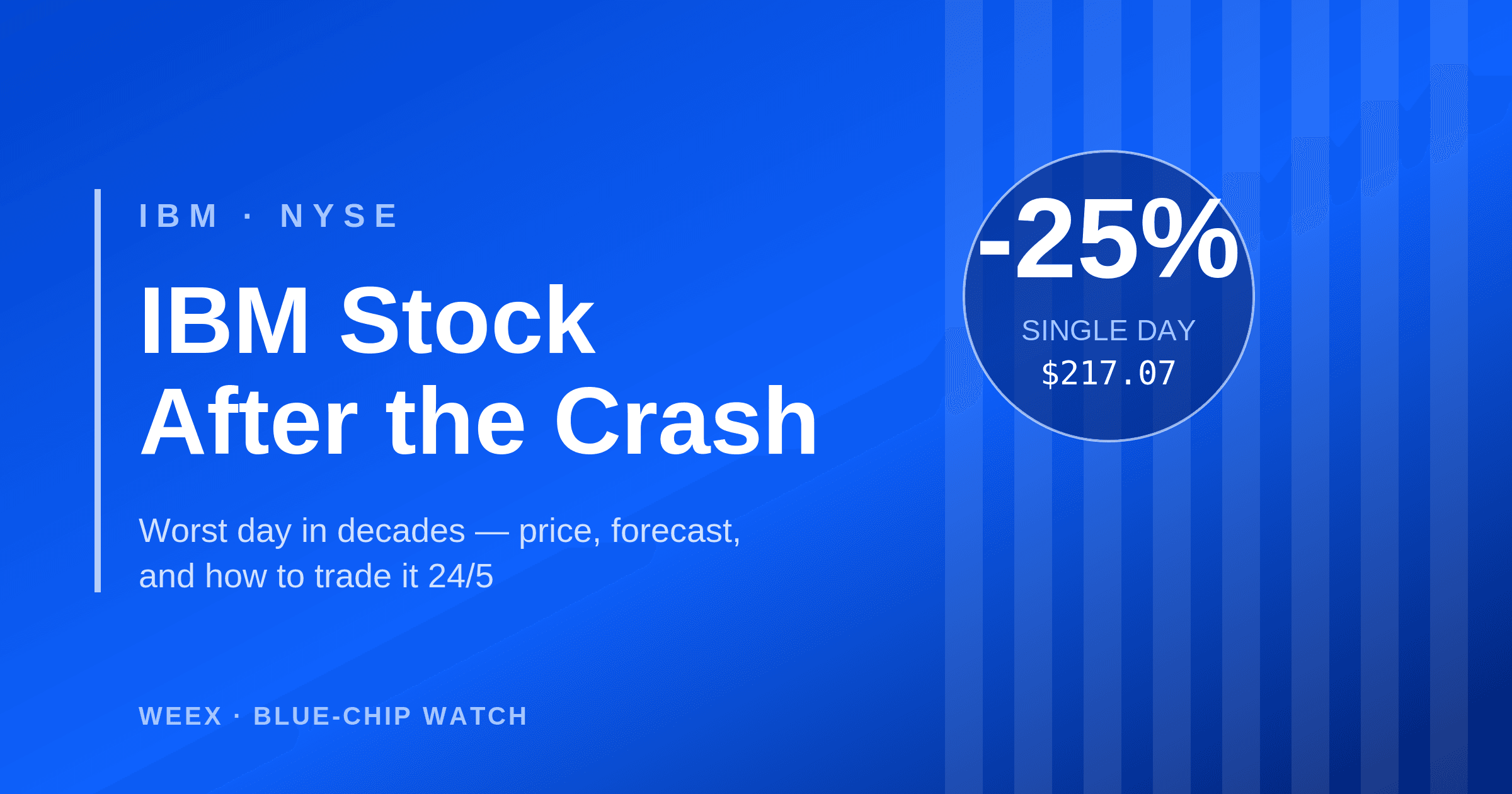
IBM stock just had its worst day in decades, closing at $217.07 on July 14, 2026 after sliding roughly 25% on a surprise second-quarter warning. The move wiped out a chunk of one of the market's steadiest large-cap names and reopened an old question with fresh urgency: is IBM stock a value opportunity, a falling knife, or simply the first visible casualty of how AI spending is rewiring enterprise IT budgets?
This guide breaks down why IBM stock crashed, what the numbers say now, where analysts stand ahead of the full Q2 report on July 22, whether the dividend is still safe, and how traders can get IBM stock exposure — including the tokenized IBM stock that trades 24/5 on WEEX.
Why IBM stock crashed 25% in a single day
The trigger was a preliminary Q2 2026 update that landed below expectations. IBM guided to revenue of about $17.2 billion (up roughly 1% year over year) and adjusted earnings of $2.93 per share, short of the roughly $3.01 analysts had penciled in. For a company valued as a stable compounder, a modest miss on a low-growth quarter was enough to trigger the steepest single-day drop in IBM's stock in decades — a rare event for a name that usually moves in single-digit percentages.
The more important detail is why the quarter came up short. CEO Arvind Krishna told investors that in the final weeks of June, clients redirected capital budgets toward hardware — servers, storage, and especially memory — to lock in supply-constrained infrastructure ahead of expected price increases. That spending had to come from somewhere, and it came out of software and consulting. Software still grew about 5% and consulting held roughly flat, but infrastructure fell around 7%, and the mix shift spooked the market.
The better reading is that this is not really an IBM-specific stumble. It is an early, visible sign that the AI hardware boom is crowding out traditional software and services budgets across enterprise tech — which is why IBM's warning dragged parts of the broader software sector down with it.
IBM stock price today and the numbers that matter
Here are the figures that frame the current setup, as of mid-July 2026.
| Metric | Value (as of July 14–15, 2026) |
|---|---|
| Share price (NYSE: IBM) | ~$217.07 |
| Single-day move | ~ -25% |
| Q2 2026 revenue (preliminary) | ~$17.2B (+~1% YoY) |
| Q2 2026 adjusted EPS (preliminary) | $2.93 (vs ~$3.01 est.) |
| Market capitalization | ~$240B |
| P/E ratio | ~22–23x |
| Dividend (annualized) | ~$6.76/share |
| Dividend yield (at ~$217) | ~3.1% |
| Full Q2 results | July 22, 2026 |
Two things stand out. First, even after the drop, IBM does not trade like a distressed stock — a low-20s P/E and a ~3% yield describe a mature business, not a broken one. Second, the market is pricing meaningful uncertainty into the July 22 report. Preliminary numbers rarely tell the whole story, and the segment commentary that accompanies full results will matter more than the headline miss.
Is IBM stock a good buy after the drop?
There is a genuine bull case and a genuine bear case, and honest coverage should give you both.
The bull case: a roughly 25% selloff on a 1% revenue miss looks like an overreaction if the software weakness is a timing issue — clients front-loading hardware in June rather than abandoning IBM's software and consulting for good. On that view, the capex pulled into infrastructure eventually normalizes, software reaccelerates, and IBM's free cash flow engine keeps funding the dividend. Buyers who like the stock argue the drop hands them a durable cash generator at a rare discount.
The bear case: the warning may be structural, not seasonal. If AI hardware permanently absorbs a larger share of enterprise budgets, IBM's software and consulting growth could stay capped for several quarters. Technically, the stock also broke below key moving averages on the crash, so momentum traders see a damaged chart rather than a clean dip to buy. "Buying the dip" on a stock that just gapped through its trend lines is where a lot of retail money gets trapped.
The disciplined takeaway: the decision hinges almost entirely on what the July 22 report says about software and consulting demand. Until then, IBM stock is a bet on interpretation, not on settled facts.
IBM stock forecast: where analysts stand after the warning
Wall Street was broadly constructive on IBM before the crash, and most published targets had not yet been revised at the time of the selloff. That means the "upside" figures below are inflated by stale targets and will likely be trimmed after July 22.
| View | Signal |
|---|---|
| Consensus rating | Majority "Buy," with a meaningful block of "Hold" |
| Median price target | ~$290 |
| Implied upside vs ~$217 | ~30%+ (pre-revision) |
| Key catalyst | Full Q2 results, July 22, 2026 |
| Main risk to targets | Downward revisions if software weakness persists |
Treat the ~$290 median as a pre-crash anchor, not a promise. The number that actually matters is whether analysts hold or cut after management explains the June spending shift in detail. A forecast built on targets set before the warning is worth less than the tone of the next earnings call.
Is the IBM dividend safe?
For many holders, IBM is a dividend story first and a growth story second, so the crash raises an obvious question: is the payout at risk? On the current data, the dividend looks intact. IBM has paid a dividend every year since 1916 and has a multi-decade record of annual increases, and management has continued to point to free-cash-flow growth to support it. The mechanical effect of the price drop is that the yield rose to roughly 3.1%, which is why income investors are the first buyers to show up on days like this.
The practical caution: a dividend is only as safe as the free cash flow behind it. A single soft quarter driven by budget timing does not threaten the payout, but several quarters of squeezed software and consulting revenue eventually would. Watch free cash flow guidance on July 22 more closely than the yield number itself — the yield looks attractive precisely because the stock fell.
How to get IBM stock exposure with tokenized IBM (IBMON and IBMX)
You do not need a traditional U.S. brokerage account to trade IBM's price action. Tokenized versions of IBM stock let non-U.S. investors take on-chain exposure to the same underlying moves, and they trade against USDT on a 24/5 schedule rather than only during New York market hours. WEEX lists two related instruments: IBMON (IBM Tokenized Stock by Ondo Finance, listed May 22, 2026) and IBMX (an xStock-model tokenized IBM share). Both are designed to track IBM's price, and the live tokenized IBM stock price page shows real-time quotes and history.
The critical distinction: holding a tokenized IBM stock gives you economic price exposure, not real shareholder rights. You do not get a vote, and the legal ownership structure differs from holding IBM shares directly — a point worth understanding before you size a position. For the mechanics of how these instruments are issued and custodied, WEEX's explainer on what tokenized US stocks are and how they work is a useful primer, and the IBM Tokenized Stock (IBMON) overview walks through this specific token.
Two practical traps to watch with tokenized equities: liquidity and hours. Tokenized IBM markets are far thinner than the NYSE listing, so spreads can widen and slippage bites on large orders — a real risk on a volatile day like a post-warning crash. And because these tokens trade when the underlying stock market is closed, the token can move on headlines hours before the actual shares reopen, which cuts both ways.
What matters most
Strip away the noise and the IBM stock story reduces to one variable: was the June budget shift a timing quirk or a structural change in how enterprises spend? If it is timing, a 25% drop on a 1% revenue miss is the kind of overreaction long-term buyers wait for. If it is structural, IBM's software and consulting growth stays capped and the stock has further to prove. July 22 is when interpretation turns into evidence — everything before then is positioning.
Ready to trade the move? You can track live pricing and take USDT-margined exposure to tokenized IBM stock on WEEX, or use the wiki guides above to understand the instrument before you commit capital.
FAQ
1. Why did IBM stock crash in July 2026?
IBM issued a preliminary Q2 2026 warning showing revenue of about $17.2 billion and adjusted EPS of $2.93, below expectations. Management said clients shifted late-June budgets toward AI hardware (servers, storage, memory), squeezing software and consulting. The stock fell roughly 25% in a single day, its steepest drop in decades.
2. What is IBM stock worth right now?
IBM (NYSE: IBM) closed around $217.07 on July 14, 2026, with a market cap near $240 billion and a P/E in the low 20s. Prices move continuously, so check a live quote before trading.
3. Is IBM stock a good buy after the drop?
It depends on whether the software weakness is temporary or structural. Bulls see an overreaction to a small miss; bears note the stock broke key technical levels and could stay pressured. The full Q2 report on July 22, 2026 is the deciding catalyst.
4. What is the IBM stock forecast for 2026?
Before the crash, most analysts rated IBM a "Buy" with a median target near $290, implying 30%+ upside. Those targets were largely set before the warning and are likely to be revised after July 22, so treat them as a stale anchor rather than a firm prediction.
5. Is the IBM dividend safe?
IBM has paid a dividend every year since 1916 and has a long record of annual increases, with an annualized payout near $6.76 and a yield around 3.1% after the price drop. The dividend looks secure on current free cash flow, but several quarters of weak software and consulting revenue would be the real threat to watch.
6. How can I trade IBM stock exposure on WEEX?
WEEX lists tokenized IBM stock — IBMON (by Ondo) and IBMX (xStock) — which track IBM's price and trade against USDT on a 24/5 basis. These give economic price exposure, not shareholder rights, and are thinner and more volatile than the NYSE listing.
Risk Warning
Trading stocks, tokenized stocks, and crypto assets involves substantial risk, and you can lose part or all of your capital. IBM's post-warning volatility shows how fast a large-cap can move on a single update, and tokenized IBM instruments (IBMON, IBMX) carry additional layers of risk: thin liquidity and wider spreads, price gaps when the underlying market is closed, custody and issuer risk, regulatory uncertainty around tokenized securities, and the fact that holding a token conveys price exposure but not real shareholder rights. Leverage magnifies both gains and losses. Nothing here is investment advice — do your own research, size positions conservatively, and never invest more than you can afford to lose.
Disclaimer: This content is provided for general branding and informational purposes only and doesn't constitute financial, investment, legal, or tax advice. Any events, rewards, online events, or related information mentioned herein should not be considered a recommendation, solicitation, or invitation to purchase, sell, trade, or otherwise deal in any crypto assets or to use any services. Crypto assets are highly volatile and may result in loss. WEEX services and online events may not be available in all regions and are subject to applicable laws, regulations, and eligibility requirements. You are responsible for ensuring that your use of WEEX services complies with local laws and for carefully assessing the risks before participating in any crypto-related activities.
You may also like
Rocket Lab Stock (RKLB): Price, Outlook and How to Buy
Qualcomm Stock (QCOM): Price, Outlook and How to Buy
AST SpaceMobile Stock (ASTS): Price, Outlook and How to Buy

Take-Two Stock (TTWO): Price, Outlook and How to Buy
United States Oil Holdings (USOH): Real Oil or Risky Bet?
United States Oil Holdings (USOH) claims to be a tokenized U.S. oil reserve. See what's verified, the red flags, and how to check the contract before buying.

NBIS Stock: Why Nebius Slid From $275 to $195, and What's Next
NBIS stock trades near $196 after slipping from $275. What Nebius does, the Meta and Nvidia deals, the 2026–2027 forecast, and the risks to watch.

MRVL Stock: Price, AI Silicon Catalysts, and 2026 Outlook for Marvell Technology
MRVL stock trades near $213 in July 2026. See Marvell's price, custom AI silicon growth, analyst targets, and how to get exposure without a US broker.
Lucid Stock (LCID): Why It Crashed and What Comes Next
Lucid stock (LCID) plunged in July 2026 on bankruptcy rumors Lucid denies. See the price, the cash-burn reality, the forecast, and how to trade LCID.
Common Issues When Using Jupiter and How to Fix Them
If you use the Jupiter DEX aggregator on Solana and your swap keeps spinning, errors pop up, or…
Top 5 DApps and Mini Apps to Try on TON in 2026
If you’re exploring TON this year, start with apps that show real usage, simple onboarding, and clear utility.…
How to Buy and Store Toncoin (TON): A Step-by-Step Guide
This guide shows beginners how to buy Toncoin (TON) through mainstream exchanges and Telegram’s built-in wallet, then move…
TON vs Solana: Which Blockchain Has the Bigger Edge?
TON and Solana both chase mass-scale, low-cost transactions—but they win in different ways. This guide compares where their…
SKHYON Airdrop: How to Share 50,000 USDT Rewards on WEEX
This guide explains what SKHYON is, how the WEEX SKHYON Airdrop works, and the steps to participate efficiently…
How to Set Up a TON Wallet: Step-by-Step Beginner’s Guide
This guide walks you through two clean paths to start with a TON wallet: the wallet built into…

What Is TON? The Blockchain Behind Telegram, Explained
Many first learn about TON from Telegram’s built-in wallet and mini apps. This guide explains what TON is,…
How to Provide Liquidity and Earn Yield on PancakeSwap?
This guide explains how PancakeSwap liquidity pools work, how to add liquidity, stake LP tokens for yield farming,…
How to Swap Tokens on PancakeSwap: A Step-by-Step Guide
This PancakeSwap tutorial walks beginners through everything needed to make a safe, low-friction token swap on BNB Smart…
What Is PancakeSwap? A Complete Beginner’s Guide
PancakeSwap is a decentralized exchange on BNB Chain where you trade directly from your crypto wallet—no account, no…
Jupiter Not Working? Here’s How to Fix the Most Common Problems
If your Jupiter swap keeps spinning, throws an error, or your wallet won’t connect, you’re not alone. This…

How Does Jupiter Always Find You the Best Swap Rate?
Jupiter is a Solana DEX aggregator built to route your swap through the most efficient path across dozens…
Jupiter vs Raydium: Which Solana DEX Should You Use?
Choosing between Jupiter and Raydium on Solana comes down to one key idea: Jupiter is a DEX aggregator…
How to Swap Tokens on Jupiter: A Step-by-Step Guide
This guide shows how to swap tokens on Jupiter, the Solana DEX aggregator, with clear steps for connecting…
What Is Jupiter? A Complete Guide to the Solana DEX Aggregator
Jupiter is the Solana DEX aggregator that routes your swap across multiple on-chain venues to find the best…
CL (WTI Crude Oil) Price Prediction July 2026: Forecast as Geopolitical Risks Keep Prices Near $80
WTI Crude Oil (ticker: CL) has firmed back toward the $80 handle in July 2026 as traders weigh…
WISHBONE Price Prediction July 2026: Forecast, Technical Levels, and Market Outlook
WISHBONE has drawn fresh attention after its listing momentum and surging meme-coin interest this month. At press time,…
Hoodrat (HOODRAT1) Price Prediction July 2026: Forecast, Technical Levels, and Market Outlook
Hoodrat (HOODRAT1) has just gone live on WEEX spot markets, and early volatility is drawing attention from meme-coin…
Metaplanet Stock (3350): Price, Board Talking Points and Outlook
S-Science Stock (Now S Crypto Energy, 5721): Price, Board Talking Points and Outlook
Remixpoint Stock (3825): Price, Board Talking Points and Outlook
Convano Stock (6574): Price, Board Talking Points and Outlook
Rocket Lab Stock (RKLB): Price, Outlook and How to Buy
Qualcomm Stock (QCOM): Price, Outlook and How to Buy
AST SpaceMobile Stock (ASTS): Price, Outlook and How to Buy
Take-Two Stock (TTWO): Price, Outlook and How to Buy
United States Oil Holdings (USOH): Real Oil or Risky Bet?
United States Oil Holdings (USOH) claims to be a tokenized U.S. oil reserve. See what's verified, the red flags, and how to check the contract before buying.
NBIS Stock: Why Nebius Slid From $275 to $195, and What's Next
NBIS stock trades near $196 after slipping from $275. What Nebius does, the Meta and Nvidia deals, the 2026–2027 forecast, and the risks to watch.


