
- Buy Crypto
- Markets
 Futures
- Spot
- Copy Trade
- Earn
- More
2025 Crypto Prediction Mega Review: What Nailed It and What Noped It?

Original Title: "2025 Crypto Prediction Review: 10 Institutions, Who Got It Right and Who Got It Wrong?”
Original Source: DeepTech TechFlow
As we approach the end of the year, it is foreseeable that the 2026 crypto predictions and outlooks of major institutions will be released over the next month.
However, before looking at the new predictions, it might be worth reviewing what these institutions said last year; after all, making predictions is easy, but accuracy is the real skill.
Recalling the end of 2024, with the market sentiment soaring and BTC just breaking $100,000, everyone's predictions were generally optimistic:
For example, BTC would surge to $200,000, stablecoin volume would double, AI agents would trigger on-chain activities, and crypto unicorns would rush to IPO... Now, a year has passed, have those predictions from back then all come true?
We have selected several typical institutions and individuals from last year's various prediction reports for a detailed review, to see whose prediction accuracy is higher.
1. VanEck: Accuracy 10%, Only Correct Prediction was Establishing a Bitcoin Strategic Reserve
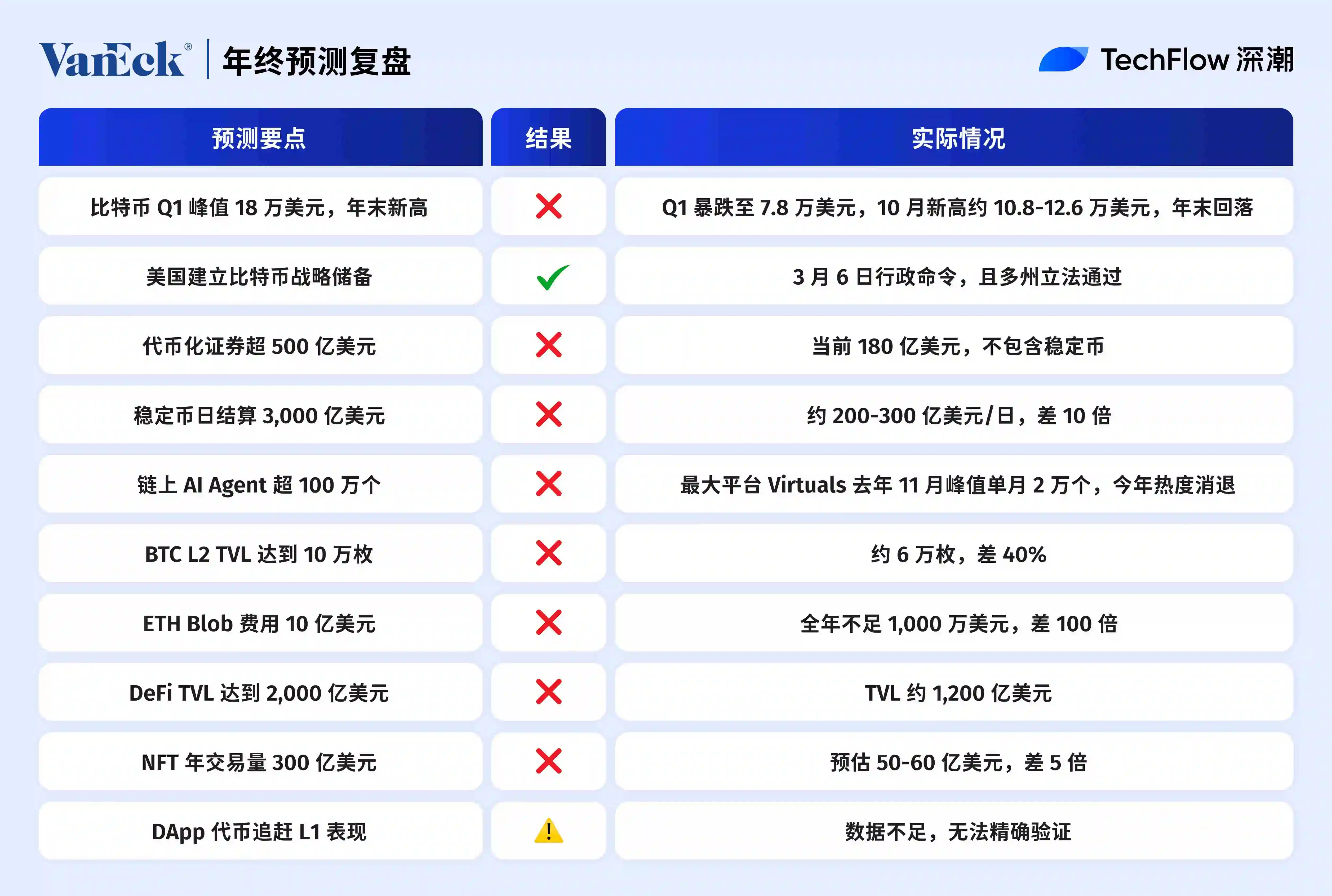
At the end of 2024, VanEck made 10 predictions, with the only correct one being the establishment of a Bitcoin strategic reserve.
The other 9 were all off the mark, and most were not slight deviations but orders of magnitude errors. For example, predicting the peak of Q1 in crypto and Bitcoin reaching $180k, and hitting a new high by the end of the year; in reality, the timing and price targets were completely opposite.
Furthermore, their market size predictions were overly optimistic. They predicted tokenized securities to reach $500 billion, whereas it was around $300-350 billion in reality; DeFi TVL was predicted at $200 billion, while it was around $1200-1300 billion in reality; NFT transaction volume was forecasted at $300 billion, whereas actual estimates were $50-65 billion.
Overall, VanEck's judgment on policy direction was quite accurate, but they systematically overestimated the on-chain economic scale.
2. Bitwise: Accuracy 50%, General Direction Correct but Price Predictions Wrong
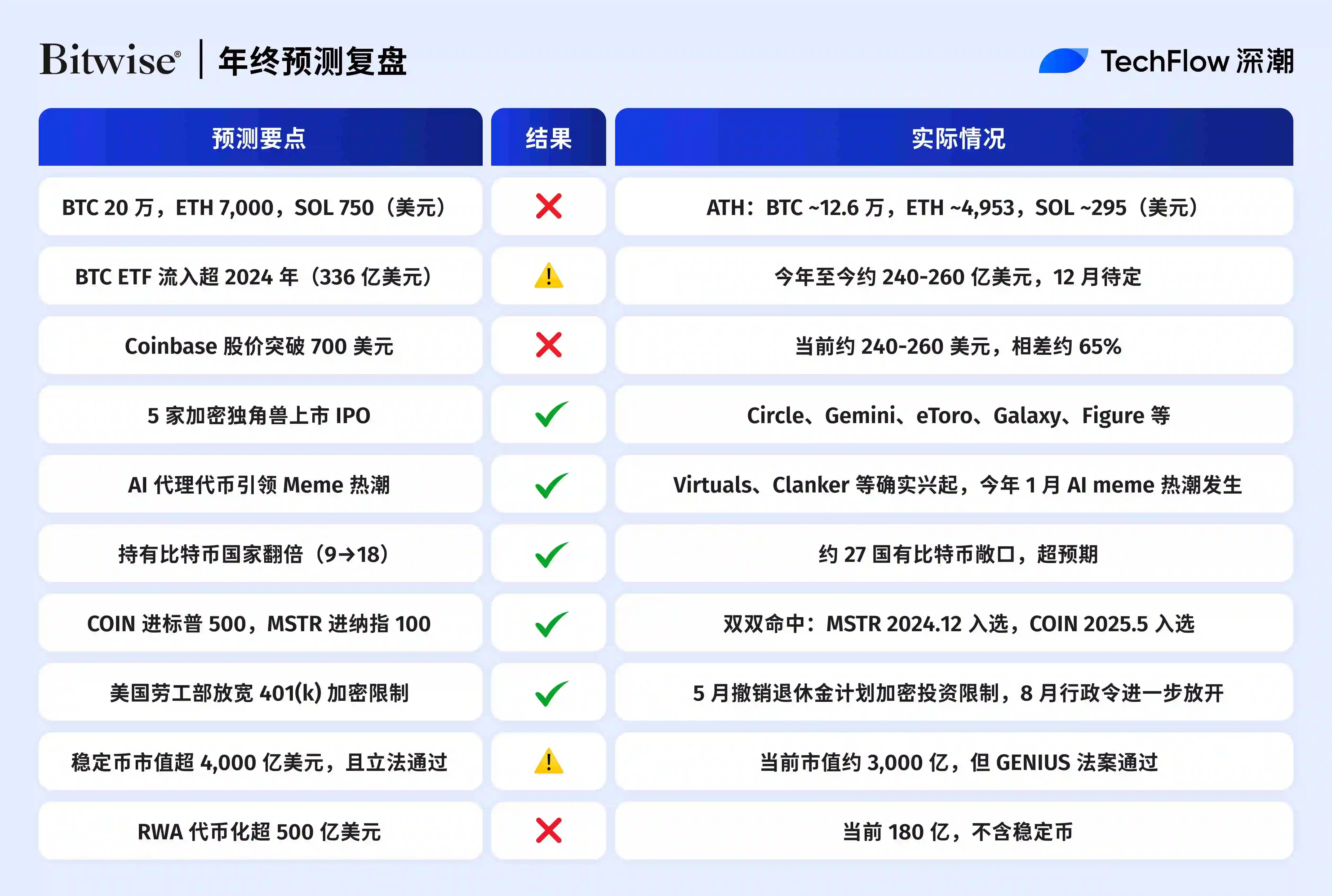
Bitwise made 10 predictions, with 5 hitting the mark, mainly focusing on regulatory and institutional adoption areas; however, their price and scale predictions also suffered from systematic overestimation.
· Policy and Institutional Adoption Hit the Mark. Coinbase and MicroStrategy entering the US stock indices became a reality; the Crypto IPO Era unfolded, with multiple crypto companies going public through IPOs; the number of countries holding BTC increased from 9 to nearly 30.
· Price Targets All Missed: Price predictions for BTC, ETH, and SOL were significantly higher than the actual performance of these tokens this year. Coinbase's stock price at $250 fell short of the $700 target by 65%. The estimated $500 billion in RWA tokenization also turned out to be an overestimation.
Overall, Bitwise demonstrated keen policy insight, accurately capturing the regulatory shift and institutional adoption momentum.
3. Coinbase: Accuracy Rate Close to 100%, Focusing on Direction Rather Than Price
Coinbase's forecasts are divided into two main categories: "Macro" and "Disruptive," mostly offering directional judgments rather than precise numbers, focusing on trend foresight.
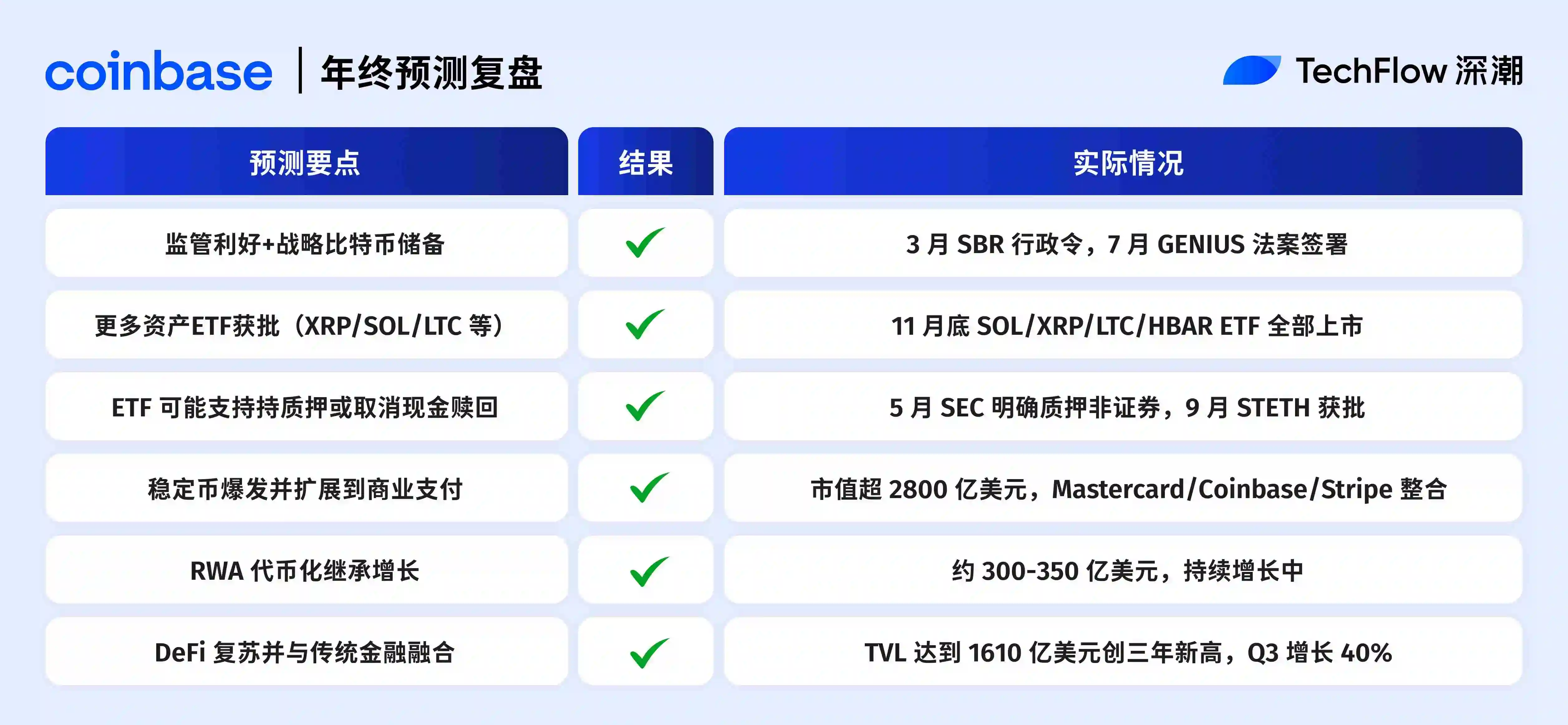
Here are some core verifiable forecasts:
Additionally, some forecasts were directionally correct but challenging to quantify:
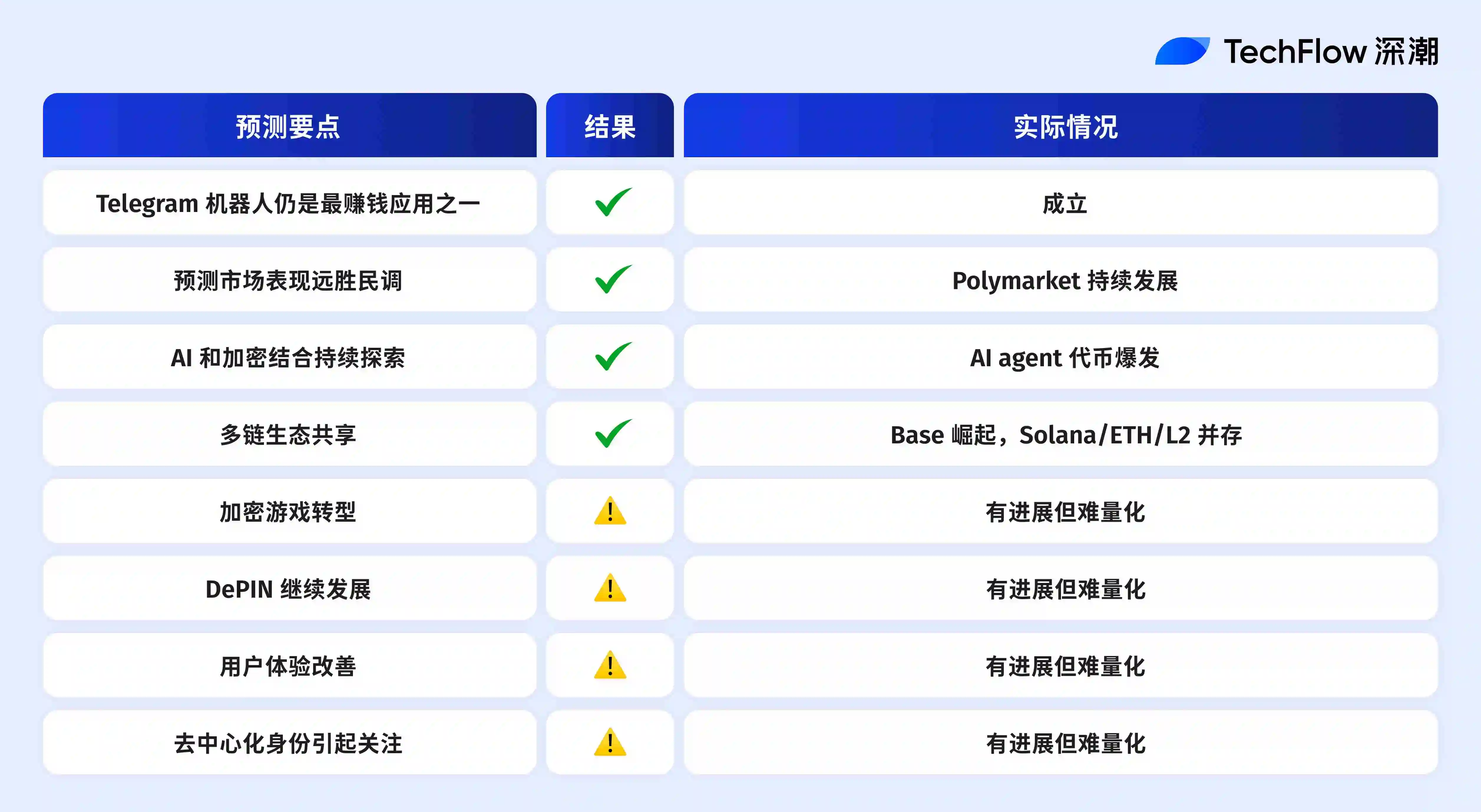
You can notice that this firm's forecasts clearly avoid specific price targets, concentrating on policy inflection points and industry trends. As a result, all core directional forecasts naturally hit the mark.
· Regulatory Shifts Fully Validated: Predictions regarding the "Most Crypto-Friendly Congress" bringing positive news and more asset ETF approvals; the actual situation indeed unfolded as predicted.
· Stablecoins and DeFi Overall Direction Correct: Predictions about stablecoins "experiencing explosive growth and expanding into commercial payments" came true this year, as evidenced by Mastercard's June announcement to support USDC/PYUSD/USDG, Coinbase integrating its payment platform with Shopify, and Stripe launching USDC subscription payments;
The prediction of a DeFi resurgence materialized, with DeFi TVL reaching $120 billion, nearing a three-year high since May 2022.
This "directional without pinpointing price" strategy, while lacking in sensationalism, retrospectively appears the most robust and less prone to being proven wrong.
4. Galaxy Research: Accuracy Rate 26%, Data-Related Predictions Almost All Wrong
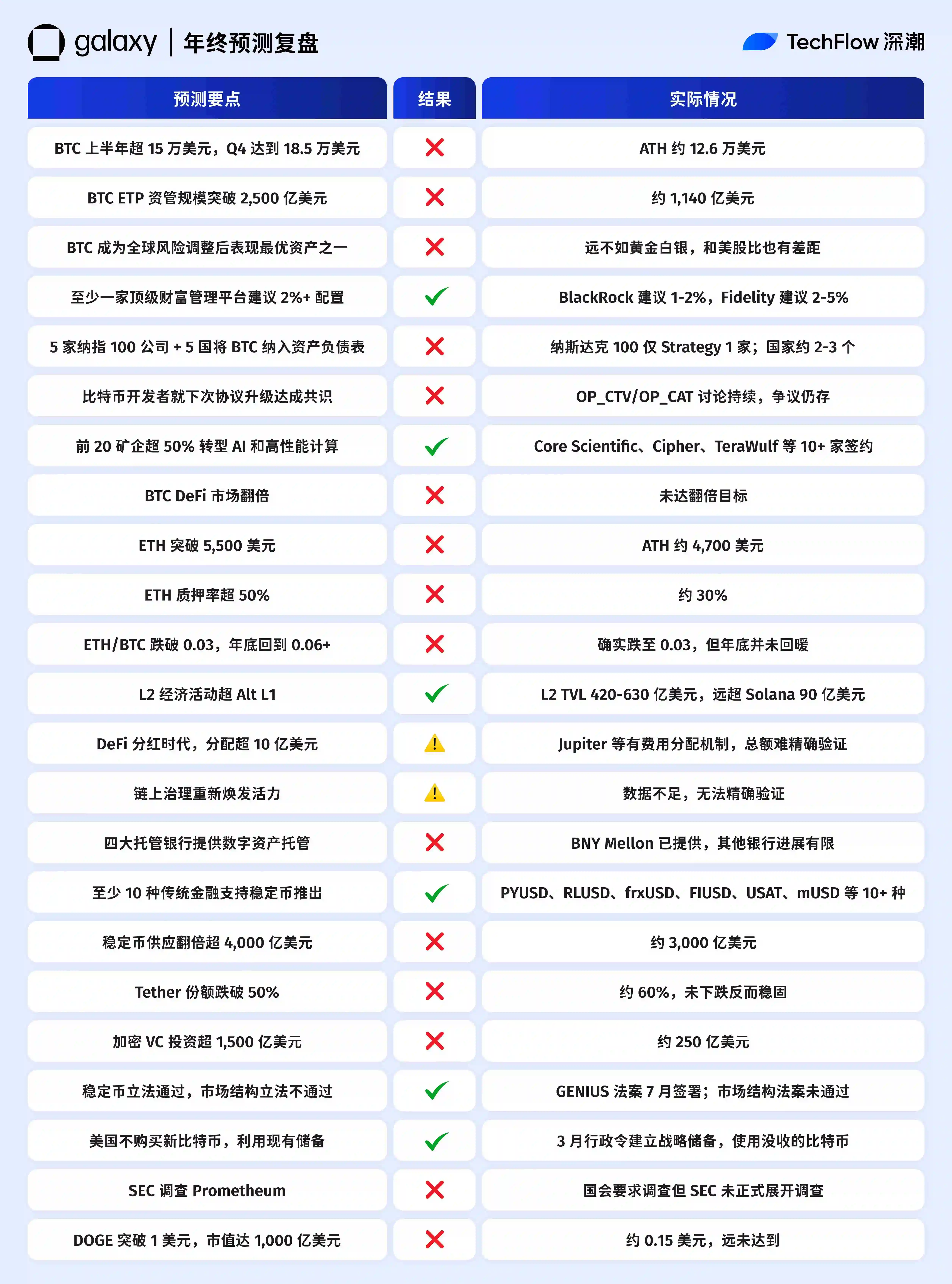
Galaxy's various researchers made a total of 23 predictions, making it the most quantitative and comprehensive list among all institutions.
In hindsight, the policy prediction team performed excellently (100% hit rate), while price and market size predictions were almost all incorrect. In particular, the prediction of DOGE breaking $1 can now be seen as overly optimistic.
Furthermore, Galaxy's predictions on ecosystem development were fairly accurate. For example, predicting that most mining companies would transition to AI and high-performance computing was indeed a prominent trend amid this year's AI boom.
When predictions are numerous and detailed, even professional research institutions will not always get everything right; the market does not always unfold as expected.
5. Hashkey: Accuracy Rate 70%, Price Predictions Too Optimistic
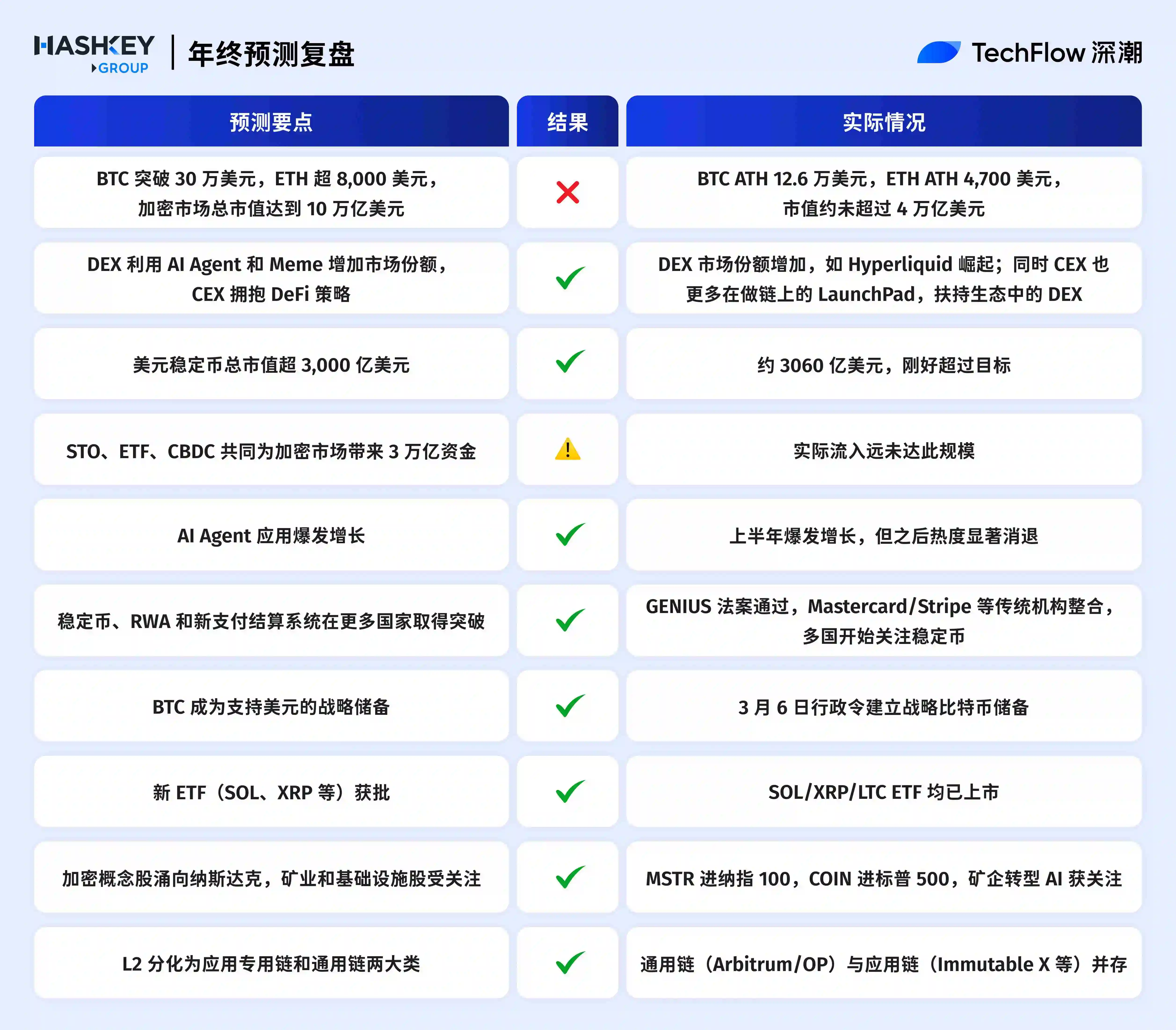
Overall, HashKey's predictions were precise regarding regulatory progress (ETFs, stablecoin legislation) and ecosystem structural changes (DEX emergence, L2 differentiation), but they were overly optimistic about price cycles.
Interestingly, these predictions also reflected the sentiment of the crypto community at the time.
After HashKey Group released its top 10 market forecasts for 2025, nearly 50,000 community users participated in a vote based on the sixteen popular predictions summarized by HashKey researchers, analysts, and traders;
The results showed that 50% of voters favored the prediction of "Bitcoin breaking $300,000, Ethereum surpassing $8,000, and the total crypto market cap reaching $10 trillion."
Ironically, the prediction with the highest voting probability is now looking the least likely to materialize by the end of this year.
6. Delphi Digital: Accuracy Rate 40%, Consumer-Level DeFi Predictions Stand Out
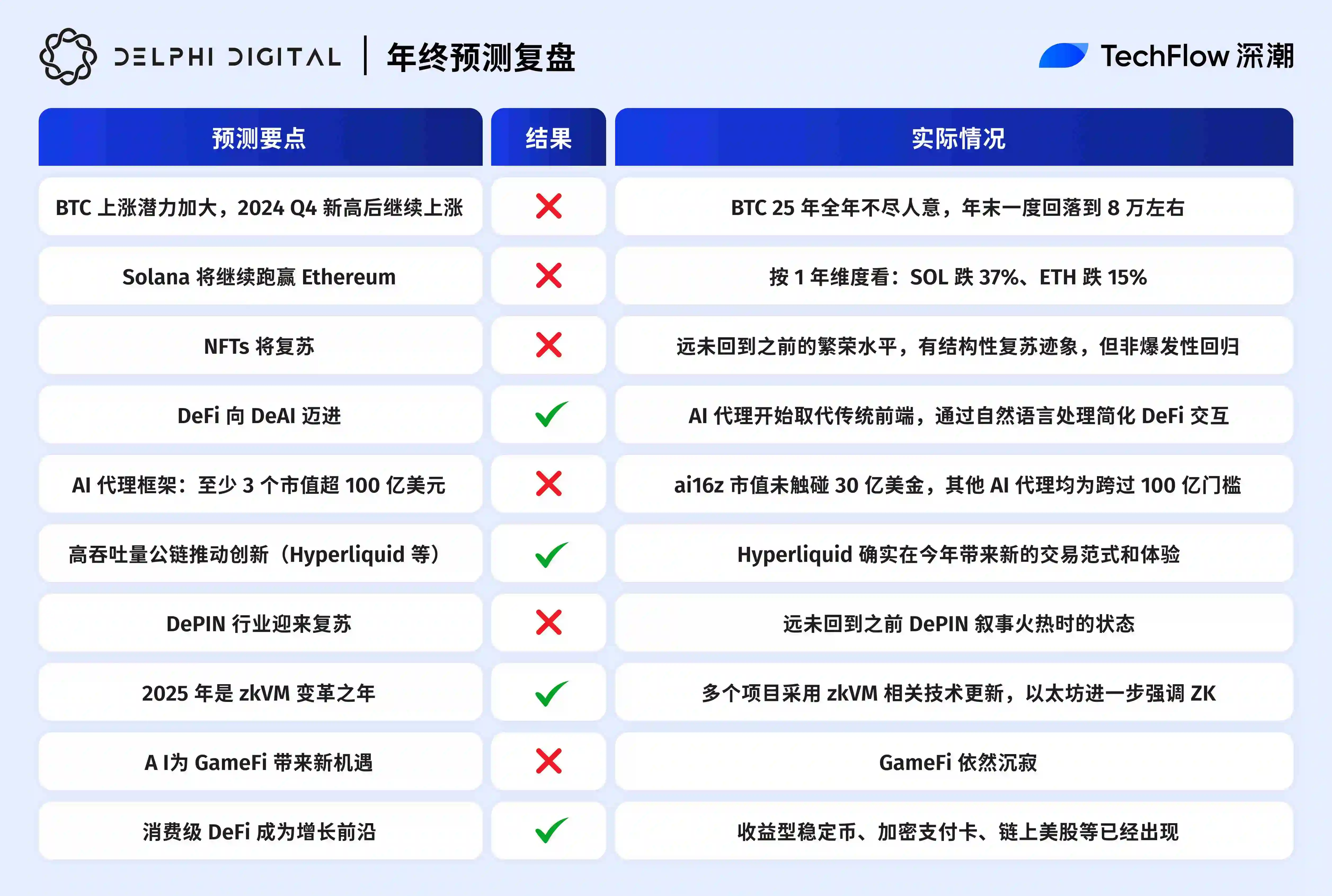
Delphi Digital's predictions were more accurate concerning technical infrastructure and consumer-level applications; with the prediction on consumer-level applications stated as:
"2025 will be a critical development milestone for consumer-level DeFi, as more and more crypto users will fully embrace on-chain financial services."
This year, we have also seen various U-cards and tokenization of US stocks. In addition, traditional financial applications such as Robinhood are gradually embracing the blockchain.
7. Messari: Accuracy 55%, No Specific Price Points Involved
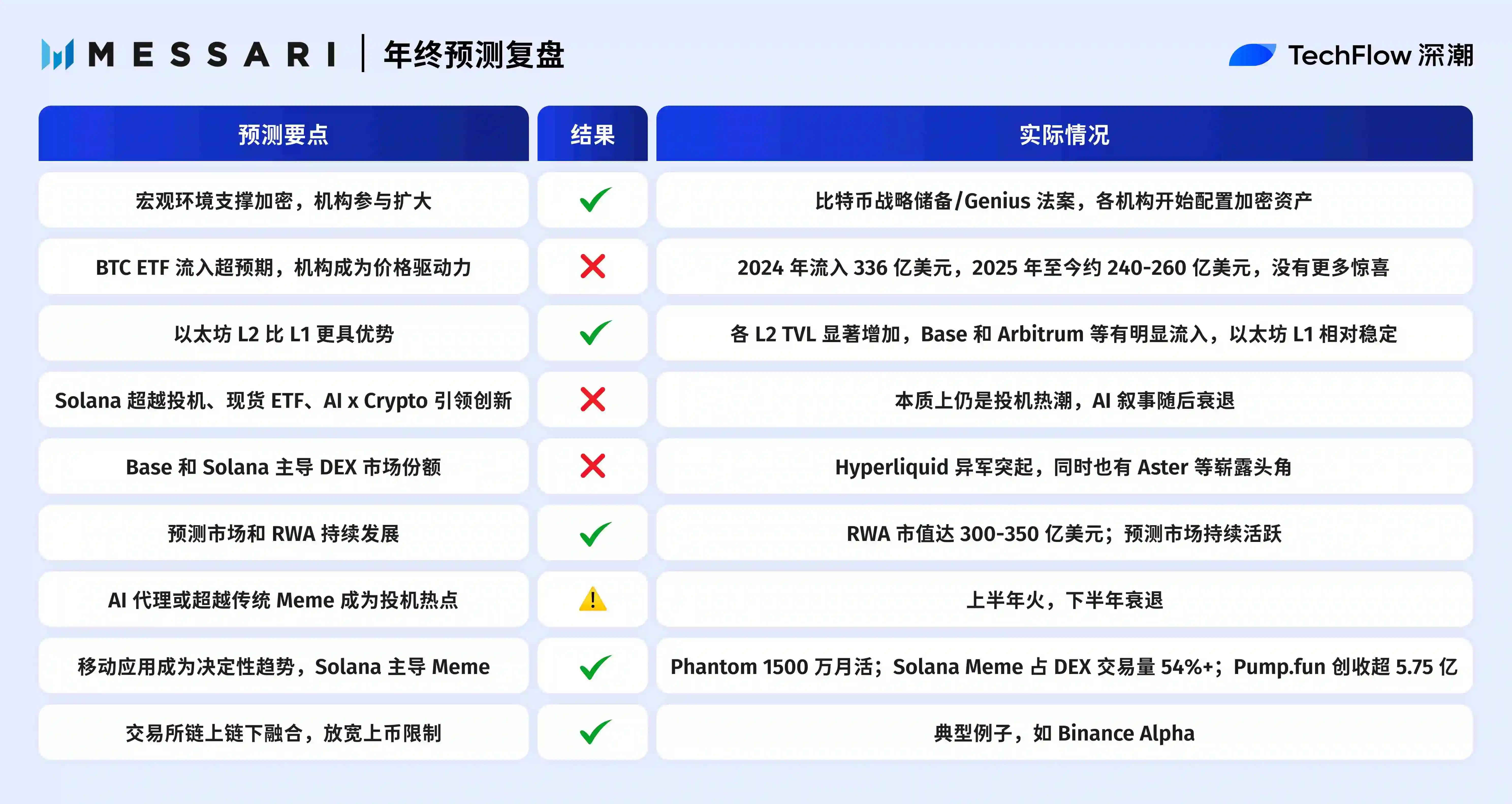
Although Messari is a data analysis platform, its predictions tend to lean towards the "trend direction" rather than "specific numbers," and in hindsight, its judgment on major trends has been relatively accurate.
8. Framework Ventures: Accuracy 25%, Providing More Confidence to Invested Projects
Next, we have selected some of the more representative personal prediction viewpoints from last year to see how the results turned out.
First is the prediction from Vance Spencer, co-founder of Framework Ventures. We have extracted the part related to crypto:
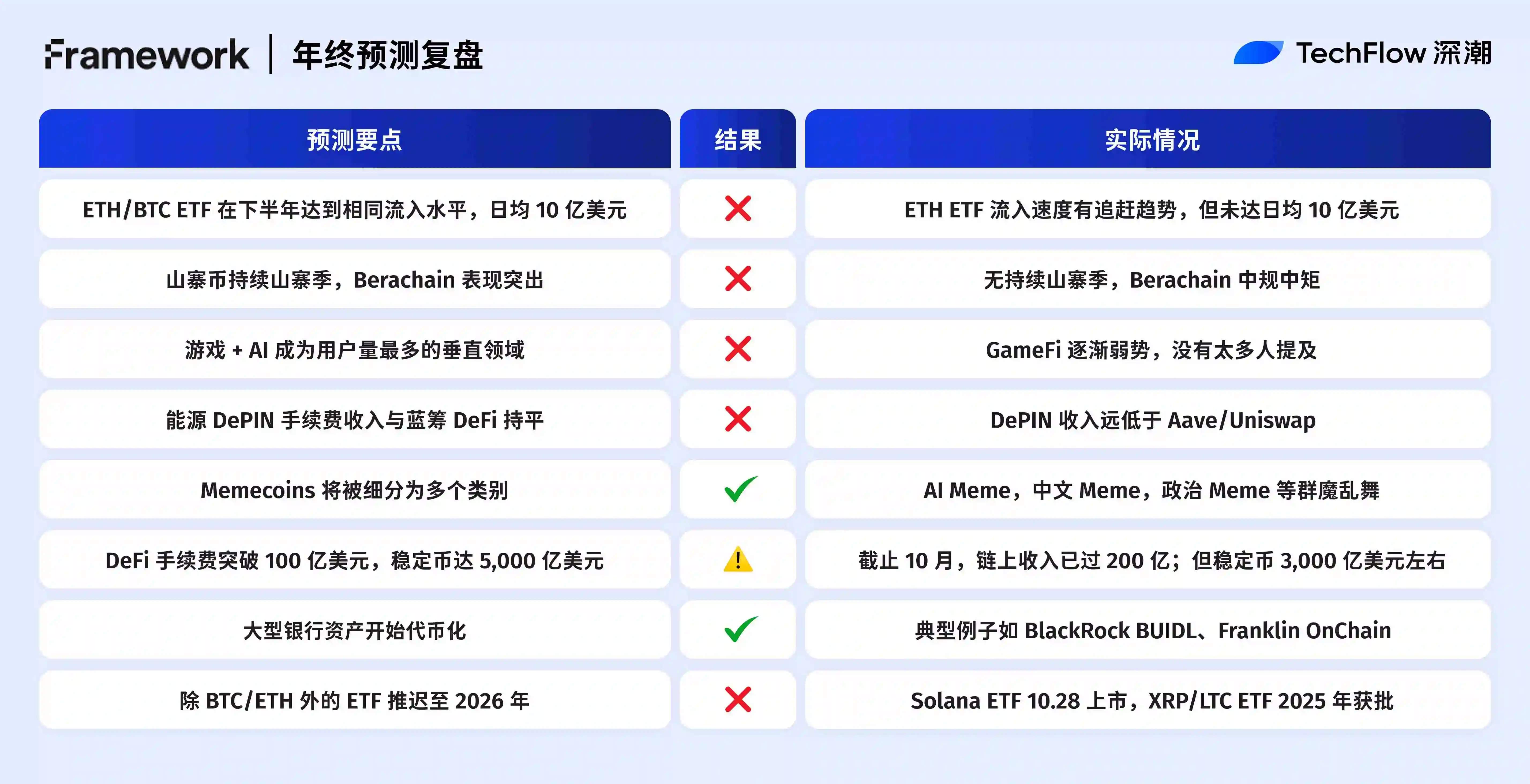
Evidently, Vance has shown high prediction expectations for projects in which he has invested, such as Glow, Daylight, and Berachain, representing the energy and public chain sectors, respectively.
In addition, some quantitative targets are overly aggressive, such as an average daily inflow of $1 billion into an ETH ETF.
9. Blockworks Co-founder: Accuracy 48%, Most Number of Predictions
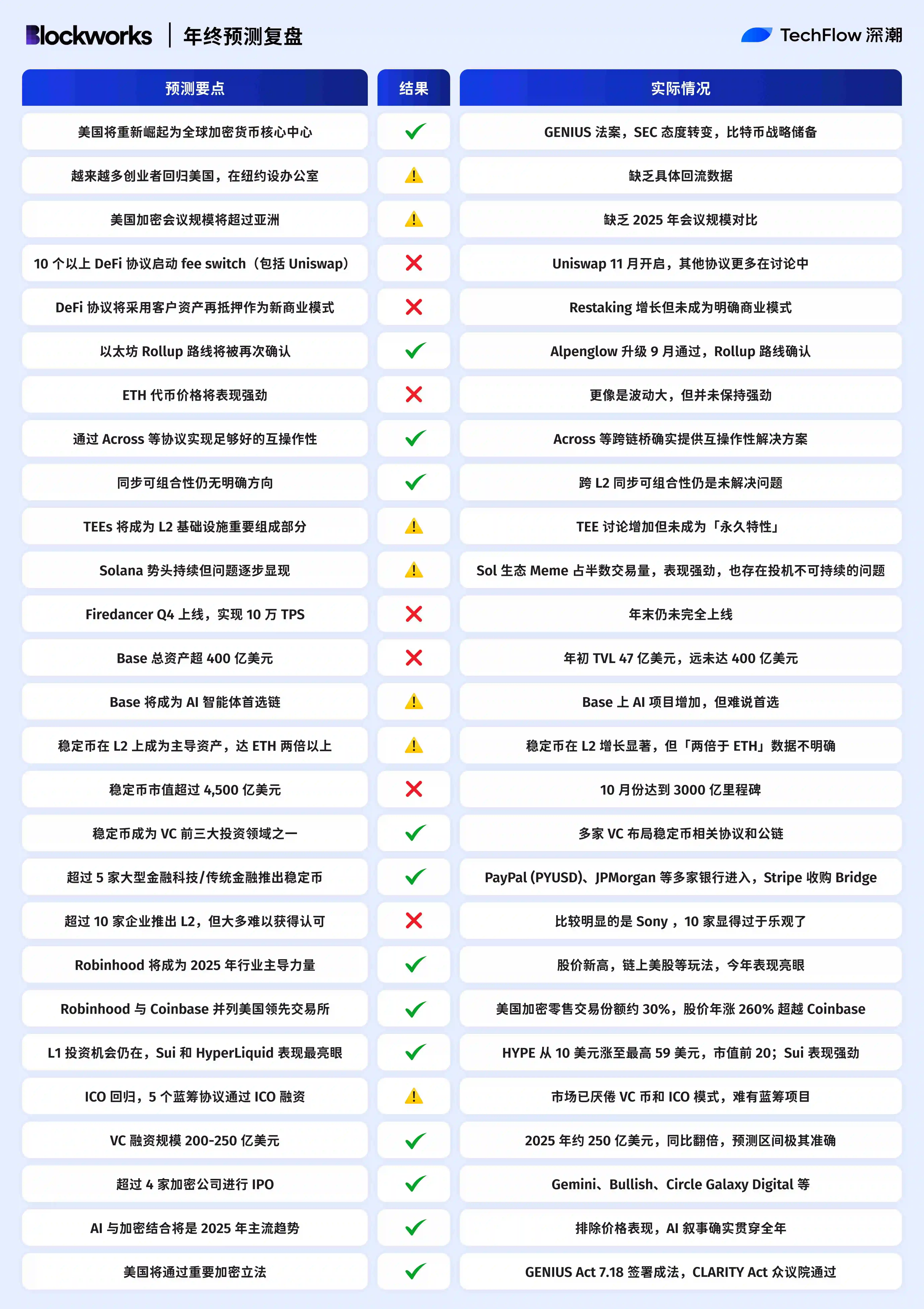
Blockworks co-founder Mippo (Twitter: @MikeIppolito_) is the individual with the highest number of predictions among our review of institutions and individuals, and although the accuracy of his predictions is good, he got nearly half of them right.
A highlight is that his prediction about the rise of Robinhood was completely correct, and he also seized the investment opportunity in L1, such as Hyperliquid and SUI, both of whose tokens have had remarkable performances this year.
10. Alliance DAO Wang Qiao & Imran: Accuracy 50%, Overly Optimistic about BTC Price
Alliance DAO's two founders, Wang Qiao and Imran, have also made predictions about the development of the next 25 years during a podcast chat.
We have compiled their views related to crypto as follows:
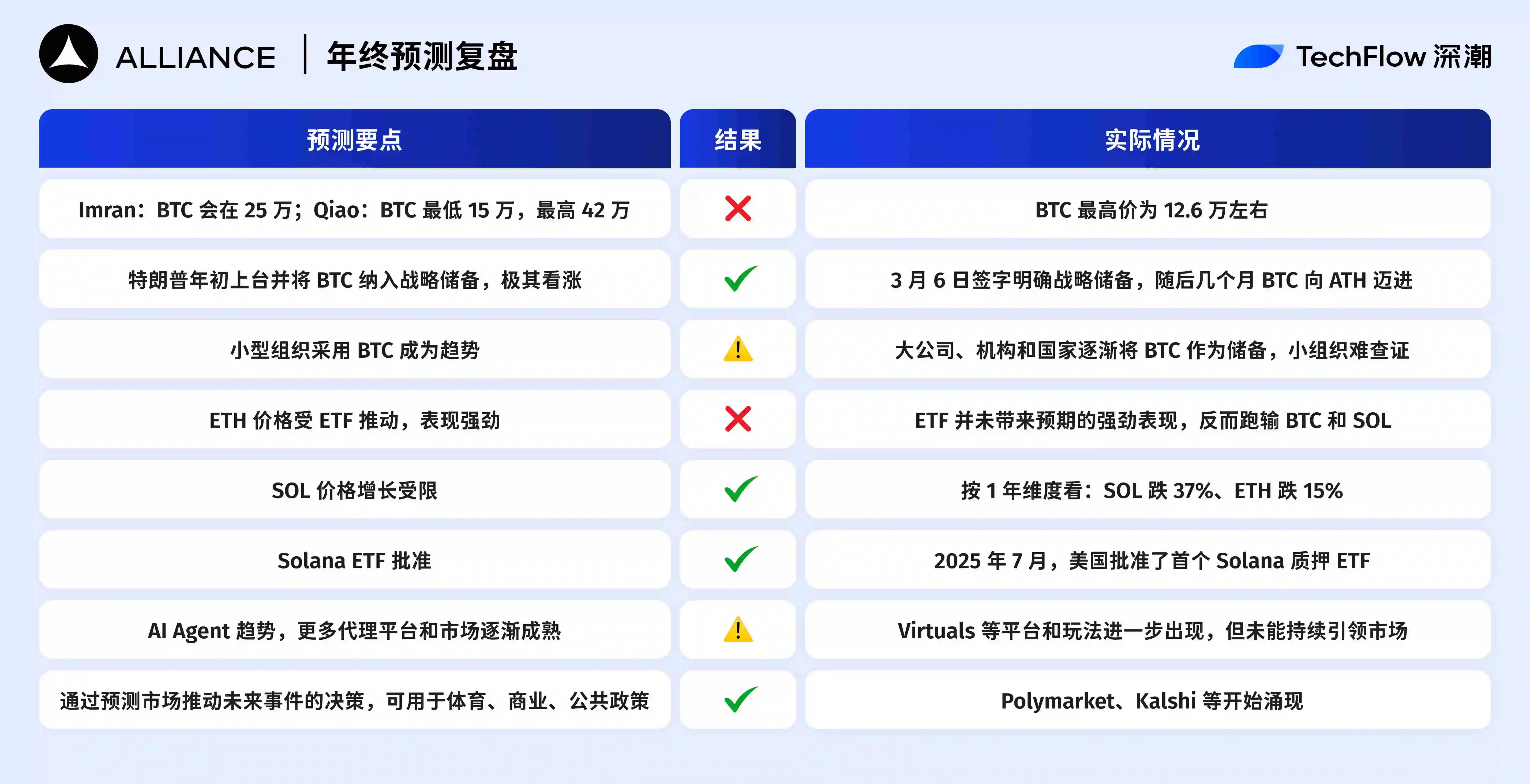
It can be seen that the two founders' expectations for BTC were overly optimistic. Even the lowest predicted value of 150K is still a long way from this year's highest BTC price.
However, their market prediction was very accurate, as they foresaw this key trend a year in advance.
Summary
After reviewing last year's predictions, several patterns are quite evident:
1. The quantity of predictions is generally inversely proportional to their accuracy. The more predictions made, the more of them tend to be wrong.
2. Attempts to predict specific price points and numbers mostly ended up being off the mark.
3. Predictions related to regulations were highly reliable. Nearly all institutions and individuals accurately predicted the improvement in the regulatory environment and the U.S.'s crypto-friendly stance.
Finally, the author believes that the value of these annual institutional forecasts lies not in "telling you what to buy" but in "telling you what the industry is thinking." These predictions can be viewed as industry sentiment indicators. If used as investment guides, the results may be quite dire.
Furthermore, it's good practice to remain skeptical of any prediction with specific numbers, regardless of whether it comes from a Key Opinion Leader (KOL), institution, or industry tycoon.
This is not to suggest that we should criticize these industry elites but rather to highlight that even incorrect predictions hold value.
They tell you what the market once believed, but no one can predict the future.
You may also like

Wall Street Shorts ETH: Vitalik is aware and has front-run, while Tom Lee remains oblivious

Social Capital CEO: How Equity Tokenization is Reshaping Capital Markets from US Stocks to SpaceX?

CoinGecko Report: Surge of 346% vs Dip of 20.8%, The Wild Rise of DEX

a16z: The Real Opportunity of Stablecoins Lies Not in Disruption but in Filling Gaps

Mining Exodus: Someone Holds $12.8 Billion AI Order

March 6 Market Key Intelligence, How Much Did You Miss?

a16z: The True Opportunity of Stablecoins is in Complementing, Not Disrupting

Predict LALIGA Matches, Shoot Daily & Win BTC, USDT and WXT on WEEX
The WEEX × LALIGA campaign brought together football excitement and crypto participation through a dynamic interactive experience. During the event, users predicted matches, completed trading tasks, and took daily shots to compete for rewards including BTC, USDT, WXT, and exclusive prizes.

Ray Dalio Dialogue: Why I'm Betting on Gold and Not Bitcoin

Who Took the Money in the AI Era? A Must-See Investment Checklist for HALO Asset Trading
Wall Street Bears Target Ethereum: Vitalik In the Know Takes Flight, Tom Lee Remains Bullish
Pump.fun Hacker Steals $2 Million, Receives 6-Year Prison Sentence, Opts for 'Self-Detonation'

6% Annual Percentage Yield as Musk Declares War on Traditional Banks
36 years, 4 wars, 1 script: How does capital price the world in conflict?

Mining Companies' Great Migration: Some Have Already Secured $12.8 Billion in AI Orders
What Is Vibe Coding? How AI Is Changing Web3 & Crypto Development
What is vibe coding? Learn how AI coding tools are lowering the barrier to Web3 development and enabling anyone to build crypto applications.
The parent company of the New York Stock Exchange strategically invests in OKX: The intentions behind the $25 billion valuation

WEEX P2P update: Country/region restrictions for ad posting
To improve ad security and matching accuracy, WEEX P2P now allows advertisers to restrict who can trade with their ads based on country or region. Advertisers can select preferred counterparty locations for a safer, smoother trading experience.
I. Overview
When publishing P2P ads, advertisers can now set the following:
Allow only counterparties from selected countries or regions to trade with your ads.
With this feature, you can:
Target specific user groups more precisely.Reduce cross-region trading risks.Improve order matching quality.
II. Applicable scenarios
The following are some common scenarios:
Restrict payment methods: Limit orders to users in your country using supported local banks or wallets.Risk control: Avoid trading with users from high-risk regions.Operational strategy: Tailor ads to specific markets.
III. How to get started
On the ad posting page, find "Trading requirements":
Select "Trade with users from selected countries or regions only".Then select the countries or regions to add to the allowlist.Use the search box to quickly find a country or region.Once your settings are complete, submit the ad to apply the restrictions.
When an advertiser enables the "Country/Region Restriction" feature, users who do not meet the criteria will be blocked when placing an order and will see the following prompt:
If you encounter this issue when placing an order as a regular user, try the following solutions.
Choose another ad: Select ads that do not restrict your country/region, or ads that allow users from your location.Show local ads only: Prioritize ads available in the same country as your identity verification.
IV. Benefits
Compared with ads without country/region restrictions, this feature provides the following improvements.
Aspect
Improvement
Trading security
Reduces abnormal orders and fraud risk
Conversion efficiency
Matches ads with more relevant users
Order completion rate
Reduces failures caused by incompatible payment methods
V. FAQ
Q1: Why are some users not able to place orders on my ad?
A1: Their country or region may not be included in your allowlist.
Q2: Can I select multiple countries or regions when setting the restriction?
A2: Yes, multiple selections are supported.
Q3: Can I edit my published ads?
A3: Yes. You can edit your ad in the "My Ads" list. Changes will take effect immediately after saving.


 App
App