
- Buy Crypto
- Markets
 Futures
- Spot
- Copy Trade
- Earn
- More
Aevo Co-Founder's Epic Rant Slams the Industry: I Wasted 8 Years of My Life in Crypto

Original Title: I Wasted 8 Years of My Life in Crypto
Original Author: Ken Chan, Co-Founder of Aevo
Translation: Azuma, Odaily Planet
Editor's Note: This past weekend, an article by Ken Chan, co-founder and CTO of Aevo, went viral on the internet with the title "I Wasted 8 Years of My Life in Crypto."
In the article, Ken Chan expresses a highly pessimistic attitude, believing that the industry has lost its idealism and has instead become the largest and most participated casino in human history. He feels disgusted by his past contributions to this casino. While we may not agree with Ken Chan's views, and many industry professionals have spoken out in response after the article gained widespread attention, objectively speaking, his portrayal does highlight the industry's current crisis of faith and value collapse.
Below is the original content written by Ken Chan, translated by Odaily Planet.

Initial Motivation
When I was a teenager, I was already highly politically motivated. Among all the books that made me increasingly radical, the works of Ayn Rand (such as "The Fountainhead" and "Atlas Shrugged") had the greatest influence on me. In 2016, I was an idealistic libertarian and even made donations to Gary Johnson. In addition to my steadfast Randian beliefs, I also enjoyed computer programming, so cryptocurrency was a natural fit for me. The spirit of cypherpunk attracted me. The idea of Bitcoin as a personal wealth bank fascinated me — the ability to carry a billion dollars in your mind across borders has always been an incredibly powerful concept to me.
However, over time, I felt that I had lost sight of my initial goals in the crypto industry. After fully immersing myself in this field, the alluring promise of cryptocurrency's transformative power gradually faded. I became disillusioned with the target users and the real recipients of the service. I completely misunderstood who the true users of cryptocurrency were, mistaking propaganda for reality. Cryptocurrency claimed to be about decentralizing the financial system, and I wholeheartedly believed it at the time, but in reality, it is merely a super system of speculation and gambling; just a reflection of the real economy.
Reality hit me like a truck. I wasn't building a new financial system at all; I was building a casino, a casino that doesn't even call itself a casino, but it's the largest-scale, 24/7 online, massively multiplayer casino our generation has created. Part of me wishes I could at least feel proud of dedicating my entire twenties to building this casino, but another part of me feels like I completely wasted my youth. I've wasted my life on this—although at least I made a lot of money from it.
Watch What They Do, Not What They Say
Cryptocurrency is a confusing thing. On one hand, you'll hear advocates say they want to entirely replace the existing financial system with on-chain systems. I can totally picture that world—where your bank account only holds USDC or Bitcoin, and you can send a billion dollars to anyone in the world in seconds. That vision remains powerful, and I still believe in it to this day.
But the incentive structures have completely twisted the narrative. In reality, all market participants are eager to throw money in, funding the next so-called "Layer 1" (Aptos, Sui, Sei, ICP, etc.). The sole winner of the 2020 Layer 1 wars was Solana, which spawned a strong speculative drive for the fourth spot (after Bitcoin, Ethereum, Solana—??), supporting a market cap of hundreds of billions of dollars.
But did this truly propel us towards the ideal new financial system? Despite VCs writing five-thousand-word articles trying to convince you, the answer is no. This hasn't created a new system at all; in fact, it has burnt through everyone's (both retail and VC) money, making everyone in the new system even poorer.
I'm not singling out Layer 1. I could provide numerous similar examples: spot DEXes, perpetual contract DEXes, prediction markets, meme platforms, and so on. The frantic competition in these races hasn't substantially birthed a better financial system. Contrary to VCs' rhetoric, we don't need to build a casino on Mars.
The Gamification of Economic Models
If I said I had no financial incentive when I first entered the crypto industry, that would be a lie. As a reader, you might think I made enough money and decided to leave the industry, making me somewhat hypocritical. Yes, perhaps I am indeed hypocritical, but maybe I'm just nauseated by the contribution I've made to this mire of financialization and gamification.
Normalizing a "mutually quickly make a buck" zero-sum behavior is not a sustainable way to create wealth in the long term. It may seem like it, but it's not. Eight years in the crypto space have completely destroyed my ability to identify a sustainable business model. Here, you don't need a successful business or product to make money. This industry is full of high market cap zero-user tokens - which completely goes against the logic of the real world. If you want to bring value to customers, not just gambling + entertainment (that's what casinos do), these zero-sum business models simply won't work.
Conclusion
I used to think "financial nihilism" was a cute and harmless concept. I thought it didn't matter to keep launching zero-sum games for the next generation. I have no doubt that Bitcoin will one day rise to $1 million, but that has nothing to do with the financial games the industry is creating.
This industry mindset is extremely toxic, and I believe it will lead to long-term societal immobility in the younger generation. You can already see it happening, and we must have the courage to resist these meaningless games.
CMS Holdings once said: "Are you here to make money? Or are you here to prove you're right?"
This time, I choose to prove I'm right.
You may also like

Wall Street Shorts ETH: Vitalik is aware and has front-run, while Tom Lee remains oblivious

Social Capital CEO: How Equity Tokenization is Reshaping Capital Markets from US Stocks to SpaceX?

CoinGecko Report: Surge of 346% vs Dip of 20.8%, The Wild Rise of DEX

a16z: The Real Opportunity of Stablecoins Lies Not in Disruption but in Filling Gaps

Mining Exodus: Someone Holds $12.8 Billion AI Order

March 6 Market Key Intelligence, How Much Did You Miss?

a16z: The True Opportunity of Stablecoins is in Complementing, Not Disrupting

Predict LALIGA Matches, Shoot Daily & Win BTC, USDT and WXT on WEEX
The WEEX × LALIGA campaign brought together football excitement and crypto participation through a dynamic interactive experience. During the event, users predicted matches, completed trading tasks, and took daily shots to compete for rewards including BTC, USDT, WXT, and exclusive prizes.

Ray Dalio Dialogue: Why I'm Betting on Gold and Not Bitcoin

Who Took the Money in the AI Era? A Must-See Investment Checklist for HALO Asset Trading
Wall Street Bears Target Ethereum: Vitalik In the Know Takes Flight, Tom Lee Remains Bullish
Pump.fun Hacker Steals $2 Million, Receives 6-Year Prison Sentence, Opts for 'Self-Detonation'

6% Annual Percentage Yield as Musk Declares War on Traditional Banks
36 years, 4 wars, 1 script: How does capital price the world in conflict?

Mining Companies' Great Migration: Some Have Already Secured $12.8 Billion in AI Orders
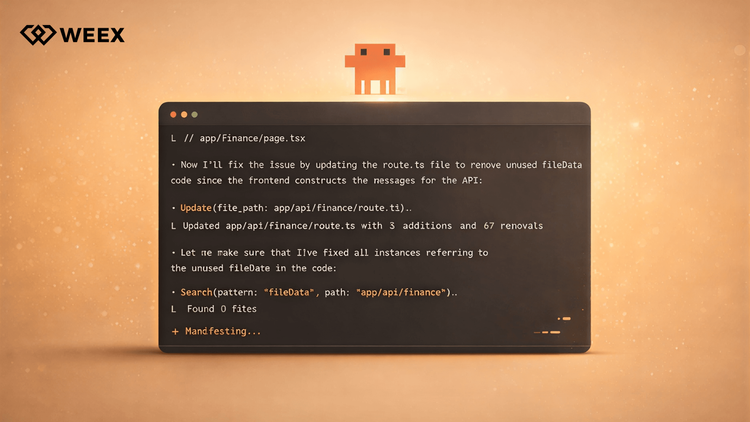
What Is Vibe Coding? How AI Is Changing Web3 & Crypto Development
What is vibe coding? Learn how AI coding tools are lowering the barrier to Web3 development and enabling anyone to build crypto applications.
The parent company of the New York Stock Exchange strategically invests in OKX: The intentions behind the $25 billion valuation

WEEX P2P update: Country/region restrictions for ad posting
To improve ad security and matching accuracy, WEEX P2P now allows advertisers to restrict who can trade with their ads based on country or region. Advertisers can select preferred counterparty locations for a safer, smoother trading experience.
I. Overview
When publishing P2P ads, advertisers can now set the following:
Allow only counterparties from selected countries or regions to trade with your ads.
With this feature, you can:
Target specific user groups more precisely.Reduce cross-region trading risks.Improve order matching quality.
II. Applicable scenarios
The following are some common scenarios:
Restrict payment methods: Limit orders to users in your country using supported local banks or wallets.Risk control: Avoid trading with users from high-risk regions.Operational strategy: Tailor ads to specific markets.
III. How to get started
On the ad posting page, find "Trading requirements":
Select "Trade with users from selected countries or regions only".Then select the countries or regions to add to the allowlist.Use the search box to quickly find a country or region.Once your settings are complete, submit the ad to apply the restrictions.
When an advertiser enables the "Country/Region Restriction" feature, users who do not meet the criteria will be blocked when placing an order and will see the following prompt:
If you encounter this issue when placing an order as a regular user, try the following solutions.
Choose another ad: Select ads that do not restrict your country/region, or ads that allow users from your location.Show local ads only: Prioritize ads available in the same country as your identity verification.
IV. Benefits
Compared with ads without country/region restrictions, this feature provides the following improvements.
Aspect
Improvement
Trading security
Reduces abnormal orders and fraud risk
Conversion efficiency
Matches ads with more relevant users
Order completion rate
Reduces failures caused by incompatible payment methods
V. FAQ
Q1: Why are some users not able to place orders on my ad?
A1: Their country or region may not be included in your allowlist.
Q2: Can I select multiple countries or regions when setting the restriction?
A2: Yes, multiple selections are supported.
Q3: Can I edit my published ads?
A3: Yes. You can edit your ad in the "My Ads" list. Changes will take effect immediately after saving.


 App
App