
Crypto ETF Fund Outflows: Is BlackRock and Other Issuers Still Making Money?

Original Article Title: When Wrappers Run Red
Original Article Author: Prathik Desai, Token Dispatch
Original Article Translation: Luffy, Foresight News
During the first two weeks of October 2025, Bitcoin spot ETFs saw inflows of $32 billion and $27 billion, setting records for the highest and fifth-highest weekly net inflows in 2025.
Prior to this, Bitcoin ETFs were on track to achieve a "no consecutive outflow week" milestone in the second half of 2025.
However, the most severe cryptocurrency liquidation event in history occurred unexpectedly. This event, which resulted in the evaporation of assets worth $190 billion, continues to haunt the crypto market.
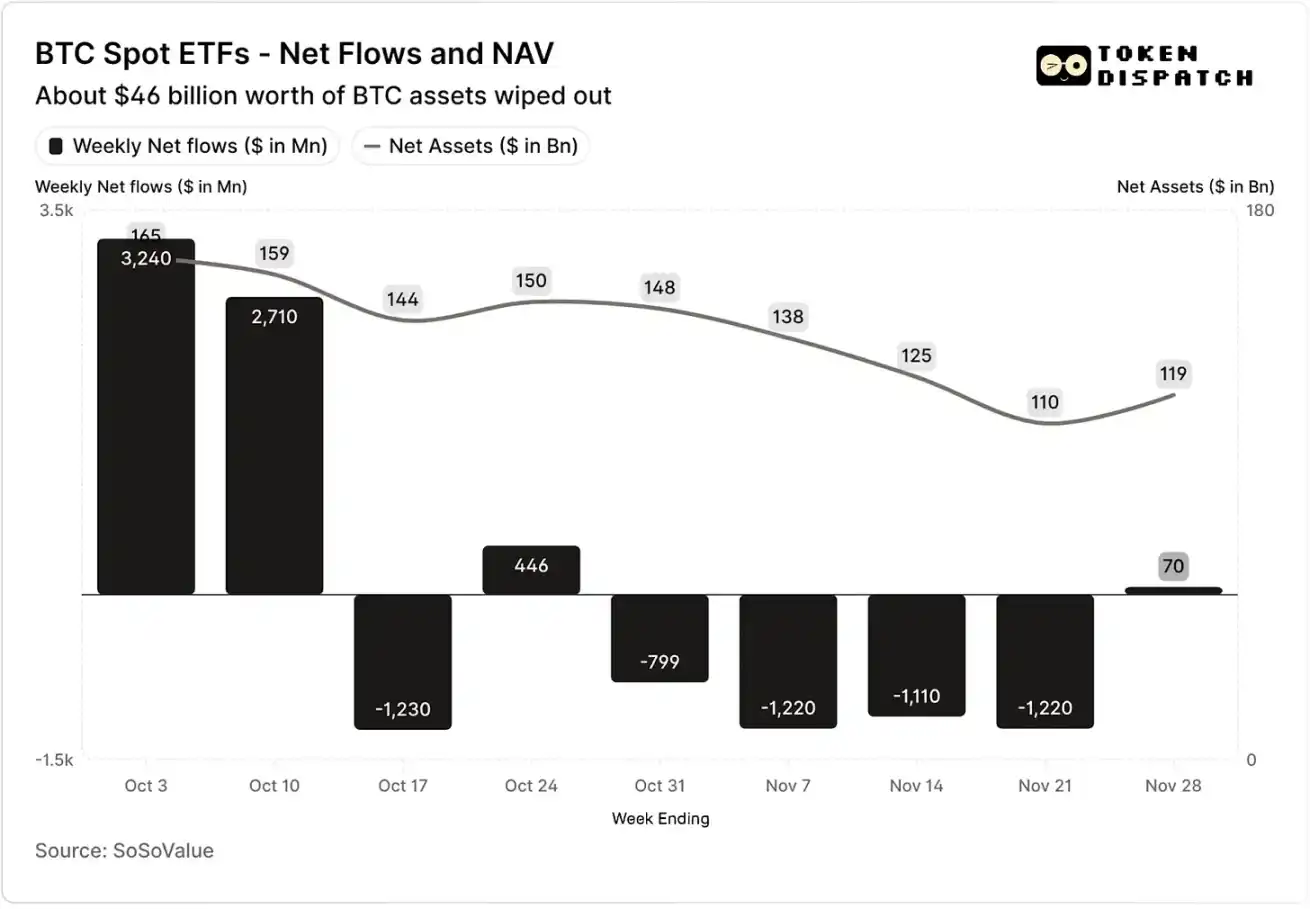
Net Fund Flows and Asset Net Value of Bitcoin Spot ETFs in October and November
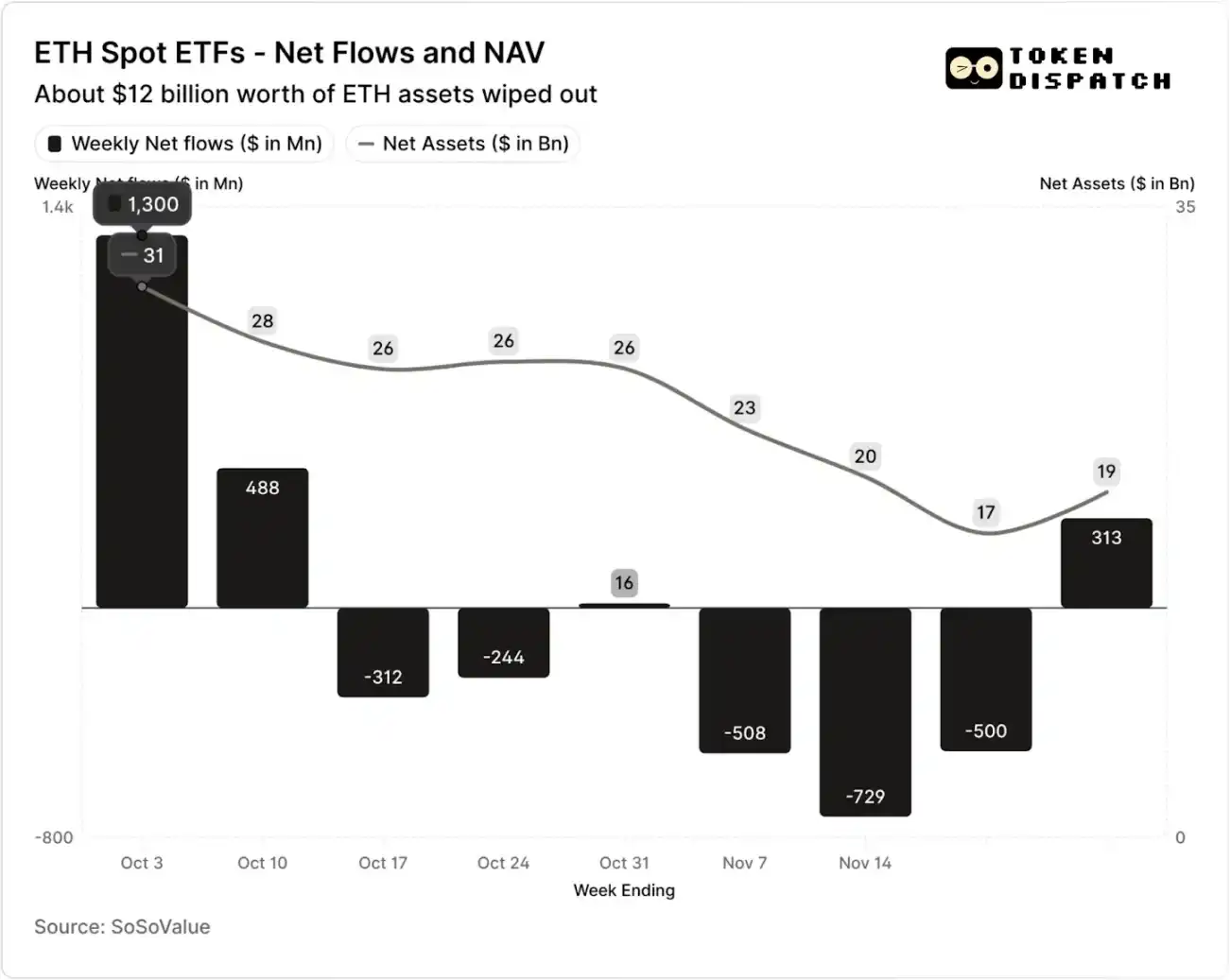
Net Fund Flows and Asset Net Value of Ethereum Spot ETFs in October and November
However, in the seven weeks following the liquidation event, Bitcoin and Ethereum ETFs experienced outflows in five weeks, totaling over $50 billion and $20 billion, respectively.
By the week ending November 21, the Net Asset Value (NAV) managed by the Bitcoin ETF issuer had shrunk from approximately $1.645 trillion to $1.101 trillion, while the Ethereum ETF's asset net value was nearly halved, dropping from $306 billion to $169 billion. This decline was partly due to the price decline of Bitcoin and Ethereum themselves, as well as some tokens being redeemed. In less than two months, the combined net asset value of Bitcoin and Ethereum ETFs evaporated by about one-third.
The retreat in fund flows reflects not only investor sentiment but also directly impacts the fee income of ETF issuers.
Bitcoin and Ethereum spot ETFs are the "money printers" of institutions like BlackRock, Fidelity, Grayscale, Bitwise, etc. Each fund charges fees based on the assets under management, typically expressed as an annual fee rate but actually accrued based on daily net asset value.
Every day, the trust funds holding Bitcoin or Ethereum shares will sell a portion of their holdings to cover transaction fees and other operational expenses. For the issuer, this means that their annual revenue is approximately equal to the Assets Under Management (AUM) multiplied by the fee rate; for the holders, this results in a gradual dilution of the amount of tokens held over time.
The fee rate range for ETF issuers is between 0.15% and 2.50%.
Redemption or outflows of funds themselves do not directly result in profit or loss for the issuer, but outflows cause a reduction in the issuer's ultimately managed asset size, thereby decreasing the asset base on which fees can be collected.
On October 3, the total assets under management by Bitcoin and Ethereum ETF issuers reached $195 billion, considering the aforementioned fee levels, their fee pool size was considerable. However, by November 21, the remaining asset size of these products was only about $127 billion.
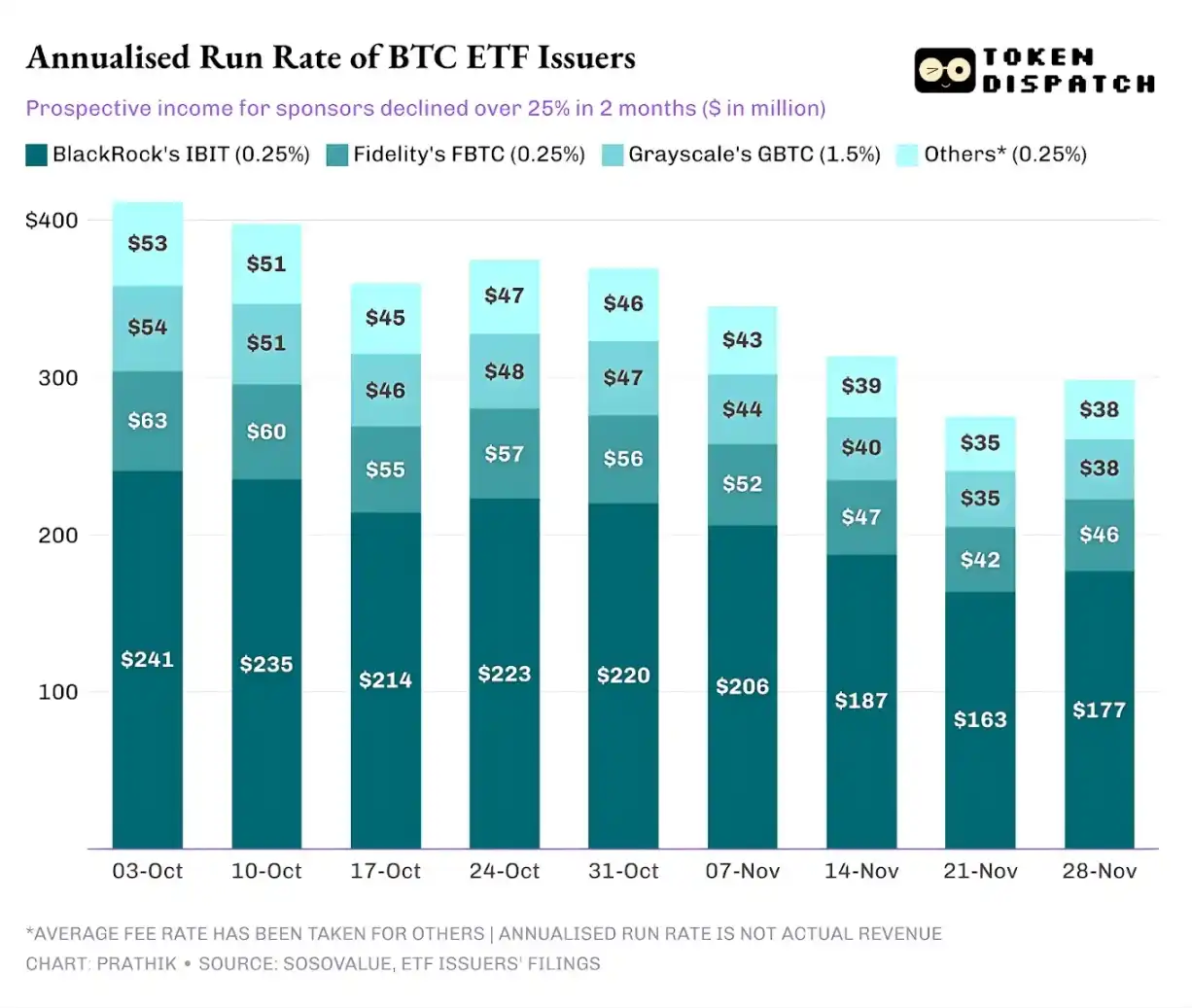
If we calculate the annualized fee income based on the weekend's assets under management, over the past two months, the potential revenue for Bitcoin ETFs has declined by over 25%; Ethereum ETF issuers have been more significantly affected, with a 35% decline in annualized revenue over the past nine weeks.
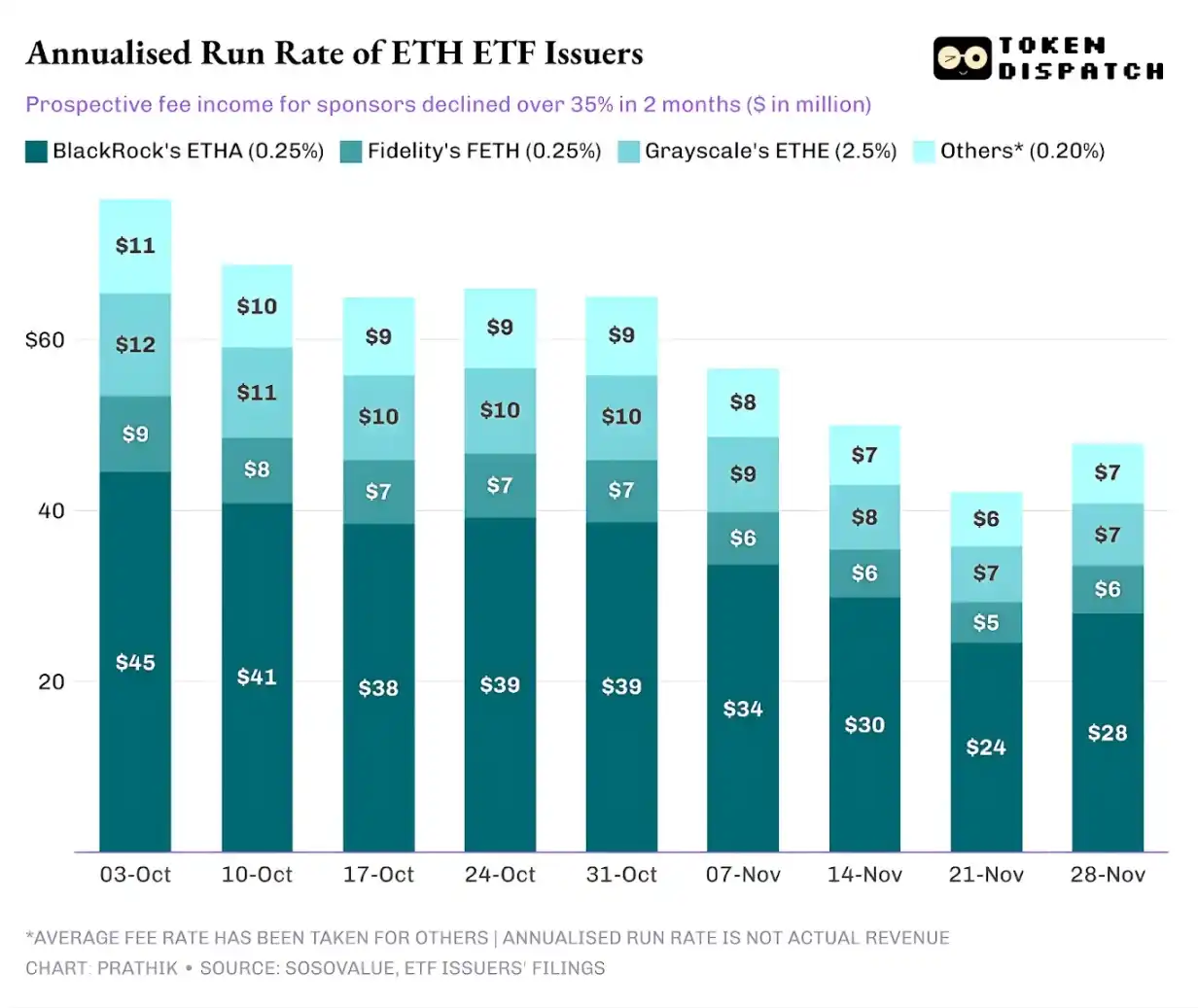
The Larger the Issuance Scale, the Harder the Fall
From the perspective of a single issuer, there are three slightly different trends behind the flow of funds.
For BlackRock, its business characteristics involve a combination of "economies of scale" and "cyclical fluctuations." Its IBIT and ETHA have become the default choices for mainstream investors to allocate Bitcoin and Ethereum through an ETF channel. This has allowed the world's largest asset management institution to charge a 0.25% fee based on its large asset base, especially when the asset size hit a record in early October, the gains were substantial. However, this also means that when large holders decided to reduce risk in November, IBIT and ETHA became the most direct selling targets.
The data is sufficient to support this: BlackRock's Bitcoin and Ethereum ETFs saw annualized fee income declines of 28% and 38%, exceeding the industry average declines of 25% and 35%.
Vanguard's situation is similar to that of BlackRock, but on a relatively smaller scale. Its FBTC and FETH funds also followed the rhythm of "inflow first, outflow later," where the market enthusiasm in October was eventually replaced by outflows in November.
Grayscale's story is more about "historical legacy issues." Once upon a time, GBTC and ETHE were the only scaled channels for numerous U.S. investors to allocate Bitcoin and Ethereum through brokerage accounts. However, with institutions like BlackRock and Vanguard leading the market, Grayscale's monopoly position no longer exists. To make matters worse, the high fee structure of its early products has led to continued outflow pressure over the past two years.
The market performance in October and November also confirmed this investor tendency: when the market is bullish, funds will shift to lower-fee products; when the market weakens, positions will be significantly reduced.
The early Grayscale cryptocurrency products had a fee rate 6-10 times lower than low-cost ETFs. Although a high fee rate can boost revenue figures, the elevated cost will continuously drive investors away, diminishing the asset under management that generates fee income. The retained funds are often constrained by frictional costs such as taxation, investment mandates, operational processes, rather than stemming from active investor choices; and each outflow reminds the market: once a superior option arises, more holders will abandon high-fee products.
These ETF data unveil several key features of the current cryptocurrency institutionalization process.
The spot ETF market in October and November demonstrates that the cryptocurrency ETF management business is as cyclical as the underlying asset market. When asset prices rise and market sentiment is positive, inflows will drive up fee revenue; however, once the macro environment changes, funds will swiftly exit.
Although large issuance institutions have established efficient "fee channels" on Bitcoin and Ethereum assets, the volatility in October and November proves that these channels are also susceptible to market cycle impacts. For issuers, the core issue is how to retain assets in the face of a new market shock, avoiding significant fluctuations in fee revenue following macro trend changes.
While issuers cannot prevent investors from redeeming shares in a sell-off, income-generating products can to some extent mitigate downside risks.
Covered call option ETFs can provide investors with premium income (Note: A covered call option is an options trading strategy where an investor holds the underlying asset while simultaneously selling an equal number of call option contracts. Through collecting the premium, this strategy aims to enhance portfolio returns or hedge some risks.), offsetting some of the underlying asset price declines; collateralized products are also a viable direction. However, such products need to undergo regulatory review before being formally introduced to the market.
You may also like

Circle CEO responds to OUSD's challenge: Stablecoins are a winner-takes-all business, and we will not slow down
Argentina vs Cape Verde: When a Record-Breaking Legend Meets an Unbreakable Underdog
WEEX exclusive pre-match analysis of Argentina vs Cape Verde, exploring Messi-led Argentina’s dominance and Cape Verde’s historic defensive breakout, with a breakdown of volatility, structure, and match dynamics.
How does Gate redo "buying and selling stocks" from the cryptocurrency world to the stock market?
Former ByteDance employee's account: How I started with two Pinduoduo hard drives and made six times the profit with Seagate to achieve financial freedom?
Visa and Mastercard join 140 giants to launch a new stablecoin, but the impact on the market landscape may still be limited
WEEX Launches Depth Chart for Spot Trading
MiCA reshuffle begins, Binance temporarily bids farewell to the EU
Raising interest rates to protect STRC and selling coins to maintain credit, this time the strategy has chosen the two most expensive paths
Morning Report | Samsung announces a 265.5 trillion won investment plan, focusing on semiconductor and AI computing power data centers; Vitalik publishes an article detailing the entire technology tree behind the confusion protocol (iO) mainline
In the era of AI, what is left of Bitcoin?
NeoSoul announced plans to integrate with the OKX Agentic Wallet, promoting AI agents' participation in the on-chain economy
Why Is Bitcoin Lagging Stocks in 2026? AI Stocks, ETF Outflows, and the Nasdaq Rally Explained
What you bought on CEX is really not US stocks: Analyzing the 94% liquidation monopoly and the evaporation of equity under a five-layer pipeline
In such a crowded cross-border payment arena, where is the next stop for the future?
Why Is Bitcoin Down in 2026? What We Can Learn From 2022
The large models in the United States are moving towards closure in the name of security
From the white-haired stock god to the billionaire fund mogul, the smart people shorting Nvidia are all getting rich using the same framework
Morning Report | CoinEx becomes a key hub for Iran to evade sanctions, involving over $3.8 billion in funds; Kalshi seeks a new round of financing, with a valuation potentially rising to $40 billion
Circle CEO responds to OUSD's challenge: Stablecoins are a winner-takes-all business, and we will not slow down
Argentina vs Cape Verde: When a Record-Breaking Legend Meets an Unbreakable Underdog
WEEX exclusive pre-match analysis of Argentina vs Cape Verde, exploring Messi-led Argentina’s dominance and Cape Verde’s historic defensive breakout, with a breakdown of volatility, structure, and match dynamics.
How does Gate redo "buying and selling stocks" from the cryptocurrency world to the stock market?
Former ByteDance employee's account: How I started with two Pinduoduo hard drives and made six times the profit with Seagate to achieve financial freedom?
Visa and Mastercard join 140 giants to launch a new stablecoin, but the impact on the market landscape may still be limited
WEEX Launches Depth Chart for Spot Trading