
Etherscan's Surcharge Scandal Exposes Ethereum Ecosystem's Data Dependency Dilemma

 Prefer us on Google


Original Article Title: "Etherscan Cancels Several Free APIs, Revealing Unforeseen Issues"
Original Article Author: Eric, Foresight News
On November 23, Lefteris Karapetsas, the founder of the open-source portfolio tracker Rotki, took to Twitter to complain about Etherscan. He mentioned that during Devcon, Etherscan suddenly announced that they would no longer provide free APIs for the Avalanche C-Chain, Base, BNB Chain, and OP Mainnet block explorers.
While he understood the pressure of providing free services, he questioned why there was no advance notice or why such a decision was made during a major event when everyone was away, leading to a "sudden attack" without any time to react.
According to Etherscan's announcement, as the chain's performance gradually improved, the data volume also increased significantly, leading to a substantial rise in costs. In this situation, they could no longer afford to provide all APIs for free and had to reluctantly convert some previously free APIs into paid versions.
It is evident that the decision to no longer offer free APIs for specific chains was likely due to insufficient funding or resource support.
Finally, the founder expressed some confusion, questioning why, apart from Avalanche, Base, OP Mainnet, and BNB Chain did not have enough money to support such critical services.
However, opposing voices quickly emerged, with the founder of Routescan and operator of the Avalanche block explorer Snowtrace, Jack, at the forefront. Jack provided some industry-insider data:
· Etherscan charges supported chains approximately between $1.5 million to $2 million annually, with some as low as around $300,000, but providing only basic data;
· For chains that are already paying, Etherscan only provides a free API with 5 RPS (Requests Per Second), and for additional requests, the monthly subscription fee can go up to $899.
· Last month, the independent visitor numbers of various chain explorers on Etherscan were as follows: OP Mainnet, 102k; BNB Chain, 2.5M; Base, 1M; HyperEVM, 30k; Avalanche, 16k. Etherscan itself had 4M visitors.
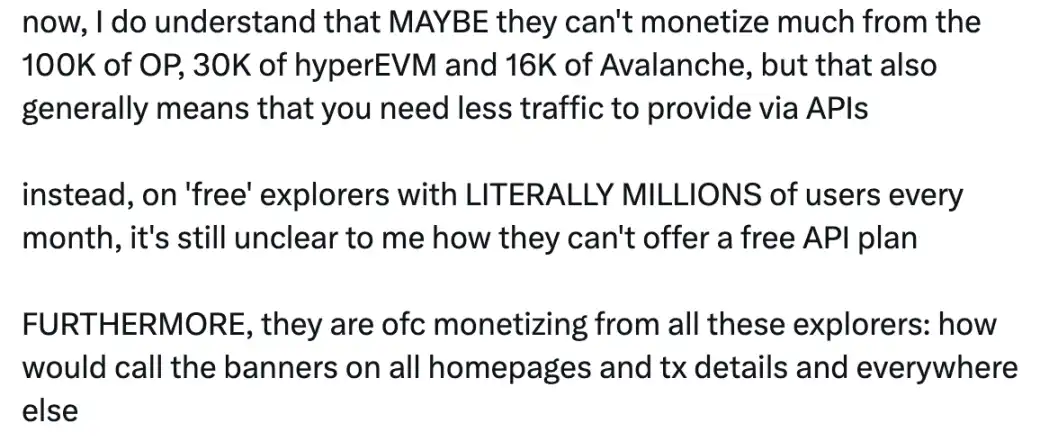
The CEO's implicit meaning is: Charging for a small number of APIs is indeed due to financial constraints, not because we find the income insignificant. For some chains that don't pay us, we have offered free service for a while and have done our utmost. Let's stop arguing about this and move on.
There isn't much to say about the discussion on this issue; it's simply a matter of some people thinking Etherscan is too greedy, while others view it as justifiable business behavior. However, some discussions arising from this event are quite interesting.
First of all, it was through this incident that the author learned about an ecosystem alliance called VERA, which promotes convenient, standardized, and open access to EVM smart contract source code, as well as the Open Labels Initiative, which drives the standardization framework and data model for EVM address labels. The fundamental goal of both organizations is to support the accessibility of blockchain data, especially validation.
The Open Labels Initiative retweeted Lefteris Karapetsas's complaint tweet, stating that over the past year, they have been working to prevent incidents like this caused by overreliance on centralized on-chain data providers. They believe that such critical infrastructure should not be monopolized but rather co-developed.
Entities such as sourcefify.eth for verifying Ethereum contract code, the Ethereum data visualization platform growthepie, the open-source block explorer Blockscout, and the previously mentioned Routescan are all contributing to the readability and accessibility of Ethereum data.
According to Akshat Mittal, a DeFi engineer at Reserve Protocol, Etherscan has not been involved in these initiatives. Is it for commercial gain? No one knows, but even if it is, it's understandable. The Ethereum ecosystem will always have individuals who adhere to open-source culture and reject excessive commercialization, which is not a matter of right or wrong but rather showcases the diversity of the ecosystem. Profit-driven institutions can ensure service quality, while open-source products will still have their place.
Furthermore, there has been recent effusive praise by IC's zCloak Network founder 0xFrancis, once again comparing IC to Ethereum.
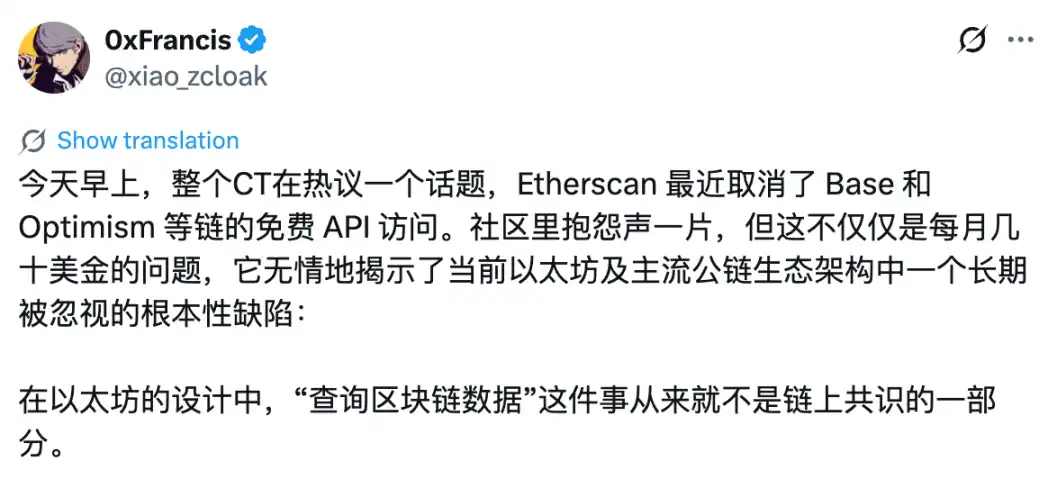
0xFrancis argues that Ethereum does not include "querying block data" as part of its consensus, so DApp development must rely on third-party RPC services. If RPC nodes collectively go offline, the chain will still run but become "unreadable."
Going deeper, if centralized RPC nodes or websites like Etherscan provide false data, they can easily deceive users. The Internet Computer (IC) incorporates querying as part of its protocol. When someone initiates a query, the request is executed through the ICP node network and returns cryptographically authenticated data to ensure its accuracy.
0xFrancis's point is not unfounded. This can be seen as a case of IC being too forward-thinking, with the Etherscan fee controversy being a typical debate about centralization versus decentralization. However, could it be that Ethereum's imperfections and the need for commercialized components have actually contributed to the ecosystem's prosperity?
Disclaimer: This content is provided for general branding and informational purposes only and doesn't constitute financial, investment, legal, or tax advice. Any events, rewards, online events, or related information mentioned herein should not be considered a recommendation, solicitation, or invitation to purchase, sell, trade, or otherwise deal in any crypto assets or to use any services. Crypto assets are highly volatile and may result in loss. WEEX services and online events may not be available in all regions and are subject to applicable laws, regulations, and eligibility requirements. You are responsible for ensuring that your use of WEEX services complies with local laws and for carefully assessing the risks before participating in any crypto-related activities.
You may also like

Walsh's 'Unified Front': Aiming for Rate Cuts?

Ethereum vs Solana Whitepaper Comparison (2026)
French Tech: AI and Quantum on the Rise, Crypto Absent

Home Robot NEO Grows "Dexterous Hands": How Do Hands Become the API to the Physical World?

What is SCEX? The Cryptocurrency Exchange for Vietnam's Market by Sacombank
Major Update for ChatGPT: Cross-Platform Functionality, One-Click Website Creation, and Lower Costs

BTC Challenges 64,000 After Breaking 63,000, Market Trading 'Manageable Risks'
As the Bubble Bursts, Who Dominates Attention in the AI Era? A 2026 Guide to Influential AI KOLs in China and the UK

Old Money in Crypto Shifts: Paradigm Raises $1.2 Billion, Half Bet on AI and Robotics

Bitdeer unveils $36M Nevada factory to shake up Bitcoin mining
Perplexity Fine-Tuned a Chinese AI Model to Match Claude Opus 4.8 at One-Third the Cost

Bank of Korea defends bank-first stablecoin plan amid bill deadlock
JPMorgan says bitcoin's main risk isn't Strategy, but blockchain adoption that doesn't benefit public chains and tokens
Fear & Greed Index Today: What Extreme Fear Means for Crypto, Stocks and Gold
Labour MPs Push to Make UK Crypto Donation Ban Permanent
Supreme Court ruling expanding Trump's authority over federal agencies raises questions for SEC, CFTC as crypto rulemaking advances

'Bottom building in progress': Analysts say bitcoin holder capitulation signals late-stage bear market

A Comprehensive Analysis: Starting from 1996, Who is Laying the Foundation for the Next Generation of Capital Markets
Luke Dashjr, the Biggest Anti-Spammer of Bitcoin, Inscribed Phrases on the Network in 2011

Whales bought 270,000 BTC while ETFs bled $7 billion. One side is wrong

The crypto IPO class of 2025-26 is down as much as 89%. Autopsy of a listing boom
Robinhood Chain Mining Guide: A Comprehensive Tutorial from Cross-Chain to Memecoin
BitGo CEO says single-digit percentages of bitcoin's supply are 'probably right' for large holders amid Strategy's sale
Beyond Private Keys: How to Safeguard the Security Boundaries of Web3 from Wallets, L2 to Supply Chains?
Vanguard Enters the Market, Opening a New Crypto Gateway for 50 Million Traditional Investors

Why the OUSD Alliance of 150 Companies Still Cannot Shake USDT and USDC?
Citigroup Analysis: Is There Still 47% Upside for Nvidia? Can Rubin and CPO Deliver?
WEEX API Fast Connect: Turn Every Sign-In Into a Live Trader in Under 10 Seconds
WEEX API Fast Connect is a one-click OAuth authorization system that lets your users link their WEEX account without ever touching an API key. Frictionless onboarding, faster conversions, higher retention — built for WEEX Broker partners.
Bitcoin's dwindling exchange reserves don't pack the same bullish punch anymore

From Le Mans to the Rollercoaster: Carl Moon Takes On Portimão
Crypto world renowned KOL and racing driver Carl Moon, backed by WEEX, heads to the Ferrari Challenge Portugal round at the Algarve International Circuit, July 16–19, fresh off a podium finish at Le Mans. Here's why this race is one to watch.
Fast execution. Split-second accuracy. Security that never blinks. That's WEEX — and that's exactly how Carl races.
Walsh's 'Unified Front': Aiming for Rate Cuts?
Ethereum vs Solana Whitepaper Comparison (2026)
French Tech: AI and Quantum on the Rise, Crypto Absent
Home Robot NEO Grows "Dexterous Hands": How Do Hands Become the API to the Physical World?
What is SCEX? The Cryptocurrency Exchange for Vietnam's Market by Sacombank
Major Update for ChatGPT: Cross-Platform Functionality, One-Click Website Creation, and Lower Costs
Contents
Latest articles






Latest coin listings on WEEX


