
- Buy Crypto
- Markets
 Futures
- Spot
- Copy Trade
- Earn
- More
Funding Wheel Halts, Crypto Treasury Firm Losing Buy-the-Dip Capability

Original Article Title: "The Battle of the Trapped Beasts: Crypto Treasury Companies are Losing the Ability to Buy the Dip"
Original Article Author: Frank, PANews
During the brief uptrend in April, crypto treasury companies, as the main holders in the market, provided continuous ammunition to the market. However, when the crypto market experienced a double whammy of price drops, these crypto treasury companies seemed to have collectively gone silent.
When the price reached a temporary bottom, it was theoretically the moment for these treasury companies to buy the dip. But the reality is that buying behavior slowed down or even stalled. The reason behind this collective silence is not simply because the "ammunition" ran out at the peak or due to panic; instead, it was a systemic paralysis where the highly leveraged financing mechanism dependent on premiums encountered a situation of "being rich but unable to use the wealth" during a down cycle.
Hundreds of Billions in Ammunition Locked Up
To understand why these DAO companies have encountered the dilemma of "being rich but unable to use the wealth," we need to first conduct an in-depth analysis of the ammunition sources of crypto treasury companies.
Take Strategy, the current leading stock of the crypto treasury, as an example. Its funding has mainly come from two directions: one is through "convertible notes," which involves borrowing money to buy coins through bonds with very low interest rates. The other is the ATM (At-The-Market) issuance mechanism, where when Strategy's stock price has a premium relative to the held crypto assets, the company can issue more shares to raise funds to increase its Bitcoin holdings.
Until 2025, Strategy's funds mainly came from "convertible notes." As of February 2025, Strategy has financed $8.2 billion through "convertible notes" to buy more Bitcoin. Starting in 2024, Strategy began to extensively use the At-The-Market (ATM) equity plan, which is more flexible compared to other issuance methods. When the stock price is higher than the market value of the held crypto assets, shares can be issued at market price to purchase crypto assets. In the third quarter of 2024, Strategy announced a $21 billion ATM equity issuance plan, and in May 2025, it established a second $21 billion ATM plan. As of now, the remaining total amount under this plan is $30.2 billion.
However, these amounts are not in cash but in the form of unsold Class A preferred shares and common shares. For Strategy to convert these amounts into cash, they need to sell these shares on the market. When the stock price has a premium (for example, if the stock price is $200, with each share containing $100 worth of Bitcoin), selling shares is equivalent to transforming the issued shares into $200 in cash and then buying $200 worth of Bitcoin again. The amount of Bitcoin per share also increases accordingly, which was the infinite bullet flywheel logic for Strategy. However, when Strategy's stock price Market-to-Net Asset Value (mNAV) data falls below 1, the situation reverses, and selling shares at that point would be at a discount. After November, Strategy's mNAV data has remained below 1 for a long time. Therefore, even though Strategy had a large amount of salable shares during this period, they were unable to purchase Bitcoin.
Furthermore, Strategy not only failed to allocate funds to buy the dip recently but also chose to raise $1.44 billion through a discounted stock sale, establishing a dividend reserve pool to support preferred stock dividend payments and existing debt interest payments.
As the standard template for crypto treasuries, Strategy's mechanism has also been studied by most treasury companies. Therefore, we can see that when the crypto assets plummeted, the reason these treasury companies failed to buy the dip and were reluctant to do so was actually because the stock price had dropped too much, locking up their "ammunition reserves."
Adequate Nominal Firepower, Actual "All Guns, No Ammo"
So, apart from Strategy, how much purchasing power do other companies have? After all, the number of crypto treasury companies in the market has now reached hundreds.
From the current market perspective, although there are many crypto treasury companies, the subsequent buying potential is not significant. There are mainly two situations here. One type of company is originally a crypto asset holding company, with the majority of its crypto assets coming from its existing holdings rather than new purchases through debt issuance. Their financing and debt issuance capabilities and motivations are not strong, such as Cantor Equity Partners (CEP), which ranks third in Bitcoin holdings with an mNAV of 1.28. Its Bitcoin holdings mainly came from the merger with Twenty One Capital, with no purchase records since July.
The other type adopts a Strategy-like strategy, but due to the recent severe drop in stock prices, the general mNAV values have all fallen below 1. The ATM limits of these companies have also been locked, and the flywheel can only turn again if the stock price recovers to above 1.
In addition to debt issuance and stock sales, there is another most direct "ammunition reserve," which is cash reserves. Taking the example of BitMine, the largest DAT company in Ethereum, although its mNAV is also below 1, the company has maintained its buying plan recently. According to data from December 1st, BitMine stated that it still has $882 million in unencumbered cash. BitMine's Chairman, Tom Lee, recently stated, "I believe Ethereum's price has bottomed, BitMine has resumed accumulation, purchasing nearly 100,000 ETH last week, twice the amount of the previous two weeks." BitMine's ATM limit is also substantial. By July 2025, the total limit of this plan was raised to $24.5 billion, with approximately $20 billion still available.
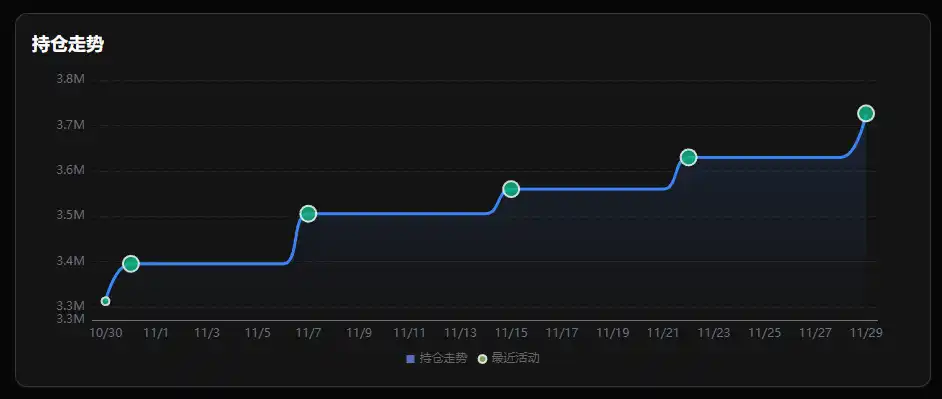
BitMine Holdings Changes
Additionally, CleanSpark proposed at the end of November to issue a $1.15 billion convertible bond within the year to purchase Bitcoin. The Japanese publicly traded company Metaplanet has been one of the most active Bitcoin treasury companies recently, raising over $400 million since November through pledging Bitcoin for loans or issuing additional shares to buy Bitcoin.
In terms of total reserves, these companies have a "nominal arsenal" (cash + credit line) amounting to hundreds of billions of dollars, far exceeding the previous bull market. However, in terms of "effective firepower," the actual ammunition they can use has diminished.
Shifting from "Leverage Expansion" to "Interest Survival"
In addition to their reserves being locked up, these crypto treasury companies are currently embarking on a new investment strategy. During the bullish market phase, most companies' strategy was quite simple: buy in mindlessly, obtain more financing as the value of their assets rose, and continue buying. However, as the situation shifts, many companies are not only facing greater difficulty in securing financing but also need to address the interest payments on previously issued bonds and operational costs.
Therefore, many companies are now shifting their focus to "crypto yield," meaning they are participating in staking activities on crypto asset networks to earn relatively stable staking rewards. They are using these rewards to cover the interest payments required for financing and operational costs.

For example, BitMine plans to launch the MAVAAN (Metaverse American Validator Network) in the first quarter of 2026 to initiate ETH staking. It is estimated that this move could bring BitMine an annualized revenue of $340 million. Similarly, treasury companies on the Solana network like Upexi and Sol Strategies are able to achieve approximately an 8% annualized return.
It can be foreseen that as long as the mNAV cannot return to above 1.0, hoarding cash to deal with debt maturity will become the main theme for treasury companies. This trend also directly affects asset selection. Since Bitcoin lacks a native high yield, the growth of pure Bitcoin treasuries is slowing down, while Ethereum, which can generate cash flow through staking to cover interest costs, has maintained a resilient treasury growth rate.
This shift in asset preference is essentially a compromise for treasury companies facing a liquidity crisis. When the avenue to acquire cheap funds through stock price premiums is closed off, seeking interest-bearing assets becomes their only lifeline to maintaining a healthy balance sheet.
At its core, the "Infinite Bullet" is nothing more than a pro-cyclical illusion built on stock price premiums. When the flywheel is jammed due to a discount, the market must face a harsh reality: these treasury companies have always been amplifiers of trends rather than saviors in adversity. Only when the market trend warms up first can the funding floodgates reopen.
You may also like

Social Capital CEO: How Equity Tokenization is Reshaping Capital Markets from US Stocks to SpaceX?

CoinGecko Report: Surge of 346% vs Dip of 20.8%, The Wild Rise of DEX

a16z: The Real Opportunity of Stablecoins Lies Not in Disruption but in Filling Gaps

Mining Exodus: Someone Holds $12.8 Billion AI Order

March 6 Market Key Intelligence, How Much Did You Miss?

a16z: The True Opportunity of Stablecoins is in Complementing, Not Disrupting

Predict LALIGA Matches, Shoot Daily & Win BTC, USDT and WXT on WEEX
The WEEX × LALIGA campaign brought together football excitement and crypto participation through a dynamic interactive experience. During the event, users predicted matches, completed trading tasks, and took daily shots to compete for rewards including BTC, USDT, WXT, and exclusive prizes.

Ray Dalio Dialogue: Why I'm Betting on Gold and Not Bitcoin

Who Took the Money in the AI Era? A Must-See Investment Checklist for HALO Asset Trading
Wall Street Bears Target Ethereum: Vitalik In the Know Takes Flight, Tom Lee Remains Bullish
Pump.fun Hacker Steals $2 Million, Receives 6-Year Prison Sentence, Opts for 'Self-Detonation'

6% Annual Percentage Yield as Musk Declares War on Traditional Banks
36 years, 4 wars, 1 script: How does capital price the world in conflict?

Mining Companies' Great Migration: Some Have Already Secured $12.8 Billion in AI Orders
What Is Vibe Coding? How AI Is Changing Web3 & Crypto Development
What is vibe coding? Learn how AI coding tools are lowering the barrier to Web3 development and enabling anyone to build crypto applications.
The parent company of the New York Stock Exchange strategically invests in OKX: The intentions behind the $25 billion valuation

WEEX P2P update: Country/region restrictions for ad posting
To improve ad security and matching accuracy, WEEX P2P now allows advertisers to restrict who can trade with their ads based on country or region. Advertisers can select preferred counterparty locations for a safer, smoother trading experience.
I. Overview
When publishing P2P ads, advertisers can now set the following:
Allow only counterparties from selected countries or regions to trade with your ads.
With this feature, you can:
Target specific user groups more precisely.Reduce cross-region trading risks.Improve order matching quality.
II. Applicable scenarios
The following are some common scenarios:
Restrict payment methods: Limit orders to users in your country using supported local banks or wallets.Risk control: Avoid trading with users from high-risk regions.Operational strategy: Tailor ads to specific markets.
III. How to get started
On the ad posting page, find "Trading requirements":
Select "Trade with users from selected countries or regions only".Then select the countries or regions to add to the allowlist.Use the search box to quickly find a country or region.Once your settings are complete, submit the ad to apply the restrictions.
When an advertiser enables the "Country/Region Restriction" feature, users who do not meet the criteria will be blocked when placing an order and will see the following prompt:
If you encounter this issue when placing an order as a regular user, try the following solutions.
Choose another ad: Select ads that do not restrict your country/region, or ads that allow users from your location.Show local ads only: Prioritize ads available in the same country as your identity verification.
IV. Benefits
Compared with ads without country/region restrictions, this feature provides the following improvements.
Aspect
Improvement
Trading security
Reduces abnormal orders and fraud risk
Conversion efficiency
Matches ads with more relevant users
Order completion rate
Reduces failures caused by incompatible payment methods
V. FAQ
Q1: Why are some users not able to place orders on my ad?
A1: Their country or region may not be included in your allowlist.
Q2: Can I select multiple countries or regions when setting the restriction?
A2: Yes, multiple selections are supported.
Q3: Can I edit my published ads?
A3: Yes. You can edit your ad in the "My Ads" list. Changes will take effect immediately after saving.



 App
App