
- Buy Crypto
- Markets
 Futures
- Spot
- Copy Trade
- Earn
- More
Kevin Hassett: Trump’s Crypto-Friendly Candidate for Fed Chair

Key Takeaways:
- Kevin Hassett, a well-known economic advisor for the Trump administration, is being considered for Federal Reserve Chair, sparking interest from the crypto industry.
- Hassett’s history in economic advisory roles and involvement with digital assets positions him as a possible advocate for cryptocurrency-friendly policies.
- Trump’s efforts to exert more control over the Federal Reserve could have significant implications for monetary policy and the crypto market.
- An independent Federal Reserve is crucial for maintaining stable economic policies, but potential appointments could shift dynamics significantly.
WEEX Crypto News, 2025-12-03 07:40:14
Understanding the Influence of Kevin Hassett on Crypto Policies
As the holiday season approaches, anticipation grows in economic and political circles over President Donald Trump’s pending decision on the next Federal Reserve Chair—a role pivotal to shaping U.S. monetary policy. Kevin Hassett is emerging as a front-runner, renowned for his economic acumen and perceived pro-crypto stance—a combination that could have a profound impact on the cryptocurrency market.
Kevin Hassett, who has served as a White House economic advisor and director of the National Economic Council, is not unfamiliar with discussions surrounding cryptocurrency. His leadership in creating the White House digital asset working group earlier this year has placed him in favorable light with crypto enthusiasts and industry stakeholders who hope to benefit from more supportive regulatory frameworks.
Hassett’s Economic Background and Crypto Affiliation
Hassett’s credentials extend from academia to pivotal roles in government. In the 1990s, he was an assistant professor of economics at the Columbia Business School, before moving to positions such as an economist for the Federal Reserve Board of Governors and a policy consultant for the U.S. Department of the Treasury under George H.W. Bush and Bill Clinton. His experience provides him with deep insights into economic policy and regulatory frameworks, crucial for understanding crypto’s intersection with traditional finance.
Hassett’s tenure in the Trump administration saw him rise to director of the National Economic Council, where he engaged with the development of policies related to digital assets. His connections to the cryptocurrency sector are further exemplified by his reported stake in Coinbase and his role on Coinbase’s Academic and Regulatory Advisory Council, aligning him with industry perspectives.
The Impact of a Pro-Crypto Fed Chair on the Industry
A Fed Chair favorable to cryptocurrencies could significantly influence market conditions. Historically, Hassett’s approach has been to advocate for lower interest rates. Such monetary policy could stimulate investment in digital currencies, potentially driving up their prices as investors seek higher returns compared to conventional financial products under lower interest environments. Interest rate policies under Hassett could thus make cryptocurrencies more attractive, as forecasts and analysis by experts like Juan Leon emphasize the bullish outlook on markets with Hassett’s potential interest rate cuts.
Moreover, the Fed, while it doesn’t directly regulate crypto, exerts considerable influence over banks and financial institutions, shaping the accessibility and legitimacy of crypto-related services. Whether through supporting crypto custody offerings or crypto-collateralized lending by adjusting banking regulations, a chair more open to these innovations could facilitate broader market participation and institutional involvement.
The White House’s Designs on the Federal Reserve
While the prospect of Hassett as Fed Chair brings optimism in some circles, it is also mired in controversy, most notably because of President Trump’s apparent desire to increase his influence over the central bank. The president’s previous move to dismiss Federal Reserve Governor Lisa Cook illustrates his intentions to appoint actors aligned with his monetary agenda.
This power struggle has prompted institutional concerns, with arguments from bodies like the Council on Foreign Relations underlining the importance of an independent Federal Reserve. An independent central bank ensures policy decisions based on rigorous economic analysis rather than political expediency, maintaining the credibility of its actions in fostering a balanced economic environment.
In contrast, a Fed closely tied to the presidential office could succumb to pressures that favor short-term economic gain through looser monetary policies. Though this could momentarily buoy crypto markets and appease certain economic sectors, long-term ramifications might include inflationary pressures and compromised stability.
Trump’s Loyalty Test and Its Effects
The floated names for the Fed Chair position, including former Fed Governor Kevin Warsh, current Governors Christopher Waller and Michelle Bowman, alongside Hassett and BlackRock executive Rick Rieder, suggest diverse outcomes. However, Hassett’s selection might redefine the Fed’s strategic priorities to align closely with the administration’s crypto-friendly and pro-growth stances, favoring lower interest rates and possibly looser regulatory constraints.
Observations from prominent commentators such as John Authers suggest that Trump’s choice may prioritize loyalty over independence, with potential implications for the Fed’s future autonomy and effectiveness. This speculation feeds into broader concerns—echoed by policy experts like George Pollack—about the durability of economically sound, apolitical decision-making within the Reserve system.
Implications for Crypto: A Mixed Bag
The intersection of politics, Federal Reserve policy, and cryptocurrency portrays a complex landscape. While Hassett’s crypto-friendly posture could offer a respite to an industry sometimes at odds with regulators, it simultaneously underscores the delicate balance between innovation, regulation, and economic stability. A shift toward less inhibited financial markets could spur short-term growth within the crypto sector, but it would indeed demand careful navigation to sidestep potential pitfalls such as inflation and volatility.
For enthusiasts and investors, understanding these dynamics involves more than just following individual appointments but recognizing their cascading effects across global economic systems. As we approach critical decisions on the Federal Reserve’s leadership, the intersection of politics, finance, and technology challenges stakeholders to stay informed and adaptable in navigating emerging policy transitions.
Frequently Asked Questions
How could Kevin Hassett’s tenure as Fed Chair affect cryptocurrency markets?
Kevin Hassett’s advocacy for lower interest rates could lead to increased investment in cryptocurrencies as investors seek higher returns. His previous involvement with crypto policies suggests a more favorable regulatory environment for digital assets.
Why is the independence of the Federal Reserve important?
An independent Federal Reserve ensures policies are based on sound economic data rather than political pressure, maintaining market stability and credibility both domestically and internationally.
What are the potential risks of a less independent Federal Reserve?
If the Fed becomes too aligned with political agendas, short-term gain could lead to long-term impacts like inflation and economic imbalance, which might negatively affect overall market confidence.
Who else is being considered for the Fed Chair position aside from Hassett?
Other candidates include former Fed Governor Kevin Warsh, current Governors Christopher Waller and Michelle Bowman, and BlackRock executive Rick Rieder.
Why is there significant interest from the crypto community in Hassett’s potential appointment?
Hassett is perceived as pro-crypto due to his previous role in developing crypto policies and his past financial interests in the sector, indicating a possible shift toward more sector-friendly policies under his chairmanship.
You may also like

Wall Street Shorts ETH: Vitalik is aware and has front-run, while Tom Lee remains oblivious

Social Capital CEO: How Equity Tokenization is Reshaping Capital Markets from US Stocks to SpaceX?

CoinGecko Report: Surge of 346% vs Dip of 20.8%, The Wild Rise of DEX

a16z: The Real Opportunity of Stablecoins Lies Not in Disruption but in Filling Gaps

Mining Exodus: Someone Holds $12.8 Billion AI Order

March 6 Market Key Intelligence, How Much Did You Miss?

a16z: The True Opportunity of Stablecoins is in Complementing, Not Disrupting

Predict LALIGA Matches, Shoot Daily & Win BTC, USDT and WXT on WEEX
The WEEX × LALIGA campaign brought together football excitement and crypto participation through a dynamic interactive experience. During the event, users predicted matches, completed trading tasks, and took daily shots to compete for rewards including BTC, USDT, WXT, and exclusive prizes.

Ray Dalio Dialogue: Why I'm Betting on Gold and Not Bitcoin

Who Took the Money in the AI Era? A Must-See Investment Checklist for HALO Asset Trading
Wall Street Bears Target Ethereum: Vitalik In the Know Takes Flight, Tom Lee Remains Bullish
Pump.fun Hacker Steals $2 Million, Receives 6-Year Prison Sentence, Opts for 'Self-Detonation'

6% Annual Percentage Yield as Musk Declares War on Traditional Banks
36 years, 4 wars, 1 script: How does capital price the world in conflict?

Mining Companies' Great Migration: Some Have Already Secured $12.8 Billion in AI Orders
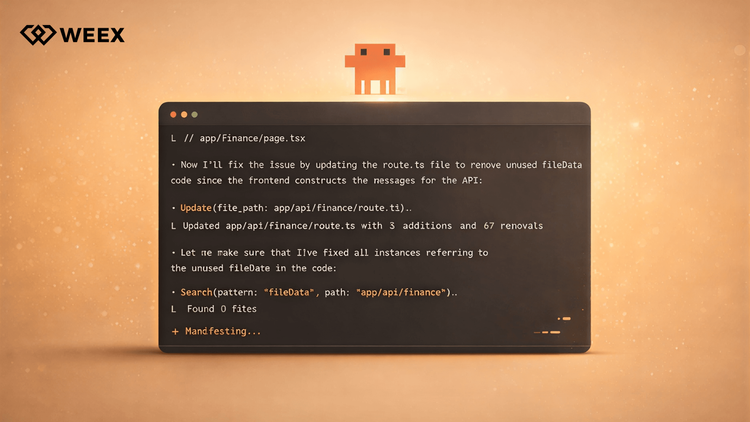
What Is Vibe Coding? How AI Is Changing Web3 & Crypto Development
What is vibe coding? Learn how AI coding tools are lowering the barrier to Web3 development and enabling anyone to build crypto applications.
The parent company of the New York Stock Exchange strategically invests in OKX: The intentions behind the $25 billion valuation

WEEX P2P update: Country/region restrictions for ad posting
To improve ad security and matching accuracy, WEEX P2P now allows advertisers to restrict who can trade with their ads based on country or region. Advertisers can select preferred counterparty locations for a safer, smoother trading experience.
I. Overview
When publishing P2P ads, advertisers can now set the following:
Allow only counterparties from selected countries or regions to trade with your ads.
With this feature, you can:
Target specific user groups more precisely.Reduce cross-region trading risks.Improve order matching quality.
II. Applicable scenarios
The following are some common scenarios:
Restrict payment methods: Limit orders to users in your country using supported local banks or wallets.Risk control: Avoid trading with users from high-risk regions.Operational strategy: Tailor ads to specific markets.
III. How to get started
On the ad posting page, find "Trading requirements":
Select "Trade with users from selected countries or regions only".Then select the countries or regions to add to the allowlist.Use the search box to quickly find a country or region.Once your settings are complete, submit the ad to apply the restrictions.
When an advertiser enables the "Country/Region Restriction" feature, users who do not meet the criteria will be blocked when placing an order and will see the following prompt:
If you encounter this issue when placing an order as a regular user, try the following solutions.
Choose another ad: Select ads that do not restrict your country/region, or ads that allow users from your location.Show local ads only: Prioritize ads available in the same country as your identity verification.
IV. Benefits
Compared with ads without country/region restrictions, this feature provides the following improvements.
Aspect
Improvement
Trading security
Reduces abnormal orders and fraud risk
Conversion efficiency
Matches ads with more relevant users
Order completion rate
Reduces failures caused by incompatible payment methods
V. FAQ
Q1: Why are some users not able to place orders on my ad?
A1: Their country or region may not be included in your allowlist.
Q2: Can I select multiple countries or regions when setting the restriction?
A2: Yes, multiple selections are supported.
Q3: Can I edit my published ads?
A3: Yes. You can edit your ad in the "My Ads" list. Changes will take effect immediately after saving.


 App
App