
- Buy Crypto
- Markets
 Futures
- Spot
- Copy Trade
- Earn
- More
Next year's biggest IPO, how will SpaceX, valued at $1.5 trillion, participate?

On-chain stock trading has rapidly evolved in the US market. Apart from stocks that are already listed and can be directly traded on the secondary market, many high-quality companies now receive significant funding through private placements without the need for an IPO, such as OpenAI and SpaceX.
For these private placement equity holdings, retail investors often find it difficult to participate. Investment opportunities usually only arise after an IPO, with a few institutional investors monopolizing pre-IPO investment opportunities. Although in the traditional finance field, platforms like Ustockplus under Korea's Dunamu, as well as Forge and EquityZen in the US, allow retail investors to purchase private placement equity within existing regulatory frameworks, these traditional financial platforms operate on a peer-to-peer matching basis. If no one is willing to sell, buyers still have limited access, leading to poor liquidity due to unpredictable transaction volumes.
So, would the situation improve with pre-IPO private equity + blockchain? Currently, there are three platforms on-chain—Ventuals, PreStocks, and Jarsy—that provide pre-IPO private equity trading. Let's take a look at their respective characteristics.
Ventuals
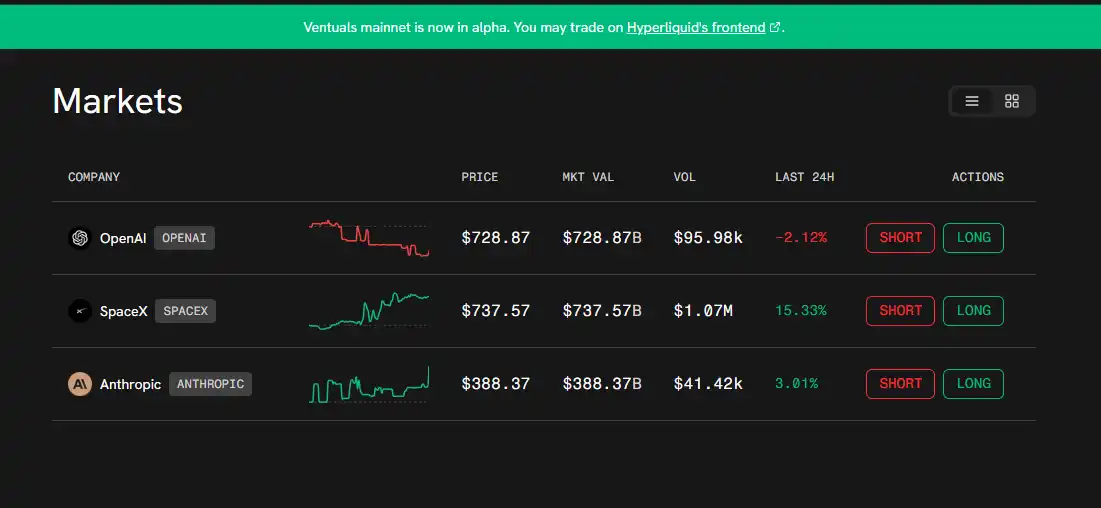
Ventuals is an IPO pre-equity perpetual contract platform built on HIP-3. On Ventuals, traders do not trade based on stock prices but on their expectations of the company's total valuation fluctuations. Holding a position on a pre-IPO company on Ventuals does not imply actual ownership of the company—only speculation on its valuation changes.
As it is not tied to actual equity, Ventuals is essentially a platform for speculating on company valuations. The advantage of this model is that Ventuals can quickly list a large number of pre-IPO company targets and respond to market trends. Moreover, having no underlying assets to a certain extent can help avoid traditional regulations.
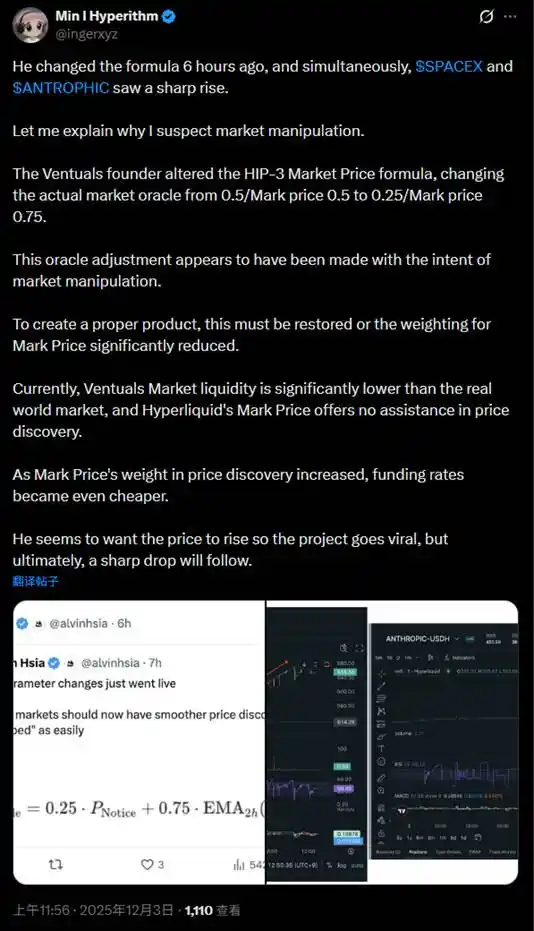
However, Ventuals' drawback is that price manipulation is easily facilitated due to reliance on oracle feeds. Private company valuation data is inherently opaque, with low update frequencies. Additionally, Ventuals recently reduced the weight of external oracle feeds to 0.25 and increased the marking price weight to 0.75, raising concerns among some players about potential market manipulation.
PreStocks
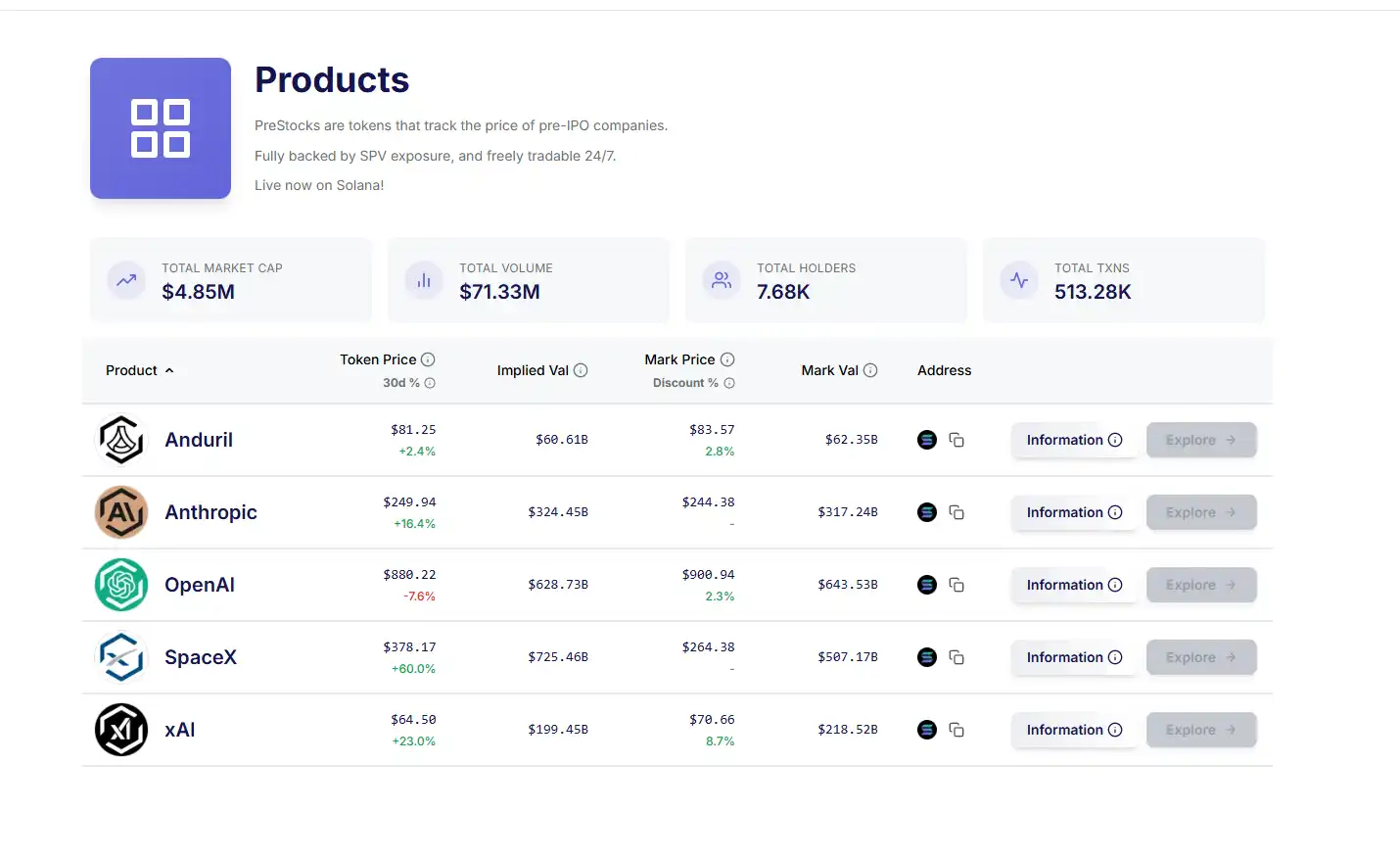
PreStocks is built on the Solana network. Unlike Ventuals, PreStocks truly tokenizes pre-IPO equity held directly or indirectly by entities investing in the underlying company. The team mentioned on their website that they will regularly release third-party verification reports to ensure that the token supply corresponds to the actual equity held and will also publish them upon active requests that can cover audit fees.
Due to the involvement of actual equity, users from countries such as China, the United States, Canada, etc., cannot practically use the platform's minting and redemption services. While it is still possible to buy and sell these equity tokens on-chain without KYC, if one wants to buy and wait for listing before redeeming these tokens for USDC, KYC is required. Additionally, despite having actual equity backing, holding equity tokens does not imply ownership, voting rights, dividend rights, or similar privileges.
PreStocks' main advantage lies in its good integration with the DeFi ecosystem, allowing direct trading in wallets such as Jupiter, OKX, and participation in low-cost lending or leverage trading within some dApps in the Solana ecosystem.
Jarsy
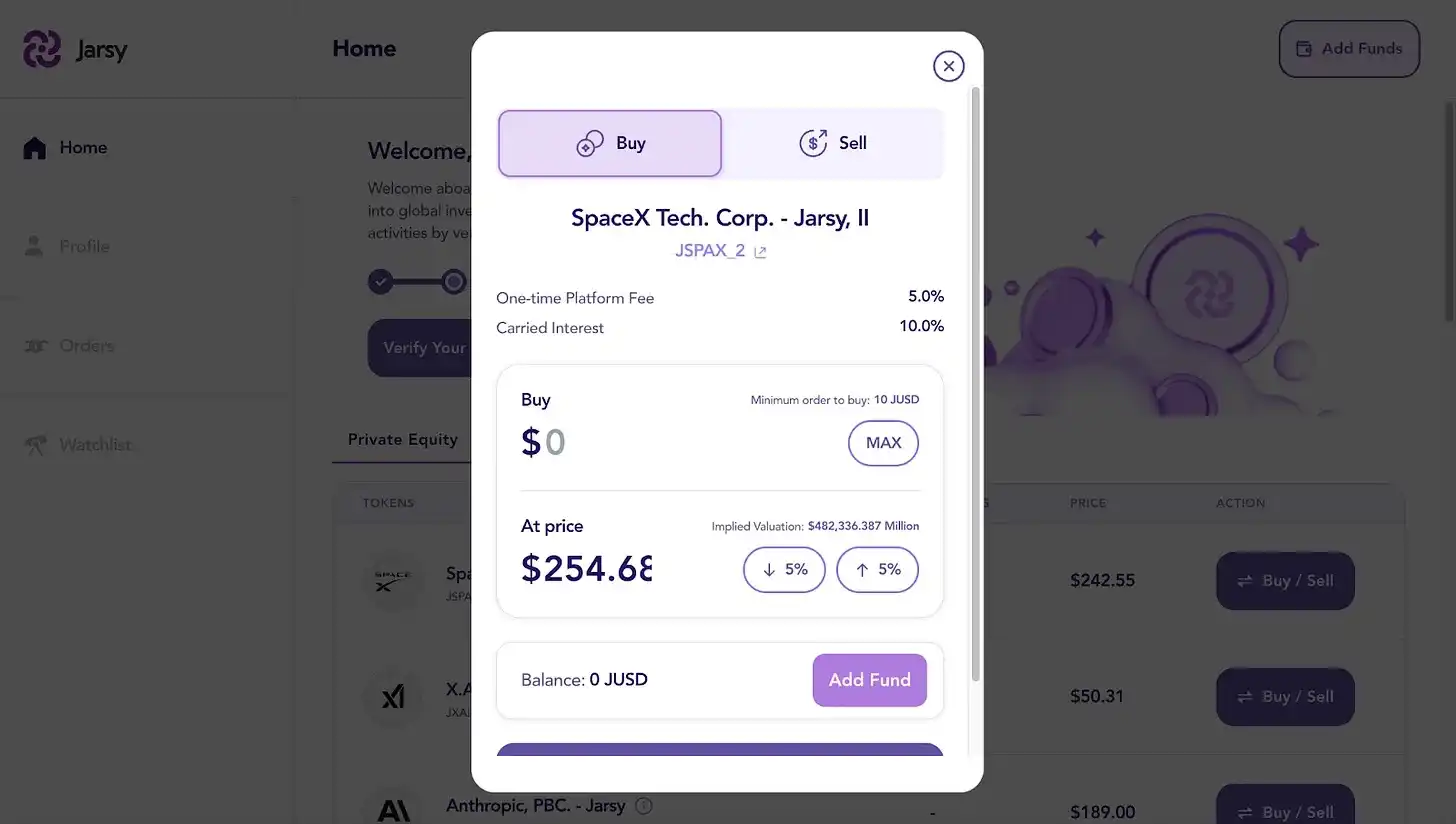
Similar to PreStocks, Jarsy also has actual equity support. However, compared to PreStocks, Jarsy is more like a blockchain-technology-based pre-IPO equity investment platform rather than a trading platform. This is because equity tokens on Jarsy are non-transferable and cannot be used in DeFi; they have their own built-in trading system and trading can only occur on the platform.
Nevertheless, Jarsy currently provides better transparency and disclosure compared to PreStocks.
Jarsy and PreStocks share some similarities and differences. Firstly, the minimum investment amounts for both platforms are very low, with Jarsy at $10 and PreStocks having none, which is beneficial for users worldwide as it lowers the barrier to entry for pre-IPO equity investments. However, a downside is that the amount of equity they can hold is relatively low; for example, xAI's equity token TVL on Jarsy is only about $1.1 million, whereas SpaceX's is approximately $1.7 million. The limited scale of actual pre-IPO equity holdings can directly lead to liquidity issues, where even seemingly small orders can cause significant price fluctuations.
Conclusion
Looking at the three companies above, liquidity remains a challenging issue for pre-IPO equity tokenization, making it difficult for large on-chain funds to enter this space.
However, the benefits are also obvious. Retail investors previously had almost no way to invest in companies like SpaceX and OpenAI before their IPOs. Now, through blockchain technology, a door that has always been closed is opened.
In fact, Echo, the on-chain funding platform created by Cobie and acquired by Coinbase for $375 million, is doing something similar. They have previously conducted a $10 million 1X Technologies Series C round of financing in a private group, although they did not tokenize equity.
It's all still early days.
You may also like

Ray Dalio Dialogue: Why I'm Betting on Gold and Not Bitcoin

Who Took the Money in the AI Era? A Must-See Investment Checklist for HALO Asset Trading
Wall Street Bears Target Ethereum: Vitalik In the Know Takes Flight, Tom Lee Remains Bullish

Pump.fun Hacker Steals $2 Million, Receives 6-Year Prison Sentence, Opts for 'Self-Detonation'

6% Annual Percentage Yield as Musk Declares War on Traditional Banks

36 years, 4 wars, 1 script: How does capital price the world in conflict?

Mining Companies' Great Migration: Some Have Already Secured $12.8 Billion in AI Orders
What Is Vibe Coding? How AI Is Changing Web3 & Crypto Development
What is vibe coding? Learn how AI coding tools are lowering the barrier to Web3 development and enabling anyone to build crypto applications.
The parent company of the New York Stock Exchange strategically invests in OKX: The intentions behind the $25 billion valuation

WEEX P2P update: Country/region restrictions for ad posting
To improve ad security and matching accuracy, WEEX P2P now allows advertisers to restrict who can trade with their ads based on country or region. Advertisers can select preferred counterparty locations for a safer, smoother trading experience.
I. Overview
When publishing P2P ads, advertisers can now set the following:
Allow only counterparties from selected countries or regions to trade with your ads.
With this feature, you can:
Target specific user groups more precisely.Reduce cross-region trading risks.Improve order matching quality.
II. Applicable scenarios
The following are some common scenarios:
Restrict payment methods: Limit orders to users in your country using supported local banks or wallets.Risk control: Avoid trading with users from high-risk regions.Operational strategy: Tailor ads to specific markets.
III. How to get started
On the ad posting page, find "Trading requirements":
Select "Trade with users from selected countries or regions only".Then select the countries or regions to add to the allowlist.Use the search box to quickly find a country or region.Once your settings are complete, submit the ad to apply the restrictions.
When an advertiser enables the "Country/Region Restriction" feature, users who do not meet the criteria will be blocked when placing an order and will see the following prompt:
If you encounter this issue when placing an order as a regular user, try the following solutions.
Choose another ad: Select ads that do not restrict your country/region, or ads that allow users from your location.Show local ads only: Prioritize ads available in the same country as your identity verification.
IV. Benefits
Compared with ads without country/region restrictions, this feature provides the following improvements.
Aspect
Improvement
Trading security
Reduces abnormal orders and fraud risk
Conversion efficiency
Matches ads with more relevant users
Order completion rate
Reduces failures caused by incompatible payment methods
V. FAQ
Q1: Why are some users not able to place orders on my ad?
A1: Their country or region may not be included in your allowlist.
Q2: Can I select multiple countries or regions when setting the restriction?
A2: Yes, multiple selections are supported.
Q3: Can I edit my published ads?
A3: Yes. You can edit your ad in the "My Ads" list. Changes will take effect immediately after saving.

What are the key highlights of this year's Ethereum's most important upgrade, the Glamsterdam upgrade?

March 6 Key Market Update You Can't Miss! | Alpha Morning Report

Sell Nvidia, Buy Power Plant: 27-Year-Old AI Investor Earns $5 Billion in One Year
The $24 Million Heist Behind It: The Most Dangerous Vulnerability in the Crypto World is Actually Human

Justin Sun Lawsuit Dismissed, BlackRock Bullish on Tokenization, What Is the English-Speaking Community Paying Attention To?

Morning News | NYSE parent company invests in OKX; Morgan Stanley provides $500 million loan to Core Scientific; Western Union partners with Crossmint to launch stablecoin USDPT

These former crypto builders have transitioned to the hottest AI projects globally



 App
App