
- Buy Crypto
- Markets
 Futures
- Spot
- Copy Trade
- Earn
- More
Stable is having its TGE tonight, will the market still buy into the stablecoin public blockchain narrative?

Original Article Title: "Stable Tonight TGE, Does the Stablecoin Public Chain Narrative Market Still Buy It?"
Original Article Author: 1912212.eth, Foresight News
At 21:00 on December 8th Beijing time, the Stable mainnet will be officially launched. Stable, as a Layer 1 blockchain supported by Bitfinex and Tether, focuses on stablecoin infrastructure. Its core design aims to use USDT as the native gas fee to achieve sub-second settlement and gas-free peer-to-peer transfers. As of the time of writing, exchanges including Bitget, Backpack, and Bybit have announced the listing of STABLE spot trading. In addition, Binance, Coinbase, and Korean exchanges have not yet announced the listing of STABLE spot trading.
Total Supply of 1 Trillion, Tokens Not Used as Gas Fees
Prior to the mainnet launch, the project team has released the whitepaper and tokenomics details. The native token of the project, STABLE, has a total supply of 1 trillion tokens, with the total amount fixed. Stable network transfers, payments, and transactions are settled in USDT, and STABLE is not used as a gas fee but is used for coordinating incentive mechanisms between developers and ecosystem participants. The STABLE token distribution is as follows: Genesis Distribution accounts for 10% of the total supply, supporting initial liquidity, community activation, ecosystem activities, and strategic distribution work; the Genesis Distribution portion will be fully unlocked at the launch of the mainnet.
40% of the total supply is allocated to the ecosystem and community, distributed to developer grants, liquidity programs, partnerships, community initiatives, and ecosystem development; 25% is allocated to the team, including the founding team, engineers, researchers, and contributors; and 25% is allocated to investors and advisors, supporting strategic investors and advisors for network development, infrastructure construction, and promotion.
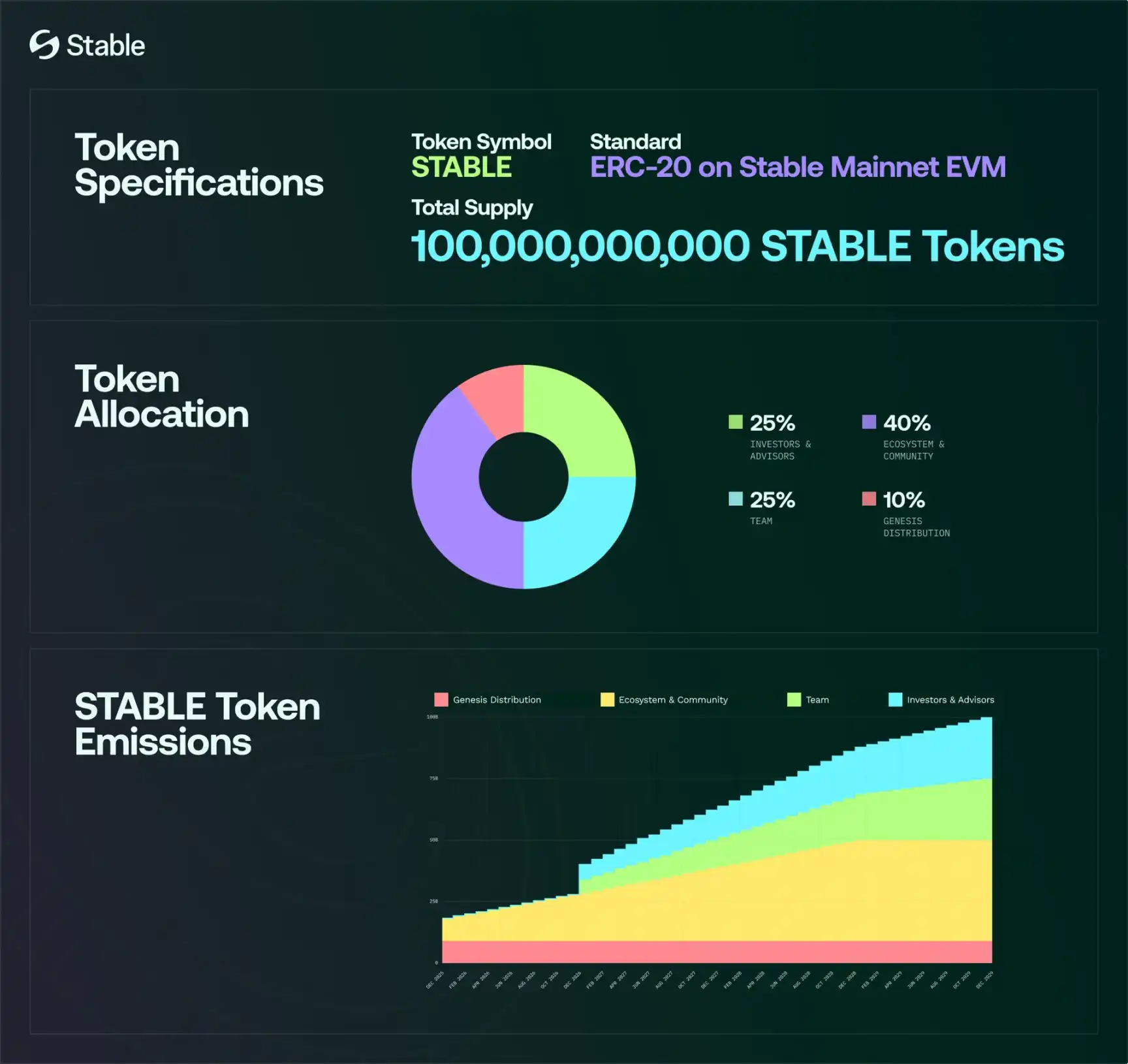
Both the team and investor shares have a one-year cliff period, with zero unlock in the first 12 months, followed by linear release. The ecosystem and community fund share unlocks 8% at launch, with the remaining portion gradually released through linear vesting to incentivize developers, partners, and user growth.
Stable adopts the StableBFT consensus protocol and utilizes a DPoS (Delegated Proof of Stake) model. This design maintains the economic security properties required for a global payment network while supporting high-throughput settlement. Staking the STABLE token is the mechanism for validators and delegators to participate in consensus and earn rewards. The STABLE token's main roles are governance and staking: holders can stake their tokens to become validators, participate in network security maintenance, and influence protocol upgrades through DAO voting, such as adjusting fee rates or introducing support for new stablecoins.
In addition, STABLE can be used for ecosystem incentives, such as liquidity mining or cross-chain bridging rewards. The project team claims that this separation design can attract institutional funds because USDT's stability is much higher than that of volatile governance tokens.
Pre-Deposit Controversy: Insider Trading, KYC Bottleneck
Similar to Plasma, Stable also opened deposits twice before the mainnet launch. The first-phase pre-deposit started at the end of October with a cap of $825 million but was filled within minutes after the announcement. The community questioned some players' insider trading. The top-ranked wallet deposited hundreds of millions of USDT 23 minutes before open deposits.
The project team did not directly respond and opened the second phase of pre-deposit activities on November 6 with a cap of $500 million.
However, Stable underestimated the market's enthusiasm for deposits. At the moment the second phase opened, a massive influx of traffic caused the website to slow down and bottleneck. As a result, after updating the rules, Stable allowed users to deposit through the Hourglass frontend or directly on-chain; the deposit feature reopened for 24 hours, with each wallet able to deposit up to $1 million, with the minimum deposit amount remaining at $1,000.
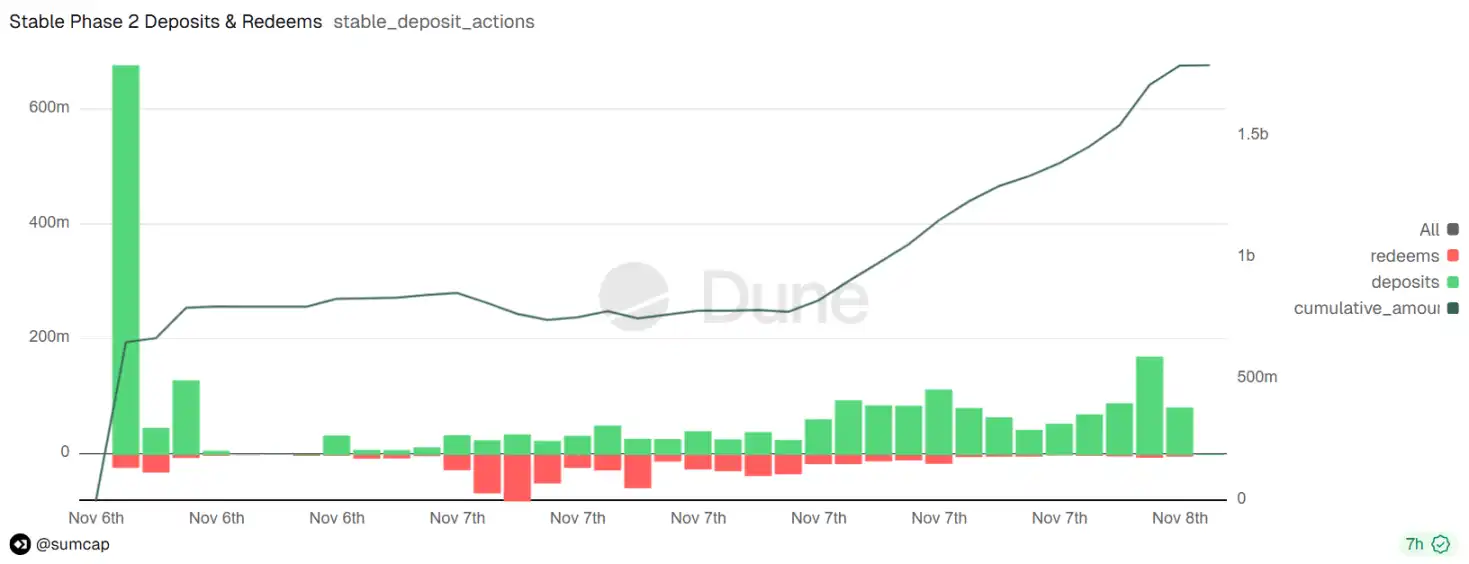
Ultimately, the total deposits in the second phase were approximately $1.8 billion, with around 26,000 participating wallets.
The audit time varied from a few days to a week, with some community users complaining about system bottlenecks or repeated requests for additional documentation.
$20 Billion FDV Probability Over 85%
At the end of July this year, Stable announced the completion of a $28 million seed round of financing, led by Bitfinex and Hack VC, bringing its market valuation to around $3 billion.
By comparison, Plasma's market value is now $3.3 billion, with an FDV of $16.75 billion.
Some optimistic observers believe that the stablecoin narrative, Bitfinex's endorsement, and Plasma's rise and fall may indicate that there will still be some heat and upward price momentum in the near future. However, pessimistic voices are stronger: Gas fees not payable with STABLE, limited utility, especially as the market has entered a bear market cycle where liquidity has become tight, its price may drop rapidly.
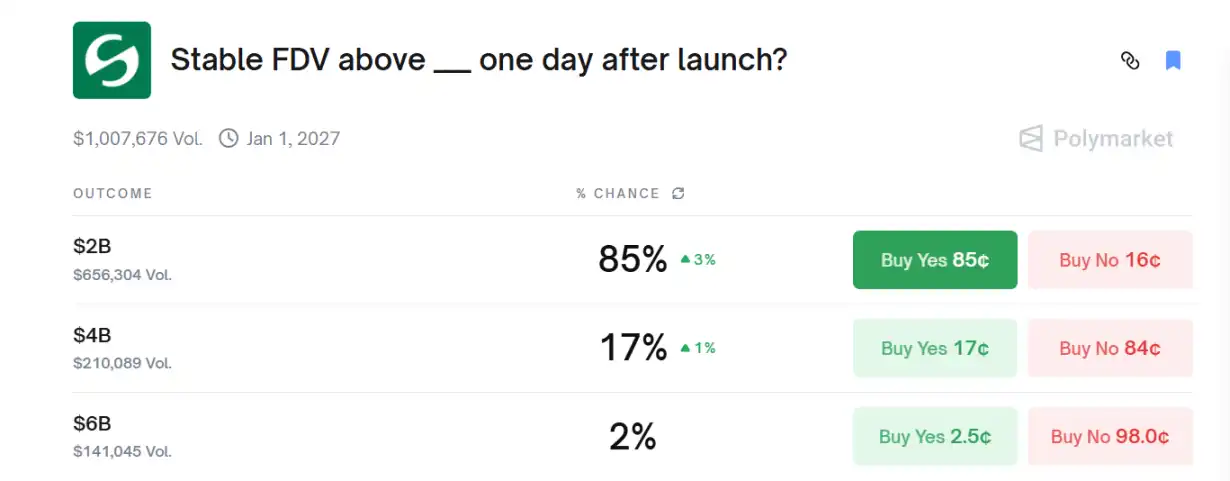
Currently, Polymarket data shows that the probability of FDV exceeding $20 billion after its listing day is 85%. Based on a conservative $20 billion calculation, the STABLE price would correspond to $0.02.
In terms of perpetual contract market, according to Bitget data, the STABLE/USDT is currently priced at $0.032, with its estimated FDV expected to rise to around $3 billion.
The first phase of Stable's pre-deposit reached $825 million, with the actual contribution of the second phase exceeding $1.1 billion, but after proportional distribution, the actual amount entered the pool was $500 million. The total pre-deposit scale is $1.325 billion. The tokenomics disclosed an initial allocation of 10% (used for pre-deposit activity incentives, exchange platform activities, initial on-chain liquidity, etc.). Assuming Stable eventually airdrops a share of 3% to 7% to pre-deposits, calculated based on the pre-market price of $0.032, the corresponding return is approximately 7% to 16.9%. This means that for every $10,000 deposit, the corresponding earnings are $700 to $1,690.
You may also like

Social Capital CEO: How Equity Tokenization is Reshaping Capital Markets from US Stocks to SpaceX?

CoinGecko Report: Surge of 346% vs Dip of 20.8%, The Wild Rise of DEX

a16z: The Real Opportunity of Stablecoins Lies Not in Disruption but in Filling Gaps

Mining Exodus: Someone Holds $12.8 Billion AI Order

March 6 Market Key Intelligence, How Much Did You Miss?

a16z: The True Opportunity of Stablecoins is in Complementing, Not Disrupting

Predict LALIGA Matches, Shoot Daily & Win BTC, USDT and WXT on WEEX
The WEEX × LALIGA campaign brought together football excitement and crypto participation through a dynamic interactive experience. During the event, users predicted matches, completed trading tasks, and took daily shots to compete for rewards including BTC, USDT, WXT, and exclusive prizes.

Ray Dalio Dialogue: Why I'm Betting on Gold and Not Bitcoin

Who Took the Money in the AI Era? A Must-See Investment Checklist for HALO Asset Trading
Wall Street Bears Target Ethereum: Vitalik In the Know Takes Flight, Tom Lee Remains Bullish
Pump.fun Hacker Steals $2 Million, Receives 6-Year Prison Sentence, Opts for 'Self-Detonation'

6% Annual Percentage Yield as Musk Declares War on Traditional Banks
36 years, 4 wars, 1 script: How does capital price the world in conflict?

Mining Companies' Great Migration: Some Have Already Secured $12.8 Billion in AI Orders
What Is Vibe Coding? How AI Is Changing Web3 & Crypto Development
What is vibe coding? Learn how AI coding tools are lowering the barrier to Web3 development and enabling anyone to build crypto applications.
The parent company of the New York Stock Exchange strategically invests in OKX: The intentions behind the $25 billion valuation
WEEX P2P update: Country/region restrictions for ad posting
To improve ad security and matching accuracy, WEEX P2P now allows advertisers to restrict who can trade with their ads based on country or region. Advertisers can select preferred counterparty locations for a safer, smoother trading experience.
I. Overview
When publishing P2P ads, advertisers can now set the following:
Allow only counterparties from selected countries or regions to trade with your ads.
With this feature, you can:
Target specific user groups more precisely.Reduce cross-region trading risks.Improve order matching quality.
II. Applicable scenarios
The following are some common scenarios:
Restrict payment methods: Limit orders to users in your country using supported local banks or wallets.Risk control: Avoid trading with users from high-risk regions.Operational strategy: Tailor ads to specific markets.
III. How to get started
On the ad posting page, find "Trading requirements":
Select "Trade with users from selected countries or regions only".Then select the countries or regions to add to the allowlist.Use the search box to quickly find a country or region.Once your settings are complete, submit the ad to apply the restrictions.
When an advertiser enables the "Country/Region Restriction" feature, users who do not meet the criteria will be blocked when placing an order and will see the following prompt:
If you encounter this issue when placing an order as a regular user, try the following solutions.
Choose another ad: Select ads that do not restrict your country/region, or ads that allow users from your location.Show local ads only: Prioritize ads available in the same country as your identity verification.
IV. Benefits
Compared with ads without country/region restrictions, this feature provides the following improvements.
Aspect
Improvement
Trading security
Reduces abnormal orders and fraud risk
Conversion efficiency
Matches ads with more relevant users
Order completion rate
Reduces failures caused by incompatible payment methods
V. FAQ
Q1: Why are some users not able to place orders on my ad?
A1: Their country or region may not be included in your allowlist.
Q2: Can I select multiple countries or regions when setting the restriction?
A2: Yes, multiple selections are supported.
Q3: Can I edit my published ads?
A3: Yes. You can edit your ad in the "My Ads" list. Changes will take effect immediately after saving.



 App
App