
- Buy Crypto
- Markets
 Futures
- Spot
- Copy Trade
- Earn
- More
South Korean Crypto KOLs Drive 1,200% $USELESS Rally: How a "Worthless" Token Hit $96M Market Cap

In the ever-evolving cryptocurrency landscape, South Korea's influential role in the altcoin market continues to make waves. The latest example is the remarkable rise of $USELESS, a memecoin experiencing a 12.15% daily surge that's pushed its market cap to nearly $100 million—despite or perhaps because of its transparently ironic name.
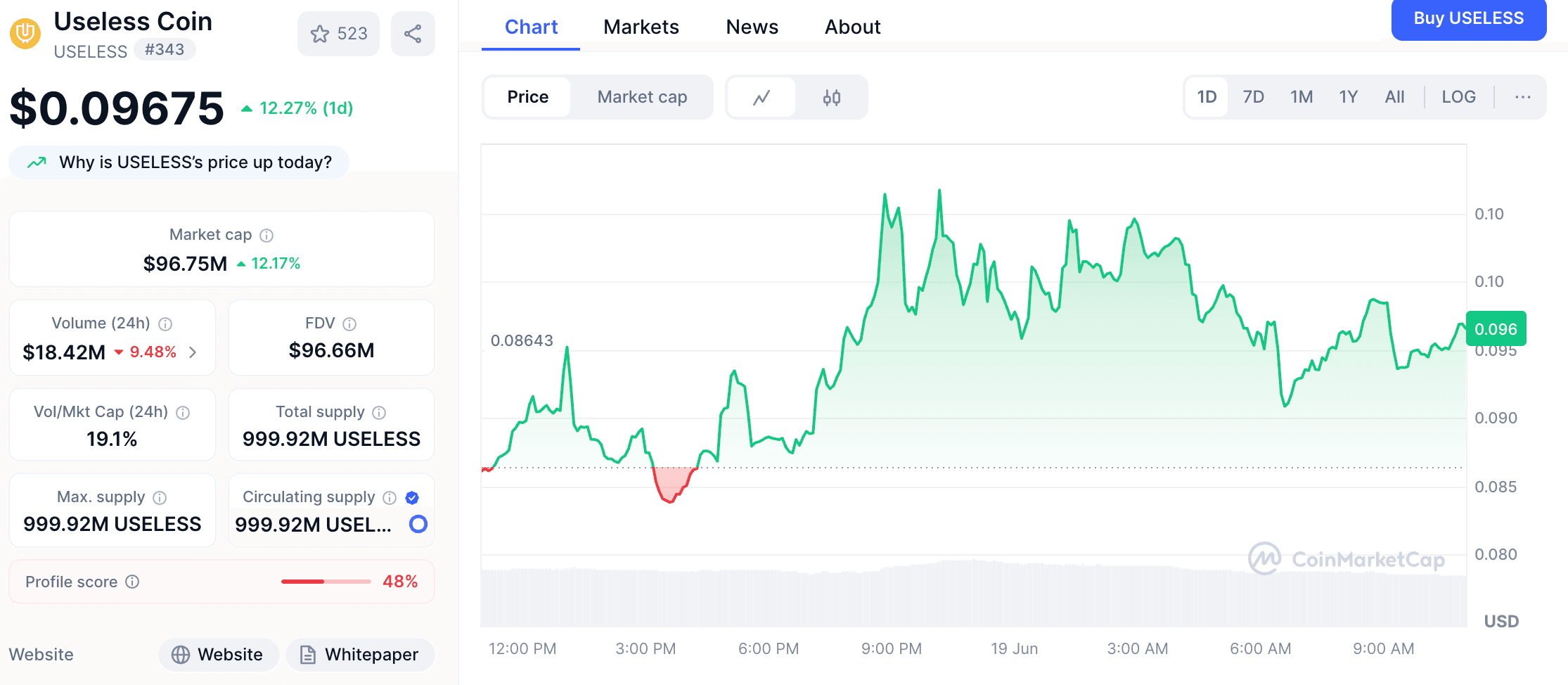
South Korean Influence Drives $USELESS Momentum
South Korea has long been known for its outsized impact on cryptocurrency markets, from last year's XRP frenzy that saw 400% price increases to the current fascination with a token that literally brands itself as worthless.
According to Bradley Park, a Seoul-based analyst at DNTV Research who spoke with CoinDesk, the $USELESS phenomenon is closely tied to Korean cryptocurrency key opinion leaders (KOLs).
At the center of this movement is Yeomyung, a prominent Korean KOL and liquidity provider. After investing early in $USELESS and holding through a 50% drawdown, he now boasts significant paper gains and has become the token's largest holder with a 2.8% stake.
"I now hold 2.8% of $USELESS, officially surpassing @theunipcs to become the largest holder. Yet I still won't sell. The era of BONK and USELESS is coming. $pump has always been 'useless'," Yeomyung (@duaud9912) posted on Twitter.
Park explained to CoinDesk: "He made enormous profits during the Trump coin hype, and with $USELESS, he's profiting from providing early liquidity and now just holding and waiting. They're all waiting for centralized exchange listings, because without that, there's no real exit."
This steadfast conviction has inspired copycat trading behavior among retail investors throughout South Korea. Even wallets associated with insiders from Solana's Jupiter platform (JUP) appear to be holding $USELESS.
From "Exit Liquidity" to Market Makers
The $USELESS phenomenon reflects a broader evolution in Korean market behavior.
"I truly believe Korean users are no longer just 'exit liquidity' in this market," Park noted. "They're starting to understand the market and gradually growing into genuine global players."
Another key figure in the $USELESS story is "Bonk Guy," an early promoter of BONK who resurfaced to enthusiastically promote $USELESS on Twitter as prices rebounded. However, some Korean traders, including Park, question his sincerity.
"Bonk Guy was the first to promote LetsBONK," Park said. "But after the price crashed, he went quiet. Now that $USELESS is rebounding, he's suddenly showing interest again."
The rise of Hyperliquid, Kaia, and now Solana-based memecoins like $USELESS indicates that South Korea has evolved beyond being a secondary market.
The Nihilistic Appeal of $USELESS
Unlike XRP's rise, which depended on U.S. regulatory clarity and narratives about deregulation under Trump, the $USELESS boom reflects the market's current attention span and exhaustion.
With no roadmap, no practical utility, and no pretense of building toward a greater vision, $USELESS represents a meme-ified disillusionment—a collective dismissal of traditional cryptocurrency promises and an ironic bet on "nothingness." Paradoxically, this bet seems more honest than many tokens claiming to change the world.
Trump Backs GENIUS Act
In related news, President Trump voiced support for the GENIUS Act on Tuesday via Truth Social. Having already passed the Senate with bipartisan support, Trump called the bill a crucial step in advancing American leadership in digital assets.
Trump urged the House to pass the legislation "at lightning speed" without modifications, demanding the bill reach his desk "with no delays, no attachments."
This stance demonstrates strong executive support for the "Guiding and Establishing National Innovation for U.S. Stablecoins Act," which introduces reserve and compliance requirements for USD-backed stablecoin issuers and represents the first major cryptocurrency legislation to pass the Senate.
Coinbase Launches Merchant Payment Platform
Coinbase (COIN) released Coinbase Payments on Wednesday—a new merchant payment solution built on its Ethereum Layer-2 network, Base.
According to CoinDesk, the platform is designed for global e-commerce platforms like Shopify, enabling 24/7 USDC stablecoin payments without merchants needing blockchain expertise. Features include gas-free stablecoin checkout, an e-commerce API engine, and an on-chain payment protocol.
Coinbase states the system aims to replicate traditional payment rails while reducing costs and offering around-the-clock settlement. This move positions Coinbase to compete with fintech companies like Stripe and PayPal in modernizing payments with blockchain infrastructure.
The release also deepens Coinbase's partnership with USDC issuer Circle (CRCL). Following the announcement, Circle's stock rose 25%, while Coinbase shares increased by 16%. Coinbase noted that stablecoins processed $30 trillion in transactions last year—triple the previous year—and is betting that programmable, dollar-pegged payments will continue disrupting the global financial system.
Market Dynamics
Despite escalating tensions between Israel and Iran, Bitcoin showed resilience with a V-shaped recovery, climbing back above $105,000. Strong ETF inflows and key support at $103,650 highlight institutional confidence amid market volatility.
Ethereum rose 4%, holding steady above $2,500. Record staking volumes and continued fund accumulation demonstrate strengthening investor confidence despite geopolitical tensions.
As traditional markets show mixed results, with gold slightly down and indexes responding cautiously to Fed policy statements, the cryptocurrency market—particularly in South Korea—continues to forge its own path with phenomena like $USELESS capturing both attention and capital.
You may also like

AI Starts to Devour the Manufacturing Industry | Rewire News Morning Edition

When Scaling Meets Speed, Ethereum Foundation Introduces "Hardness" to Safeguard the Base Layer

Google, Circle, Stripe Flock Together to Let AI Spend Money: Payment Giants' Joys and Worries in 2026 Q1

$100 Billion Factory Purchase: Bezos and Middle Eastern Capital Shift AI Money from Cloud to Shop Floor

Xiaomi and MiniMax both unleash their ultimate moves, signaling the start of the Agent Pricing War.

Predicting markets has taken the spotlight, but the Perp DEX has been quietly waging war on traditional exchanges.

Is the Market Slump Still Making Millions a Day? Is pump.fun's Revenue Real?

Understanding x402 and MPP in One Article: The Two Paths of Agent Payments

Quick Look at the Latest 18 Graduation Projects from Alliance: Who's the Next Pump.fun?

It's not just the prediction market that profits from the Iraq War

The "bank card" of AI has caught the attention of the giants
Morning News | U.S. SEC approves tokenized trading on Nasdaq; Animoca Brands announces investment in AVAX tokens; Algorand Foundation completes strategic integration

$70 trillion wealth transfer, the financial gateway is being rewritten | Interview with Robinhood CEO Vlad Tenev
Whale Opens 20x Oil Short on Hyperliquid With 5.6M USDC at Risk
Key Takeaways A significant leveraged short position on crude oil has been initiated on Hyperliquid using 5.6 million…

Bitcoin: The Ultimate Hedge Against Chaos
Key Takeaways Michael Saylor, co-founder of Strategy, firmly believes Bitcoin is the ultimate hedge against macroeconomic chaos. Strategy…
“Set 10 Major Targets First,” Whale Reopens Long Positions in Bitcoin
Key Takeaways A prominent cryptocurrency whale known as @Jason60704294 has reopened a long position in Bitcoin. The whale…

Analysis: Despite Bitcoin’s Price Dip, Bullish Trends Persist
Key Takeaways Despite Bitcoin’s decline below $71,000, its bullish momentum remains strong, with significant buying activity from ETFs…
DeFi Protocol Neutrl Faces Potential Security Breach
Key Takeaways The DeFi protocol Neutrl has reported a suspected attack on its front-end interface, urging users to…


 App
App