Xiaomi and MiniMax both unleash their ultimate moves, signaling the start of the Agent Pricing War.

 Prefer us on Google

On March 18 and 19, two Chinese companies successively released their respective Agent-oriented large models. The domestic AI startup MiniMax launched M2.7, and Xiaomi's large model team MiMo introduced V2-Pro. Both models entered the global top tier in the Agent benchmark, but their API output pricing is 1/21 and 1/8 of Claude Opus 4.6, respectively.
Both companies played their cards in the same week, but with completely different hands. They represent two completely different technical paths, betting on two futures of the Agent era.
Same Exam, 1/17 Tuition Fee
First, let's look at the most intuitive comparison.
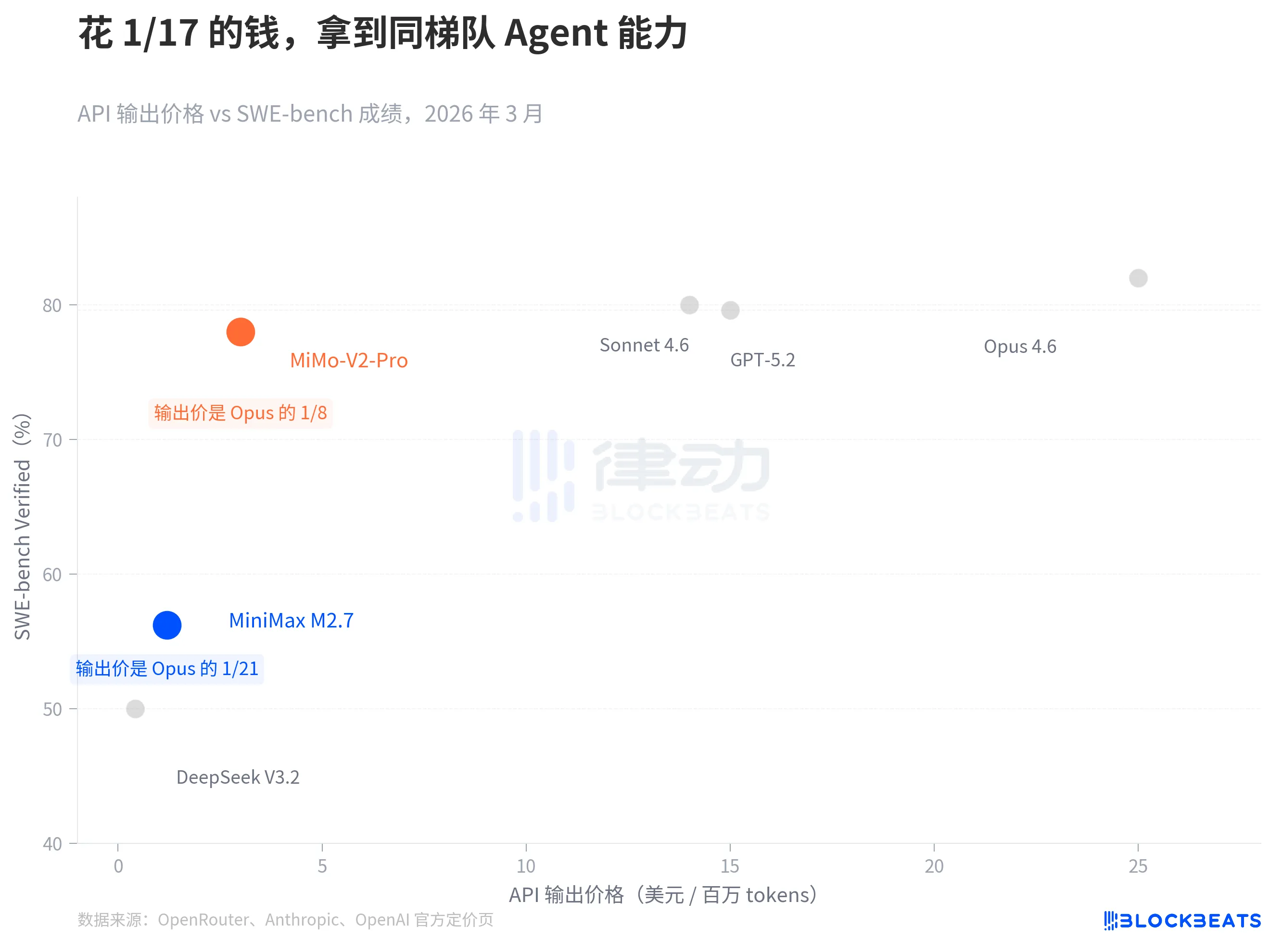
According to OpenRouter and various company official pricing pages, based on API output price (per million tokens), MiniMax M2.7 is $1.2, and MiMo-V2-Pro is $3. As a reference, the output price for Claude Opus 4.6 is $25, GPT-5.2 is $14, and Claude Sonnet 4.6 is $15.
The price difference is an order of magnitude, but the performance difference is not. In SWE-bench Verified (the current mainstream benchmark for measuring code engineering capability), MiMo-V2-Pro scored 78%, Sonnet 4.6 was 79.6%, a difference of less than two percentage points. M2.7's SWE-Pro score is 56.22%, on par with GPT-5.3-Codex. In VIBE-Pro (end-to-end project delivery capability), M2.7 scored 55.6%, approaching the level of Opus 4.6.
The focus of this chart is not on who is higher or lower—the benchmark systems of various companies are not entirely aligned, so direct comparisons should be cautious. The focus is on the "price-performance scissor difference": domestic Agent models have squeezed into the same performance band, but are in completely different price ranges.
Trillion Parameters vs. Self-evolution
Price is just the surface. The two companies have presented two completely different sets of trump cards.
MiMo-V2-Pro follows the "go big or go home" route. According to Xiaomi's official announcement, V2-Pro has over 1 trillion total parameters, 42B activation parameters, and supports an ultra-long context of 1 million tokens. Its core innovation is the Hybrid Attention mixed attention mechanism, adjusting the ratio of Sliding Window Attention (SWA) to Global Attention (GA) to 7:1—its predecessor V2-Flash was 5:1. This architecture makes the model more stable in scenarios where long documents are processed and multiple tool parallel calls in the Agent scene. In PinchBench (Agent tool invocation capability assessment), MiMo-V2-Pro scored 84%.
M2.7 took a completely different path. According to MiniMax's official tech blog post on March 18, M2.7's parameter count was not disclosed, but it demonstrated a "self-iterative evolution" mechanism: the model autonomously ran over 100 optimization loops, including analyzing failure trajectories, planning modifications, modifying its own code architecture, running evaluations, and looping again, ultimately achieving a 30% performance improvement on an internal evaluation set. In the MLE Bench Lite (Machine Learning Contest Difficulty Assessment), out of 22 challenging problems, M2.7 secured 9 gold, 5 silver, and 1 bronze, with an average medal rate of 66.6%.
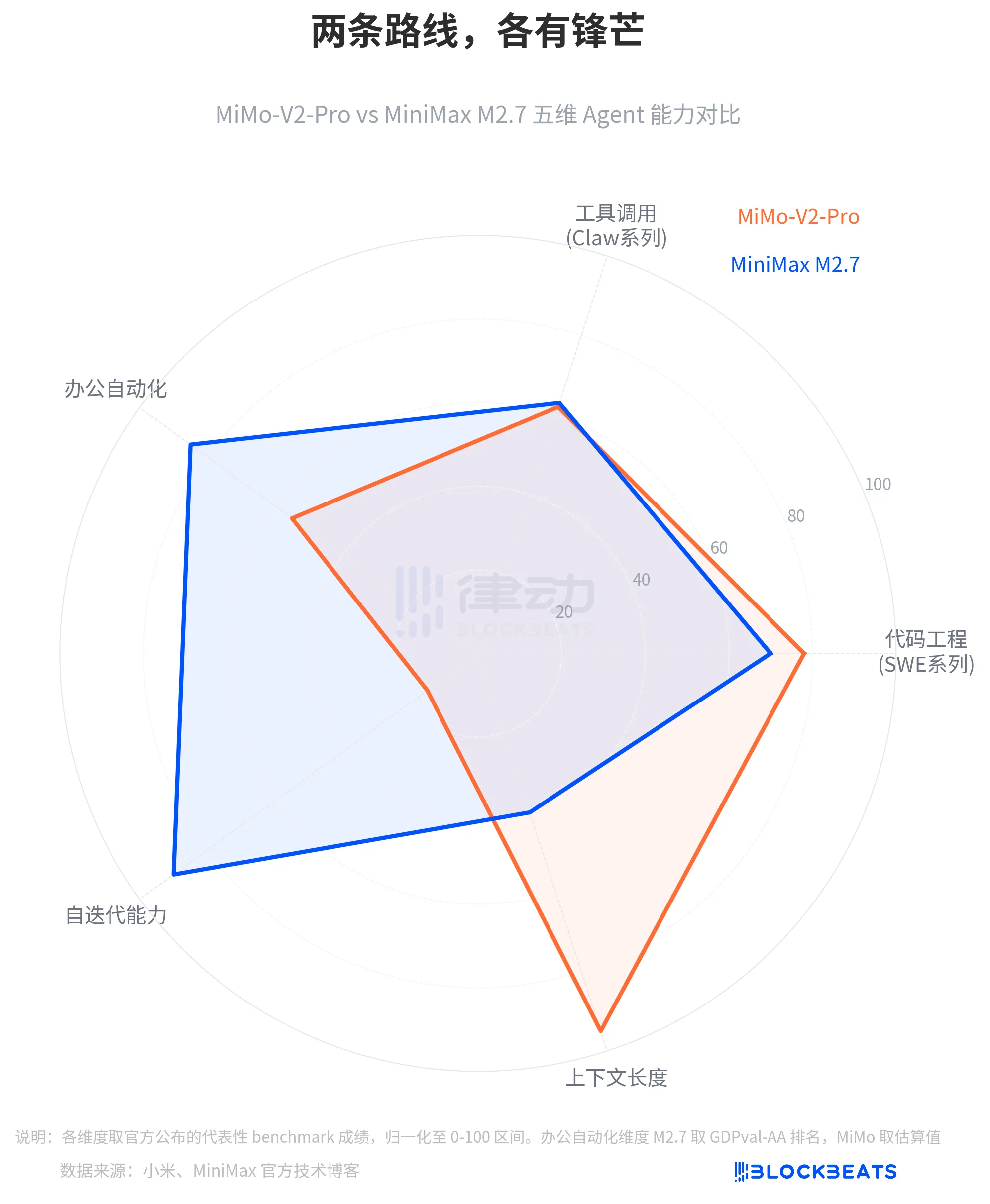
From five dimensions, the two paths are aimed in completely different directions: MiMo-V2-Pro clearly dominates in context length and code engineering dimensions, while M2.7 widens the gap in office automation and self-iterative capability. According to MiniMax's same tech blog post, M2.7 scored ELO 1495 on GDPval-AA (Office Document Processing Evaluation), ranking first among open-source models, and maintained a 97% skill compliance rate in the MM-Claw test covering over 40 complex skills.
Four Versions in Five Months
Not only are the technical paths of the two companies different, but their iteration rhythms are also completely different.
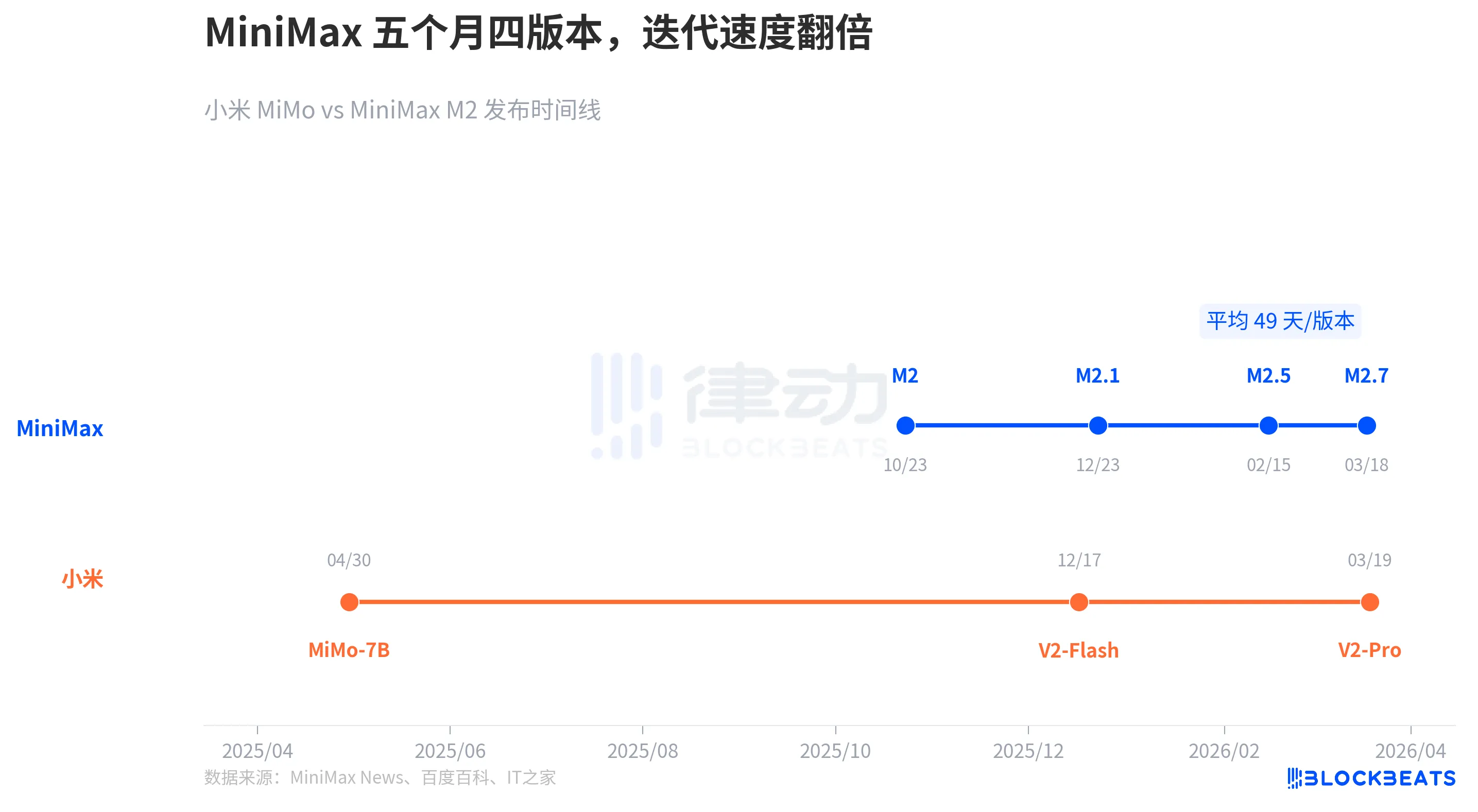
According to public release records, from the release of M2 in October 2025 to the release of M2.7 in March 2026, MiniMax iterated four versions within five months, averaging a major version every 49 days. The gap between M2.5 and M2.7 was only about 30 days.
The rhythm of Xiaomi's MiMo is different: MiMo-7B was released in April 2025 (an open-source inference model with 7B parameters), V2-Flash was released in December of the same year (with 309B total parameters), and V2-Pro was released in March 2026 (with 1T total parameters). The parameter scale between each generation is much larger, but the intervals between versions are also longer.
MiniMax chose small, frequent steps, with each iteration not making big leaps but at a very high frequency. M2.7's self-iterative mechanism itself is designed for "continuous evolution." Xiaomi opted for a more impactful approach, with each version featuring significant changes in parameter scale and architecture.
-- Price
Anonymous 8 Days, Summit OpenRouter
In addition to the technical roadmap, Xiaomi's release strategy has also broken industry conventions.
According to Reuters, on March 11, an anonymous model named Hunter Alpha appeared on the world's largest API aggregation platform, OpenRouter. No brand endorsement, no product launch event, no technical blog. Its API pricing was extremely low, yet its performance was surprisingly strong.
The community began to speculate about its origins. According to Republic World and several tech media reports, the most mainstream speculation was DeepSeek V4, as MiMo team leader Luo Fuli had previously worked on research at DeepSeek. The number of API calls quickly skyrocketed, with the total number of calls during the anonymous period exceeding 1 trillion tokens, reaching the top of the OpenRouter weekly rankings.
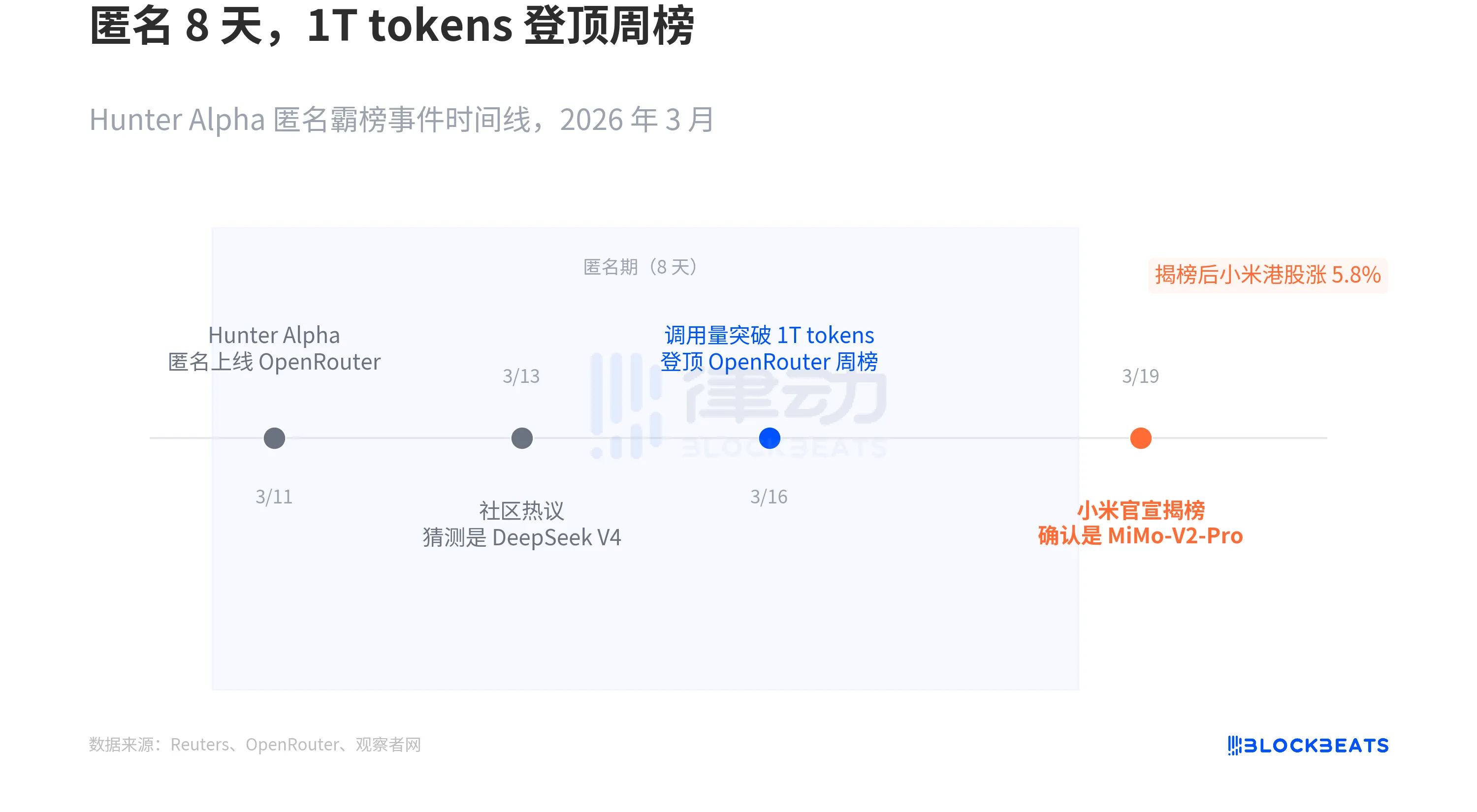
Early on March 19, Xiaomi revealed: Hunter Alpha is indeed MiMo-V2-Pro. According to the same Reuters report, Xiaomi's Hong Kong stock once surged by 5.8% after the revelation.
This is the first time a domestic large-scale model has proven itself on a global platform through purely blind testing. Not relying on the brand, not relying on publicity, it took 8 days to let developers vote with their feet.
This content is provided for general informational purposes only and doesn't constitute financial, investment, legal, or tax advice. Any events, rewards, online promotions, or related information mentioned herein should not be considered a recommendation, solicitation, or invitation to purchase, sell, trade, or otherwise deal in any crypto assets. Crypto assets are highly volatile and may result in loss. The availability of WEEX services, products, and related events may vary by region. You are responsible for ensuring that your participation is in accordance with applicable local laws and regulations.
You may also like
Solana Staking ETF Poised for Imminent Launch: Analysts Signal Green Light as of 2025-08-22
Exciting Times Ahead for Solana Enthusiasts Imagine the thrill of a rocket ready to blast off – that’s…

Kraken IPO delayed until Q2 2027: report
Giertych Wanted to Extort Information Regarding Zondacrypto? Suszka's Sister Reveals the Background
CLARITY Act could advance within weeks, Atkins says
Solana inflation cut is premature, SOL Strategies CEO says
XRP Ledger order-book volume jumps 79% as traders fall

Fed's Beige Book: U.S. Economy Shows Modest Growth, Inflation Pressures Persist

BCRA Reform Could Be One of the Most Restrictive in the Region, According to an International Banking Association
Saudi Arabia Confirms Death of Two Filipino Sailors in Iranian Attack on Oil Tanker
Wholesale Dollar Falls but Remains Above $1.510 as Market Anticipates Greater Pressures
AI Investment and Strong Corporate Profits: Positive Signals for the U.S. Economy Identified by Fed Chair - Bloomberg
Tracking Cryptocurrency May Be Included in Exporters' Currency Revenue Control

The Best Decentralized AI Platforms in 2026
U.S. Treasury Market Trapped in Triple Storm of Inflation, Tightening, and Supply as Yields Surpass 4.8%
ArbitrumDAO Income Reached $6.19 Million In H1
What the $344M crypto political spending spree wants from Congress next
AI Security Becomes Billion-Dollar Market, Attracts $100 Million
Weak ADP and Rising Treasuries: What Changes for Investors

Google Gemini Reduces Token Usage by Up to 88% When Analyzing Videos
Circle President Testifies Before Congress, Calls for Improved Regulation Framework for Stablecoins and Digital Asset Markets
What is Hedera Hashgraph and how does HBAR work?
What are NFTs and do non-fungible tokens still matter in 2026?
Agentic Payment Research Report: From Payment Pathways to Ecological Landscape
What is Chainlink and how does the LINK oracle network work?
Stripe's Bridge Acquisition: Stablecoin Volumes Quadrupled
Breaking News: Rafał Zaorski Arrested? Prosecutor Targets Zondacrypto. "R.Z." in the Hands of CBZC
Strikes on Warehouses Change the Map of Ukrainian Retail: Prices May Rise by 5-8%
What is Bitcoin halving and why does it move the price

AI: Anthropic and Nvidia Enter the Realm of a Bitcoin Mining Giant

Crypto SEC News: 24/7 Trading on Wall Street with or without Blockchain?
Solana Staking ETF Poised for Imminent Launch: Analysts Signal Green Light as of 2025-08-22
Exciting Times Ahead for Solana Enthusiasts Imagine the thrill of a rocket ready to blast off – that’s…
Kraken IPO delayed until Q2 2027: report
Giertych Wanted to Extort Information Regarding Zondacrypto? Suszka's Sister Reveals the Background
CLARITY Act could advance within weeks, Atkins says
Solana inflation cut is premature, SOL Strategies CEO says
XRP Ledger order-book volume jumps 79% as traders fall