
Who are the members of Strategy's "Mystery Shareholder Group"?

Original Article Title: "Stock Price Halved but Long-Term Capital Bet Revealed, Unveiling the Strategy 'Mysterious Shareholder Group'"
Original Article Author: Wenser, Odaily Planet Daily
Amid market turmoil, the "BTC Treasury Company Leader" Strategy saw its stock price continue to decline. Despite the company recently announcing the establishment of a $1.44 billion dividend reserve fund for dividend and interest payments, it failed to regain market confidence—coupled with the news of a possible exclusion from the MSCI index, its stock price once plummeted by nearly 10%.
However, from a shareholder structure perspective, Strategy still enjoys some long-term capital favor, including institutions like Deutsche Bank with an asset management scale of $1.6 trillion.
Strategy (MSTR) Shareholder Composition Revealed: Public Companies and Retail Investors Account for Nearly 50%
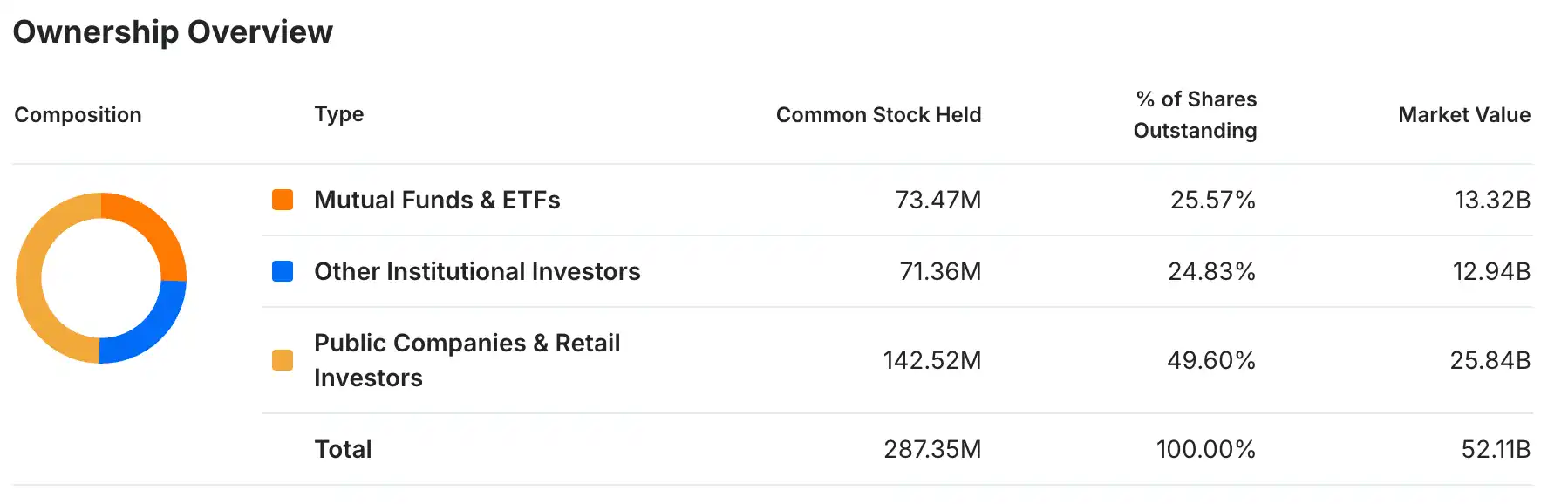
According to information from the Investing website, as of the end of Q3 this year, Strategy's common stock holdings are mainly composed of mutual funds and ETF funds, institutional investors, public companies, and retail investors, with the following breakdown:
· Mutual funds and ETF funds hold a 25.57% stake;
· Institutional investors hold a 24.83% stake;
· Public companies and retail investors hold a 49.6% stake.
· Currently, the total number of Strategy (MSTR) shares is around 287 million, with a total market value of around $52.1 billion.
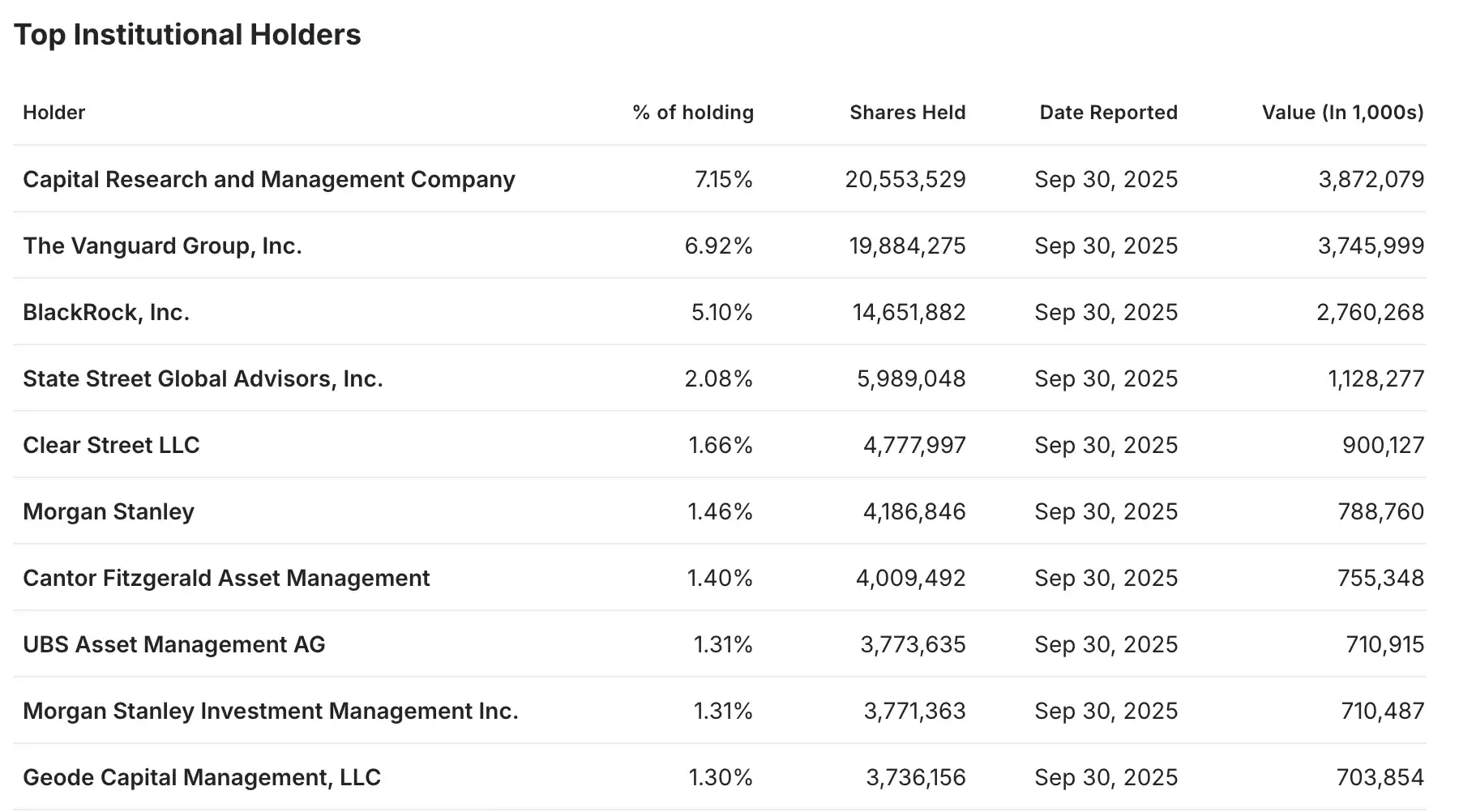
Among institutional investors, Strategy's shareholders include Vanguard Group, BlackRock, Morgan Stanley, UBS Asset Management, and other globally renowned companies.
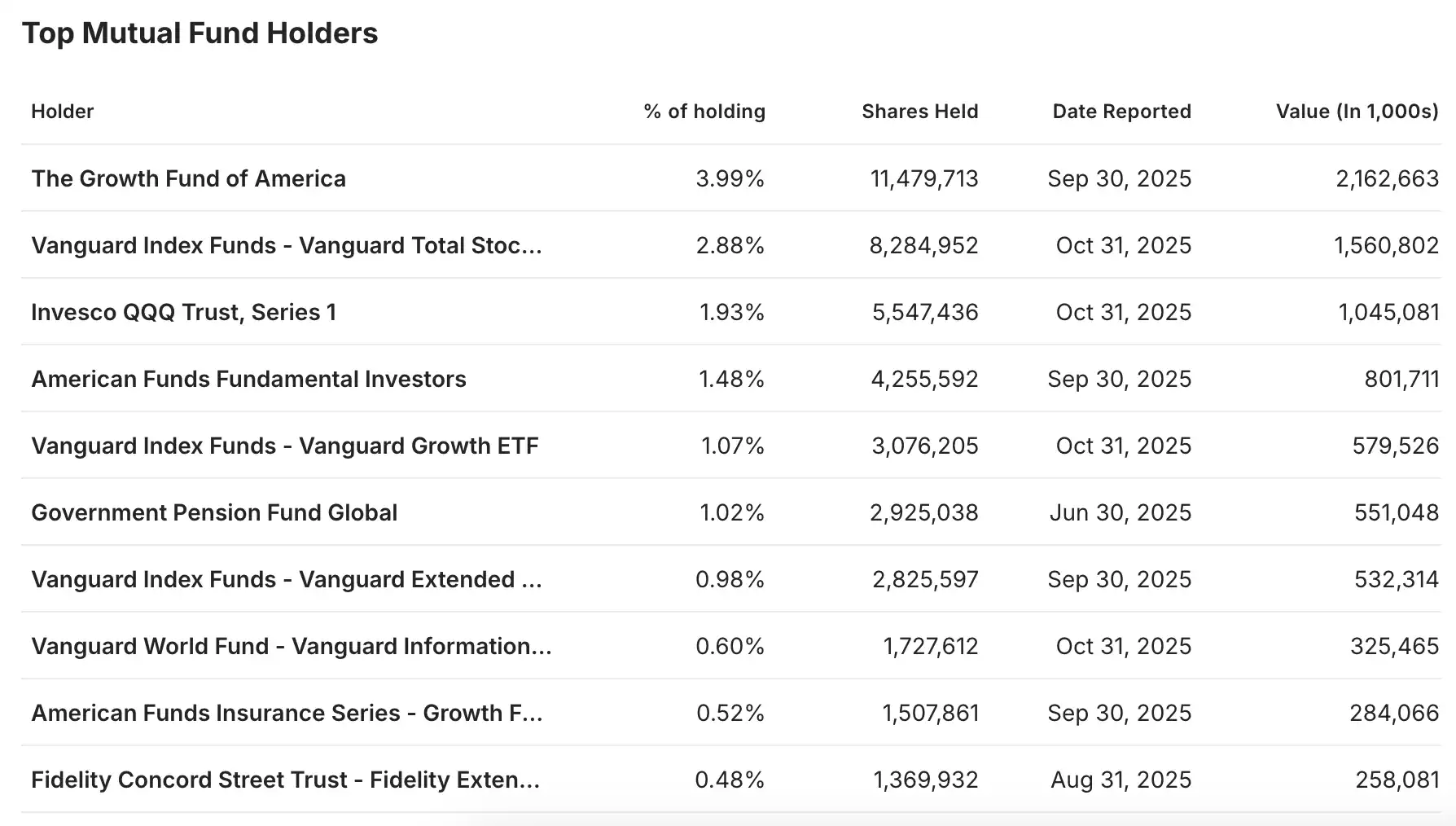
In mutual funds, Strategy's shareholder list is also very impressive, with front-runners being well-known funds in the industry.
Next, in addition to the usual asset management institutions, we will focus on selecting some representative shareholders for individual introductions, so everyone can better understand the many "mysterious shareholders" behind Strategy, who are honored as the "First Concept Stock of BTC" and "DAT Trend Leader."
Central Banks and Large Banks: The "Invisible Wealthy" of Strategy Stockholders
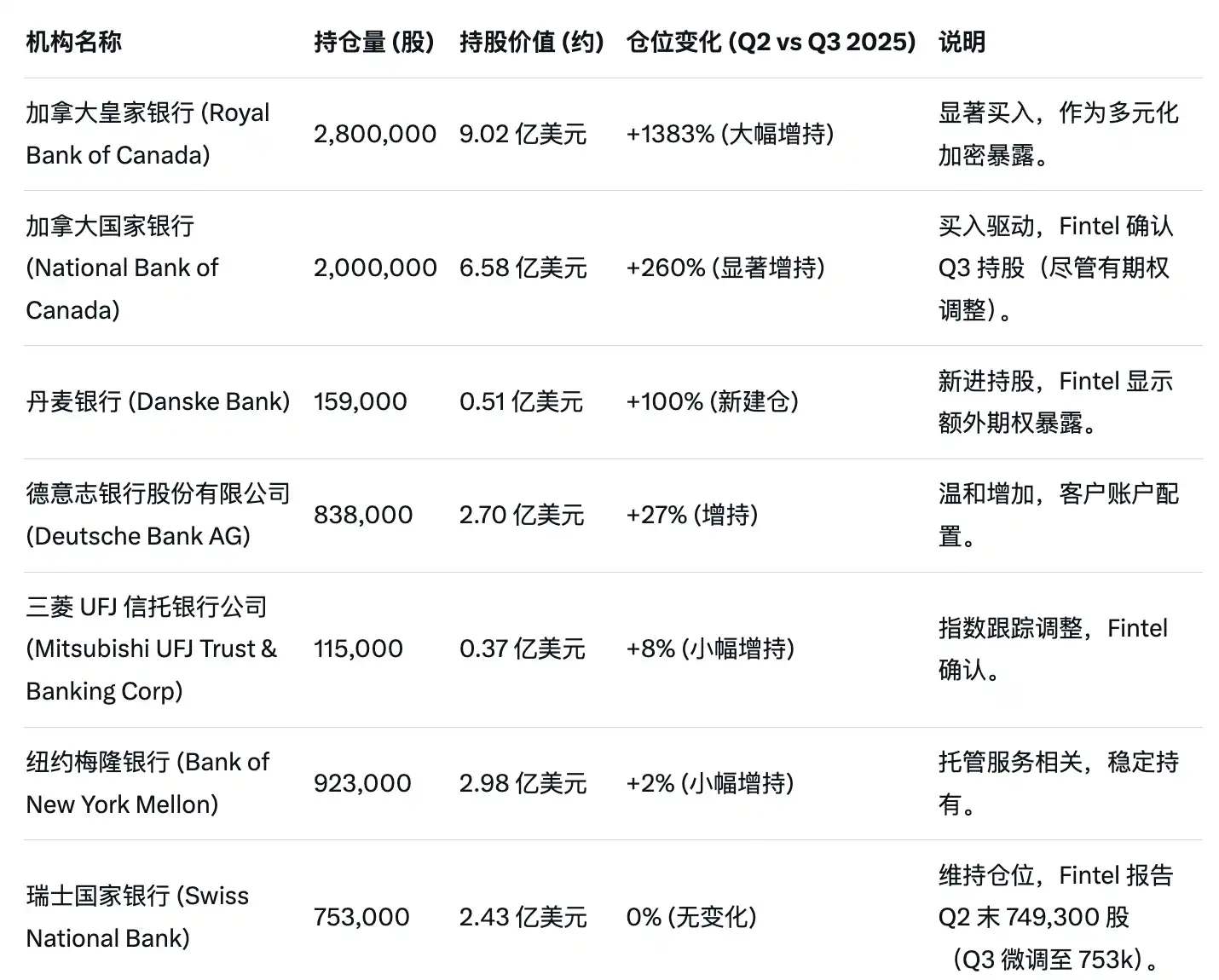
Among the Strategy shareholder list, the most special group is undoubtedly the central banks of various sovereign nations and large banks. Although the primary reasons for various central banks holding Strategy stock are often to implement a diversified investment strategy or to indirectly increase exposure to BTC assets, their holdings are indeed an undeniable fact and the most direct form of "voting with their feet."
According to information from Stockzoa website, as of the end of Q3, the central banks and large banks holding Strategy stock were as follows:
In addition to the above banks, some central banks briefly held Strategy stock but later liquidated their positions due to market volatility or their own asset allocation requirements. For example, the Central Bank of Norway held around $500 million worth of MSTR shares at the beginning of the year, continuously increased its holdings, at one point held around 2.98 million MSTR shares, and ultimately liquidated its entire position in Q2 of this year, worth approximately $1.2 billion, with an unrealized loss of around $200 million. The Saudi Arabian Monetary Authority also disclosed holding 25,600 MSTR shares, indirectly holding BTC asset exposure, but may have since liquidated its position.
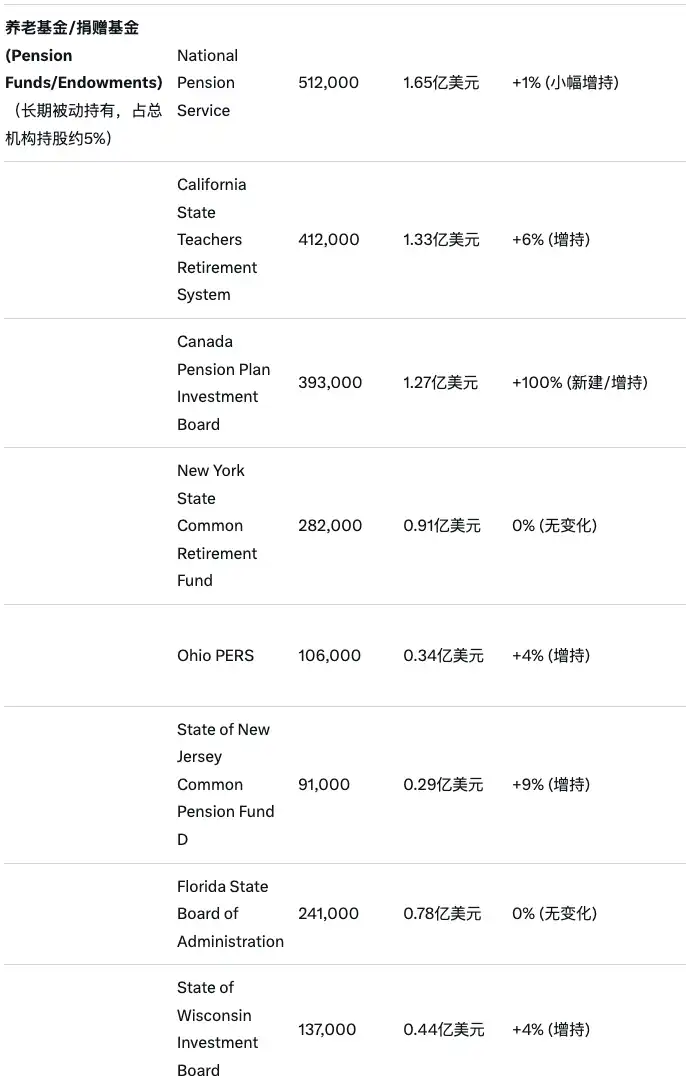
Pension and Endowment Funds: Potential Players in the Strategy Q3 Shareholder Roster
Apart from banking institutions, pension funds and endowment funds are also one of the "main players" in the Strategy stockholder roster, and thanks to their massive fund sizes, perhaps the hope for further increases in Strategy stock holdings still depends on their performance.
Likewise, according to information from the Stockzoa website, as of the end of Q3 (compared to Q2), the pension funds and endowment funds holding Strategy stock were as follows (compiled from Grok):
This mainly includes national pension funds, state pension funds, industry foundations, the Canada Pension Plan, and other institutional organizations.
Hedge Funds: The "Shark-Like Predator" Among Strategy Shareholders?
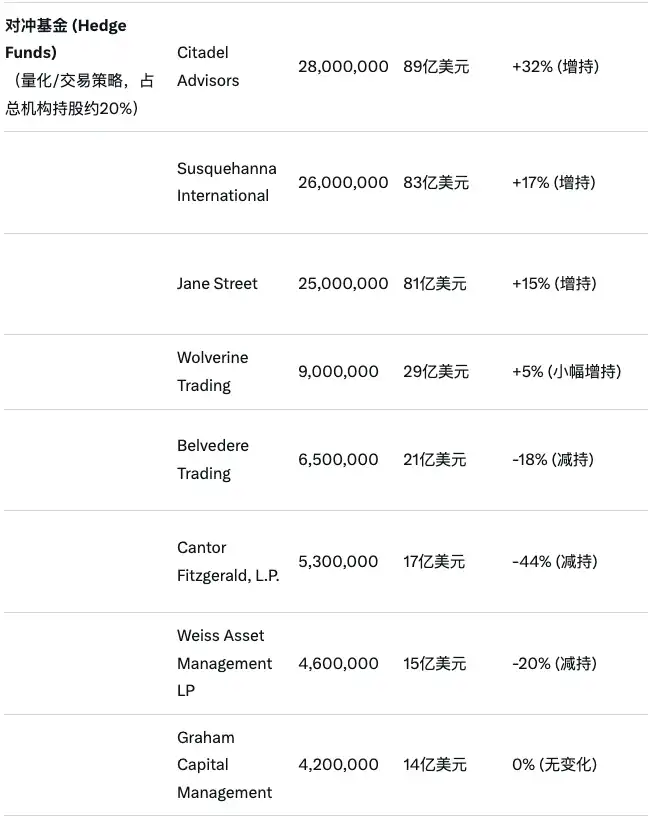
Among the Strategy shareholder roster, hedge funds may be the most keenly perceptive and market-sensitive institutions, therefore, in Q3, although most hedge funds chose to increase their MSTR holdings, crypto prime brokers and well-established hedge funds like Cantor Fitzgerald, L.P., and Weiss Asset Management LP still chose to reduce their positions.
Per information from the Stockzoa website, as of the end of Q3 (compared to Q2), information on hedge funds holding Strategy stocks is as follows (compiled from Grok):
On the Data Front, Looking at Strategy Shareholder Changes: Institutions Remain the Key Holders, with Increased Positions Far Outweighing Decreased Positions
Aside from the aforementioned group-level view, some hidden insights can be gleaned from the data on institutional shareholder changes regarding Strategy.
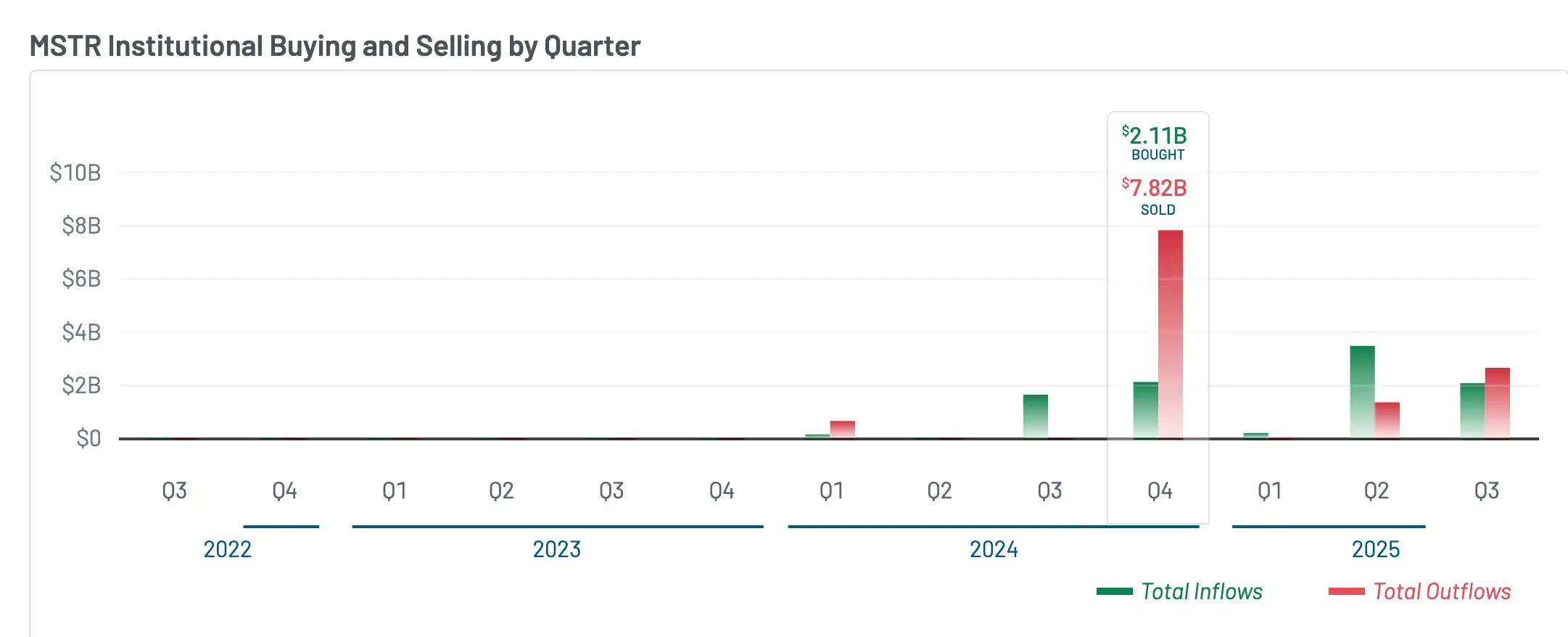
Strategy Stock Trading Data Shows Relative Balance, Well Below Historical Peaks
According to data from the Marketbeat website, Strategy stock inflow and outflow reached a record 78.2 billion shares sold and 21.1 billion shares bought in Q4 2024, with a staggering buy/sell ratio close to 1:4. In contrast, this number for Q3 of this year has dropped to 26.4 billion shares sold and 20.7 billion shares bought, with a buy/sell ratio of about 1:1.25, indicating a relatively balanced buy/sell data. From this perspective, Strategy stock has not entered a so-called "dumping stampede period" but rather is experiencing normal fluctuations.
Behind the Scenes of Institutional Holdings Data: Institutions Increasing their Positions Hold Twice as Many Shares as those Decreasing
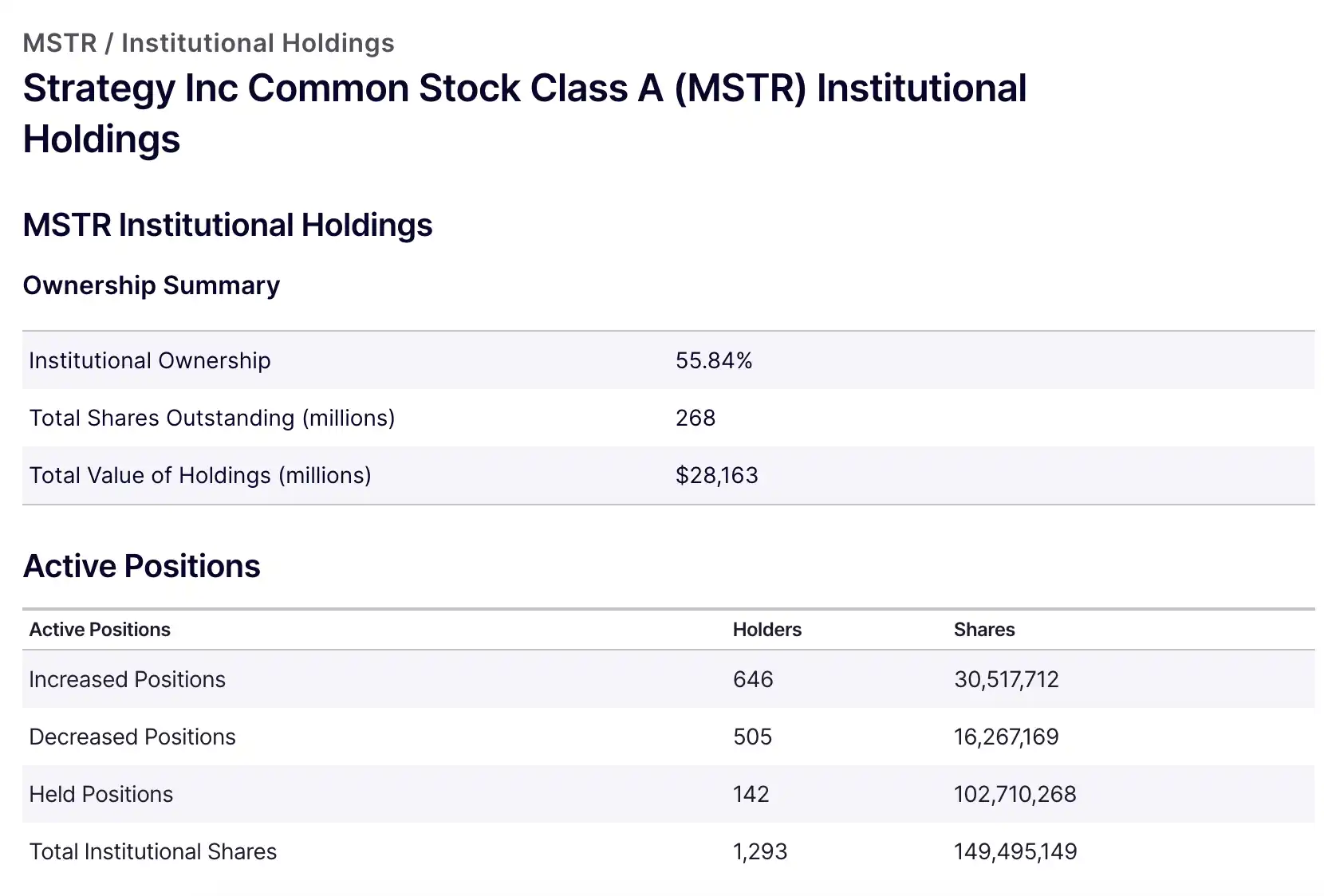
According to official Nasdaq data, the current institutional ownership of Strategy stock is approximately 55.84%, with a total of 1293 holding institutions, including 646 institutions increasing their positions, 505 institutions decreasing their positions, and 142 institutions maintaining their positions.
Furthermore, the number of shares increased by institutions is about twice the number of shares decreased by institutions (30.51 million shares:16.26 million shares). This indicates that the market can readily absorb the buying pressure for Strategy stock. Moreover, more institutions have chosen to hold their positions, with such institutions holding a high quantity of 102 million shares, accounting for two-thirds of the institutional ownership percentage. This indirectly underscores institutional investors' confidence in Strategy's future.
In summary, despite a significant drop in stock price, the fundamental holding of Strategy and the structure of institutional holdings have not significantly deteriorated. With the market gradually recovering, there may be hope for a bottom rebound and a new uptrend.
You may also like

Circle CEO responds to OUSD's challenge: Stablecoins are a winner-takes-all business, and we will not slow down
Argentina vs Cape Verde: When a Record-Breaking Legend Meets an Unbreakable Underdog
WEEX exclusive pre-match analysis of Argentina vs Cape Verde, exploring Messi-led Argentina’s dominance and Cape Verde’s historic defensive breakout, with a breakdown of volatility, structure, and match dynamics.
How does Gate redo "buying and selling stocks" from the cryptocurrency world to the stock market?
Former ByteDance employee's account: How I started with two Pinduoduo hard drives and made six times the profit with Seagate to achieve financial freedom?
Visa and Mastercard join 140 giants to launch a new stablecoin, but the impact on the market landscape may still be limited
WEEX Launches Depth Chart for Spot Trading
MiCA reshuffle begins, Binance temporarily bids farewell to the EU
Raising interest rates to protect STRC and selling coins to maintain credit, this time the strategy has chosen the two most expensive paths
Morning Report | Samsung announces a 265.5 trillion won investment plan, focusing on semiconductor and AI computing power data centers; Vitalik publishes an article detailing the entire technology tree behind the confusion protocol (iO) mainline
In the era of AI, what is left of Bitcoin?
NeoSoul announced plans to integrate with the OKX Agentic Wallet, promoting AI agents' participation in the on-chain economy
Why Is Bitcoin Lagging Stocks in 2026? AI Stocks, ETF Outflows, and the Nasdaq Rally Explained
What you bought on CEX is really not US stocks: Analyzing the 94% liquidation monopoly and the evaporation of equity under a five-layer pipeline
In such a crowded cross-border payment arena, where is the next stop for the future?
Why Is Bitcoin Down in 2026? What We Can Learn From 2022
The large models in the United States are moving towards closure in the name of security
From the white-haired stock god to the billionaire fund mogul, the smart people shorting Nvidia are all getting rich using the same framework
Morning Report | CoinEx becomes a key hub for Iran to evade sanctions, involving over $3.8 billion in funds; Kalshi seeks a new round of financing, with a valuation potentially rising to $40 billion
Circle CEO responds to OUSD's challenge: Stablecoins are a winner-takes-all business, and we will not slow down
Argentina vs Cape Verde: When a Record-Breaking Legend Meets an Unbreakable Underdog
WEEX exclusive pre-match analysis of Argentina vs Cape Verde, exploring Messi-led Argentina’s dominance and Cape Verde’s historic defensive breakout, with a breakdown of volatility, structure, and match dynamics.
How does Gate redo "buying and selling stocks" from the cryptocurrency world to the stock market?
Former ByteDance employee's account: How I started with two Pinduoduo hard drives and made six times the profit with Seagate to achieve financial freedom?
Visa and Mastercard join 140 giants to launch a new stablecoin, but the impact on the market landscape may still be limited
WEEX Launches Depth Chart for Spot Trading