
What Is Averaging Down (Nanpin)? How It Works and Its Risks

 Prefer us on Google



Averaging down — nanpin in Japanese — is the practice of buying more of an asset after its price has fallen, in order to lower the average purchase price of the overall position. The idea is that if the price later recovers, the position breaks even sooner than it would have from the original, higher entry. It is a widely known tactic, but it is also one of the riskiest, and this article explains both the mechanics and the serious dangers. It is educational and is not a recommendation to average down.
How averaging down works
Suppose you buy an asset and its price then falls. Averaging down means buying an additional amount at the lower price, which pulls your average cost down.
- You buy 1 unit at 100. Your average cost is 100.
- The price falls to 80, and you buy 1 more unit. Now you hold 2 units at an average cost of 90.
- The price now only needs to recover to 90, rather than 100, for the overall position to break even.
On the surface this looks appealing: the break-even point is closer. But that lower average comes at a cost — you now have a larger position exposed to the same falling market.
Why averaging down is dangerous
The central danger is simple: averaging down adds money to a losing position while the price is still going against you. If the decline continues, you now lose more, faster, because your position is bigger.
- It can turn a small loss into a large one. Each additional purchase increases exposure precisely when the trade is not working.
- It is especially hazardous with leverage. In leveraged futures or perpetual trading, adding to a losing position increases the risk of your margin being exhausted and the position being forcibly closed — see liquidation on liquidation and margin on margin. A downtrend that continues can wipe out a leveraged position entirely.
- It assumes recovery. Averaging down only works if the price eventually rises. If the asset keeps falling — or never recovers — you have simply committed more capital to a losing bet.
Averaging down is a form of contrarian trading, the broader style discussed in trend-following vs contrarian trading, and it inherits that style's core danger: fighting a trend that may keep going.
A worked example — including the downside
Return to the example above: 2 units at an average of 90 after the price fell to 80.
- If the price recovers to 90, the position breaks even — the tactic worked.
- If the price falls further to 60, the loss is now on 2 units instead of 1 — the tactic magnified the damage. With leverage, a move like this could trigger liquidation before any recovery is possible.
The asymmetry is the whole point: averaging down offers a modestly closer break-even in exchange for a much larger loss if you are wrong about the recovery.
Related concepts
- Liquidation: what can happen to a leveraged losing position — liquidation.
- Margin: the collateral that averaging down puts at greater risk — margin.
- Trend-following vs contrarian: the broader style averaging down belongs to — trend-following vs contrarian trading.
Summary
Averaging down (nanpin) means buying more of a falling asset to lower your average cost. It brings the break-even point closer, but it does so by enlarging a losing position, which can turn a small loss into a large one — and with leverage it raises the risk of liquidation. Understanding it means understanding its danger, not treating a lower average as a safety net.
This article is for educational and informational purposes only and does not constitute investment, financial, or tax advice. Cryptocurrency and derivatives trading involve significant risk. Always do your own research.
Disclaimer: This content is provided for general branding and informational purposes only and doesn't constitute financial, investment, legal, or tax advice. Any events, rewards, online events, or related information mentioned herein should not be considered a recommendation, solicitation, or invitation to purchase, sell, trade, or otherwise deal in any crypto assets or to use any services. Crypto assets are highly volatile and may result in loss. WEEX services and online events may not be available in all regions and are subject to applicable laws, regulations, and eligibility requirements. You are responsible for ensuring that your use of WEEX services complies with local laws and for carefully assessing the risks before participating in any crypto-related activities.
You may also like

Gold Price Outlook 2026: Third-Party Analyst Scenarios (Maintained, Educational)
Silver Price Outlook 2026: Third-Party Analyst Scenarios (Maintained, Educational)
How to Buy Bitcoin in Brazil: A Step by Step Guide for Beginners

Dolar Crypto in Argentina: How to Use Stablecoins for Dollar Exposure and Buy Bitcoin
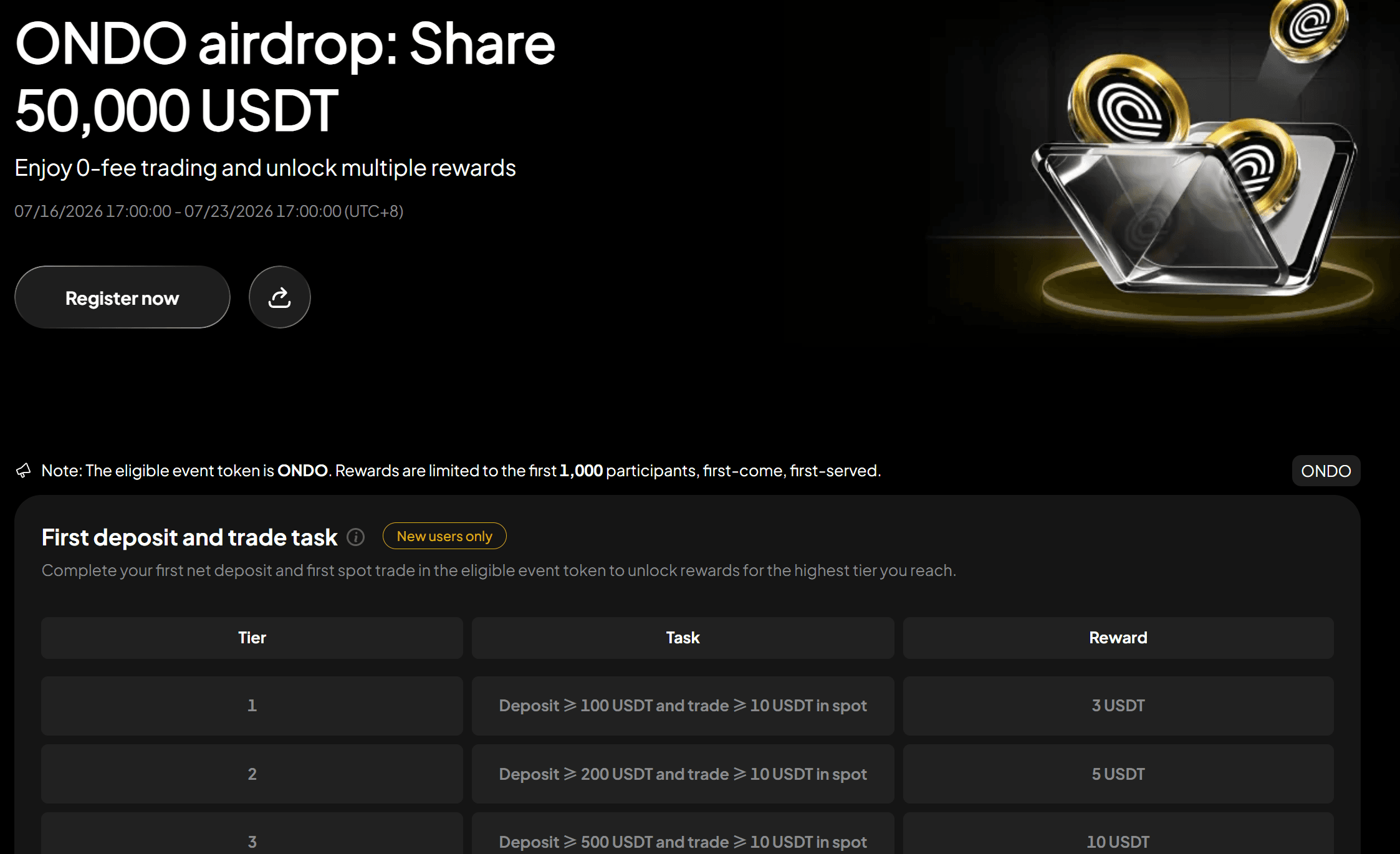
Claim ONDO Airdrop Rewards: Complete Tasks and Share 50,000 USDT
Claim ONDO Airdrop rewards on WEEX and share 50,000 USDT. Learn how to join, complete trading tasks, earn bonuses, and trade ONDO/USDT during the event.
Japan's Crypto Regulation Basics: The FSA, JVCEA, and User Protections

How Overseas Crypto Exchanges Work for Japan Residents (and the Risks)
Modelo 721 Explained: Declaring Foreign Crypto Holdings in Spain
DEX vs CEX for Perpetuals: Trading Perps On-Chain vs on an Exchange

What Is an On-Chain Order Book? How Order-Book DEXs Work
What Is a Perp DEX? Perpetual Futures on Decentralized Exchanges
Italy Crypto Tax 2026: The Capital Gains Rate Rises to 33%
Support and Resistance: How to Identify Key Levels on the Chart

Supply and Demand Zones: A Smart-Money Trading Guide
Price Action Trading: Reading Raw Market Behavior

Head and Shoulders Pattern: How to Spot and Trade It
Classic Chart Patterns: Triangles, Double Tops/Bottoms and Flags
Airdrop Farming: How to Farm Crypto Airdrops the Right Way
What Is a Moving Average (MA)? Types and How to Read Them
What Is Elliott Wave Theory? A Beginner's Guide to Counting Waves
What Is Fibonacci Retracement? How to Draw and Use It
What Is the Ichimoku Cloud? A Beginner's Guide to Reading It
What Is the VIX (Fear Index)? How to Read It and Its Link to Crypto
What Is Dow Theory? The Six Principles Explained
What Is a Death Cross? Understanding the Bearish Signal
What Is a Golden Cross? A Beginner's Guide to the Bullish Signal
MiCA Regulation: What Changes for Polish Crypto Investors
Open Interest: What It Means in Futures Trading
Call vs Put Options: What They Are and How They Differ
What Are Sakata's Five Methods? Classic Candlestick Patterns Explained
Gold Price Outlook 2026: Third-Party Analyst Scenarios (Maintained, Educational)
Silver Price Outlook 2026: Third-Party Analyst Scenarios (Maintained, Educational)
How to Buy Bitcoin in Brazil: A Step by Step Guide for Beginners
Dolar Crypto in Argentina: How to Use Stablecoins for Dollar Exposure and Buy Bitcoin
Claim ONDO Airdrop Rewards: Complete Tasks and Share 50,000 USDT
Claim ONDO Airdrop rewards on WEEX and share 50,000 USDT. Learn how to join, complete trading tasks, earn bonuses, and trade ONDO/USDT during the event.
Japan's Crypto Regulation Basics: The FSA, JVCEA, and User Protections


