
Best AI Compute and GPU Stocks to Buy in 2026: Full Guide for Beginners

 Prefer us on Google


The AI hardware market has shifted. Two years ago, everyone fought over training chips. Now it’s all about inference, power efficiency, and custom silicon.
By mid-2026, hyperscalers will spend over $700 billion on AI infrastructure — that’s locked in. That money is flowing to the hardware builders: GPUs, ASICs, advanced memory, and packaging.
If you’re looking for the best stocks to buy in 2026, the AI compute sector offers real opportunities. Below, we break down the top AI stocks and how to trade them 24/7 with USDT on WEEX — no traditional brokerage needed.
Why 2026 Is Different for AI Stocks
The first wave of AI was about building models. That meant buying as many GPUs as possible, stacking them in data centers, and training giant LLMs.
The second wave — the one we’re in right now — is about running those models live. Inference workloads now account for roughly two-thirds of all AI compute demand. That shifts the entire hardware equation.
Agentic AI (autonomous, multi-step agents) needs a completely different balance: more CPUs per GPU, lower latency, and radically better power efficiency. Data center operators are no longer asking “how fast can this train?” They’re asking “what’s the cost per inference token?”
That’s why custom silicon is exploding. And that’s why the stocks below are positioned to benefit for years, not months.
Best AI Compute and GPU Stocks to Buy in 2026
NVIDIA (NVDA)
- Market cap: $5.3 trillion
- Core role: GPU design + CUDA ecosystem
NVIDIA still commands about 75–80% of the AI accelerator market. Its Blackwell architecture is ramping, and the next-generation Vera Rubin platform (due late 2026) promises a 10x improvement in performance-per-watt.
The real moat isn’t the hardware. It’s CUDA. Millions of developers are locked in. And with a combined order backlog estimated at $1 trillion for Blackwell and Rubin through 2027, NVDA has incredible revenue visibility.
The shift to inference actually benefits NVIDIA’s software advantage. Developers don’t want to retool for custom chips if they can just keep using CUDA.

AMD (AMD)
- Market cap: $0.76 trillion
- Core role: High-performance CPUs + competitive AI GPUs
AMD has quietly become the primary alternative to NVIDIA, especially for cost-sensitive inference workloads. Its MI300 and MI350 accelerators are now inside Meta, OpenAI, and other hyperscalers.
Here’s the kicker: Agentic AI needs a much higher CPU-to-GPU ratio (moving from 1:8 to roughly 1:1). That plays directly into AMD’s strength — its EPYC data center CPUs are best-in-class.
AMD’s chiplet-based GPUs offer better memory density, which is a huge advantage for memory-bound inference tasks.

Broadcom (AVGO)
- Market cap: $1.96 trillion
- Core role: Custom ASICs + networking fabrics
Broadcom doesn’t sell off-the-shelf GPUs. Instead, it helps hyperscalers build their own chips. It co-developed Alphabet’s TPU and custom silicon for Meta. Today, Broadcom dominates nearly 70% of the custom ASIC market.
On top of that, Broadcom makes the ultra-fast switching silicon that binds thousands of processors together. Without it, AI factories don’t work.
The custom silicon market is growing faster than general-purpose GPUs. Broadcom has a clear path to $100 billion in custom chip revenue by 2027.

TSMC (TSM)
- Market cap: $1.82 trillion
- Core role: Advanced fabrication + CoWoS packaging
Every major AI chip — from NVIDIA, AMD, Broadcom, Apple — is built by TSMC. It holds a near-monopoly on leading-edge 3nm and 2nm process nodes. And its CoWoS advanced packaging is completely sold out through the end of 2026.
That’s pricing power. Real, structural, irreplaceable pricing power.
Even if individual chip designers lose market share, TSMC wins. It’s the physical backbone of the entire AI boom.
Micron Technology (MU)
- Market cap: $0.84 trillion
- Core role: High-bandwidth memory (HBM)
Modern AI processors are memory-bound. That means performance is limited by how fast data can move in and out of the compute core. Micron’s HBM3E and next-gen HBM4 are essential for every top-tier GPU platform.
Micron has already pre-sold its entire HBM production capacity multiple years forward. That’s a structural shift from a cyclical commodity business to a mission-critical bottleneck asset.
Severe HBM shortages through 2027 give Micron long-term, high-margin pricing power.
How to Trade These AI Stocks on WEEX
You don’t need a US brokerage account to get exposure to these names. WEEX offers two methods to trade AI compute stocks using crypto rails.
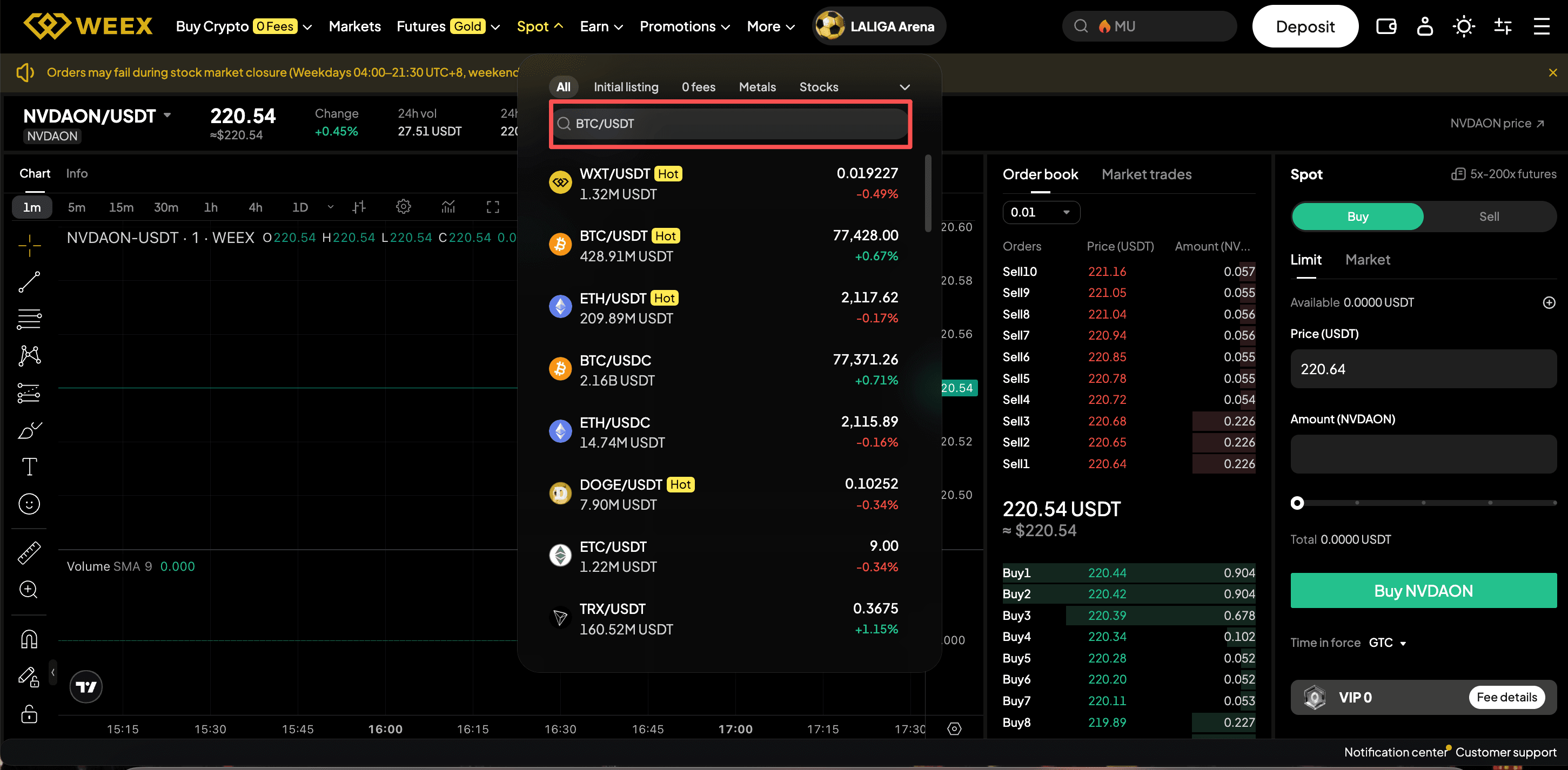
Method 1: Buy Tokenized Stocks on WEEX Spot
Tokenized stocks track real-world equities 1:1. You buy and hold them like any other crypto asset, but the economic exposure mirrors the actual stock.
How to buy:
- Deposit USDT into your WEEX account.
- Search for tokenized symbols like
NVDAX(NVIDIA),AMDX, orTSMX. - Place a market or limit order. Minimum investment is fractional — start with as little as $10.
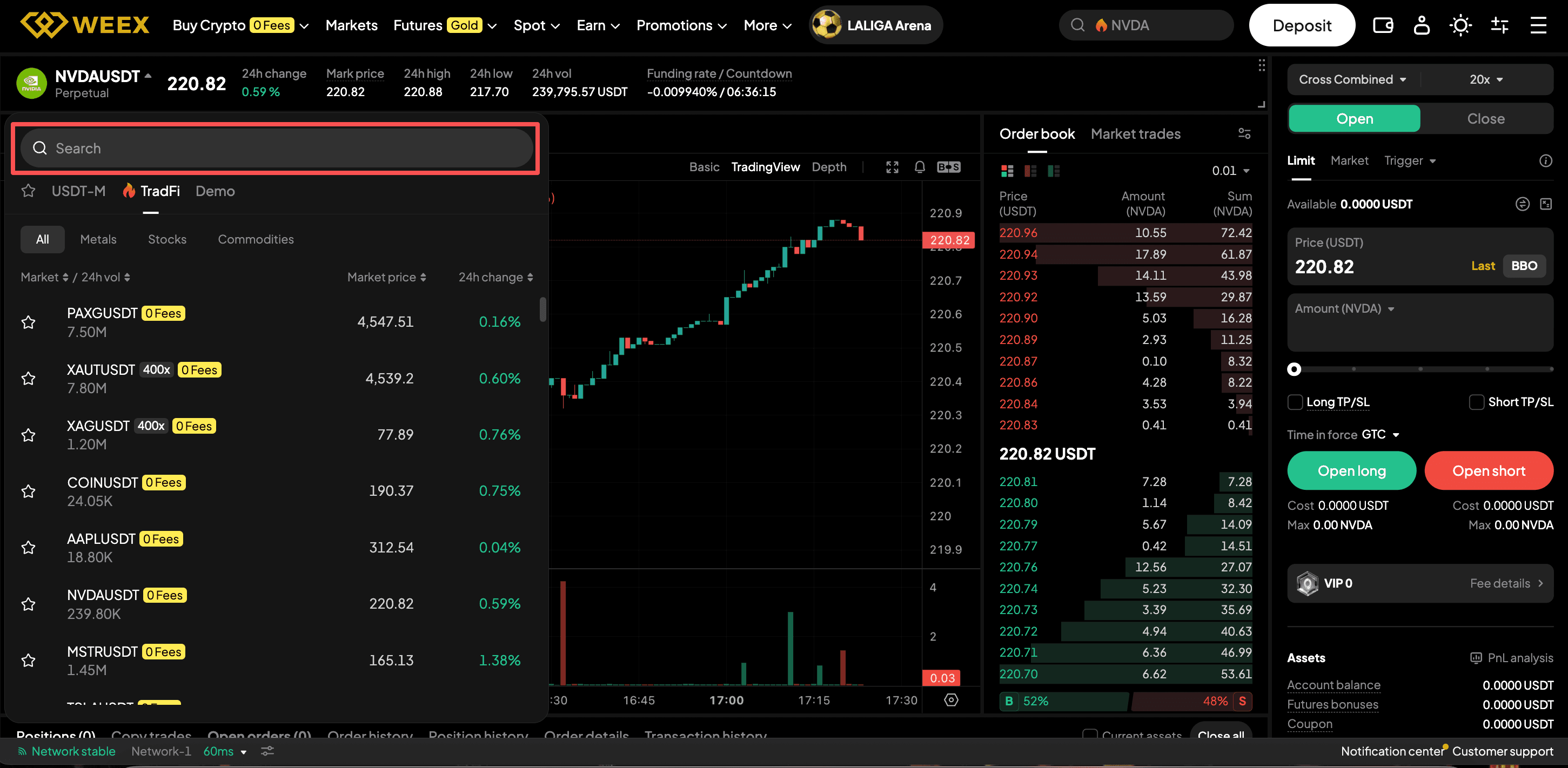
Method 2: Buy Stock Futures on WEEX TradFi
For active traders who want leverage and 24/7 access, WEEX offers USDT-margined perpetual contracts on leading US tech stocks.
How to trade:
- Deposit USDT into your WEEX account.
- Search for trading pairs like
NVDAUSDT,AMDUSDT, orAVGOUSDT. - Choose to go long or short, set your leverage (up to 100x), and place your order.
- Set take profit or stop loss to manage risk.
Why WEEX? No VPN required. No USD funding. No KYC nightmares. Just USDT and a few clicks.
Risks to Know Before Investing in AI Compute Stocks
Even with strong tailwinds, these stocks come with real risks:
- Valuation compression – If hyperscalers slow down spending, multiples will contract fast.
- Geopolitical dependence – Most advanced chips are made in Taiwan. Supply shocks or export restrictions are constant threats.
- Technological obsolescence – A breakthrough custom chip from a hyperscaler could upend third-party GPU margins.
- Tokenized asset limitations – Tokenized stocks track price only. No voting rights, no dividends.
Final Thoughts: Should I Buy AI Compute Stocks in 2026?
The hardware layer of AI is generating real, recurring cash flows today — not just hype. Diversifying across designers (NVIDIA, AMD), custom silicon (Broadcom), foundry (TSMC), and memory (Micron) gives you exposure to the entire compute stack.
If you’re looking for the best stocks to buy in 2026, these five belong on your watchlist. And with WEEX, you can trade them 24/7 using USDT — no traditional broker needed.
Start small. Use stop losses. And never risk more than you can afford to lose.
Ready to trade on WEEX TradFi? Sign up on WEEX Now and Start Trading!
Disclaimer: This content is provided for general branding and informational purposes only and doesn't constitute financial, investment, legal, or tax advice. Any events, rewards, online events, or related information mentioned herein should not be considered a recommendation, solicitation, or invitation to purchase, sell, trade, or otherwise deal in any crypto assets or to use any services. Crypto assets are highly volatile and may result in loss. WEEX services and online events may not be available in all regions and are subject to applicable laws, regulations, and eligibility requirements. You are responsible for ensuring that your use of WEEX services complies with local laws and for carefully assessing the risks before participating in any crypto-related activities.
You may also like

How to Buy TSMC Stock: What International Investors Need to Know Before Placing an Order

Is SPCX Stock Price a Buy Below Its IPO Price? What Happens Before August 6
SPCX Stock Price Falls Below IPO Price for the First Time: What Investors Should Do Now

TSMC Stock Price Prediction 2026-2027: Can TSM Reach $600 After the Q2 Beat?
Is TSMC Stock a Buy After Q2 Earnings? What 22x Forward Earnings and 61% AI Revenue Tell Investors

TSMC Stock Jumps After Record Q2 Earnings: What the AI Chip Boom Looks Like From the Inside
How to Buy Netflix Stock: A Guide for International Investors

NFLX Stock Price Prediction 2026-2027: Can Netflix Recover to $100?

Is NFLX Stock a Buy Before Q2 Earnings? What the 46% Decline From the High Tells Investors

FIFA World Cup 2026 Final Date: Time, Venue, and the Spain vs Argentina Showdown
NFLX Stock: What Moves Netflix and How to Trade It 24/5
ATAI Stock Soars on Eli Lilly's $2.8B Buyout: What It Means

ISRG Stock: Why Intuitive Surgical Fell After a Q2 Beat
TSMC Stock After Record Q2 Earnings: Why TSM Slipped
CXMT Pre-IPO Perpetual: How to Trade Hyperliquid's Chip Bet

NFLX Stock Q2 Earnings Today: What Netflix Needs to Deliver to End the 2026 Selloff
PayPal Stock Jumps 17% on Stripe and Advent's $53 Billion Takeover Bid: What Investors Should Know
Is ASML Stock a Buy After Q2 Earnings? What the €43-45 Billion Full Year Guidance Tells Investors

ASML Stock Price Prediction 2026–2027: Can ASML Reach $2,500?
ASML Stock Jumps After Q2 Beat: What the €9.3 Billion Quarter and Raised Guidance Mean for Investors
Robinhood Chain Takes Off—What Are the Key Highlights and Opportunities?
Stock Trading Platform Guide: How to Choose the Best Platform for Your Trading Style
Stock Analysis Guide: How to Read P/E Ratio, RSI, Volume, and Key Market Metrics
How to Use Grok AI for Crypto Trading: A Practical Guide for 2026
Polymarket vs. Kalshi: Which Prediction Market Platform Survives the Regulatory Crackdown?
How to Read Prediction Market Odds: A Complete Beginner's Guide
What Is Liquidity in Prediction Markets and Why Does It Matter?
How Accurate Are Prediction Markets? What the Research Actually Says
Is Polymarket Legal in the US? What the CFTC Approval Actually Means
Tokenization in Crypto vs Data Security: What Is Tokenization and How Both Protect Your Assets?
How to Buy TSMC Stock: What International Investors Need to Know Before Placing an Order
Is SPCX Stock Price a Buy Below Its IPO Price? What Happens Before August 6
SPCX Stock Price Falls Below IPO Price for the First Time: What Investors Should Do Now
TSMC Stock Price Prediction 2026-2027: Can TSM Reach $600 After the Q2 Beat?
Is TSMC Stock a Buy After Q2 Earnings? What 22x Forward Earnings and 61% AI Revenue Tell Investors
TSMC Stock Jumps After Record Q2 Earnings: What the AI Chip Boom Looks Like From the Inside
Contents
Popular coins
Latest articles





