Best Crypto Futures Trading Platforms in October 2025

By: WEEX|2025-10-02 10:15:00
0
Share
copy

Key takeaways

  • Choosing the right crypto futures exchange depends heavily on evaluating key aspects such as fee structures, platform usability, range of supported assets, and—most importantly—security measures.
  • Trust and security are frequently the top priorities, especially since many exchanges also serve as custodians for users’ digital assets. Key features to look for include Proof-of-Reserves (PoR), two-factor authentication (2FA), and a proven operational track record.
  • Regional accessibility is another essential factor. With crypto regulations evolving worldwide, many derivatives platforms limit services to specific countries, and some may only offer a narrow set of markets or trading pairs depending on the user’s location.

What is Crypto Futures Trading?

Crypto futures are derivative contracts that derive their value from an underlying digital asset, such as Bitcoin or Ethereum. Unlike spot trading, futures do not involve immediate transfer of the actual cryptocurrency. Instead, traders agree to buy or sell an asset at a predetermined price on a future date.

While the basic mechanics of futures trading may resemble spot trading, futures open the door to more sophisticated strategies—including leveraged positions and the ability to go long or short. This allows traders to speculate on price movements without owning the underlying asset. In today’s crypto markets, derivatives trading volume consistently surpasses that of spot markets.

Which Crypto Exchange Offers the Best Futures Trading?

Over the past ten years, the cryptocurrency exchange landscape has evolved from rudimentary trading websites into a sophisticated financial ecosystem. Leading platforms now offer advanced trading products coupled with robust security frameworks, serving not only as venues for spot and derivatives trading but also as gateways bridging digital assets with traditional finance.

Selecting a suitable futures trading platform requires careful evaluation, as each exchange offers distinct advantages in areas such as fee models, leverage options, and risk management tools. These differences can significantly influence trading outcomes, risk exposure, and overall user experience. The optimal choice varies by individual, reflecting diverse trading strategies, asset preferences, and risk tolerance levels.

In the assessment that follows, we examine key futures trading platforms based on critical factors including security protocols, product diversity, fee competitiveness, and interface design. This analysis aims to equip traders with the insights needed to identify the exchange that best aligns with their specific trading objectives and operational requirements.

-- Price

--

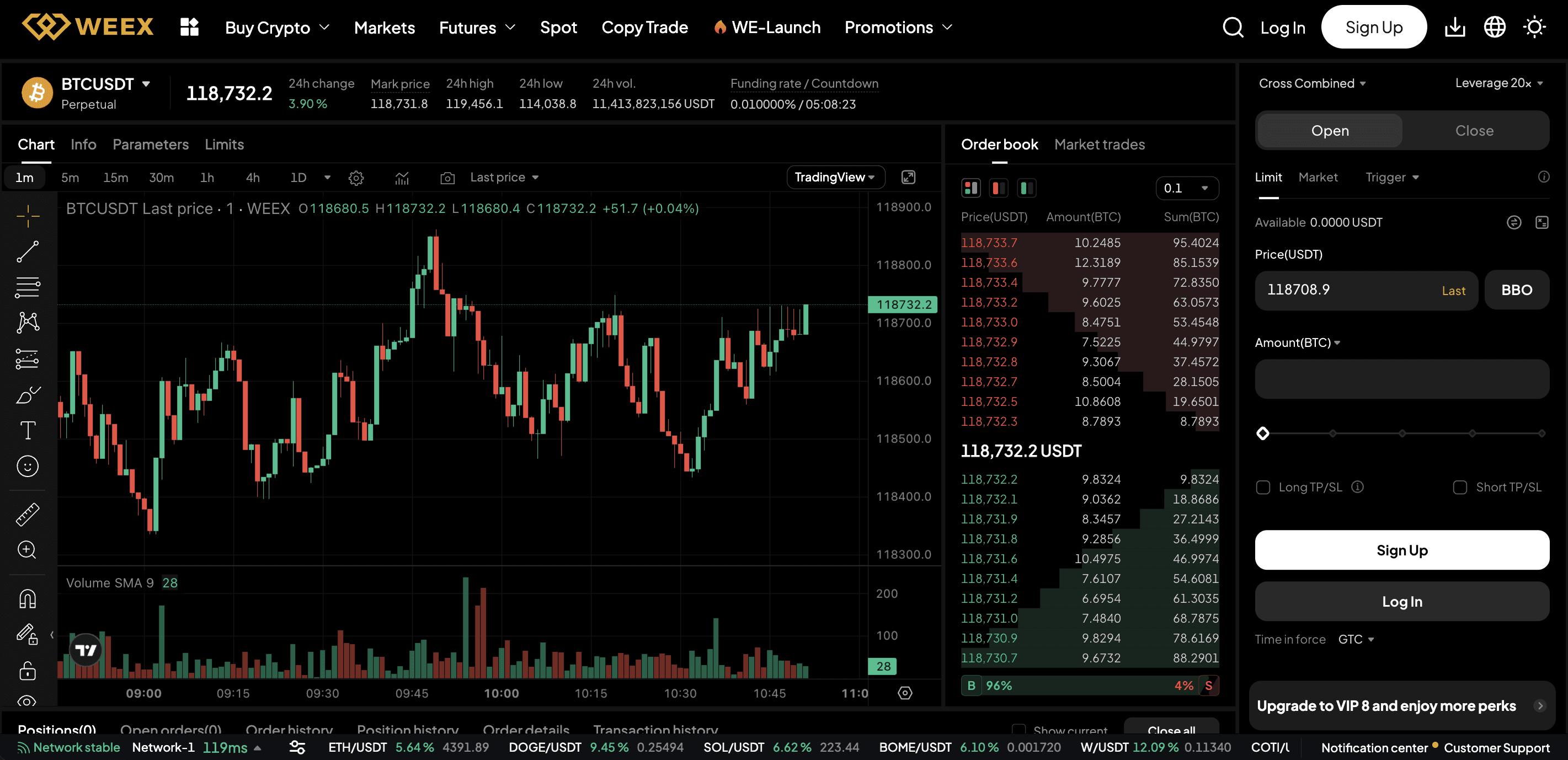
1. WEEX

WEEX stands as an emerging force in the crypto derivatives landscape, establishing its presence through competitive trading conditions and user-centric features. The platform has built a reputation for providing reliable execution capabilities combined with an accessible trading environment suitable for both novice and experienced traders.

The exchange offers substantial leverage options reaching up to 400x across a diverse portfolio of 1700+ trading pairs. Its fee structure remains competitive at 0.02% for maker orders and 0.08% for taker orders. Among its standout features is an industry-leading commission rebate program that offers up to 90% rebates, distributing over $12 million in monthly commission payouts to its user base. The platform's interface design emphasizes simplicity and functionality, delivering an ad-free trading experience that eliminates distractions while maintaining comprehensive tool access.

WEEX demonstrates impressive liquidity metrics, currently ranking second industry-wide in critical depth measurements including order book density and narrow price spreads. The platform's BTC markets can comfortably accommodate transactions of at least 800 BTC within a minimal 0.01% price variance, showcasing robust market depth. 

Also, WEEX Liquidity has earned recognition from authoritative platforms like Cryptorank, a testament to our robust market depth. This is exemplified by the ability to trade 800 BTC within a razor-thin 0.01% spread, a feature that directly contributes to lightning-fast, zero-lag trade execution and minimizes slippage for our users.

To master future trading, just read How to Trade Bitcoin Futures on WEEX and do your first future trading now!

Best Crypto Futures Trading Platforms in October 2025

Pros

  • Easy-to-use interface
  • Strong futures and copy trading features
  • No KYC for basic use
  • Competitive fees
  • Transparent reserves and protection fund

Con

  • No fiat withdrawals

2. MEXC

MEXC remains one of the largest crypto futures brokers for daily trading volume. It handles several billion dollars each day, providing futures trades with deep liquidity and tight spreads.

The platform offers perpetual futures, which rely on traditional order types but without expiration dates. Over 900 futures markets are listed, including the best meme coins like Pepe, Bonk, and Shiba Inu. MEXC supports linear and inverse contracts, and they settle in USDT or the underlying asset, respectively.

Leverage is available on all crypto futures, with large-cap pairs providing 500x multiples. The exchange reduces leverage limits on markets with weaker liquidity to help traders mitigate risk. The futures dashboard allows full customization, and users deploy drawing tools and technical indicators for real-time analysis.

Research shows that MEXC is one of the best crypto futures trading platforms for low fees. Traders pay just 0.01% per side on limits and 0.04% on markets.

New users register with an email address only and remain anonymous unless they withdraw more than 20,000 USDT daily, or 100,000 USDT monthly.

Pros

  • Access over 900 perpetual futures markets
  • Choose between linear and inverse contracts
  • Pay a maximum futures trading commission of 0.04%
  • No KYC when withdrawing under 20,000 USDT daily

Cons

  • The platform operates offshore without regulation
  • U.S. traders cannot access the exchange

3. Binance

Binance is a good option for traders who prefer traditional delivery futures over perpetuals. The tier-one exchange provides quarterly and bi-quarterly contracts for Bitcoin and Ethereum. These futures contracts, unlike perpetuals, do not incur funding fees. Traders may exit positions early, but they can also hold until the contract expiration date. This structure allows Binance users to trade futures with longer-term strategies.

Binance also caters to perpetual traders, with over 530 available markets. You can access the best altcoins, including Sui, Dogecoin, BNB, and Cardano, with leverage up to 125x.

The platform is known for its advanced trading tools, as Binance traders access multiple timeframes, indicators, deep order books, and automated bots. Accessibility includes desktop and mobile trading, ensuring futures traders monitor positions on the move.

Regarding fees, market makers get the lowest trading commissions of 0.018% per side. Takers pay more than double at 0.045%.

Pros

  • Trade delivery futures with quarterly and bi-quarterly expirations
  • Suitable for entering longer-term futures trades without funding fees
  • Also supports over 530 perpetual markets
  • The exchange boasts over 283 million users

Cons

  • Delivery futures support Bitcoin and Ethereum only
  • Restricts leveraged products in the U.S.
  • Often relies on third-party gateways for fiat payments

4. OKX

OKX offers one of the most extensive derivative ecosystems, including a comprehensive range of cryptocurrencies, instruments, and contract types.

Day traders may prefer OKX's perpetual futures market, which covers over 290 digital assets. Users find their favorite coin or token through narrative filters like RWA, AI, meme coins, and Layer 1. Perpetual futures incur funding rates every eight hours, and only longs or shorts are charged.

The next option is delivery futures, with only daily and weekly markets available for Bitcoin and Ethereum. These contracts offer longer-term exposure without funding fees. OKX also supports crypto options for the two market leaders. Seasoned traders access fully-fledged options chains with multiple strike prices and expiration dates, while beginners use the Simple Options tool for an easier trading experience.

OKX's entry-level commission when trading futures via market orders is 0.05% per side. Market makers and those who meet 30-day volume milestones receive lower commissions.

Pros

  • Access perpetuals, delivery futures, and options in one safe place
  • High-level charting tools with 100+ technical indicators
  • Heavily regulated in several global markets

Cons

  • U.S. traders can access OKX spot trading but not futures products
  • Delivery contracts support daily and weekly expirations only
  • Strict onboarding process with enhanced KYC

5. Bybit

If you're looking for the best crypto futures trading platform for supported markets, Bybit is a top choice. With over 600 perpetual contracts, Bybit provides access to a wide range of digital assets. Alongside market leaders like Bitcoin, XRP, BNB, and Ethereum, users trade volatile meme coins such as Popcat, SPX6900, Brett, and Peanut the Squirrel. Traders also speculate on decentralized finance (DeFi) futures contracts, from Zora and Uniswap to Pendle, Aave, and Ondo.

Most futures markets trade with USDT, although select pairs also support USDC. Platform users also choose between linear and inverse contracts, depending on their risk tolerance and trading goals. Bybit offers leverage of up to 200x on major pairs, but these limits decline when trading more volatile markets.

The exchange's fee structure is competitive and transparent. Traders pay 0.02% or 0.055% per side when placing limit or market orders, respectively. The platform also charges a small 0.05% settlement fee.

Pros

  • Gain exposure to over 600 digital assets via leveraged futures contracts
  • Supports smaller-cap meme coins with high volatility
  • Contract specifications include linear and inverse settlement

Cons

  • The charting platform may be overwhelming for beginners
  • Bybit is not available in the U.S. or the UK
  • Its derivative markets are not approved by any regulators

Why Choose WEEX?

Founded in 2018, WEEX has rapidly grown into one of the most trusted crypto exchanges, serving over 6.2 million users across 130+ countries. With a strong emphasis on security, liquidity, and ease of use, WEEX provides over 1,700 trading pairs and up to 400× leverage for futures trading, making it a powerful option for both beginners and pro traders.

Which Crypto Futures Exchange is Right for Me?

With hundreds of crypto futures exchanges to choose from, identifying your best option can be difficult. Ultimately, your trading proficiency, country of residence, and risk tolerance will all play a major part in informing your decision, which will naturally differ from another trader’s.

Trading proficiency: Different venues cater to different trader niches — though most are accessible to all skill levels, some offer unique products or features that are purpose-built for beginners or pro traders. Related is the user experience the exchange provides. The ease with which you can navigate the platform is critical in capitalizing on trades. Traders just getting familiar with how to integrate futures trading into their crypto strategy will likely have a different workflow than a seasoned high-frequency trader capturing arbitrage opportunities. Choosing the best crypto futures exchange for you may depend on your overall proficiency and familiarity with crypto trading to begin with, before you find the platforms that have the right features that match your needs.

Country of residence: With ever-changing global regulations, platforms can rarely offer true global coverage without running afoul of legislation. The same exchange may often need to provide a completely different experience from one country to the next to remain compliant. It’s worth considering exchanges that are proactive and transparent on this front — namely, those that actively strive to obtain the required licenses and comply with regulations.

Risk tolerance: Trusting a third-party with your funds comes with an inherent risk that they could be lost. It’s impossible to engage with a custodial exchange fully trustlessly, though you should familiarize yourself with prospective platforms’ security commitments and the measures they take to reduce your risk. Look for exchanges that implement measures such as Proof-of-Reserves (POR) audits, SOC compliance, and 2FA. Consider their track record and any major security breaches they may have sustained historically.

Trade Now

Time after time, both new and seasoned futures traders turn to WEEX for its seamless trading experience, top-tier security, and diverse product lineup.

Join millions of users who trust WEEX to trade futures and stay ahead in the fast-evolving crypto market. Start now!

You may also like

How to Buy Apple Stock on WEEX TradfFi in 2026: A Guide for TradFi and Crypto Investors

Apple remains a $4 trillion tech powerhouse — but traditional brokerages are no longer your only option. Here’s how to invest in 2026.

Key TakeawaysApple (AAPL) trades near its all-time highs, with analyst targets averaging $310 per share for 2026 — a potential 10%+ upside from current levelsYou can now gain exposure to Apple’s stock price 24/7 through WEEX TradFi perpetual futures — no brokerage account, no fiat deposit, no KYC hasslesUnlike traditional brokers, WEEX lets you trade Apple with USDT collateral, adjustable leverage (up to 100x), and the same interface crypto traders already use

Old Way: How to Buy Apple Stock Through a Brokerage

Before we explore better alternatives, here’s how traditional investors buy Apple shares:

Step 1: Choose a regulated brokerage (Fidelity, Schwab, Robinhood, etc.)Step 2: Complete identity verification and KYC (can take 2-5 business days)Step 3: Fund your account with USD via bank wire (another 1-3 days)Step 4: Buy AAPL shares during Nasdaq trading hours (9:30 AM – 4:00 PM ET)

The problem: This process assumes you have access to the U.S. banking system. For millions of global investors — particularly in Asia, Africa, and Latin America — opening a U.S. brokerage account ranges from difficult to impossible.

Even for those who can, you’re locked into fixed trading hours, minimum share purchases, and no leverage unless you apply for a margin account.

New Way: Trade Apple Perpetual Futures on WEEX TradFi in 2026

WEEX TradFi offers a fundamentally different approach. Instead of buying shares through a broker, you trade USDT-margined perpetual futures that track Apple’s real-time stock price — 7x24, with no brokerage account required.

What Are Apple Perpetual Futures?

A perpetual futures contract is a derivative that tracks the price of an underlying asset — in this case, Apple (AAPL) stock — but with no expiration date. You can hold a position for minutes, days, or months without worrying about contract rollovers.

Unlike traditional futures, perpetuals use a funding rate mechanism to keep the contract price anchored to Apple’s actual stock price on Nasdaq. Every 4 to 8 hours, longs pay shorts (or vice versa) depending on whether the perpetual is trading at a premium or discount to the spot price.

For crypto traders, this structure is already familiar — it’s exactly how BTC and ETH perpetuals work. WEEX applies the same logic to Apple, Microsoft, Nvidia, and other major stocks.

How WEEX TradFi Compares to Traditional Brokerages td {white-space:nowrap;border:0.5pt solid #dee0e3;font-size:10pt;font-style:normal;font-weight:normal;vertical-align:middle;word-break:normal;word-wrap:normal;}FeatureWEEX TradFiTraditional BrokerAccount setupMinutes, using existing crypto accountDays to weeks, plus bank verificationTrading hours7X24Nasdaq hours only (9:30 AM – 4:00 PM ET)Minimum tradeFractional (as little as $1 USDT)1 full share (~$270+)LeverageAdjustable up to 50xNone without margin accountCollateralUSDT (no fiat needed)USD via bank wireShort sellingBuilt-in (go long or short)Requires margin account approvalGlobal accessYes — any country where crypto trading is permittedRestricted by brokerage licensingWhy WEEX TradFi Works Better for Global Investors

WEEX solves three major friction points that traditional brokerages can’t:

No Banking Dependency

You don’t need a U.S. bank account, a local bank that supports international wires, or any fiat currency at all. Deposit USDT from any wallet, exchange, or OTC desk — on-chain transfers take minutes, not days.

Trade When News Breaks

Apple reports earnings, the Fed announces rate cuts, or a supply chain disruption hits China — these events don’t wait for the Nasdaq opening bell. With 24/7 trading on WEEX, you can enter or exit positions immediately when news breaks, not 12 hours later.

Unified Portfolio Management

Your Apple position sits alongside gold, oil, forex, and crypto — all in one USDT account. No separate logins, no capital transfers between platforms, no fragmented margin.

How to Trade Apple Futures on WEEX in 2026: Step-by-Step GuideStep 1: Create Your WEEX Account

Go to WEEX official website and register with your email or phone number. Complete basic KYC verification — this typically takes 5-10 minutes.

Step 2: Deposit USDT

Transfer USDT to your WEEX account or buy directly via fiat or quick buy. Choose any network — ERC-20, TRC-20, BEP-20 — all are supported.

Step 3: Search for Apple Perpetual Contracts

Go to the WEEX Futures page and search for AAPLUSDT.

Step 4: Set Your Leverage

Adjust leverage from 1x to 50x. Lower leverage (2-5x) mimics spot exposure with less risk. Higher leverage amplifies both gains and losses — use cautiously.

You can access up to 100x leverage on AAPL.

Step 5: Choose Long or ShortLong if you expect Apple’s stock price to riseShort if you expect Apple’s stock price to fall

Unlike traditional brokers, short selling on WEEX requires no margin account approval or share borrowing — just click “Sell” and you’re short.

Step 6: Place Your Order

Choose between:

Market order — executes immediately at current priceLimit order — executes only at your specified priceStop-loss / Take-profit — automatic exit levels for risk management

Note: Always set stop-loss and take-profit before clicking buy.

Step 7: Monitor Funding Rates

Every 8 hours, a funding fee is exchanged between longs and shorts. Check the current rate before holding positions overnight. In most market conditions, funding rates are minimal (0.01% or less).

How to Trade Apple Futures Safely: 4 Strategies for BeginnersStrategy 1: Earnings Season Directional Plays

Apple reports earnings four times per year. The stock typically moves 3-7% on the day of release. With WEEX perpetuals, you can:

Enter a position minutes before the report (no settlement delays)Use 3-5x leverage to amplify the moveSet tight stop-losses (2-3%) to cap downsideStrategy 2: Hedging a Crypto Portfolio

If you hold significant crypto, Apple often moves independently of Bitcoin. During crypto drawdowns, Apple may hold steady or rise — especially if macro fears (inflation, rates) are driving the selloff. A long Apple position can offset crypto losses.

Strategy 3: News-Based Scalping

Apple is constantly in the news — product launches (iPhone 18 expected September 2026), supply chain updates, antitrust rulings, China relations. Each event creates intraday volatility. With 24/7 access, you can trade these headlines immediately, not the next morning.

Strategy 4: Diversification Without Brokerage Overhead

For crypto-native investors who don’t want to open a traditional brokerage account, WEEX TradFi offers a single interface for Apple, gold, oil, forex, and crypto. Rebalance across asset classes without leaving the platform.

Final Thoughts: Buy Apple Stocks on WEEX TradFi

Apple remains one of the most important companies in the global economy — 4 trillion in market cap, 400 billion in annual revenue, and a device ecosystem that touches billions of users. Gaining exposure to Apple’s price movements is a core position for many investors.

Traditional brokerages served the 20th century well. In 2026, you have better options: 24/7 trading, no banking friction, fractional access, and unified portfolio management with crypto and commodities — all from a single USDT account.

WEEX TradFi isn’t just an alternative to Robinhood or Fidelity. It’s a fundamentally different paradigm: stock exposure designed for the crypto-native world.

Ready to trade APPLE futures? Sign up on WEEX Now and Start Trading!

FAQ

Q: What if I invested $10,000 in Apple 30 years ago?

If you had invested $10,000 in Apple 30 years ago (in 1996) and reinvested your dividends, that position would be worth roughly 6.9 million to 11 million today.

Q: What could Apple stock be worth in 2030?

Apple's share price will double to around $550

Q: Is Apple a long-term stock?

Apple Inc. continues to represent a high-quality compounder with durable earnings power and significant capital return support, making it a core long-term holding in global equity portfolios.

Q: Will Apple stock reach $500?

It is possible for Apple (AAPL) stock to reach $500, but analysts generally project this as a long-term milestone for 2030 or beyond.

How to Trade FUTU Futures in 2026: Why WEEX TradFi is the Best Choice for Beginners

You’re not here for dividends. You’re here because Futu Holdings (FUTU) powers China’s online brokerage boom—and you want to know: too late, or just getting started?

By 2026, Futu’s twin apps (Futubull and Moomoo) made it a $21.7 billion force. But active traders know: while others wait for the NASDAQ bell, the smart crowd trades FUTU futures 24/7 on crypto exchanges.

This guide covers: what FUTU futures are, how TradFi perpetual contracts work, and how to trade them without a traditional broker account.

What Is Futu Holdings

Futu Holdings is the parent company behind Futubull and Moomoo — two digital brokerage platforms dominating Hong Kong, Singapore, and increasingly the US market .

The company makes money three ways:

Brokerage commissions from every trade users placeMargin financing interest when traders borrow to leverage upWealth management fees from fund products

As of May 2026, FUTU trades around 124–124–155 per share, with a 52-week range between 96.27 and 202.53 . The stock is volatile — exactly what futures traders want.

FUTU Recent earnings snapshot (Q4 2025):

EPS: 3.07(beatestimatesby3.07(beatestimatesby0.01)Revenue: 827.15million(above827.15million(above788.73M expected)Next earnings (Q1 2026): estimated June 4, 2026What Are FUTU Futures

Traditional futures are contracts to buy or sell an asset at a predetermined price on a specific future date. They expire. You have to roll them over. It’s a headache.

FUTU futures on WEEX Exchange work differently.

What you’re trading is a perpetual contract — no expiration date, no rollover, no physical delivery. You hold the position as long as you want and close it when you’re ready.

Here’s the key: you’re not buying Futu stock. You’re trading the price movement of FUTU using USDT as your margin. Go long if you think earnings will crush estimates. Go short if you think the Hong Kong market cools off.

What Is TradFi Perpetual Contracts

TradFi stands for Traditional Finance — stocks, commodities, forex, gold. TradFi perpetual contracts apply crypto’s most successful derivative structure (the perp) to these traditional assets .

How they work:

You deposit USDT. You choose an asset — FUTU stock, gold, crude oil, NASDAQ indices. You open a position with leverage. No broker account. No USD bank transfer. No tax forms. Just a crypto wallet and a few clicks .

Key differences from traditional futures:

td {white-space:nowrap;border:0.5pt solid #dee0e3;font-size:10pt;font-style:normal;font-weight:normal;vertical-align:middle;word-break:normal;word-wrap:normal;}FeatureTraditional FuturesTradFi Perpetuals (on WEEX)Expiration dateYes — must roll overNo — hold indefinitelySettlement currencyUSD, HKD, etc.USDTTrading hoursMarket-specific sessions7月24日Physical deliveryPossible for commoditiesNever — cash settledAccount neededBrokerage accountCrypto wallet + exchange account

The funding rate mechanism keeps the perpetual price anchored to the real FUTU stock price. Every few hours, longs pay shorts or shorts pay longs depending on which side is more crowded .

This structure has exploded in 2026. Binance’s TradFi perp volume grew from 0.2% to 4.9% of major futures markets in just 90 days — with silver perps hitting 20.8% of COMEX volume at peak .

Why FUTU Futures in 2026Earnings volatility

Futu reports Q1 2026 earnings around June 4 . The stock moved 15-20% around past reports. With 10x leverage, that’s a 150-200% move — in either direction.

Hong Kong-China retail boom

Chinese retail investors are hungry for US stocks. Futu’s platforms are their primary gateway. As long as that demand holds, FUTU stays relevant.

24/7 access to NASDAQ names

Futu trades on NASDAQ. NASDAQ closes at 4 PM ET. If news drops at 9 PM, traditional traders wait until morning. FUTU futures traders act immediately .

No PDT rule

The Pattern Day Trader rule (25k minimum for frequent trading) doesn’t apply to crypto-based futures. Trade as much as you want with whatever capital you have.

FUTU Stock vs. FUTU Futures: What’s the Difference?

td {white-space:nowrap;border:0.5pt solid #dee0e3;font-size:10pt;font-style:normal;font-weight:normal;vertical-align:middle;word-break:normal;word-wrap:normal;}AspectFUTU StockFUTU Futures (Perpetual)What you ownEquity shareA contract tracking priceTrading hoursNASDAQ hours (9:30 AM – 4 PM ET) + limited after-hours (4-8 PM ET) 7月24日Leverage2x max from most brokersUp to 100xSettlement currencyUSDUSDTDividendsYou receive themPriced in (no separate payment)Voting rightsYesNo

Note: Stock is for investors. Futures are for traders.

How to Trade FUTU Futures on WEEX TradFi: Step-by-StepStep 1: Deposit funds

You need to deposit USDT (Tether) on WEEX. Buy USDT with fiat or transfer from your crypto wallet.

Step 2: Find the FUTU perpetual contract

Go to the WEEX Futures page and search for FUTUUSDT.

Step 3: Decide to go long or short

Go long: You expect Futu’s next earnings to beat estimates or Hong Kong retail activity to surgeGo short: You think valuation is stretched or competition (like Tiger Brokers) is eating market share

Step 4: Set leverage

Start small. 5x or 10x is plenty for beginners. 100x leverage means a 1% move against you liquidates your position. You can access up to 50x leverage on FUTU .

Step 5: Place stop-loss and take-profit

Always set stop-loss and take-profit before clicking buy. The market can gap overnight. Stop-losses save accounts.

Step 6: Monitor funding rates

Check the funding rate before holding overnight. If it’s high, you’re paying to keep the position open.

Key Risks to Know Before Trading FUTU FuturesLiquidation risk: Leverage magnifies losses. A 10% drop with 10x leverage = 100% loss. Your position closes automatically when margin runs out.Funding rate cost: If everyone is bullish on FUTU, longs pay shorts. Holding through high funding rates eats profits.Basis risk: The perpetual price tracks the real FUTU price via an index. In extreme volatility, the basis can widen before correcting.After-hours spreads: When NASDAQ is closed, FUTU futures still trade. Liquidity can thin out, widening spreads .Conclusion

The debate is whether Chinese retail demand for US stocks will cool off. The data says no. Hong Kong and Singapore trading volumes remain strong, and Futu's platforms keep adding users.

Even if competitors catch up, Futu holds the edge. Its app experience and liquidity keep traders locked in. For active traders: earnings volatility + 24/7 markets + leverage = opportunity.

Ready to trade FUTU futures? Sign up on WEEX Now and Start Trading!

FAQ

Q: What is FUTU futures?

FUTU futures are perpetual contracts tracking the price of Futu Holdings stock (NASDAQ: FUTU). They have no expiration date and settle in USDT, allowing 24/7 trading.

Q: How is FUTU futures different from buying FUTU stock?

Futures give you leverage, 24/7 access, and USDT settlement. Stock gives you ownership, dividends, and voting rights. Futures are for short-term trading; stock is for investing.

Q: What are TradFi perpetual contracts?

TradFi perpetuals apply crypto’s perpetual swap structure to traditional assets like stocks, gold, and oil. You trade price movement with USDT margin, no broker account required .

Q: Where can I trade FUTU futures?

You can trade FUTU futures on WEEX TradFi. Look for FUTUUSDT pairs on the futures trading page.

Can Silver Hit $200 in 2026? Trade XAG Futures on WEEX TradFi

In early 2026, the momentum was undeniable. Silver smashed through the $100 barrier, seemingly validating Robert Kiyosaki's most aggressive calls.

However, as of late May 2026, the metal has retraced sharply, hovering in the 73–73–80 range.

That volatility begs the question: Is the bull run over, or is this the last chance to buy before the predicted surge to $200?

While Kiyosaki doubles down on his “fiat is trash” narrative, the market mechanics have shifted. Here is the professional breakdown of the silver price 2026 outlook and why sophisticated traders are moving to platforms like WEEX TradFi to position for the next leg up.

Why This Correction Isn’t a Collapse

To understand if silver can reach $200, we have to respect the bear arguments first.

Recently, institutions like UBS have slashed price targets, citing a slowdown in Chinese solar panel demand and a retreat in ETF inflows. The physical deficit is shrinking, and high interest rates remain a headwind.

But here is the contrarian view. Kiyosaki’s $200 prediction isn’t based on current industrial demand alone. It’s based on currency debasement. With the Fed signaling shifts in monetary policy and the dollar index showing structural weakness, the “fake money” printing press is spinning up again.

Silver remains one of the most undervalued hard assets. Once the Fed pivots, the metal could gap higher violently.

The 2026 Supply Crunch vs. Green Demand

Ignoring short-term noise, the macro setup for silver price 2026 is still bullish. Even UBS admits the market is in a deficit — just a smaller one than last year.

Solar & EVs – The “low silver” tech isn’t ready for prime time. Photovoltaic silver paste consumption remains high.The catch‑up trade – Gold is at all‑time highs. Historically, when the gold‑to‑silver ratio is elevated, silver eventually plays catch‑up.

If you wait for $80 to hold before buying, you might end up chasing the price. The smart money is setting limit orders on the dip.

Should Investors Buy Silver Now?

Not everyone should buy silver just because Kiyosaki says so. It really comes down to how much risk you can stomach and what you're trying to achieve.

If you think inflation isn't going away and the dollar will keep sliding, silver makes sense as a long-term hedge. But don't kid yourself — this market is a rollercoaster. Prices can swing 10% in a single week, let alone a month.

That's why most seasoned investors don't go all in. They treat silver as one piece of a bigger puzzle — alongside stocks, crypto, or even cash. Spreading your chips around keeps you sleeping at night when silver decides to take a 20% dive.

Trade XAG on WEEX

Forget waiting for COMEX hours. To capitalize on overnight volatility driven by Asian markets or Middle East tensions, you need a platform that never sleeps.

This is why professional retail traders choose to Trade XAG on WEEX.

Unlike traditional brokers that freeze during news events, WEEX operates 24/7.

Liquidity: Allowing you to go long or short with leverage up to 400x.Real‑World Asset (RWA) access: Trade tokenized silver that directly tracks the spot price, avoiding the rollover costs of traditional futures.Security: Transparent proof of reserves and a “no KYC hassle” for crypto natives, bridging the gap between TradFi security and DeFi accessibility.

Conclusion: Trade Silver on WEEX TradFi

Let's be real — Kiyosaki's $200 call has gotten everyone talking. And sure, he's got some solid points backing him up: fiat currencies looking shaky, inflation still hanging around, and green tech hungry for more silver.

But here's the catch. Silver is wild. Always has been. Hitting $200 is a long shot, not a sure thing. So don't get emotional. Don't chase pumps. Manage your risk like a pro, or this market will eat you alive.

If you want to trade silver without the old-school broker headaches, WEEX TradFi gives you 24/7 access, deep liquidity, and the ability to hedge both crypto and hard assets in one place.

Sign up on WEEX Now and Start Trading!

FAQ

Q: What is the current silver price trend for 2026?

As of late May 2026, silver is trading in a correction zone between 73and73and80, pulling back from highs above $100 due to easing supply deficits and rising interest rates.

Q: Is it safe to Trade XAG Futures on WEEX TradFi?

Yes. WEEX has established itself as a secure gateway between crypto and traditional finance. The platform provides proof of reserves and adheres to strict risk controls for its XAG perpetual futures.

Q: Will silver ever reach $100?

Silver has already broken the triple-digit mark. The precious metal made history by officially surging past $100 per troy ounce for the first time.

The Next Big Thing in On-Chain AI: Latest Developments in the Base Chain AI Ecosystem

The Base Chain AI ecosystem is undergoing a structural overhaul, with Venice (VVV) having replaced Virtual Protocol as the dominant force in the ecosystem, driving a new wave of AI innovation and hype.   The evolution of the Base Chain AI ecosystem follows a clear trajectory of “out with the old, in with the new”:In 2024, Virtual Protocol dominated the ecosystem with its “AI Agent Launchpad” model, incubating over 50 Agents and reaching a peak market capitalization of $500 million;In 2025, projects like Clanker and BankrCoin began expanding into automated trading;By 2026, Venice had closed the loop between the “application layer and financial layer,” fully seizing control of the AI ecosystem.Venice’s breakthrough was no accident. Under Erik Voorhees’s architecture, the platform has shed the shadow of its early days as a DeepSeek concept coin, instead building a closed-loop business growth model supported by real user growth, subscription revenue, and sophisticated token economics: The explosive popularity of OpenClaw provided the initial user base, and the platform successfully “commoditized” AI inference costs by linking subscription revenue to VVV buybacks and burns, and allowing stakers to mint $DIEM tokens with actual API credit limits.As of May 2026, the Venice platform had over 2 million total users, 55,000 paid subscriptions, monthly revenue of $835,000 (growing at a monthly rate of 15%), and VVV had risen over ninefold since the beginning of the year, with a circulating market capitalization of approximately $795 million.Here are some noteworthy projects in the Venice ecosystem: Venice (VVV): A privacy-focused, censorship-resistant generative AI platform that has built a unique “privacy AI + token economy” ecosystem through its VVV token. Rather than training its own models, the platform leverages open-source model capabilities, emphasizing privacy protection and TEE (Trusted Execution Environment) proof technology. Through an innovative token mechanism, it empowers users to become participants and owners of the platform’s economy, serving as the core of the Venice ecosystem.Trade VVV/USDT Now Diem (DIEM): An innovative computing power equity tool within the Venice ecosystem, minted by staking sVVV, representing a permanent stake in the Venice platform’s computing power. Its core design is “1 DIEM = $1 in API credit automatically renewed daily.” This credit is valid indefinitely and can be used to pay for Venice’s AI inference services.Trade DIEM/USDT Now Dolphin Network (POD): A distributed AI inference and training network that allows users to contribute idle GPU computing power and earn POD token rewards. Its core value lies in providing distributed computing power support for Venice and jointly developing key AI models.Trade POD/USDT Now gitlawb (GITLAWB): A decentralized code collaboration platform offering GitHub-like functionality for AI agents, supporting code pushes and pull requests via cryptographic identities. It recently integrated Venice AI models, launched the OpenGateway free LLM API, and received sponsorship from Xiaomi MiMo and GMI Cloud.Trade GITLAWB/USDT Now It is clear that the strong performance of the Venice matrix signals that the Base AI sector is moving from “testing the waters” to “practical implementation.” Assets within its ecosystem, such as VVV, DIEM, POD, and GITLAWB, have begun to form a synergistic network encompassing “governance, computing power, tools, and services.”The boom in the Venice ecosystem has also directly boosted activity across the Base chain ecosystem. According to DeFiLlama data, on May 24, the 24-hour trading volume on Base chain DEXs surpassed that of Solana for the first time, reaching $1.217 billion.However, behind this boom, the fast-paced nature of rapid capital rotation and the sharp rises followed by declines in some assets remains evident. Historical experience suggests that Base’s underlying DNA is inherently “slow-burning,” relying on compliance infrastructure and EVM compatibility to follow a long-term trajectory. What has recently been overshadowed by liquidity spikes is the rhythm by which high-quality projects build fundamentals through genuine API calls, continuous token burns, and iterative developer contributions.In the future, whether this “Renaissance” of the AI ecosystem can weather both bull and bear markets will not depend on short-term narrative packaging, but rather on the granularity of technical delivery, the conversion rate of real revenue, and the ability to truly transition from “single-point explosions” to “ecosystem resonance.” We will continue to track on-chain data and developer activity, seeking certainty amid the noise. Reade More:Base AI Spot Challenge:Share $100,000 Latest Updates on WEEX

Welcome Bonus from WEEX - Claim Up to 30,000 USDT! Join Now!

Explore the latest token rewards on WEEX Token Airdrop and discover more opportunities to claim crypto bonuses.

Put your idle crypto to work with WEEX Auto Earn and start earning flexible rewards from your digital assets.

Is Polymarket a Gambling Site? Complete Guide to Polymarket

You've seen the screenshots on X. Millions of dollars riding on election outcomes, Oscar winners, even weather patterns. Polymarket is everywhere.

But here's the question that keeps popping up in Telegram groups, tax forums, and late-night crypto debates: Is Polymarket gambling?

Let's cut through the Web3 marketing speak and give you a straight answer.

How Does Polymarket Decentralized Prediction Market Work

You put money into a pool. You pick an outcome. If you're right, you get paid. If you're wrong, you lose everything. That's the core mechanic.

Polymarket runs on Polygon blockchain. No middleman holds your funds. Smart contracts handle the payouts. Technically, it's decentralized. But technically, a roulette wheel is also just a spinning disk with numbers.

The platform calls it "information discovery" or "crowd-sourced forecasting." Critics call it betting. Users call it whatever helps them sleep at night.

So is Polymarket considered gambling by regulators? That depends entirely on where you live.

Is Polymarket Legal

Let's start with the US. The Commodity Futures Trading Commission (CFTC) has gone after prediction markets before. They don't like unregulated event-based binary options. Is Polymarket legal in the US? Sort of. The platform blocked US users after a 2022 CFTC settlement. But VPNs exist. People still use it.

Now here's where the answer gets clearer.

In May 2026, Indonesia blocked Polymarket. Not just restricted it. Full ban. The government's official statement called it "online gambling in disguise." That's a direct quote.

When a country with strict anti-gambling laws looks at Polymarket and says "that's gambling," you should pay attention.

So what country banned Polymarket recently? Indonesia is the biggest example. More will follow.

Prediction Market vs Gambling: Is There Actually a Difference?

Here's the argument Polymarket fans make:

"It's not gambling. It's hedging. Traders use derivatives to manage real-world risk. Farmers use futures to protect crop prices. This is the same thing."

Here's why that argument falls apart for 99% of users:

A farmer hedging corn prices actually grows corn. A airline hedging fuel prices actually flies planes. They have real exposure to those outcomes.

What real-world risk are you hedging by betting on who wins the next presidential debate? None. You just want to be right and get paid.

That's not hedging. That's gambling with extra steps. The difference between prediction market and gambling comes down to intent. If you have no underlying position to protect, you're not hedging. You're betting.

Do You Pay Taxes on Polymarket Winnings?

Short answer: yes. Long answer: it depends how your country classifies it.

Some tax authorities treat prediction market profits as capital gains. You bought a share for 0.30 and sold it for 1.00. That's a $0.70 gain. Report it.

Others treat it as gambling winnings. Different rates. Different rules. Sometimes no reporting threshold at all.

The question "is Polymarket a gambling income" matters because of how you file. A CPA who understands crypto is not optional here. Guessing gets people audited.

Bottom line: the IRS (or your local equivalent) doesn't care what you call it. They want their cut.

Can Trading Be Considered Gambling?

People ask this a lot. And the honest answer is: it depends how you trade.

Buying an index fund and holding for 20 years? That's investing. Buying a stock because you read a 10-K and understand the business? That's also investing.

Buying a binary option that expires in five minutes based on a news headline you saw on X? That's gambling. You just found a faster way to lose money.

Polymarket sits right in the middle of this blurry line. It uses trading vocabulary—"buying shares," "order books," "liquidity"—but applies it to zero-sum event betting.

The vocabulary doesn't change the math.

Final Thoughts: Is Polymarket Gambling?

If it looks like betting, acts like betting, and regulators call it gambling, it's gambling.

Polymarket has a slick UI and runs on blockchain. That doesn't change the core mechanic. You wager money on an uncertain outcome. Someone else takes the other side. Winner gets paid. Loser gets nothing.

That's not investing. That's not hedging. That's a bet. Use it if you want. Just don't lie to yourself about what it is.

FAQ

Q: Is Polymarket considered gambling or trading?

A: Under most legal frameworks, it's gambling. Traditional trading involves buying assets with intrinsic value. Polymarket involves wagering on zero-sum, time-bound events. If you're wrong, you lose everything. That's betting, not investing.

Q: Is Polymarket legal in the US?

A: Not exactly. Polymarket settled with the CFTC in 2022 and blocked US users. But people use VPNs. The legal risk is on the platform, not individual users in most cases—but check your local laws before touching it.

Q: Do you have to pay taxes on Polymarket winnings?

A: Yes. Most tax authorities expect you to report profits. Classification varies: some treat it as capital gains, others as gambling winnings. Talk to a CPA who understands crypto. Don't guess.

Q: What is the difference between Polymarket and traditional gambling sites?

A: The technology and terminology. Polymarket runs on blockchain and uses trading language ("shares," "liquidity"). Traditional gambling sites use "bets" and "odds." The underlying mechanic—wagering money on uncertain outcomes—is identical.

What Does Liquidation Mean and How to Avoid Liquidation 2026? Best Strategies for Beginners

You open a trade. Leverage set to 10x. Price moves against you by 10%. Your position is gone.

That's liquidation. It happens fast. It happens to beginners and experienced traders alike. And if you don't understand how it works, it will happen to you too.

Let's break down what does liquidate mean in crypto, why liquidations happen, and how to avoid getting caught.

What Is Liquidation in Crypto?

Liquidation in crypto happens when you trade with leverage and the market moves against you. The exchange closes your position automatically because you no longer have enough funds to keep it open.

You lose your collateral. The trade ends. No second chances.

When someone asks what does it mean to get liquidated in crypto, the answer is simple: the exchange decides your position is too risky and closes it for you. You don't get a vote.

How Crypto Liquidations Happen

Let's walk through the process step by step.

Step 1: You open a leveraged trade. You put up collateral called "initial margin."Step 2: The market moves against you. Your remaining margin shrinks.Step 3: You hit the "maintenance margin" level — the minimum amount the exchange requires to keep your trade open.Step 4: The exchange issues a margin call. This is a warning. They ask you to add more funds.Step 5: If you don't add funds and price keeps moving against you, the exchange automatically closes your position.Step 6: The exchange charges a liquidation fee for closing your trade. That fee encourages traders to close their own positions before the system does it for them.

The whole process can take seconds. Most traders never see the margin call coming.

What Is the Liquidation Price?

The liquidation price is the exact price at which your position gets automatically closed.

It's not a fixed number. It depends on several factors:

How much leverage you usedThe current price of the assetYour remaining account balanceThe exchange's maintenance margin rate

You can calculate your liquidation price before opening a trade. Most exchanges show it to you. If you ignore it, that's on you.

Types of Liquidation: Partial vs Total

Not all liquidations are the same.

Partial liquidation means only part of your position gets closed. The exchange reduces your exposure but leaves some of your trade open. This is usually voluntary — the trader chooses to close a portion to protect the rest.

Total liquidation means your entire position is gone. Everything. The exchange closes your whole balance to cover losses. This is almost always forced liquidation. You didn't act. The exchange acted for you.

Here's what new traders don't know: after total liquidation, the exchange also charges a fee. So you lose your margin plus you pay for the privilege of being liquidated.

What Happens If Liquidation Exceeds Your Margin?

Bad situation. It's called bankruptcy.

If price moves so fast that your liquidation price blows past your initial margin, you could end up with a negative balance. You owe the exchange money.

Most major exchanges have insurance funds to cover this. The insurance fund absorbs the loss so you don't go negative. But not every exchange has one, and not every trade is covered.

Check before you trade. Don't assume you're protected.

How to Avoid Liquidation

Three methods. All of them work. None of them are complicated.

Control your risk percentage per trade

Decide how much of your account you're willing to lose on a single trade. The standard rule? 1% to 3% of your total account.

If you risk 1% per trade, you'd need to lose 100 trades in a row to go broke. That's nearly impossible even in crypto.

This is the single most important rule in trading. Most people ignore it. Most people get liquidated.

Always use a stop-loss

A stop-loss automatically closes your trade at a preset price.

Example: You enter at 10,000.Yousetastop−lossat10,000.Yousetastop−lossat9,800. If price drops to $9,800, you're out. You lost 2% instead of 100%.

Without a stop-loss, a sudden crash liquidates your entire position. With one, you live to trade another day.

Be smart with leverage

Higher leverage = higher risk. That's not a theory. That's math.

2x leverage: price moves 50% against you to get liquidated5x leverage: price moves 20% against you10x leverage: price moves 10% against you20x leverage: price moves 5% against you50x leverage: price moves 2% against you

Most beginners use too much leverage. Then they wonder why they got liquidated.

Match your leverage to your risk tolerance and market conditions. High volatility + high leverage = guaranteed liquidation.

Final Thoughts

Crypto liquidation explained in one sentence: you borrow money to trade, price moves the wrong way, the exchange takes your money and closes the trade.

Understanding what does liquidate mean in crypto is the difference between surviving and blowing up your account.

The tools to avoid liquidation are simple. Risk 1-3% per trade. Use stop-losses. Don't over-leverage.

But simple doesn't mean easy. It takes discipline. Most traders don't have it. That's why most traders lose money.

Ready to start futures trading? Sign up on WEEX Now and Start Trading!

FAQ

Q: What is liquidation in crypto?

Liquidation in crypto happens when a leveraged trade moves against you and the exchange closes your position automatically because you no longer have enough margin to keep it open.

Q: What does liquidate mean in crypto?

To liquidate means the exchange forces you to close a leveraged position at a loss. You lose your collateral (initial margin) and the trade ends.

Q: What does it mean to get liquidated in crypto?

Getting liquidated means you failed to meet the margin requirements for your leveraged trade. The exchange closes your position, and you lose the funds you put up as collateral.

Q: How do crypto liquidations happen?

Liquidations happen when the market moves against your leveraged position, your margin drops below the maintenance requirement, and the exchange issues a margin call. If you don't add funds, the exchange automatically closes your position.

iconiconiconiconiconiconicon
Customer Support:@weikecs
Business Cooperation:@weikecs
Quant Trading & MM:bd@weex.com
VIP Program:support@weex.com