
Meta Stock Rallied After a $16.68 Billion Settlement: Why a Legal Loss Sent Shares Higher

 Prefer us on Google
Meta stock climbed sharply the same week the company agreed to pay out one of the largest legal settlements in its history, and that sequence isn't the contradiction it first appears to be. Meta stock had been trading well below its 52 week high for months, weighed down by a lawsuit that Meta's own legal team had estimated could cost as much as $1.4 trillion in a worst-case verdict. When that open-ended risk got replaced with a fixed, quantified number, Meta stock did exactly what markets tend to do once genuine uncertainty gets resolved: it repriced upward, fast.
Moves like this are exactly the kind of event WEEX's Stock Spot 2.0, running from August 31 through September 15, 2026, is built around, giving traders a way to act on named stock tokens, including Meta, as part of a broader lineup covering the Magnificent Seven and other major names, without needing to open a separate brokerage account.
What Meta Actually Settled and Why the Number Mattered
Meta reached a $16.68 billion settlement with 29 U.S. states, confirmed through court documents on August 26, resolving all federal and state court claims that the company had deliberately designed Facebook and Instagram to be addictive to children and teenagers, according to Investing.com. The agreement also requires Meta to implement nationwide platform changes, including default safety settings, addressing the substance of the claims rather than simply settling to make the case disappear.
The specific number is what made this a market moving event rather than routine legal housekeeping. Meta's own legal team had calculated that a worst case verdict in the trial, which opened in Oakland on August 18, could reach as high as $1.4 trillion, a figure that had weighed heavily on the stock throughout the proceedings. A $16.68 billion settlement, while still a substantial sum in absolute terms, represents a small fraction of that worst case exposure, which is precisely why the market treated the resolution as a relief event rather than a cost event.

Why Capping an Open Ended Risk Moves a Stock More Than the Payment Itself
Markets generally price in uncertainty more harshly than they price in a known, finite cost. An open ended legal exposure, one where the eventual number could range anywhere from a modest settlement to a company-threatening verdict, forces investors to discount the stock against a wide range of bad outcomes simultaneously. Once that range collapses down to a single, disclosed figure, even a large one, the stock no longer has to carry the weight of every worse scenario that was previously still on the table.
This dynamic explains why Meta stock surged 3.9% in pre-open trading immediately following the settlement news, according to Investing.com, even though $16.68 billion is not a trivial amount for any company to pay. The move wasn't really about the settlement being cheap. It was about the settlement being final, replacing an unresolved liability that could have run into the trillions with a number the market could actually underwrite.
How Analyst Conviction Reinforced the Move
The settlement didn't move Meta stock in isolation. The prior evening, analyst Mark Mahaney reiterated a Buy rating and lifted his price target to $860, arguing that Meta's long-term AI-driven earnings power remained intact despite the legal overhang, according to Investing.com's reporting. That kind of analyst reinforcement, arriving right as the legal risk was being resolved, gave traders a second reason to buy beyond the settlement news alone.
This pattern repeated in the days that followed. Meta stock climbed a further 3.5% to reach $598.75 after Bernstein SocGen Group reiterated an Outperform rating with an $800 price target, with analysts arguing Meta was on track to surpass Google Search in advertising revenue in 2026, according to Investing.com. The combination of a resolved legal overhang and a string of bullish price target revisions from separate analysts created a self-reinforcing setup, where each piece of positive news made the next one land with more weight than it might have carried on its own.
-- Price
The AI Product News That Added to the Momentum
Beyond the legal settlement and analyst commentary, Meta added its own concrete news to the mix. The company's Superintelligence Labs unveiled Muse Voice Transcribe, a real-time speech recognition model priced at $3 per 1,000 audio minutes, which posted a 3.1% word error rate on a key streaming benchmark, a result Investing.com reported as besting comparable offerings from OpenAI and Google. Meta also launched Meta AI for Mac and moved its Muse Code product out of beta during the same stretch.
This detail matters because it shifted part of the rally's narrative away from pure legal relief and toward tangible product execution. A stock recovering purely because a lawsuit got resolved is a different story than a stock recovering because a lawsuit got resolved and the company is simultaneously shipping AI products that beat competitors on a measurable benchmark. The second version gives investors a forward-looking reason to stay in the position rather than just a reason the downside risk got smaller.
What This Rally Says About Meta's Remaining Distance to Recover
None of this means Meta stock has fully recaptured its prior highs. The stock's 52 week range runs from a low of $520.26, touched during the peak of trial related anxiety, to a high of $790.80, according to Investing.com, and even after this rally, Meta remains well below that upper bound. The settlement removed a specific source of downside risk, but it didn't by itself close the entire gap between where the stock trades now and where it traded before the legal overhang existed.
That remaining distance is worth sitting with rather than assuming the rally has already run its course. A stock recovering from a legal risk discount typically closes that gap in stages, first pricing out the worst-case scenario, as this settlement did, and only later re-rating toward its prior valuation as the market gains confidence that the underlying business, in Meta's case increasingly centered on AI monetization and advertising execution, can sustain the growth that justified those earlier, higher prices.
Where To Trade Meta Stock Exposure Directly
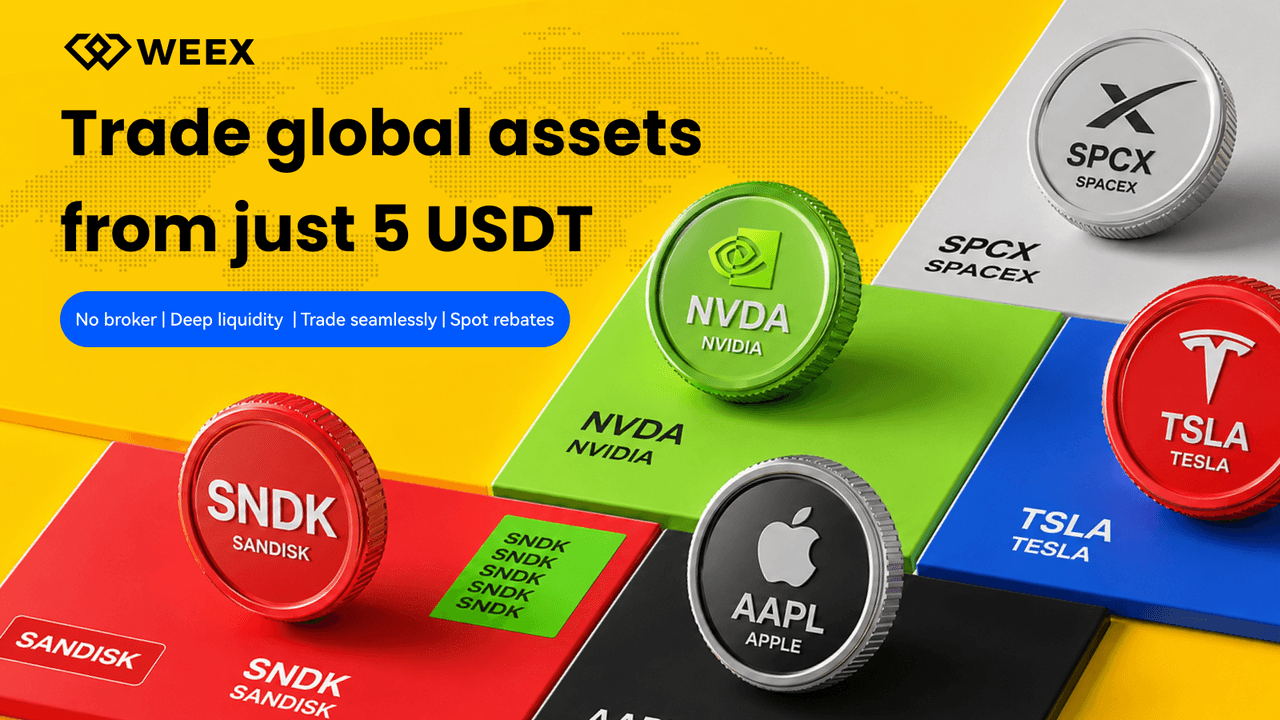
For traders looking to act on moves like this one, WEEX Stock Spot 2.0 offers price tracking stock tokens covering a broad range of major equities, including Meta,Nvidia, Apple, and Tesla ... The product is distinct from WEEX's existing Ondo and xStocks offerings, letting users trade directly with USDT, starting from as little as 5 USDT, without needing to open a separate brokerage account.
It's worth being clear about what this product actually is. Meta stock tokens on WEEX track the price performance of Meta shares, but they don't represent actual ownership of the underlying stock. Orders aren't routed to Nasdaq, the NYSE, or any external broker, and holding a Meta stock token doesn't confer real shareholder status or the rights that come with it, including voting, participation in shareholder meetings, or dividends. Execution price is determined by the matched result within WEEX's own Meta stock token trading pair.
WEEX is currently running its Stock Spot 2.0 Trading Carnival, live from August 31 through September 15, 2026 (UTC+8), covering the broader Stock Spot 2.0 section rather than any single name. The campaign includes a first-order loss protection offer for new users, covering up to 60 USDT in bonus funds if a first trade in the Stock Spot 2.0 section results in a loss, a Champion Stock Prediction event where users trade a curated list of tokens and can earn rewards tied to how those selections perform, and an all-user trading rewards pool sharing 30,000 USDT in cash based on cumulative trading volume across the section. Full terms, including trading thresholds and reward tiers, are available on WEEX's event page.
Conclusion
Meta stock's rally traces back to a specific mechanism rather than a simple case of good news: a $16.68 billion settlement replaced an open ended legal exposure that could have reached $1.4 trillion with a fixed, known cost, and the market repriced the stock upward once that uncertainty was removed. Reinforcing analyst price target increases and a string of AI product launches, including Muse Voice Transcribe, added further momentum on top of the legal relief. Meta stock still trades well below its 52-week high, meaning this rally reflects the market pricing out a specific risk rather than a full recovery to its prior valuation.
FAQ
1. Why did Meta stock rise after a $16.68 billion settlement?
The settlement replaced an open ended legal risk, one Meta's own legal team estimated could reach $1.4 trillion in a worst-case verdict, with a fixed, known cost, prompting the market to reprice the stock once that uncertainty was resolved.
2. What did Meta's settlement actually resolve?
It resolved all federal and state court claims from 29 U.S. states alleging Meta deliberately designed Facebook and Instagram to be addictive to children and teenagers, and requires Meta to implement nationwide platform safety changes.
3. Did analyst ratings play a role in the rally?
Yes. Analysts including Mark Mahaney and Bernstein SocGen Group reiterated bullish ratings and raised price targets to $860 and $800 respectively around the same period, reinforcing the move triggered by the settlement.
4. Has Meta stock recovered its prior highs?
Not fully. The stock's 52-week range spans $520.26 to $790.80, and even after this rally, Meta remains below its high, suggesting the market has priced out a specific risk rather than fully re-rating the stock.
5. Can I trade Meta stock exposure without a brokerage account?
Yes, through WEEX Stock Spot 2.0, which offers price-tracking Meta stock tokens funded with USDT starting from 5 USDT. These tokens track Meta's price performance but don't confer actual share ownership or shareholder rights.
This content is provided for general informational purposes only and doesn't constitute financial, investment, legal, or tax advice. Any events, rewards, online promotions, or related information mentioned herein should not be considered a recommendation, solicitation, or invitation to purchase, sell, trade, or otherwise deal in any crypto assets. Crypto assets are highly volatile and may result in loss. The availability of WEEX services, products, and related events may vary by region. You are responsible for ensuring that your participation is in accordance with applicable local laws and regulations.
You may also like

What Is Tangem Wallet? A Complete Beginner's Guide

MetaMask Transaction Stuck or Failed? Here's How to Fix It

John Ternus Is Apple's New CEO: What He Inherits After 15 Years of Tim Cook
Easypaisa P2P Payments: How to Choose a Merchant and Confirm a USDT Order
XST Stock: Why This Ticker Points to Four Completely Different Companies
Should You Buy AVGO Stock? What a Street Wide "Strong Buy" Rating Actually Requires
Broadcom Stock Price Fell After 86% Revenue Growth: What the Q4 Guidance Gap Actually Means
AAPL Under Ternus: What Apple's CEO Change Means for Traders
CyberLeek Crypto: The GTA 6 Token's Exit Liquidity Problem

AIINU After LongX: What the NVDA 3x Fee Loop Actually Pays
MetaMask Seed Phrase & Private Key Security Guide
How to Install and Set Up MetaMask (2026 Updated Guide)
What Is MetaMask? A Complete Beginner's Guide

What Is Arbitrum (ARB) and How Does This Ethereum Layer 2 Work?
Is Arbitrum (ARB) Worth Buying After Its 30% Rally? An Analysis About Utility, Supply and Risks
GoPro Stock Soared 40%: What the $1.14 Merger Actually Pays
Stealth XST Coin: The $1,806 Daily Volume Behind a $2.3M Cap
Dell Earnings: $95B AI Backlog Now Dwarfs Its Own Guidance
Fable 5.1: What Anthropic's New Model Means for AI Tokens

Dell Stock Surges 9.4% After Smashing Earnings Estimates: What Drove the AI Server Beat

Why Is GoPro Stock Surging 80%? A YouTuber's 8.5% Stake and a Short Squeeze Collide

XST ETF vs XST Coin (XSolut): Don't Confuse These Two Completely Different Assets
What Is PONS? Inside the "100x Coin" Taking Over Robinhood Chain
Stock Spot vs Perpetuals vs Real Stocks: Key Differences
WEEX Stock Spot 2.0 Rewards Guide: Trade & Share $100K
ARK Invest Crypto Stocks vs ARKB: How Cathie Wood Gets Crypto Exposure
Which ARK ETFs Hold Coinbase Stock? COIN Exposure in ARKK, ARKW and ARKF
How Much Coinbase Stock Does Cathie Wood Own? ARK’s COIN Position Explained

Why Is Cathie Wood’s ARK Invest Buying Coinbase, Circle, BitMine and Bullish?

Cathie Wood’s $50 Million Crypto Stock Bet Explained: What Did ARK Invest Buy?
What Is Tangem Wallet? A Complete Beginner's Guide
MetaMask Transaction Stuck or Failed? Here's How to Fix It
John Ternus Is Apple's New CEO: What He Inherits After 15 Years of Tim Cook
Easypaisa P2P Payments: How to Choose a Merchant and Confirm a USDT Order
XST Stock: Why This Ticker Points to Four Completely Different Companies
Should You Buy AVGO Stock? What a Street Wide "Strong Buy" Rating Actually Requires





