
NVIDIA Stock in 2026: Real Shares, Tokenized NVDA, and Perpetuals Compared

 Prefer us on Google

NVIDIA (NVDA) closed at $203.28 on July 20, 2026, up 0.23% on the day, with a market capitalization near $4.92 trillion — still the most valuable listed company in the world. Those are the numbers most searches surface. What they don't tell you is that "buying NVIDIA stock" no longer means one thing. You can hold the actual share through a broker, hold a blockchain token backed one-for-one by that share, or trade a USDT-settled perpetual that only tracks its price. Each route has a different owner, a different set of hours, and a different way to lose money.
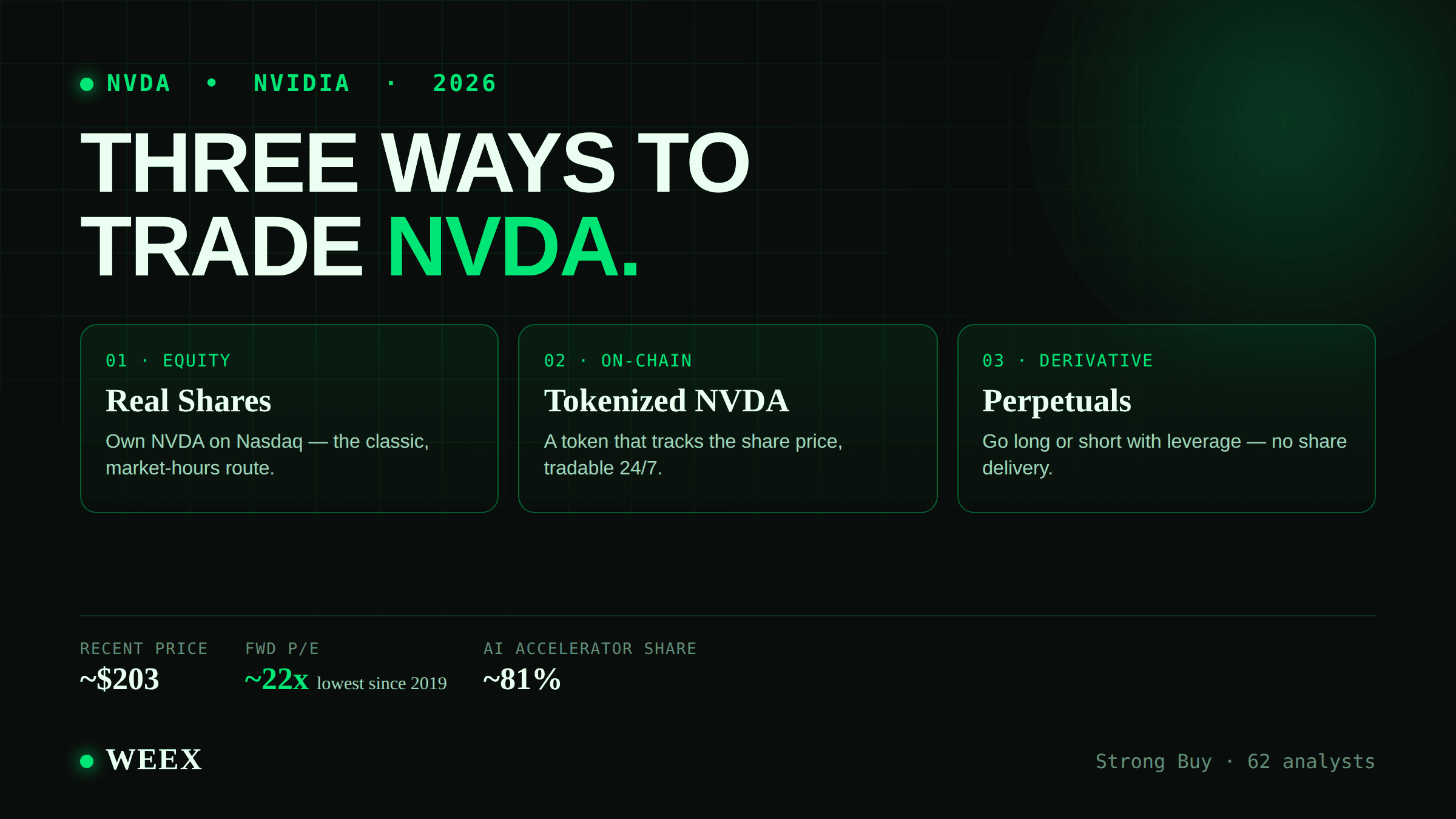
This piece skips the price-target theater and focuses on the part the quote pages leave out: the three ways to get NVIDIA stock exposure in 2026, how they actually differ, and what a crypto-native trader should watch before choosing one.
NVIDIA stock price today and the numbers that matter
As of July 20, 2026, NVDA trades at $203.28, roughly 14% below its 52-week high of $236.54 and well above the $164.07 low (data: stockanalysis.com). The stock carries a price-to-earnings ratio of about 31 — rich by broad-market standards, but modest for NVIDIA's recent earnings growth. Sell-side desks remain constructive: eToro's aggregated coverage shows a "strong buy" consensus and an average target near $310 as of mid-2026.
The key facts, in one place:
| NVIDIA (NVDA) — key facts | Value (as of July 20, 2026) |
|---|---|
| Share price | $203.28 |
| Daily change | +0.23% (+$0.47) |
| Market cap | ~$4.92 trillion |
| P/E ratio | ~31.1 |
| 52-week range | $164.07 – $236.54 |
| Analyst consensus (eToro) | Strong Buy, avg target ~$310 |
Treat every figure here as a snapshot. NVIDIA is one of the most heavily traded equities on Earth, and its price can move several percent on a single earnings line or export-policy headline. The market-cap number matters less as a bragging point than as a warning: a company this large needs enormous incremental demand to compound returns from here.
Three ways to get NVIDIA stock exposure in 2026
Here is where "NVIDIA stock" fractures into distinct products. A traditional brokerage share, a tokenized stock like NVDAx, and a USDT-margined perpetual are not interchangeable, even though all three rise and fall with NVDA.
| Feature | Brokerage share (NVDA) | Tokenized stock (e.g. NVDAx) | Perpetual futures (NVDA/USDT) |
|---|---|---|---|
| What you own | The actual share | A token backed 1:1 by a custodied share | Nothing — a price-tracking contract |
| Settlement asset | USD | Stablecoin / on-chain | USDT |
| Leverage | Usually none (margin optional) | None | Up to 100x |
| Trading hours | US market hours | ~24/5 | 24/7 |
| Dividends / voting | Yes | Passed through by issuer, no voting | No |
| Main risk added | Broker/market | Issuer + custody + peg | Liquidation + funding |
The practical takeaway: a brokerage share is the cleanest form of ownership and the slowest to access. A tokenized stock keeps 1:1 backing but adds an issuer and custodian between you and the equity. A perpetual gives you the fastest, most flexible price exposure — and the only one that can be liquidated before NVIDIA's price ever proves you right.
Does a tokenized NVDA token equal owning the stock?
No, and the distinction is where inexperienced buyers get surprised. A tokenized stock such as NVDAx is described by its issuer as backed one-for-one by real NVIDIA shares held by a third-party custodian — but the token gives indirect exposure, not legal ownership of the underlying share. You generally get price tracking and dividend pass-through; you do not get shareholder voting rights, and your claim runs through the issuer and custodian rather than to NVIDIA directly.
Two frictions are worth pricing in. First, tokenized equities trade on their own venues and can drift from the reference price: on July 15, 2026, NVDAx was quoted around $212 on Kraken while the underlying share sat near $203 a few days later — different timestamps, but a reminder that token and share are not the same tape. Second, "24/5" or "24/7" access cuts both ways. When the US market is closed, a token or perpetual can gap on news with thinner liquidity and wider spreads than the regular session, so the convenience of always-on trading comes with worse fills at exactly the moments you most want to act.
How to trade NVIDIA (NVDA/USDT) on WEEX
For a crypto-native trader, the appeal of an exchange like WEEX is settling everything in USDT from one account, without a brokerage approval or currency conversion. WEEX offers NVIDIA exposure two ways: tokenized spot stock (USDT-settled, no leverage, closest to holding) and a stock perpetual, NVDA/USDT, that tracks the share price with leverage of up to 100x and trades around the clock. There is no official NVDA crypto coin — the perpetual is a derivative on the stock's price, settled in stablecoins, not a claim on shares.
The flow is straightforward: deposit USDT, open the TradFi section, find the NVDA/USDT pair, choose long or short, set your leverage and your stop-loss and take-profit, then place the order. WEEX's own guides walk through both products in detail — see how to trade spot stocks and stock futures on WEEX for the mechanics, and does NVDA have a crypto coin and how to trade NVDA/USDT for the NVIDIA-specific walkthrough. For the wider menu of tickers and indices, the WEEX TradFi US-stocks guide covers the full setup.
What most first-timers miss is the funding rate. A perpetual holds its peg to the underlying through periodic funding payments between longs and shorts. Hold a leveraged NVDA/USDT position for days and funding — not just price direction — starts to shape your P&L. On leverage, a routine 5% move against a 20x position is a full wipeout, and after-hours gaps can trigger that liquidation while you sleep. Size positions as if the gap will happen, because eventually one does.
Is NVIDIA stock worth buying near $203?
That is an individual decision, not a recommendation, but the honest framing is this: NVIDIA is a high-quality business trading at a demanding-but-not-absurd valuation, roughly 14% off its high, with Wall Street still leaning bullish. The bull case rests on continued AI-infrastructure spending and NVIDIA's grip on the accelerator market. The bear case is concentration — a $4.9 trillion company that already dominates its category needs the AI capex cycle to keep expanding, and any slowdown, export restriction, or credible competitor hits a crowded trade hard.
The more useful point for anyone reading this on a crypto exchange: how you get exposure can matter as much as whether NVIDIA rises. Owning the share (or a 1:1 token) lets you sit through drawdowns; a leveraged perpetual can stop you out during the same drawdown the long-term thesis survives. Match the instrument to your holding period, not to your conviction.
Frequently asked questions
1. What is the current NVIDIA stock price?
As of July 20, 2026, NVDA traded at $203.28, up 0.23% on the day, with a market cap near $4.92 trillion and a 52-week range of $164.07 to $236.54. Prices move constantly, so confirm the live quote before acting.
2. Can I buy NVIDIA stock with crypto?
Not the actual share directly, but you can get NVIDIA price exposure using stablecoins through tokenized stocks (backed 1:1 by real shares) or USDT-settled perpetual futures such as NVDA/USDT on WEEX. These settle in crypto and do not require a traditional brokerage account.
3. Is a tokenized NVDA the same as owning NVIDIA shares?
No. A tokenized stock is backed one-for-one by a custodied share and tracks the price, but it gives indirect exposure, not legal ownership. You typically forgo voting rights, and your claim runs through the token issuer and custodian.
4. How much leverage can I use on NVDA/USDT?
WEEX's stock perpetuals offer leverage up to 100x. Higher leverage magnifies both gains and losses — at 20x, a 5% adverse move can liquidate the position — so most traders use far less than the maximum.
5. Does NVIDIA have its own cryptocurrency or token?
No. There is no official NVIDIA-issued crypto coin. Products like NVDA/USDT perpetuals or NVDAx tokenized stock are third-party instruments that track NVIDIA's share price; they are not endorsed or issued by NVIDIA.
Risk Warning
NVIDIA-linked instruments carry real risk of partial or total loss. The underlying share is volatile and can gap sharply on earnings or policy news, and the crypto-based products layer additional risks on top. Perpetual futures such as NVDA/USDT expose you to liquidation and to ongoing funding costs; high leverage can erase a position on a routine intraday move, including during after-hours gaps when liquidity is thin. Tokenized stocks add issuer, custody, and peg-deviation risk, and may trade at a premium or discount to the reference share. None of the above is investment advice. Trade only what you can afford to lose, size for the gap you don't expect, and confirm live prices and product terms before committing funds.
Disclaimer: This content is provided for general branding and informational purposes only and doesn't constitute financial, investment, legal, or tax advice. Any events, rewards, online events, or related information mentioned herein should not be considered a recommendation, solicitation, or invitation to purchase, sell, trade, or otherwise deal in any crypto assets or to use any services. Crypto assets are highly volatile and may result in loss. WEEX services and online events may not be available in all regions and are subject to applicable laws, regulations, and eligibility requirements. You are responsible for ensuring that your use of WEEX services complies with local laws and for carefully assessing the risks before participating in any crypto-related activities.
You may also like
Tesla Stock Is Down 17% in 2026: What Q2 Earnings Need to Deliver to Turn the Story Around

What Is Mark Cuban's Stock Options Philosophy? How SpaceX Turned Welders Into Millionaires

SPCX Stock Price and the $25 Billion Short Position: Is a Short Squeeze Coming?

Is SPCX Stock Price a Buy? What Uber, Airbnb and Rivian's IPO Crashes Tell Investors
SPCX Stock Price Hits All Time Low: What Investors Should Do Right Now

How Will the CLARITY Act and Bank-Grade Stablecoin KYC Rules Change Crypto Trading in 2026

Why Is BitMine Buying Millions of Ethereum Tokens and Staking $9 Billion in ETH in 2026

How to Protect Your Bitcoin from Physical Attacks: Lessons From the NYC Crypto Torture Case in 2026
What Is the NYC Crypto Kidnapping Case? The Soho Bitcoin Attack Explained — 2026 Case Analysis

SpaceX Stock (SPCX): Now Public, and Back Where It Started
USA Rare Earth (USAR): What It Is and How to Trade the Token
How to Buy USAR Coin: Buying Tokenized USA Rare Earth Stock the Right Way
WEEX Poker Party Series 4: Draw Cards to Split a $1M USDT Pool
Can TENDIES Coin Recover After the Pullback? Price Outlook Explained
Who Really Makes Money on Prediction Markets? Smart Money vs Retail Traders
The Hidden Problem With Prediction Markets: Who Pays the Winners?
Prediction Markets Are the Future of Finance or Just Gambling?
How Polymarket and Kalshi Turned Predictions Into a Billion-Dollar Business

Why Prediction Markets Are So Hard to Regulate: The CFTC vs SEC Debate
Are Prediction Markets Legal? CFTC vs SEC Regulation Explained

Why Is TSMC Stock Down After a 77% Profit Jump? What Wall Street Is Actually Worried About
Is Samsung Stock a Buy at Its Lowest Level Since the AI Boom Began?
Samsung Stock and the KOSPI Bear Market: What the 30% Decline From Peak Tells Investors
Oil Price Above $90: What the US-Iran War Means for Your Portfolio Right Now
Iran War and Bitcoin: Why Crypto Is Not Acting Like a Safe Haven at $90 Oil
KOSPI Stock Market Enters Bear Market: What a 25% Drop From the Peak Means for Investors
KOSPI Stock Bear Market: What It Means for Samsung, SK Hynix and Korean Chip Stocks
Is the KOSPI Stock Market a Buy After Entering Bear Market Territory?
SK Hynix Leveraged ETFs SKHL SKHX SKHZ: What Each One Does and Who Should Use Them
Barclays Sees 70% Upside for SK Hynix Stock: What the Overweight Rating Means
Tesla Stock Is Down 17% in 2026: What Q2 Earnings Need to Deliver to Turn the Story Around
What Is Mark Cuban's Stock Options Philosophy? How SpaceX Turned Welders Into Millionaires
SPCX Stock Price and the $25 Billion Short Position: Is a Short Squeeze Coming?
Is SPCX Stock Price a Buy? What Uber, Airbnb and Rivian's IPO Crashes Tell Investors
SPCX Stock Price Hits All Time Low: What Investors Should Do Right Now
How Will the CLARITY Act and Bank-Grade Stablecoin KYC Rules Change Crypto Trading in 2026
Contents
Popular coins
Latest articles


